

A musty closet smell is worth ten minutes of diagnosis before it becomes an argument with your landlord, because the answer decides who does the work — and the two jobs are completely different.
Mine showed up in October 2024 in a one-bedroom in Philadelphia with a walk-in closet off the bedroom. The first time I noticed it I was looking for a duvet cover, and I remember thinking the closet smelled damp in a way that the rest of the apartment did not. I left the door open and went to make tea. When I came back the smell was still there, and it was stronger near the floor than near the top.
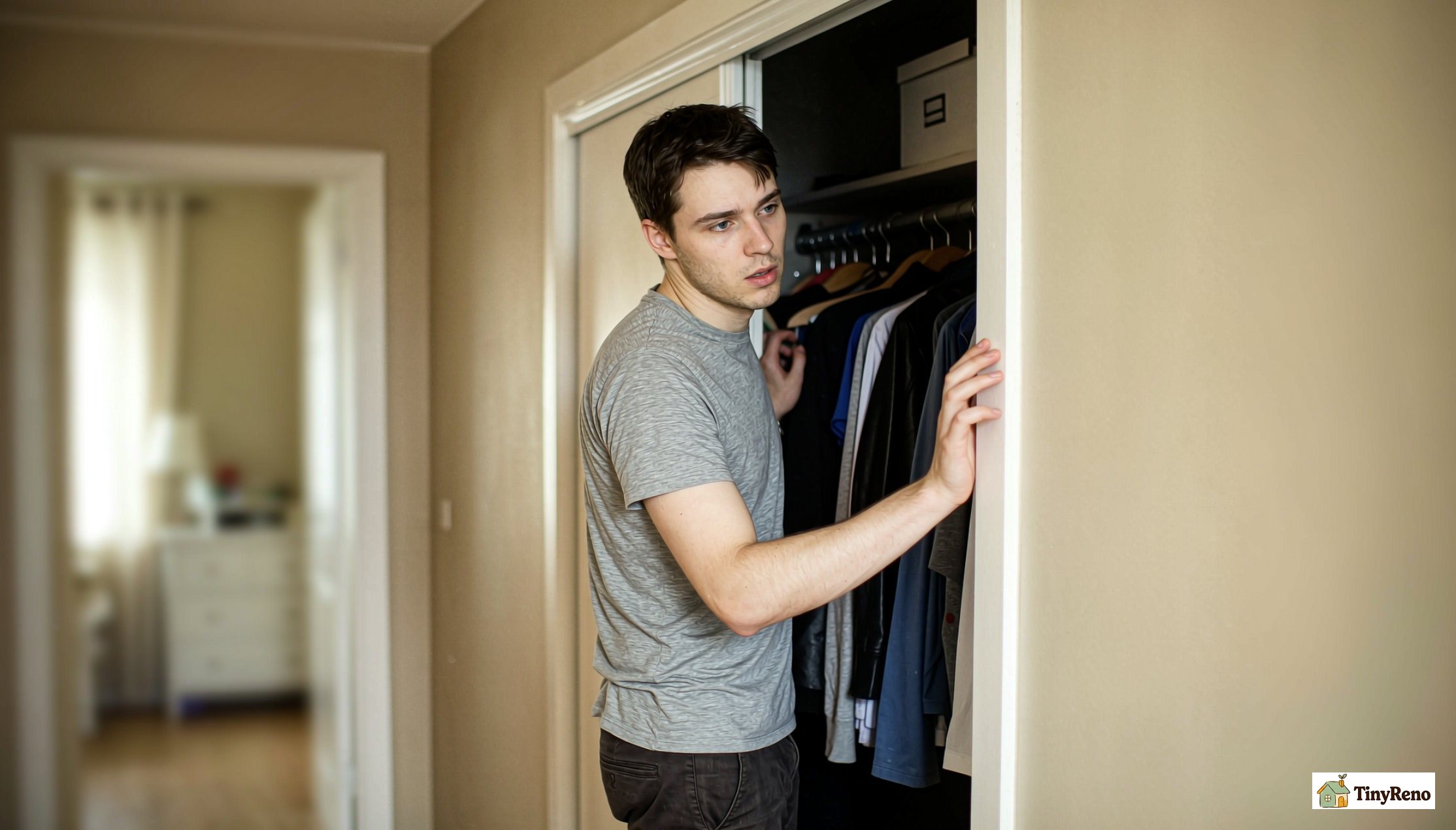
That last detail turned out to be the whole thing. I did not know it at the time. I spent four months buying dehumidifiers, emptying the closet twice, running the bathroom fan for an hour after every shower, and eventually reporting a "mould problem" to my landlord. He sent a contractor, who spent twenty minutes looking at it and said, in the tone of a man who has said this many times, "that's your closet."
He was right, and the reason he was right is the reason this article exists. A closet is a separate little room with its own air, and it can develop its own smell for reasons that have nothing to do with the building. But it can also be the one place where a building-wide problem shows up first, and those two situations look almost identical from the hallway.
Where does the smell sit in the room?
There is one decisive test, and it is also the cheapest — it takes about ninety seconds.
Open the closet door and step back into the room. Wait. Then walk back into the closet and wait again. Two questions follow from that, and they are separate questions.
Does the smell follow you out? If you step out of the closet into the room and the smell goes away within a minute or two, the source is inside the closet. The closet is holding stale, damp, air. This was my case. It smelled strongly in the closet, faded in the doorway, and was completely gone by the time I reached the kitchen.
Does the smell show up anywhere else in the apartment? A closet-specific smell that stays in the closet is a closet problem. A smell that appears in the closet and also in the bathroom and behind the bed and in the corner of the hallway is a building problem, and the closet is simply the smallest space where it concentrates.
The hallway outside a closet on a landing, with the doors of three other flats behind it, produces this same pattern, and no amount of sorting will fix it. That is why test one has two parts and not one.
Question three: is it stronger low or high? Cold, damp, heavier air settles, so a problem at floor level points at the floor, the skirting, the back of the closet, or the base of an exterior wall. A problem that is stronger at the top points at the ceiling, the top of the wall, or something stored high up. This is a rough test, not a scientific one, but it consistently separated the cases I have had.
Question four: does it change when you open the window? A closet smell that fades when you open the closet door to the outside air and comes back when you close it is a trapped-air problem. A smell that does not change is coming from a material, such as damp timber or mildew in a wall.
What a closet actually is, and why it smells different from the room
Understanding a musty closet smell renter source means understanding what a closet really is. A closet is a box with one opening, a door that is usually not sealed, and a very small volume of air compared to the rest of the apartment. That is enough to make it behave differently in one specific and useful way.
Air in a closet is still. It has almost no circulation. Warm air from the room enters at the top when the door is open and cooler air sits at the bottom. Moisture given off by everything stored inside, and by the timber of the closet itself, has nowhere to go. It accumulates until the air inside is damper than the air outside, and then it is your nose that tells you.
This is why the classic advice of "just air out your closet" fails. Opening the door for ten minutes moves a trivial amount of air through a very small space. What actually changes the closet is changing what is in it, because the things stored in it are what is giving off the moisture.
So the diagnosis is really a question about the contents, and the three things that generate a closet smell are these:
Textiles that have been in a dark enclosed space for years. Cardboard boxes are the usual culprit and they are worse than people expect, because the corrugated cardboard is hygroscopic, it takes on moisture from the air and holds it. A closet packed with boxes from a previous tenant is a closet with a humidity problem built into it. And the classic move of "put everything in plastic bins" makes it worse if the bins are sealed, because you have now trapped the moisture in with the contents.
Timber that has absorbed damp at some point. A closet floor or back wall that has been touched by water at some stage, even years ago and even a small amount, can keep releasing a faint musty smell indefinitely. This one you cannot fix by sorting.
An actual leak or rising damp at the back or base. This is the case where you need the landlord, and the way to tell it apart from the other two is that a leak or rising damp produces a pattern rather than a general smell. Look at the back corners of the closet floor, the skirting, and the base of the wall for dark staining, blistering paint, or a mustiness that is sharp rather than general.
What to do about each of the three causes
If it is trapped air from the contents, this is your job and it is a day of work. The sequence that works: empty the closet completely and take everything out of the room, not just to the landing. Then leave the closet door open and the window open, and put a fan in front of the closet opening pointing in. Leave it for two full days. Then bring things back in stages rather than all at once, and notice which category of thing makes the smell return.
What comes back first is usually the answer. In my case the first thing that brought the smell back was a stack of cardboard boxes that had been in the closet since before I moved in, and the second was a wool blanket that had been rolled up in the corner for years. I kept the wool blanket in a sealed bin and the boxes went to the recycling centre, and the closet has been fine for two years.
And this is the part that sounds obvious and is not: ventilation only helps after you change the contents. A fan in front of a closet full of damp cardboard is moving damp air around the problem.
If it is a material problem in the timber, this is the landlord's job, and it is a habitability question. A closet that smells musty because of damp timber is a closet that cannot be used for what a closet is for, and in most jurisdictions a landlord is required to keep the unit fit for habitation. Report it in writing with photos and a dated timeline. This is a slow argument and it is worth having slowly rather than not at all.
If it is a leak or rising damp, this is urgent and this is the landlord's job. The distinction from the other two is that a leak keeps happening. Wet timber keeps getting wet. If you are seeing staining that grows, paint that blisters, or a floor that is damp in the morning and dry in the afternoon, stop sorting and start writing. Every week of delay is a week of the timber getting worse, and the repair bill goes up with it.
The four things I would do in the first hour
Pulling this together into the order I would actually do it, rather than the order it would be nice to do it:
One: open the closet door and step back, twice. Sixty seconds, and it splits the problem into "mine" and "the building's." Do this before you buy anything.
Two: check the back corners and the skirting of the closet. Look for dark staining, blistering paint, or a sharply musty smell right at the base. This is where a leak shows itself first, and it is the difference between a Saturday of sorting and a letter to the landlord.
Three: check the other rooms in the apartment for the same smell. Bathroom, behind the bed, the hall corner. If it is there too, it is the building and you should be writing to the landlord before you start emptying cupboards.
Four: if it is the closet, empty it completely and get the contents out of the room. Not onto the landing, where the damp air joins the rest of the apartment. Out of the apartment, ideally, or at minimum out of the bedroom and into a room you can close the door on.
Five: leave the door open and a fan in front of it for two days. Then bring things back in stages and find the culprit.
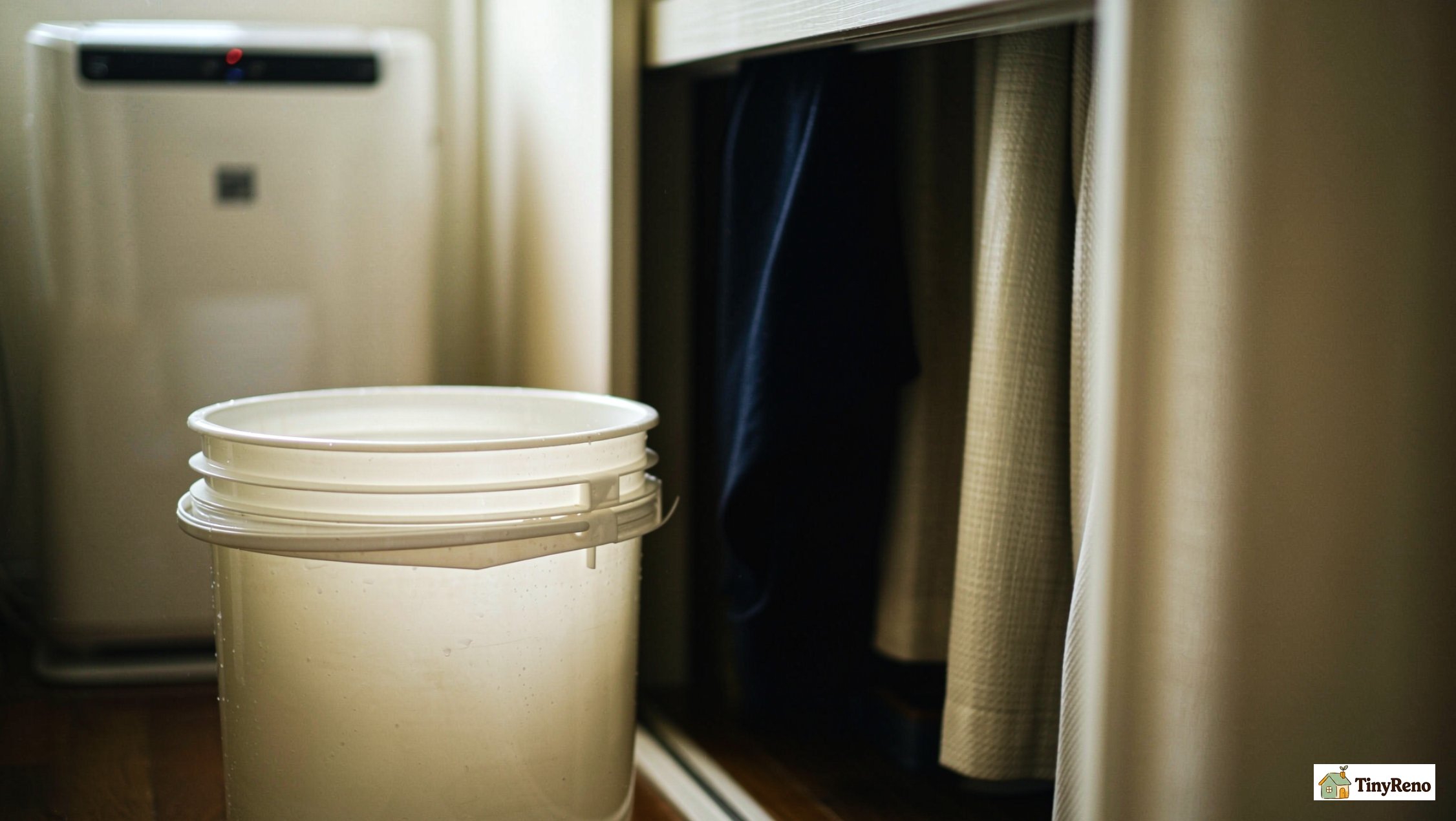
Musty closet smell renter source problems have one more trap worth naming plainly, because it wastes people months: One more thing worth saying plainly, because it wastes people months: do not start with a dehumidifier. I bought one. It ran for a month, it pulled a surprising amount of water out of the air, and the smell came back the minute I turned it off, because the source was the cardboard still sitting in the closet giving off moisture into air that had nowhere to go. A dehumidifier is a good tool for a building-wide damp problem and a poor tool for a closet with cardboard in it.
The version I would tell a friend
If someone asked me about a closet that smells musty, here is the short version, and it is the version that would have saved me four months and one unnecessary dehumidifier.
Open the door, step back, and see whether the smell follows you out. If it does not, it is your closet and it is your job for the day. If it does, it is the building and it is a letter to the landlord, not a weekend of sorting.
Then check the back corners and the skirting before you do anything else, because a leak there changes the urgency completely. And if it is the closet, empty it all the way out of the apartment, leave it open with a fan for two days, and then bring things back in stages and find out what was making the smell. My money was on the boxes, and it was not the boxes, it was a wool blanket that had been rolled in a corner for four years.
What I would also tell that friend, having been the tenant who complained about mould and was told the mould was my own closet: the landlord was right about my closet, and he was also right that I could have sorted it myself. Both of those things were true at the same time, and I had spent four months treating them as if they were in conflict.


Discussion (0)
Sign in to join the discussion