

Nobody searches for “rusty metal bed frame” voluntarily. The search usually happens after a move-out statement arrives with a number on it. My friend Priya’s frame rusted through, and she was billed $180. My own frame rusted through three years later, and I was not billed anything. The two frames were nearly identical. The difference between them is the subject of this article, and it took me a while to work out because it is not really about rust or money. It is about who owned the frame, who was responsible for maintaining it, and who could prove what.
Let me put the two cases next to each other, because this is really two questions wearing the same coat, and people get them confused and pay for the confusion.
Priya rented a furnished one-bedroom in Fort Wayne in 2023. The bed frame was part of the landlord’s furniture: a simple powder-coated steel frame with a slatted base. It rusted. She moved out after eighteen months, and the landlord sent a $180 deduction for a new frame, arguing that the frame had been damaged during her tenancy. The frame was not hers, but the landlord was claiming she had failed to maintain it.
My frame was bought by me, from a shop, with a receipt, in 2024. It rusted. I moved out of the same building complex, three units away from Priya, in 2026, and nobody asked me for a cent, because nobody had any claim on it. The deduction sheet for my unit had one line on it for a cupboard hinge and nothing at all for the bed.
So here is the question that actually decides things, and it is not about rust at all: whose frame was it?
Three Versions of the Same Problem
My friend Tom moved into a third unit in the same complex, and his situation was different again. He did not have a frame at all when he arrived. He bought one himself, in his first week, out of a second-hand shop, and it was already a bit rusty when he got it. He never told the landlord about it, and he never photographed it either. When he moved out eighteen months later, the frame was worse, and the landlord asked about it, and Tom realised in that moment that he had no idea what his position was. He ended up paying a reduced charge after some argument, and he still does not know whether he owed it.
Three frames, three outcomes. Priya’s frame belonged to the landlord, and she was charged after the landlord claimed she had failed to maintain it. My frame was mine, so the landlord had no claim on it. Tom’s frame was also his, but he had no documentation of its condition when he bought it, so when the landlord raised the rust, Tom could not show what it looked like on day one.
The pattern worth noticing is that rust appeared in all three cases, and in every one of them the conversation was decided by documents rather than by the condition of the steel. But ownership is only the first question. The second is who was responsible for maintaining the frame. The third is who can prove what condition it was in when the tenancy began. The three outcomes follow from how well each of us documented ownership, condition, and maintenance.
How Rust Actually Develops on a Steel Bed Frame
Rust is not one thing. There are two very different categories and they have different consequences for both the frame and your deposit, because one of them is a maintenance failure and the other is a manufacturing failure.
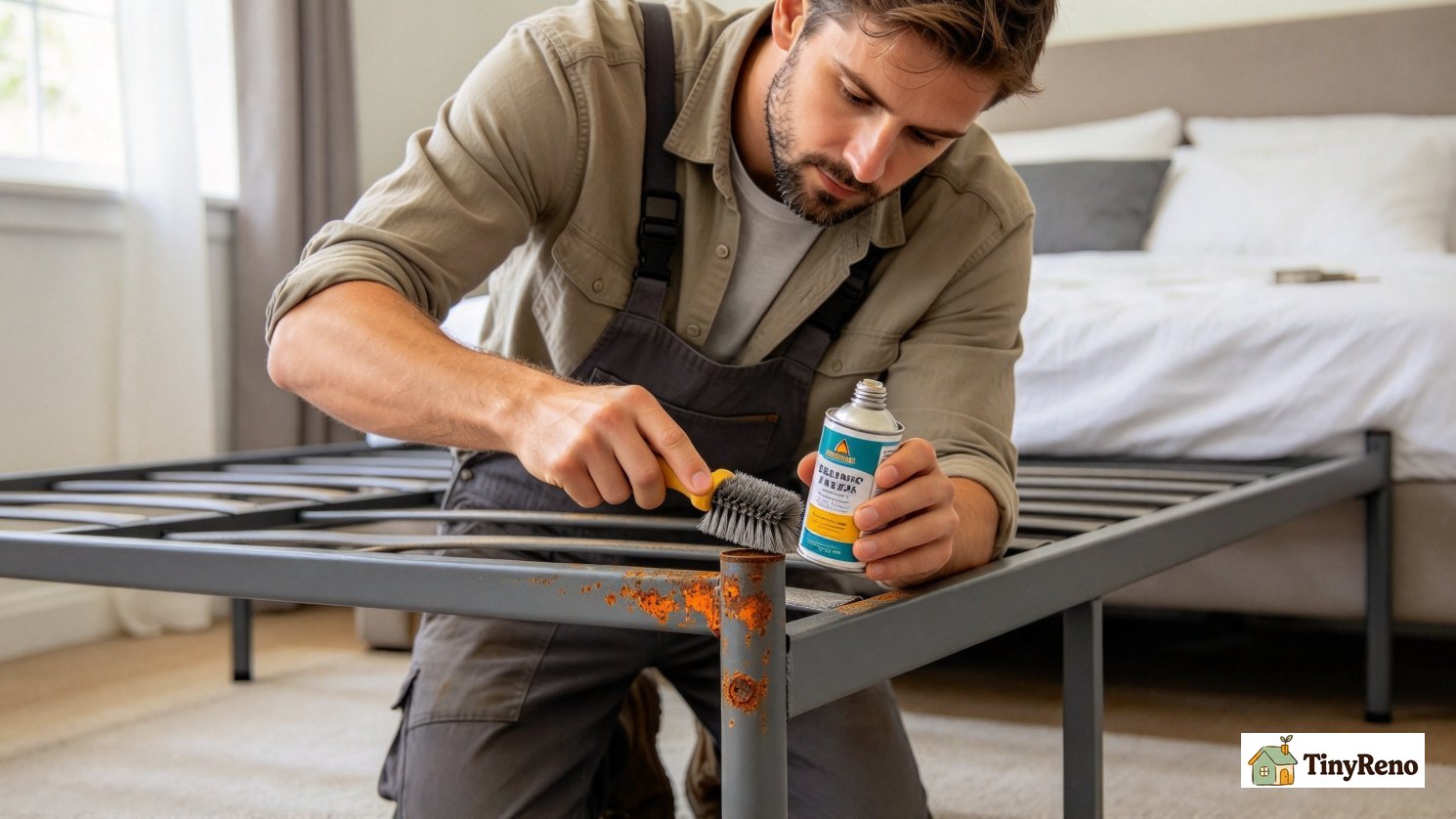
Surface corrosion is the orange, flaky, dusty kind that appears when a coating breaks down and moisture sits on bare steel. It starts as a few pinprick spots, usually in a place that holds water: where a leg meets a plastic foot, where two tubes are welded together, where the frame meets the wall and the room is damp, or where a mattress sits against a rail for years and traps humidity. It spreads slowly and it looks alarming but it can often be stopped, and a frame with surface corrosion is a frame that needs a wire brush, a rust converter, and a coat of paint. That is a fifty-dollar job if you do it yourself.
Structural corrosion is the other kind. This is where the steel itself has been eaten away, usually from the inside of the tube or at a joint, and you find it when the frame starts to feel soft, when a leg bends under your weight, or when rust flakes out of a weld seam. By the time a frame reaches that condition, it has usually been quietly failing for a long time, and it is at the end of its life. It also has a characteristic look: the rust comes from underneath, is darker and denser than surface dust, and often leaves a reddish-brown stain on the sheets below it.
The test is simple and it takes ten seconds. Press a fingernail or a coin firmly against the rusted area. If the surface is soft and it flakes or crumbles, the metal underneath has been eaten and the frame is structurally compromised. If the rust is hard, chalky, and does not give way, it is sitting on the surface and the frame may well be fine. A magnet is an even better tool: if the magnet still clings firmly to the steel under the rust, the section is still solid steel. If it has gone through, the magnet falls away.
That distinction is what made the difference for Tom. His frame had surface rust that had been left in a humid corner of the room for a year and a half, and it was never once tested or mentioned. When the landlord pointed at it, Tom could not say whether it was the same frame he bought or a different one, and he could not say whether the corrosion had been active for a year or two. He had no photographs and no receipt, so he had nothing to offer but an opinion, and an opinion does not get you a discount.
What Priya Should Have Done, and What I Did Instead
Priya’s case was the hardest because the frame belonged to the landlord, and a landlord is generally responsible for the condition of the furniture they provide. That does not mean a landlord can never charge for damage to their own furniture. It means the question shifts from ownership to causation: did the rust develop during the tenancy, and did the tenant fail to maintain the frame?
Priya had no move-in photographs. She moved into a furnished unit and treated the furniture as part of the scenery, which is common. Eighteen months later the frame was rusted, and she had no way to show when the rust started. She argued that rust takes years, and she was probably right. But the landlord said it started after she moved in, and without a baseline photo or a condition report, she could not contradict him.
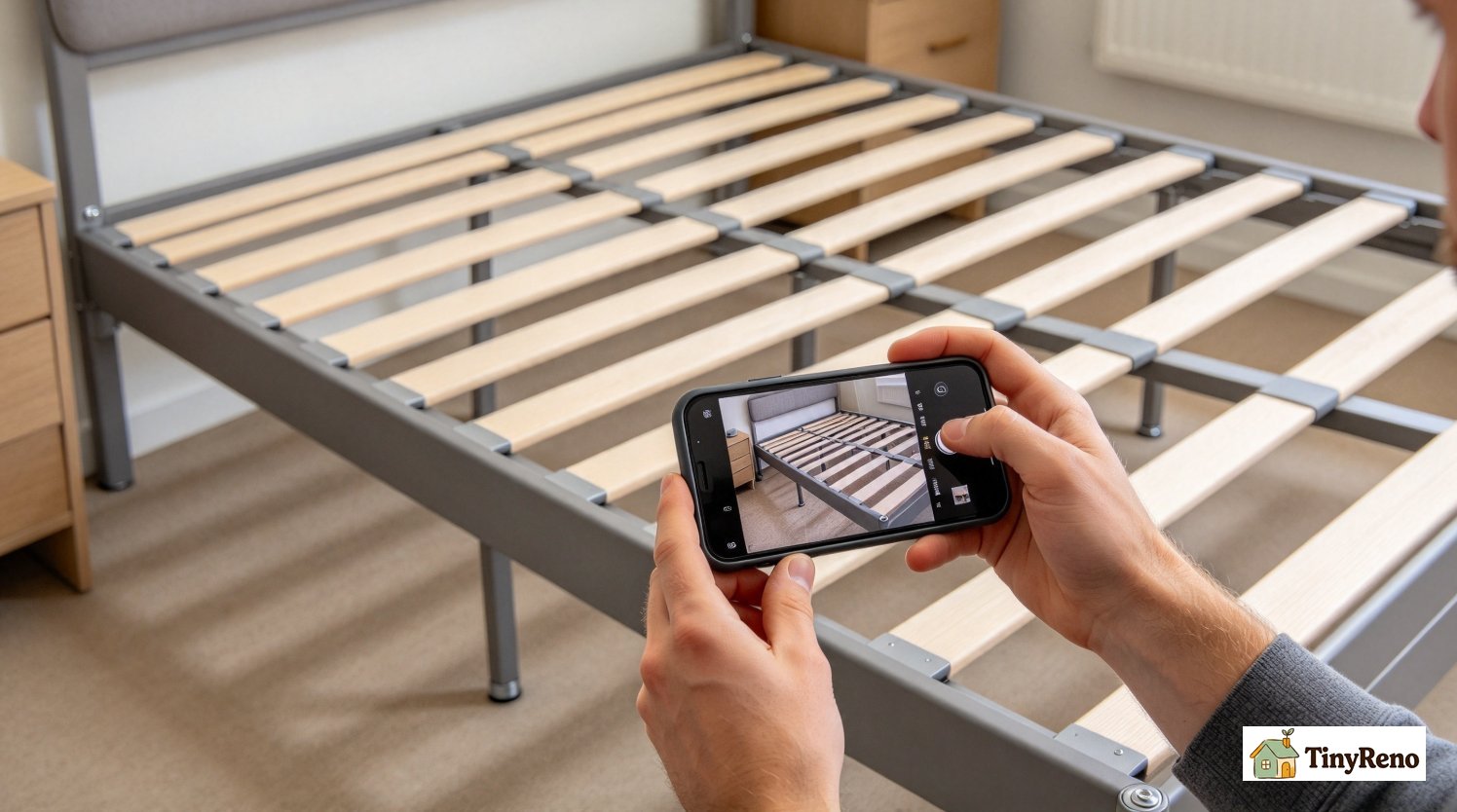
What I did, which took about ten minutes and has become my default, is this. On the first day of every tenancy I now photograph every item of furniture with the camera's date stamp visible if the phone will do it, and I include one shot of the whole room so the items can be placed. For anything metal I take a second close shot of the joints, the feet and any weld points, because that is where rust starts and that is what I would want to see if a claim came in two years later. I keep the whole set in a folder and I never delete it when I move out.
The other thing I did was put my own purchase in writing. When I bought the frame I photographed the receipt and the store's invoice, and when I moved it into the flat I took a photograph of it standing in the corner where it was going to live. That single purchase photograph is the reason nobody ever asked me a question about the frame. It shows what it looked like on the day it arrived, it shows the rust that was already on the second-hand one, and it establishes that it was never the landlord's to begin with.
What I would tell Priya now is that the photograph matters more than the argument. If a landlord cannot show the frame was sound when they handed it over, they have a harder time proving the tenant let it fail. That is a stronger position than arguing about who owns a piece of steel.
The Underrated Point About Where the Frame Lives
One more thing that came out of comparing the three cases, and it is the bit nobody thinks about until it is too late: humidity decides how a frame fails. Tom's frame rusted because it stood against an exterior wall in a corner with no window and no airflow, and the carpet in that corner held moisture against the steel foot for eighteen months. My frame stands away from the wall in a room with a window that opens. Same building, same climate, same metal, completely different outcome.
This is worth taking seriously, because it means you have some control over the rate at which the frame degrades even when the frame is not yours. Airflow is the cheap intervention: leave a small gap between the frame and the wall so air can move, and keep the frame off a damp carpet where you can. If you notice the first orange spots forming, treating them immediately with a wire brush and a rust converter or a cold-galvanising paint keeps a frame alive for years, and a treated frame looks like a maintained frame rather than an abandoned one.
The other side of this is to report it. If a landlord-supplied frame is rusting in your unit, you have a duty to tell them, not just a right to. A frame you have flagged and ignored is a frame you may well be asked to pay for, and a frame you have flagged and the landlord has ignored is a frame you have very good grounds to argue about. Send the message, keep a copy, and photograph the rust before you clean it. That photograph does double duty: it shows you raised it, and it establishes the date the rust was already there.
What I Would Do Differently Now
I would photograph the frame on day one even if I am certain it will be fine, because certainty is a feeling and rust is a fact. The photograph costs four seconds and it is the only thing that works at a two-year remove.
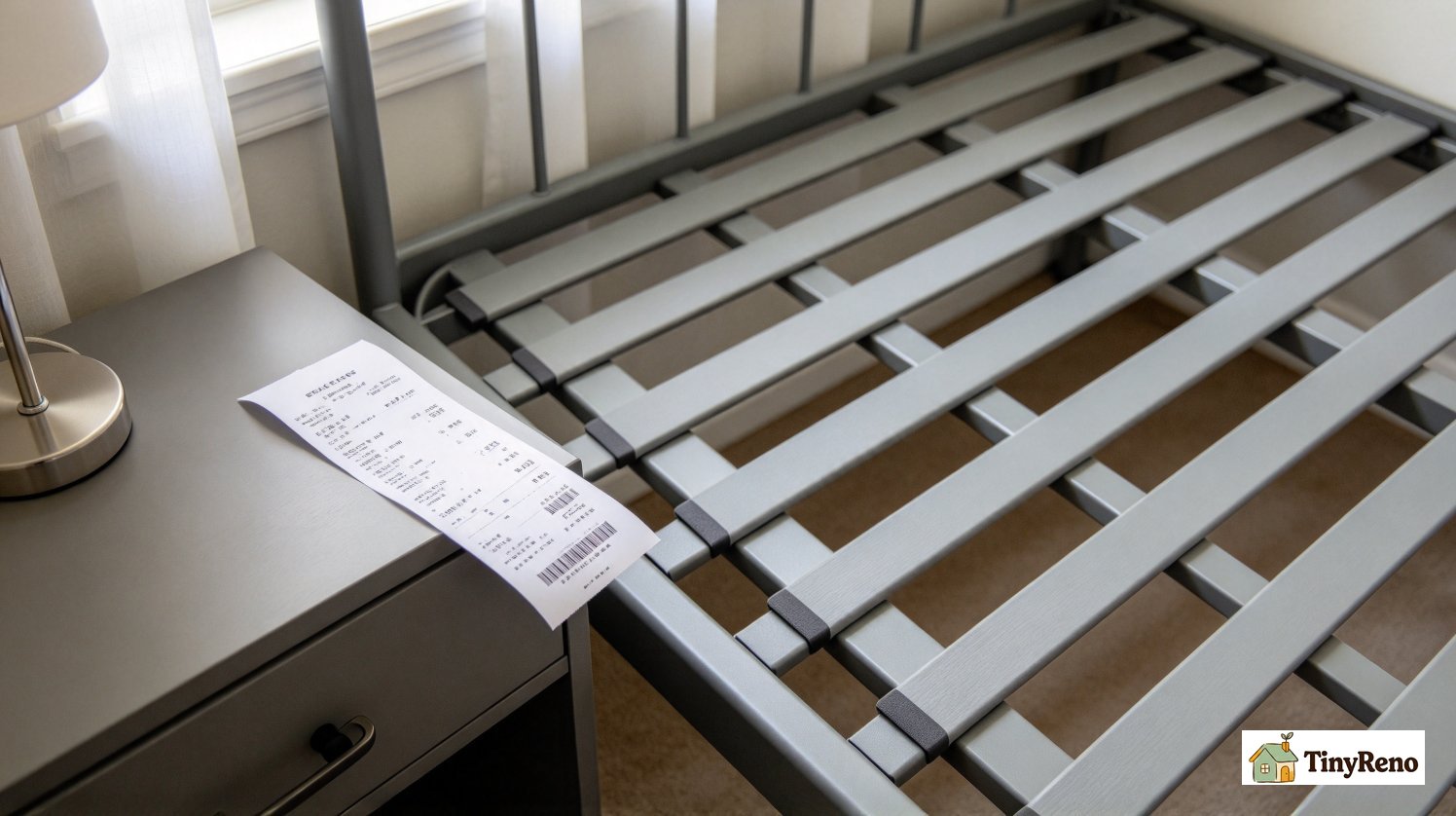
I would keep the receipt for my own furniture in the same folder as the move-in photographs, because having the invoice that says what I paid and when is what makes a renter's item a renter's item rather than a disputed landlord's item. Tom's whole problem was that he could not prove the frame he was being asked about was the frame he had bought.
I would check the lease for a furniture schedule, or ask for one. Many furnished tenancies include an inventory, sometimes a photo inventory, sometimes a document signed at check-in that lists what is in the unit and its condition. If one exists, it is the single most useful piece of paper in the tenancy for a dispute like this, because it is evidence of the condition at handover that both sides agreed to. If one does not exist, asking for one, or offering to create one with photographs at handover, is a small thing that pays off later.
And I would deal with rust the week I see it rather than the week I move out. A ninety-minute treatment at the first sign of a spot costs nothing, and it removes any argument about whether the frame was neglected while it was in my care.
Where Those Three Frames Are Now
Priya's frame was replaced. She paid a hundred and ten dollars rather than the hundred and eighty, which she negotiated by pointing out that the replacement frame she found was a better make than the original at a lower price, and the landlord accepted that because it was a specific proposal rather than a complaint. The old one went into a skip. She still maintains that she should have paid nothing, and she is not entirely wrong, and she learned the same lesson I did at the cost of a hundred and ten dollars and most of a summer.
Tom's frame is in a skip as well, though I think he kept a piece of it. He bought another one, this time a solid wood frame, and he has a photograph of it in the corner with a ruler in frame for scale.
Mine is still here. It has surface rust at two joints that I treated in the second year, and it has a small pencil mark on the leg where I noted the date. It is not beautiful. It has been in three moves and it will probably go to a fourth. But nobody has ever asked me for a cent for it, and I have a photograph of it in a box in my current flat that was taken before I bought it.
The takeaway is small and unglamorous. Rusted bed frames are not really a legal puzzle. They are about ownership, maintenance, and evidence. A photo on the first day, a receipt if the frame is yours, and a written report if you see rust starting will usually settle the question before it becomes a deduction.


Discussion (0)
Sign in to join the discussion