

Nobody searches for “broken fridge shelf” for fun. Usually the search starts after a move-out statement arrives with a number on it. In my case, a glass shelf broke in the fridge in my Dayton rental, and the landlord added $280 to the deposit deduction. I did not pay that full amount, and I did not walk away from the rental over it. I found a way to figure out what had actually happened to the glass, and I wrote it down so the next person does not have to spend a month being frightened by a letter. This is what I found, written down so that the next person does not have to spend a month being frightened by a letter.
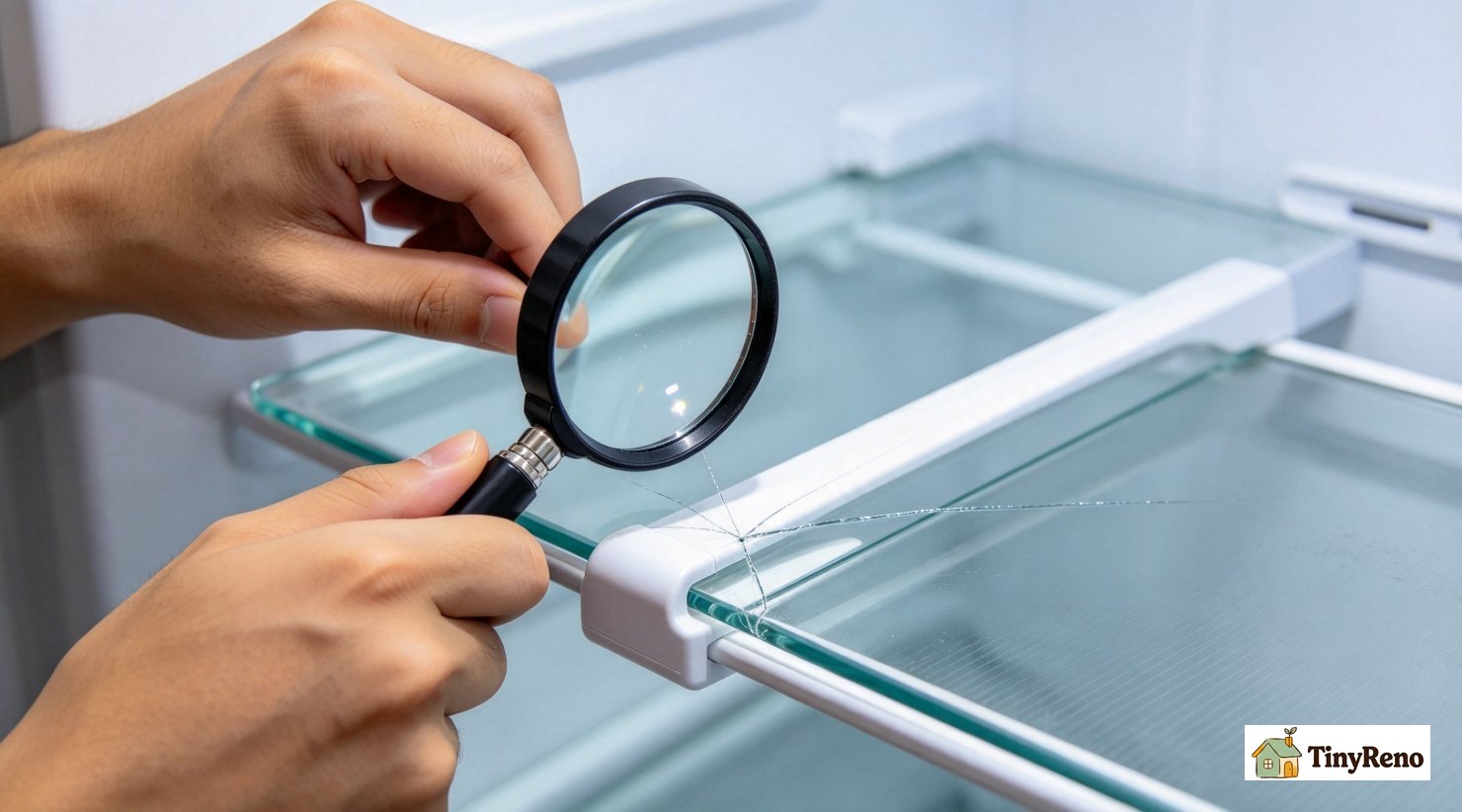
The short version: a broken shelf is not always a mystery. The shape of the crack and the point where it started can tell you a lot about the likely cause. A crack that begins at a corner, where the shelf rests on its plastic support, and radiates outward often points to strain at the support. A crack that begins in the middle of the glass, where nothing touches it, can point to a defect or internal stress. A break that starts at a chipped front edge often points to impact. These patterns are useful, but they are not a substitute for a technician’s opinion.
What I Actually Did, Step by Step
First, I did nothing for four days, which was the smartest thing in the whole process. I did not clean it up, I did not throw the pieces away, and I did not reply to the email that told me the deduction had been added. A broken shelf case is decided in the first week, usually by whoever moves fastest, and moving fast means losing the evidence. I took photographs from four angles, including one straight down at the broken edge and one of the intact shelf next to it, and I made sure the same shelf was in frame in both so the comparison was obvious. Then I waited.
Second, I read the lease. It said damage to the appliance would be deducted at the cost of repair or replacement, with no explanation of how that cost was calculated. It also had a clause making the tenant responsible for damage caused by the tenant, and I noticed that "caused by the tenant" was doing a lot of work in that sentence. That clause is the centre of the dispute, and it is where most people lose.
Third, I called a refrigeration technician. I found one through a local trade directory rather than through the company that had serviced the fridge, because I wanted somebody with no relationship to either the landlord or the appliance manufacturer. I asked a specific question: can you tell from a broken glass shelf whether it was overloaded, whether it was fatigued, or whether it was defective? The answer was yes, with conditions, and the conditions became the framework for everything that followed.
Fourth, and this is the part most people skip, I found the appliance's model and serial number and looked up the warranty documentation. I also looked up the manufacturer's published guidance on shelf loading, which turned out to specify a maximum load per shelf and to warn against placing heavy items on the front edge. That document did two things at once: it told me what the safe load was, and it told me the manufacturer expected people to get this wrong, which meant a defect claim was worth making.
Fifth, I wrote to the landlord with the evidence attached, itemised, and I made a specific offer rather than a denial. That offer is where most disputes get solved.
How to Read the Crack
This is the useful part and almost nobody teaches it. There are three basic patterns and they map onto three different causes, and knowing which one you are looking at turns the argument from a matter of trust into a matter of reading glass.
A crack that starts at a corner, at the point where the glass sits in the plastic cradle or channel that holds it, and runs outward in a curve is a shelf that was being held badly. Either the shelf was slightly too wide for the slot it sat in, or it was sitting on a hard support that concentrated the load onto its edge. This is a fit problem, and a fit problem is the manufacturer's problem, because the shelf was designed to sit in that slot. You will often see a faint white haze around the starting corner of the crack, where the glass has been rubbing against the plastic for months.
A crack that starts in the middle of the pane, in the clear flat area where nothing touches it, and radiates outward in straight lines is a defect in the glass. Real tempered glass has internal stresses from the way it is made, and a shelf with a bad stress point will sometimes crack on its own while sitting there. When the crack starts in the middle, that is the single most useful fact you can put in front of a landlord or a technician, because nothing you put in a fridge applies force to the middle of a shelf.
A break that starts at a front edge where the glass is chipped or ground often points to impact: someone leaned on it, knocked it during a move, or slid a heavy container instead of lifting it. That pattern is harder to dispute, and if the evidence points that way, fighting it may not be worth the effort.
Two more details are worth knowing. A fresh fracture often has bright, sharp edges, while an older stress crack may have a cloudy or frosted line. And tempered glass is designed to break into many small, relatively dull pieces rather than long sharp shards. If a shelf breaks into long sharp spikes, it may not be tempered glass, or it may not have been properly tempered. If it breaks into many small pieces, that is consistent with tempered glass, but it does not by itself prove a manufacturing defect.
What Was Actually True in My Case
In my case, the shelf had cracked at the front left corner. The front edge had a chip about the width of a fingernail. It had broken into several pieces rather than shattering into fine grains, which suggested it may not have been tempered glass, or that the break had started at the edge and propagated before the rest of the pane gave way. There was no food on the shelf above it. The technician walked me through three things over about forty minutes.
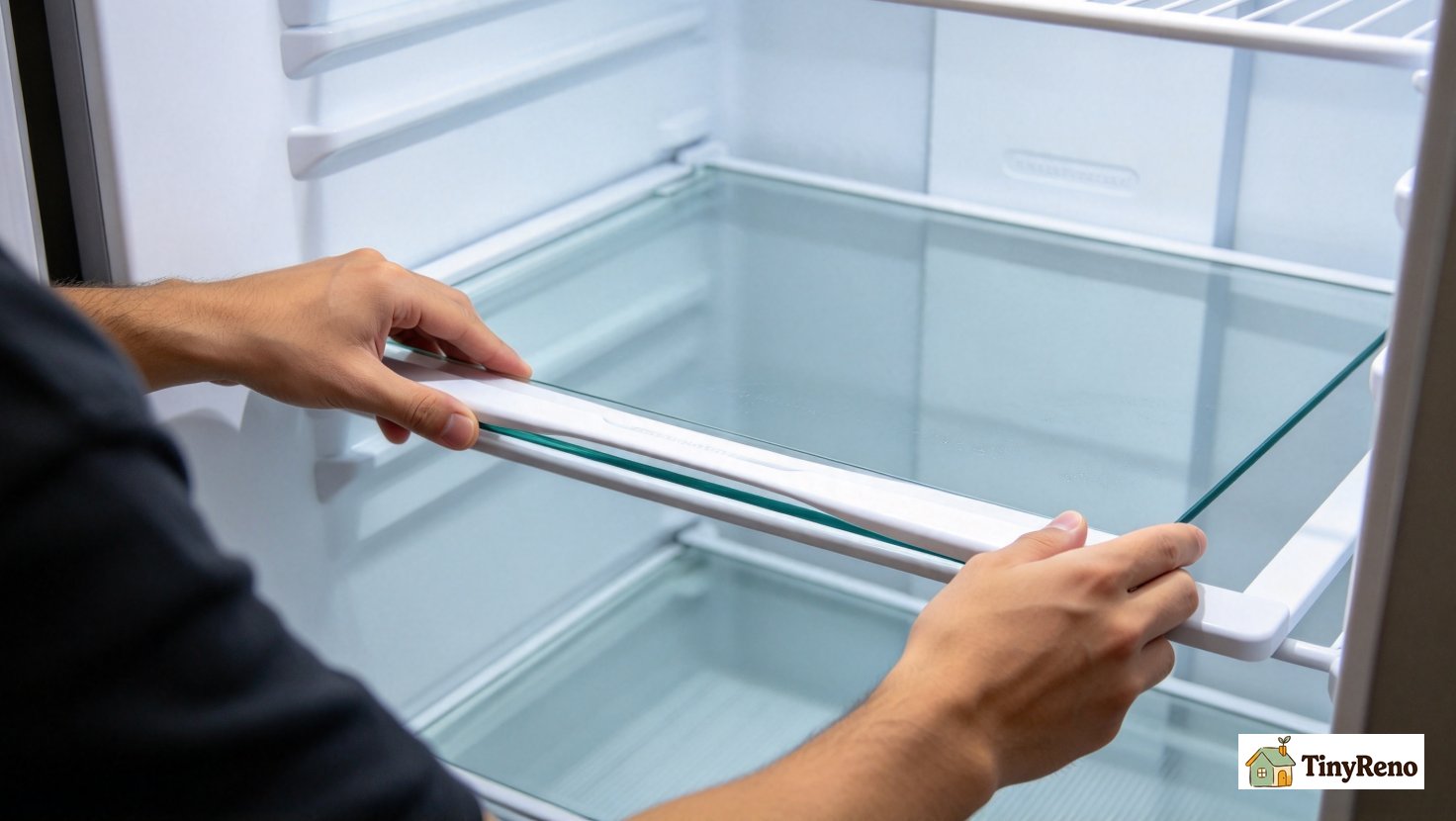
He put the intact shelf from the crisper onto the same slots and showed me that it sat with a visible wobble, about two millimetres of movement at the front edge, because the shelf was a quarter-millimetre too wide for the channel. That wobble was the whole cause of the failure. The shelf had been chafing against the plastic support at that corner for long enough to work a chip into the front edge, and one day the fridge was moved slightly during a delivery and the chipped edge caught. He showed me the pale abraded band around the corner, exactly what you would expect to find.
He then showed me the second shelf, the glass one at eye level, and it had the identical wear pattern at the same corner, plus a fine dust of glass in the bottom of the crisper drawer where a piece had been abrading. If both shelves were doing the same thing in the same place, the shelves were not the problem. They were doing exactly what they were designed to do in a slot a fraction of a millimetre too narrow.
And the load was irrelevant. The shelf above had held nothing heavier than a tub of butter and a jar of mustard, and nothing had ever been placed on its front edge, because there was nowhere to put anything on a shelf wedged in tight.
The technician’s view was that the shelf had been chafing against the support because it was slightly too wide for the channel, and that the chipped front edge eventually caught when the fridge was moved. I had not installed the shelf and I had not moved the fridge, though I did accept that the appliance was in my care during the tenancy.
What to Send Before You Pay Anything
Send a short email with five things in it, and attach the photographs rather than linking them. For this kind of dispute, the email is most of the case. Photograph the broken shelf in place before you remove it, then keep every piece in a box. Photograph the slot with a surviving shelf sitting in it so the fit is visible.
The five things are: the facts of the damage in two sentences with no argument in them; your photographs; the specific question you want answered, phrased so it can be answered yes or no; the evidence you have gathered; and a proposal that gives the landlord an easy way to end this. The most useful question is the narrow one, because a landlord can dismiss a complaint but cannot easily dismiss a measurement.
Here is the shape of it. "A glass shelf in the refrigerator cracked in the fridge in unit [x]. It fractured at the front left corner, and the edge at that corner is chipped and abraded. The surviving shelf above shows the same wear at the same corner, and the shelf has about two millimetres of play in its support channel. I am not disputing that the shelf broke while the appliance was in my care. I am asking for the shelf to be replaced on a defect basis rather than deducted as tenant damage, and I have attached photographs showing the wear pattern on both shelves and the fit of the surviving shelf in the same slot. A technician has confirmed the cause. If you would prefer it done through the warranty route I am happy to arrange it, and if you would rather I pay a replacement shelf and supply the part myself I will do that instead."
That last sentence matters more than it looks. You are offering two ways for him to avoid a fight: the manufacturer pays, or you pay the part. What you are not doing is arguing about the legal position, which he does not have to engage with, because the mechanism has already done the work.
What If the Landlord Still Says No?
Then you have a figure to argue about rather than a feeling, and that changes the conversation. Ask for the itemised breakdown of the two hundred and eighty dollars, because a single number is much harder to defend than three line items. Ask specifically what the manufacturer would have charged for the shelf, because the retail price and the warranty replacement cost are different numbers and the landlord had the option of the second one. Ask whether he has attempted the warranty route, and if not, why not.
Understand that the landlord may be as irritated by a warranty claim as by a claim for damage, because warranty work is paperwork and telephone calls and it is his name on the form. If he declines the warranty route in a reply that makes his reasoning clear, you have a document showing the item was defective and he chose not to pursue that.
If you reach small claims, do not frame it as a property dispute. Frame it as a debt. The landlord claims you owe $280. You say you do not, because the item was defective. The burden of showing what happened usually sits with whoever asserts the debt, but the exact procedure and burden vary by state and by court. Practically, you turn up with your photographs, the technician's written opinion, the manufacturer's fit guidance, and the correspondence showing you offered to resolve it. If the landlord never responded to your evidence, that is also a fact for the court, because it means the claim was never tested.
One practical warning. Do not withhold the deposit or refuse to hand the keys back over this. A dispute about a fridge shelf is not a reason to create a much larger one, and the amount of rent you keep walking away from is a far bigger number than a glass shelf. Pay what you think you owe, keep the rest, and pursue the difference afterwards if it is worth the filing fee. I paid the $80 I was comfortable with and disputed the rest. It took four months and a letter from the manufacturer, but the remaining $200 was eventually taken off the deposit, and the fridge got a new shelf that fit properly.
What I Would Tell My Past Self
Photograph the inside of every appliance on day one, including the shelves in their slots, with a coin or a ruler in one shot so there is a scale reference. My whole case rested on the difference between a two-millimetre gap and a gap you can see, and I had no photograph from the start of the tenancy showing the shelves were a bad fit. I had the broken shelf, which was enough, but it was luck rather than method.
Then photograph every appliance again in the last week, before anything breaks. If the shelf was already chipped when you moved in, that is the photograph that ends the conversation instantly.
Keep the broken parts. Every piece, in a box, for the length of the dispute. A landlord who cannot say the piece was thrown away has to engage with what is in front of him. Mine was still on my kitchen counter eight weeks later, which was absurd to look at and completely effective.
And do not accept a number without a breakdown, ever. The landlord in my case had a number before he had a cause. Once I asked for the cause, the number stopped being the interesting part.
Where That Shelf Is Now
The fridge has a new shelf, fitted by a company technician, and it sits in the channel without any wobble at all. The landlord recovered part of the cost from the manufacturer about six weeks after I moved out, which was not part of our agreement and was probably a coincidence of timing, but it did confirm the diagnosis. He never sent me the rest, which I have decided is a reasonable trade for not spending the autumn in a small claims hearing about a sheet of glass.
What I keep from it is a habit of looking at things before they break. The fridge in my current place has the same brand of shelf and the same narrow channel, and the corner where it rubs has a small pencil mark on it that I put there in week two. It is going to break one day, and when it does there will be a photograph from the first week showing exactly where the crack started, because the evidence is not in the broken glass. It is in the attention before the break.
A fridge shelf is one of the cheapest possible disputes and one of the most common, and the resolution is not in the law. It is in a photograph of a corner taken on the first day of a lease.


Discussion (0)
Sign in to join the discussion