

Touching up paint before a move-out is a topic I learned the expensive way. The last time I did it, I made a thumbprint-sized scuff many times larger, and then paid for the difference. There is now a patch on that bedroom wall the size of a dinner plate, in a slightly different shade of white, and I paid the landlord $170 to have a professional repaint the entire wall. Touching up a patch in the middle of a wall, it turns out, is genuinely difficult to do well.
The original scuff would have cost me nothing. Most renters searching for this advice are trying to avoid the same dinner plate I ended up paying for. I want to save you the weekends I spent learning it. I’ll start with what I got wrong, then what landlords actually deduct for, then the narrow band of marks worth patching and the larger band that are not.
How a Thumbprint Became a Dinner Plate
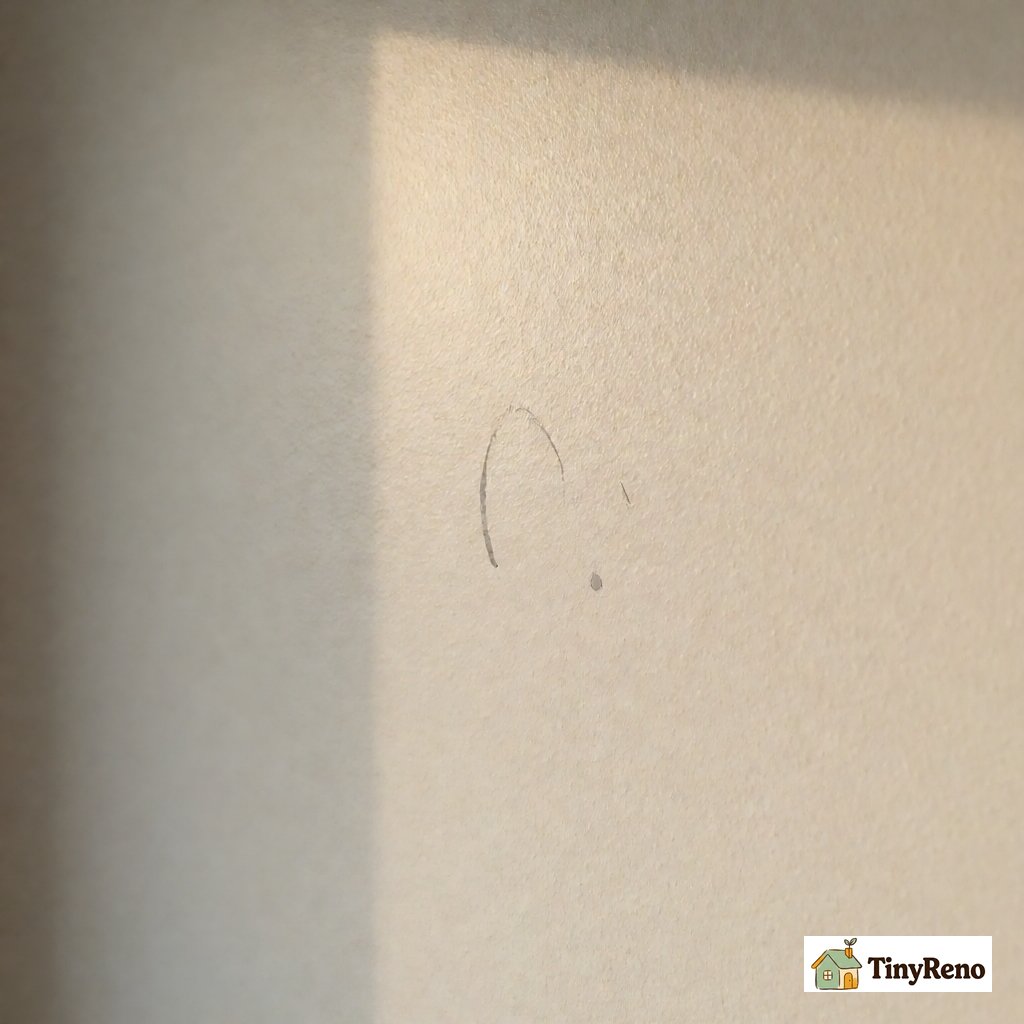
The scuff came from a suitcase wheel. I had been in the apartment fourteen months and was moving out, dragging a hard-shell case down the hallway one-handed because the other hand held a lamp. The case caught the wall at hip height in the bedroom doorway and left a grey arc about the size of my thumb, right where the light switch was.
I did not think about it for about an hour. Then I did what every renter does, which is to look at it very closely and decide that nobody will notice. It was white on white. It was in a doorway. It was low down where the light does not reach.
It was extremely noticeable. I have learned since that a scuff at that height on a white wall catches every single ray of light that comes in at an angle, and that once you know that, you cannot unsee it. Anyone who has seen this effect once will understand the panic, and the panic is exactly what makes people paint.
So I bought a small can of interior latex in what the label described as "almond" and painted a blob over it with a cheap brush. The blob was slightly too big, slightly too thick, and slightly the wrong colour, because almond and the wall's actual colour differ by less than you would think and more than the eye can judge in a store under fluorescent light. The blob now read as a dinner plate against a thumbprint.
Then I made the second mistake, which was to try again with a slightly different shade and a slightly smaller brush, which produced a third circle. At that point I had three overlapping patches in two tones, and I understood that the repair was no longer a repair. It was now a surface that needed to be repainted, and a surface that needs repainting gets painted all the way to the edges, onto the corner, and around the light switch, and after a baseboard and a window frame too, and by then it is a wall-painting bill, which is a completely different category of landlord deduction from a scuff.
My landlord's letter said: "Wall repair and repaint, bedroom, $170." The original mark was not on the invoice at all. It had been erased by my own hand. Everything I know now about touching up paint came from that single line item.
What Landlords Actually Deduct For
I have since read a lot of these letters, from friends and from people who asked me to look at them, and the pattern is consistent enough to be worth stating plainly. Landlords do not deduct for scuffs. They deduct for holes, for stains that will not come out, for peeling paint, for unauthorised paint colour, and for damage that requires a repaint rather than a patch.
Holes are the big one. A nail hole from a picture hook is the most common deduction in residential move-outs, and also the one where the amount is most worth challenging, because the same hole can be a fifteen-dollar item or a two-hundred-dollar item depending entirely on how it is treated. The size of the hole decides the treatment.
Stains are the second category, and the relevant distinction is whether the stain came off with cleaning. A scuff is a surface deposit, and surface deposits come off with a damp cloth. A stain that has soaked through the paint into the plaster is a different material problem. If it wipes off, it is not a deduction. If it does not, you are in the territory of a spot primer and a repaint, which is a legitimate cost.
Peeling paint is the third, and tenants often inherit it without realising. Paint that peels because of moisture coming through the wall is the landlord's problem, because the paint failed, not the tenant. Paint that peels because someone applied it badly, or over a damp wall, is different. If you painted a rental room without asking and it is now peeling, you are likely paying for that.
Unauthorised paint colour is the fourth, and it catches people out because it is not damage at all. If you paint a bedroom a strong colour and do not tell the landlord, you can be charged for a full repaint, and that repaint is not a repair of your scuff, it is a correction of your choice.
The fifth category is damage requiring a repaint rather than a patch, and this is the category my own repair accidentally created. A patch is a small job anyone competent can do for very little, while a repaint involves cutting in around trim and dealing with the fact that a wall is never one flat colour under different light.
The Measurement That Decides Everything
Before you touch a paint tin, put a ruler next to the mark and take a photograph with the ruler in frame. This is the single most useful thing you can do, and it takes fifteen seconds, because it converts the argument from a matter of opinion about size into a matter of measurement.
The bands that matter are these. A mark under about a quarter inch across, or a shallow scuff with no gouge into the paint, is a touch-up job and almost never worth a deduction. A nail hole in drywall, a few millimetres, is a fill-and-sand job that a landlord will usually accept as done with a little filler and a dab of paint, and many will not even charge for it if the wall is being painted anyway. A hole large enough to need a patch of drywall is a bigger job, and that is where the money starts. And a mark that has taken paint off down to the plaster is on the other side of a line from everything above: that is a repair, not a touch-up.
And a mark that has taken paint off down to the plaster, or a gouge through the paint and into the drywall face, is on the other side of a line from everything above. That is a repair, not a touch-up.
The reason to measure rather than to guess is that landlords are not being unreasonable when they charge for a genuinely large hole. A ruler in the photograph is also the cheapest possible evidence for anyone planning a touch-up, because it converts an opinion about size into a fact about size.
The other thing measurement gives you is a defence against the repair-versus-replace argument applied to walls. If a landlord says the whole wall needs repainting because of your mark, and your mark is a quarter inch across with no depth, then the repaint was not caused by your mark and the deduction does not follow from it. Repaints happen at the end of tenancies for many reasons at once, and bundling them into one line item against the tenant is not the same as them being caused by the tenant.

The Marks You Should Actually Patch
There is a narrow band of marks where touching up is genuinely the right call, and it is worth being specific because most of the advice floating around says to touch up everything, and touching up everything is how I ended up with a dinner plate.
Small nail holes and picture hook holes are the first category and the clearest win. A hole of a couple of millimetres in drywall is filled with a small amount of lightweight setting compound, sanded smooth once it dries, and touched with a dab of paint. My mistake in the bedroom was not the technique, it was the colour and the brush, so take a chip of the existing paint to the store, or the paint can itself if the landlord has left it, and use a small brush and two thin coats rather than one thick one.
Small scuffs and surface marks are the second category, but only when genuinely shallow. If you can see the paint colour with your fingernail and the surface is still flat, it is a scuff, and it takes a damp cloth and five minutes. If your fingernail catches in it, it is a gouge, and it is no longer a scuff.
And that is the whole list. Everything else, the rules are the opposite of what most people expect.
The Marks You Should Leave Alone
Do not touch a mark that is bigger than a coin. Do not touch a mark you have already touched once, because the second attempt almost always makes the colour worse. Do not touch a mark where the paint is down to plaster. Do not touch a mark on a wall you are not sure about the original colour of, because a nearly-right patch is more visible than the scuff was. And do not touch anything in the last week of the tenancy.

What to Say in the Move-Out Email
The email is where the money is, and it is much cheaper than paint. Send it before you hand the keys back, on the same day, and keep it short.
Say which marks exist, say what you have done about them if you have done anything, and say plainly which ones you have left alone and why. Something like: "Two small nail holes in the bedroom wall at about 1/8 inch, filled and touched up. A scuff at hip height in the bedroom doorway about the size of a thumb, no gouge into the paint, left as is. A patch of old adhesive residue near the kitchen window frame, removed." That is three sentences, and it does three things. It discloses, which protects you if the landlord finds something you did not mention. It shows which marks you addressed, which is the thing that makes a reasonable landlord's inspection fast. And it states that the remaining scuff is shallow, which is a fact the landlord can check rather than argue with.
Attach the photographs, including the ruler shots. If you did touch anything up, photograph the finished patch in daylight and with the lights on, because a patch that looks perfect under a bulb looks wrong at night, and it is better you know that than the landlord discovers it.
Do not write a paragraph explaining why the scuff is not your fault. Most landlords do not need that. If the mark is shallow and you have said so, the landlord can look at it and decide, and if he charges you anyway, the reply you send next is where you make the argument, not the handover email.
If a deduction letter arrives anyway for a mark you photographed and disclosed, that letter is where you apply the measurement. Something like: “The mark by the bedroom door is about three-quarters of an inch across with no gouge, and the attached photo shows the ruler next to it. A quarter-inch nail hole has been filled and sanded. I would welcome a repair quote rather than a replacement figure for the wall.”
What I Would Do Differently Now
If I could go back with what I know now, I would do four things differently. I would take the ruler photos before doing anything, so I would have known the mark was a scuff and not a gouge. I would have wiped it with a damp cloth first, because it came off in ninety seconds and the dinner plate never had to exist. I would have left the nail holes alone, because the building was repainted at the end of that tenancy anyway, which I found out about two weeks after I paid for my own patch. And I would have sent the handover email with the photos attached, which would have made the whole thing a ten-minute conversation instead of a $170 lesson.
That last one is the part that still stings, and it is not the money. It is that I spent several weekends and $170 on a problem I created. The original problem would have cost me nothing. I have a rule now that I think about more often than I would like: the cheapest repair is the one you do not make.
Where That Wall Is Now
The wall is painted. The landlord sent a painter, and the painter painted the whole bedroom wall, and it is now a slightly different white than the other walls in the flat, which I am told you can only see in certain light, which is exactly what he said when I pointed it out.
Nobody lives in that apartment now. It changed hands twice after me and is currently a short-term let, which means the wall has been repainted at least once more for reasons that have nothing to do with me. The scuff is gone, the dinner plate is gone, and the hundred and seventy dollars bought a surface that lasted about four years before a decorator chose a slightly warmer white for the room.
What I kept from all of it is a roll of painter's tape and a small ruler, and a habit that takes about ninety seconds on the first day of a new lease: walk every room with the ruler in your pocket, put your finger on anything that catches, and take a photograph. I have caught two scuffs and one sticking door this way since the bedroom wall, and I have paid for exactly one, because that one was mine and it was on a door that cost nothing to fix.
The other two are still there, under the tape I marked them with, waiting for the next person to move in and wonder why there is a small rectangle of tape in the corner of a room with no explanation. There is no explanation. I just have a rule now, and the rule came from a dinner plate.


Discussion (0)
Sign in to join the discussion