

Replacing landlord curtains was not the problem I thought it was. The problem was that I did it without taking a single record, and about two years later a judge in small claims court looked at my landlord's invoice, looked at the blurry photo on my phone, and asked the question that ended nine months of worrying: "Who is telling the truth about these curtains?" I told the truth, but only because by then I had started treating replacing landlord curtains as a lease question, not a decorating one. If you have already taken down the dusty panels your landlord left behind and are now losing sleep over it, this is the article I wish someone had handed me back on West Third Street, the week the old velvet came off the rod.
Here is what I got wrong, what I got right by accident, and the sequence of moves that took me from a dusty window to a courtroom without losing my deposit. It all comes down to one question: when does replacing landlord curtains count as damage? The honest answer is that most curtain disputes are not really about the curtain. They are about what you can prove, and when you bothered to prove it.
The Monday I Pulled Down the Old Velvet and Could Not Put It Back
I had been in the apartment eleven months. The landlord's curtains were two panels of gold velvet that had gone from dusty to grey to something closer to the colour of an old five-cent coin. Sunlight did not really get through them; it just heated up the room. I bought a pair of linen-look panels from a discount store for forty dollars, hung them on the existing rod with the existing hooks, and forgot about it for nine more months. Replacing landlord curtains, in other words, was a job I finished in eleven minutes with a screwdriver and a stepladder. That was not the part that came back to bite me.
The bite was at move-out. I did exactly what every reasonable person does: took down my new panels, hung the original velvet back up, and left. My landlord, Mr. Ainsley, waited eleven days, then sent a letter deducting six hundred and forty dollars from my deposit. The line item read: "Silk curtains — original set — destroyed, $640."
I sat on the floor of my new apartment and read that letter four times, because the word "silk" did not match anything I had ever seen in that unit. The panels I took down were polyester velvet, badly faded, with a cardboard seam allowance you could see if you held them up to a window. But I had nothing. No move-in checklist, no photos, nothing. In eleven months I had never once thought to point my phone at that window. I had replaced the curtains on faith, and then I lost the argument about them.
Before You Touch the Fabric: Photograph, Measure, and Write One Email
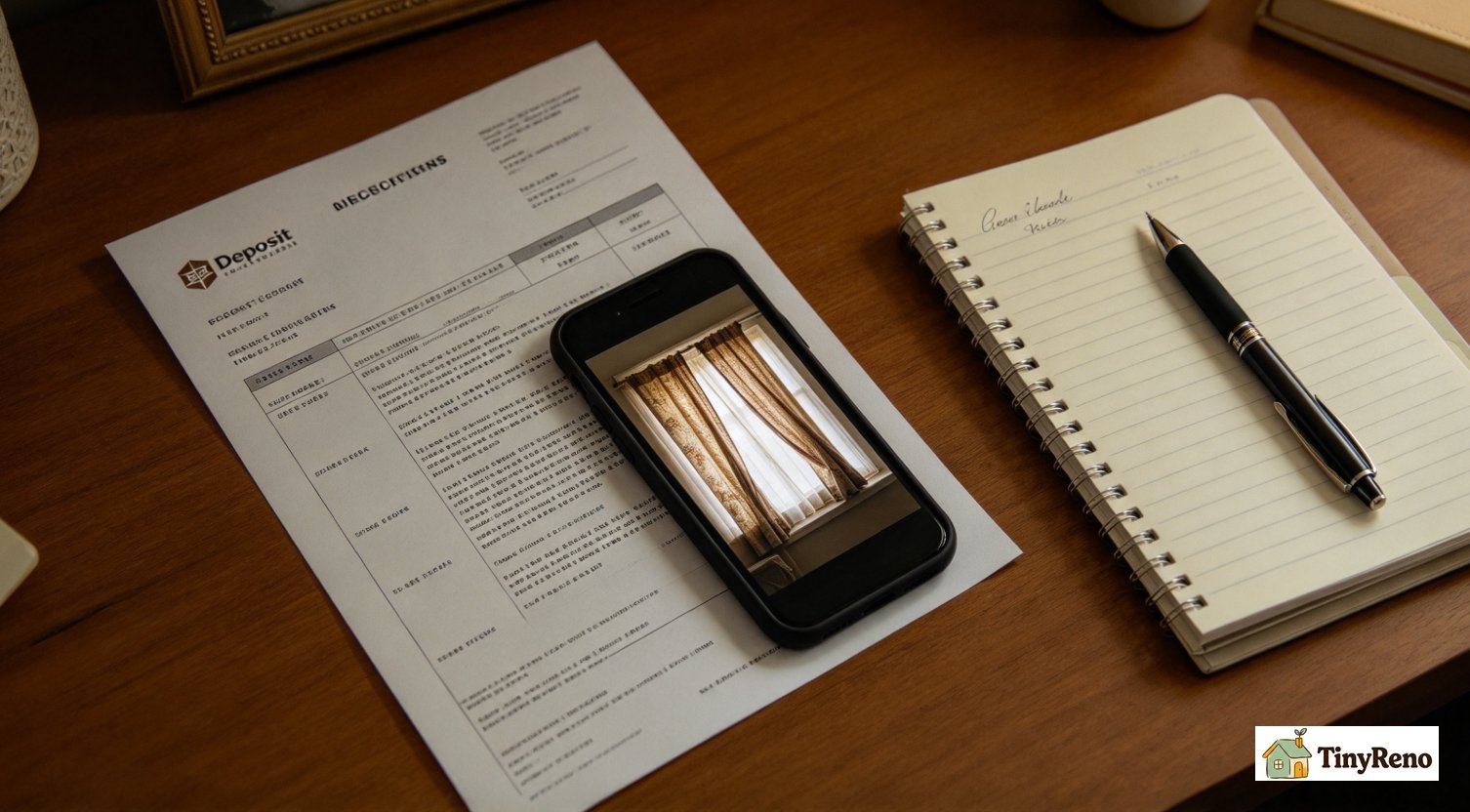
What I did not have, and what I now tell every renter to do, is a thirty-second record taken the day you move in. Replacing landlord curtains is only safe if you can later prove what they looked like before you touched them. My neighbour Priya, who has been in four rentals and never lost a penny of a deposit, does this with her phone while she is still unpacking boxes.
She stands across the room and shoots the whole window, then walks up close and shoots the curtain: the top, the hem, the back of the rod pocket where the manufacturer's label usually hides, and the panel folded over so both the face fabric and the lining show. Then she holds a tape measure against it and takes one photo with the numbers in frame. Then she sends one email: "Hi, moving in today. The living room curtains are the two gold velvet panels, dirty but intact, and I am leaving them as they are. Photos attached. I will be putting up my own window covering in the next few weeks."
That email does three things at once. It sets a baseline condition, it puts the landlord on notice that the curtains are about to change, and it creates a timestamped record the landlord actually received. None of it is magic, but when the argument later becomes "were these ever silk?", you have a document from day one instead of a memory from day 600.
If you have already swapped the curtains without doing this, do not panic. Do not delete anything. The recovery path is the next four sections.
The Day You Replace Them: Keep the Original Panels Alive
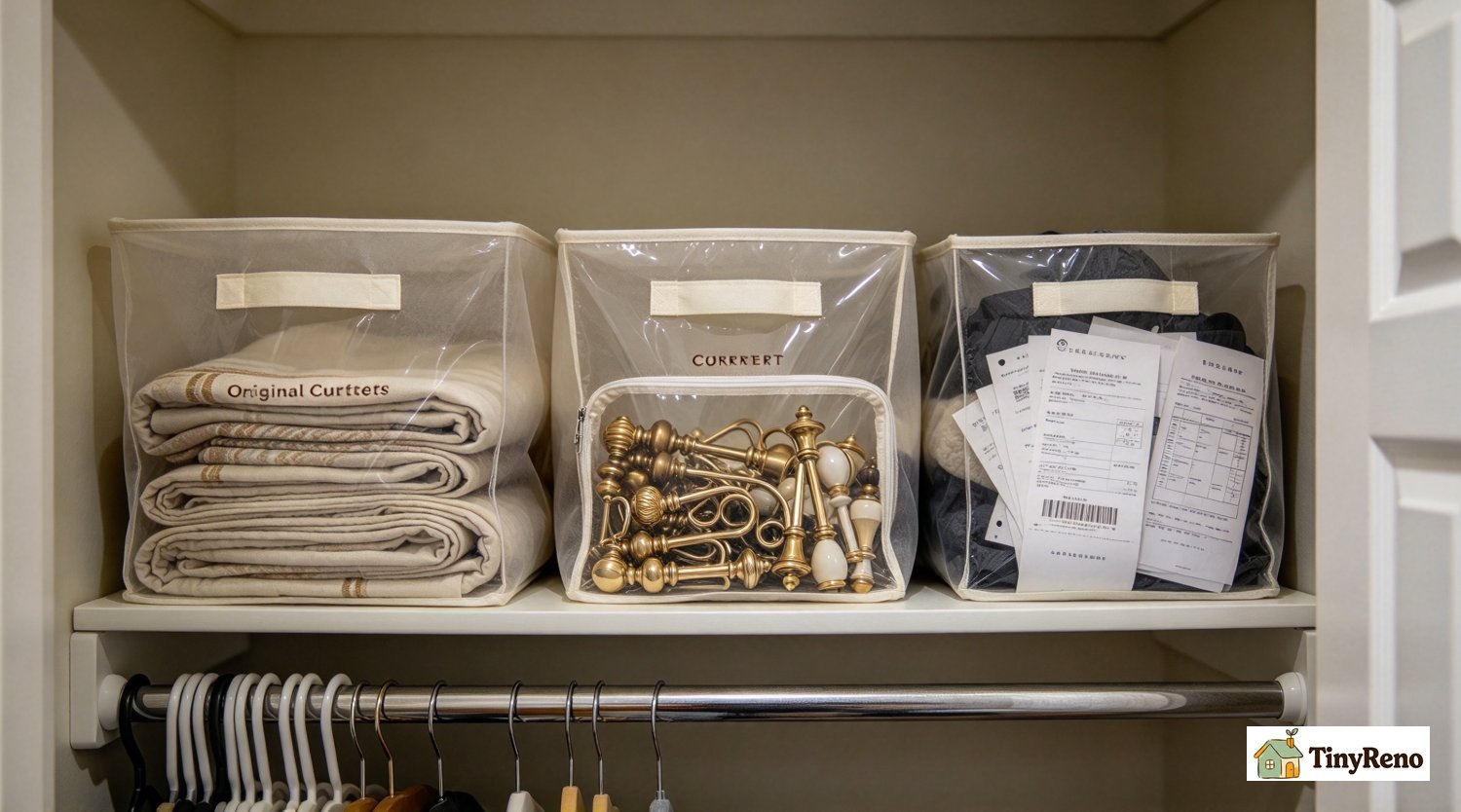
The urge when you pull down filthy landlord curtains is to throw them out, which is exactly why they are about to become a problem. The rule that saves you: the old panels go into a bag in your closet, never into a bin.
The system that works is what my friend Tomas calls the three-bag setup. One bag for the panels, folded loosely so you do not put new creases in them. One bag for the hardware — every hook, finial, bracket, and the rod itself if you are swapping it. One bag for receipts and instruction sheets, because the paper that came with the original hardware names the manufacturer and model, and that model number is exactly what a landlord or a judge needs to check whether a price claim is real.
Tomas also photographs the hardware before it comes off the wall, because hardware is where the value argument usually hides. A landlord claiming six hundred dollars for "curtains" is really lumping the panels, the rod, and the hooks together. If the rod is a fifty-cent tension pole and the panels are a polyester print from a department store, that invoice is just a guess about retail replacement cost with no connection to what was actually in the unit.
One more habit of his, and it is the single most useful one in this whole article: photograph the empty window before the new panels go up. Bare wall, bare rod, bare frame. That single image kills the most common landlord claim, which is that the tenant removed something permanent. It shows the window was never altered. No drilled hole, no cracked bracket, no paint gouge. When the only change is fabric, the argument stays about fabric. One caution from the same friend: do not drill, patch, paint the window frame, or shorten the rod. If the panels are the only thing that changed, you are arguing about the price of cloth. If you also drilled a bracket hole, you are arguing about drywall repair, and judges understand drywall repair far better than they understand velvet.
When the Letter Arrives: Decompose the Invoice Line by Line
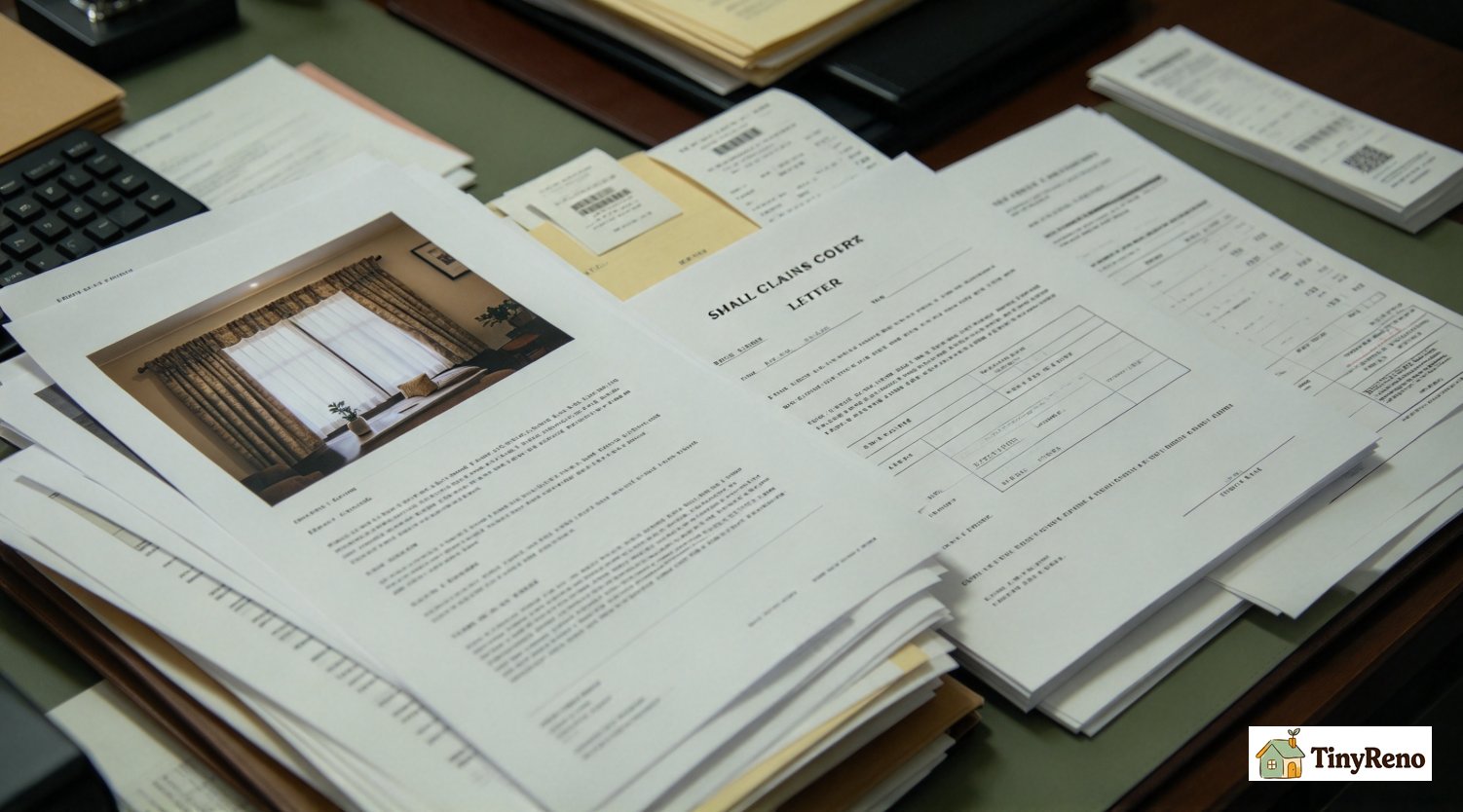
Mr. Ainsley's letter was five sentences long and cost me six hundred and forty dollars. What saved the case was that the letter was sloppy in a specific, usable way: it never broke the claim down. It did not say what the curtains cost, when they were bought, or what condition they were in when I moved in. It just said "silk curtains — original set — destroyed." That phrase was the whole ballgame.
An invoice for property damage is, at its core, a claim about replacement value. It does not matter whether replacing landlord curtains was reasonable; it only matters whether the loss can be proved. To make the claim stick, your landlord has to establish three things:
- The item actually existed.
- Your act damaged it.
- The amount charged is a reasonable replacement cost, not an inflated guess.
When I broke Mr. Ainsley's letter into those three pieces, every one had a hole in it.
The first hole: nobody had ever established the curtains were silk. There was no invoice, no receipt, no photo, no witness statement in the letter. When I asked him in writing for the original purchase documentation or any photo of the curtains taken during the tenancy, he sent back four sentences and no paperwork. A landlord who genuinely owns a set of silk panels has a receipt from a department store or a boutique, or at the very least a photo on his phone from the day he bought the place. A party who cannot produce the thing they are claiming existed is on shaky ground.
The second hole: causation. Between move-in and move-out, nearly two years passed. Dust, sunlight, a smoker living upstairs for a stretch, and general age did more to that velvet than my forty-dollar linen panels ever did. A landlord claiming damages has to show your act caused the loss and separate your contribution from time's contribution. A faded curtain at the end of a long tenancy is arguably in the condition it was in at the start, which nobody can prove without the missing move-in photos.
The third hole: the amount. Even if the landlord proved the panels were silk and that I damaged them, replacement cost is what the courts generally look at, not what the panels were originally worth to him. Silk panels that retailed at ninety dollars back in 2015 might reasonably be replaced for a hundred and twenty now. If the invoice is six hundred and forty dollars, ask how that number was built. The honest answer is usually that it came out of a furniture catalogue with your deposit added on top.
So do not argue in circles. Send one letter asking three specific questions and demanding documents. My lawyer, a tenant-side attorney named Renata Osei who handles small claims in the county, told me to number the questions so there is no ambiguity about what goes unanswered:
- What replacement cost are you claiming, and what is your source for that number?
- Can you provide the original receipt, a photograph of the curtains, or a description of their condition before I replaced them?
- Do you have any document showing the curtains were silk?
Then set a deadline, state that you dispute the deduction, and request the full deposit back. Renata's rule was about tone: the letter should read like an invoice dispute between two adults who both want to avoid a hearing, because sounding aggressive gives the judge a reason to see you as the difficult one. In about eight cases out of ten, a documentation request followed by a firm deadline is the whole resolution, because writing it out carefully forces a landlord to confront what they can actually prove.
Small Claims Court: What Actually Decides a Case Like This
My hearing was fourth on the docket that morning and took nineteen minutes, including the walk back out to the hallway. Two other curtain cases were on the same list. Renata told me afterward that curtain and fixture disputes are among the most common categories in residential small claims, and they all have one feature in common: they are almost always won or lost on documents, not on testimony. The procedure is deliberately simplified. You file a claim naming the landlord as defendant, the landlord is served, and both sides submit evidence — usually photos and paperwork rather than live witnesses. On hearing day each side gets a short window to present, and the judge decides. There is no jury, and a lawyer is usually not necessary.
Four things decided my hearing, and they are the same four that decide most of these cases.
The first was the photographs. Priya's method, which I had not used, would have made my case trivial. What I had instead was a handful of photos from month eight that I took for an unrelated reason — I was listing a spare room on a rental site. Those photos happened to show the full length of the original curtains in decent light. A judge looking at them compared them to the landlord's claim, and the answer to "were these ever silk?" was plainly no.
The second was the hardware. The invoice treated the panels, the rod, and the hooks as one bundled "original set" for six hundred and forty dollars. I asked the judge whether anyone had ever valued those components separately. Nobody had. The rod was a tension-fit pole with decorative end caps. The hooks were plastic. There was no proof anywhere of what any of it was originally worth, and failing to prove the value of the thing you claim was destroyed answers the claim on its own.
The third was the deposit ledger. Landlords who deduct from deposits are supposed to keep an itemised statement. When the landlord's own ledger did not break out the curtain claim separately and instead showed a single lump "tenant damage," the court had nothing to test the amount against. The ledger was the landlord's own document, and he could not use the court to enforce a figure he had never itemised for himself.
The fourth was that the landlord's claim was about replacement cost and mine was about a laundry bill. I bought my panels at a discount store for forty dollars and still had the receipt. It did not excuse anything, but it framed the case honestly: I am not asking for a silk set. I am asking for the deposit you took for something I did not damage.
The court disallowed the curtain deduction entirely and awarded me the balance of my deposit plus court costs, which in my county go to the winning party. It also took the landlord's property management company off the approved screening list for two years — a consequence I had not known about until afterward. A bad deduction has consequences the landlord may be underestimating.
The Ten Rules I Handed to My Neighbours
Three people in my building cornered me in the hallway and asked what I would have done differently. Here is the compressed version:
- Photograph the landlord's curtains on day one — wide shot, close shot, and a tape measure in frame.
- Email the landlord the same day, describe the panels, and attach the photos.
- Never bin the original panels. Bag the fabric, the hardware, and the paperwork separately.
- Change the fabric and nothing else, so the claim stays about cloth and not drywall.
- Photograph the bare window before you install anything. It proves you never damaged the fixture.
- Keep every receipt. A forty-dollar receipt defeats a six-hundred-dollar invoice more reliably than any argument you make in person.
- When the deduction letter arrives, dispute the specific line item, ask for the documentation behind it, and set a deadline.
- Separate the three questions in any damage claim: did it exist, did I cause it, and is the number a reasonable replacement cost?
- File before your local deadline.
- The goal is not to win the hearing but to make it unnecessary. That is why this list begins with the least dramatic rule of all: take eleven minutes with your phone.
Mr. Ainsley never replaced his curtains with mine. The gold velvet went into a dumpster that April. What I did find out, from the clerk's file, was that the ruling in my case was cited to his property management company twice more the following year. That is the part I think about most. The dispute was never really about velvet, and never really about six hundred and forty dollars. It was about who had a record, and who had taken eleven minutes on the first day to point a phone at a window.


Discussion (0)
Sign in to join the discussion