

A blind cord safety issue arrived in my apartment as a single loop of white cord hanging in the bedroom, about forty centimetres across, at precisely the height of my son's head. I had been in that room every day for two years and I had never once looked at it. I noticed it because he pulled the cord, because that is what a two year old does, and the blind went up and the loop came down around his neck and I got to him in about a second and a half. Nothing happened. The point of this article is that the reason nothing happened was luck and a cord that had been badly installed, and not anything I had done.
Here is the difficulty with blind cords in a rental, and it is why I did not fix it the way the internet says to. The standard advice is to fit a cord tension device, a small clip that screws into the wall and holds the cord against it, and that advice is correct for a house. In a flat you do not own, you cannot drill a hole in a painted wall without asking, and if you drill and fill it well you have still put a hole in a wall you do not own. So the fix has to involve no holes at all, which is entirely possible and took me ten minutes once I understood the problem.
So the blind cord question I would answer has three parts. What makes a cord dangerous, which is not the presence of a cord but two specific measurements, and knowing those two numbers tells you whether your blind needs anything done at all. How to secure it without drilling, which is a knot and a piece of tape and about ten minutes. And whose job it is, which depends on whether the blind came with the apartment, because that determines whether you are writing to a landlord or buying a two pound clip in a hardware shop.
What actually makes a cord dangerous
Most people's mental picture is a cord hanging down, and the picture is wrong. A cord hanging down from a blind is not the hazard. The hazard is a cord that forms a closed loop large enough for a small neck to pass into, and reachable when a child is standing, sitting or climbing. Two measurements decide it, and neither is the length of the cord.
The first is loop size. A loop needs to be big enough to go over a child's head, which is why safety rules talk about a gap of a certain width. The practical version is simpler: if you can push the loop open and put your own head through it comfortably, it is a hazard, and if you cannot, it probably is not. For a toddler that threshold is forgiving. For a three or four year old it is not, because a loop that will not go over an adult head can still go over a smaller one, and because the older child can reach higher and can climb.
The second is drop length, and this is the one people get wrong in the other direction. The question is not how long the cord is, it is how high the loop is off the floor. A cord that loops at fifteen centimetres above a carpet is a hazard for a toddler on the floor. The same cord looped a metre and a half above the floor is a hazard for a child standing on a chair, which is the scenario that actually causes the injuries, because children climb. This is why the standard advice includes checking what furniture is near the window, and why in a bedroom the bed itself counts, because a child who can climb onto a bed can reach a loop that was safe when they were on the floor.
There is a third thing that is not a measurement and is more important than either, which is the presence of something to climb on. A blind cord is only dangerous in combination with a chest of drawers, a chair, a table, a bookshelf, a bed, or a sofa. In a room with nothing to climb, the cord is a nuisance rather than a hazard. That matters for what you do about it, because it means that in some rooms the right answer is to move the furniture and leave the cord alone, and that is free.
And the practical test, which is the one I used. Sit on the floor where the loop hangs and see whether you can reach it. Then stand on the bed and see whether you can reach it. If the answer is no on the floor and yes on the bed, then the bed is the problem and the fix is either to secure the cord or to make sure the child cannot get on the bed unsupervised. You will know the answer in about ten seconds, and it is more reliable than any number you can find online. That test settles any blind cord question in under a minute.
How to secure it without drilling
There are two cords on almost every venetian or roller blind and they create two different problems, and it is worth knowing which is which before you start. The ladder cord is the pair of strands running up through the holes in the slats, and it is what forms the loop, because the two strands are separate and hang side by side, and the loop is the space between them. The pull cord is the single cord with the wand or the plastic pull attached, and it forms a loop when you close the loop at the top of it and it hangs down. Both need dealing with, and the fix for each is different.
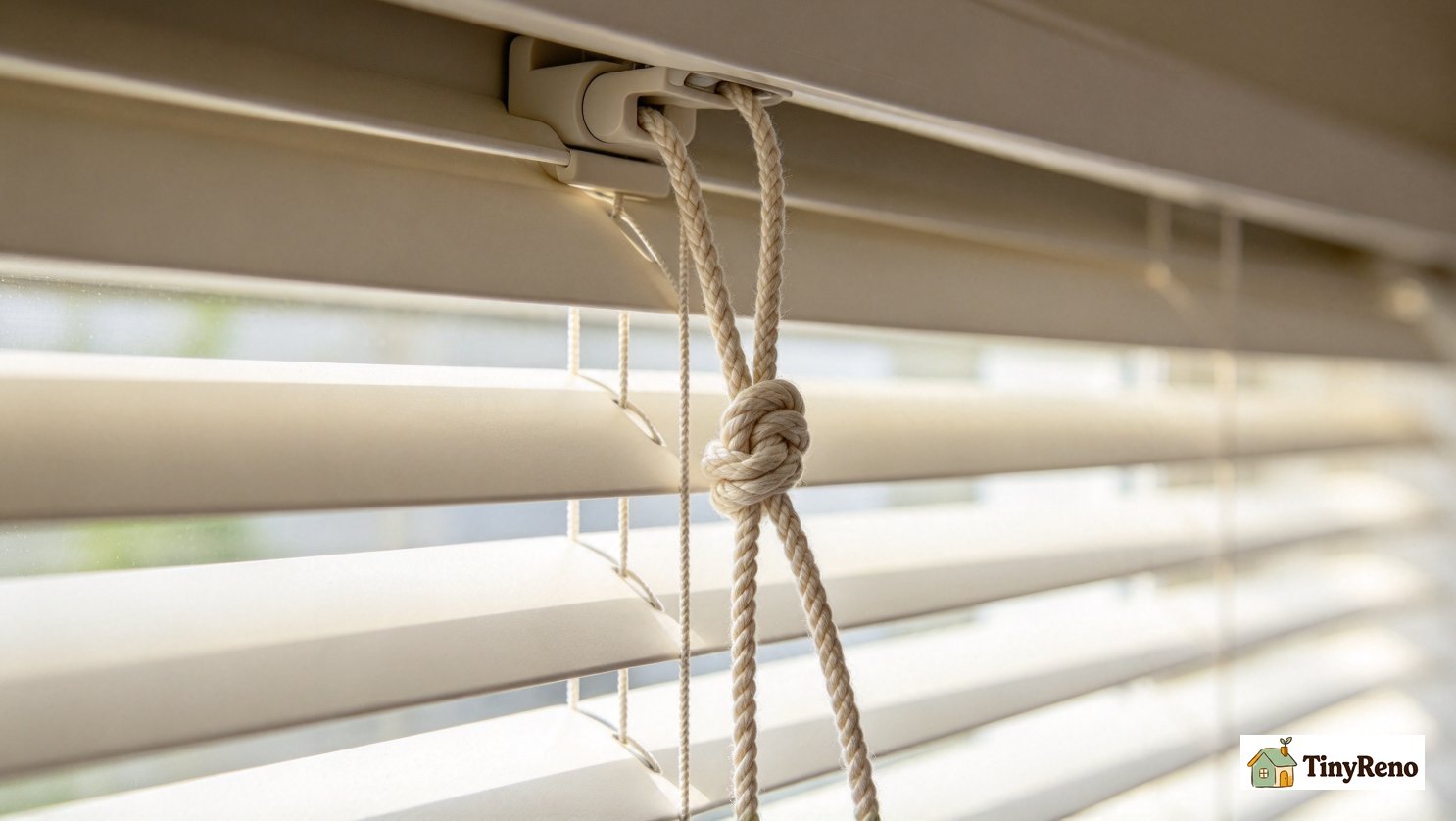
For the ladder cord, the fix is to tie the two strands together just below the blind head, which closes the loop. A cord cleat is a small plastic device made for this and costs a couple of pounds, and it is tidiest because it can be undone. A reef knot in the two strands does the same job for nothing and holds well on braided nylon cord, which is what most of them are. Aim for the strands to be separable by no more than a couple of centimetres, and put the knot a few centimetres below the head of the blind so the slats still move.
For the pull cord, the options are in increasing order of permanence. Tying a knot in it shortens it, which is free and takes a minute, and it does not fix a loop because the loop is still there, so it is only half a solution. Running the cord up into the head of the blind, if the blind has a channel or if the cord can be fed between the slats and taped inside the head, gets it out of reach entirely and leaves no mark on the wall at all. Taping it flat against the wall with removable tape stops it swinging and stops a loop forming, and this is the method most rental apartments will end up using.
On that tape, one warning, because it is the same warning as every other adhesive in a rental. Use removable tape, not ordinary tape, and use it on a flat painted wall rather than a textured or wallpapered one, press it down properly, and check it after a week. With a small child, do not rely on the tape alone, because it is the one part of the fix that can fail without anyone noticing. Treat a taped pull cord as a temporary measure and get the blind re-corded properly, and ask for a cordless pull or a cordless blind, which solves it permanently.
There is also a version worth knowing about, a hook-and-loop strap that wraps around the cord and sticks to itself, with no adhesive and no hole, and it comes off cleanly. The standard of doing this right in a rental is simple: no hole in the wall, no mark on the paint, and a loop that cannot be formed.
The same hazard in the rest of the apartment
Blind cords are the one everybody thinks of, but the geometry that makes them dangerous is not specific to blinds, and once you know what to look for you will find it in five or six other places in the same apartment. The pattern is always the same three things together: a cord, a loop it can form, and something to climb on. Change any one of the three and the hazard goes away, which is why the same two fixes work everywhere.
The first is curtain tie-backs, which are the ones most often forgotten. A tie-back hangs at roughly the height of a small child's neck, and a decorative tasselled one is often a long loop of cord with a weighted end, and the whole point of a tie-back is to hang in a loop. In a bedroom with a cot in it, a tie-back on the curtain next to the cot is a serious problem, and the easiest thing in this list to fix, because a tie-back can be wound up and tucked out of reach.
The second is floor and table lamps, where a bead chain or a pull cord on a tall floor lamp hangs at exactly the height that matters. The third is the chain on a blind winder, since a lot of people replace a dangerous loop cord with a winder and then leave the chain hanging in its place. The fourth is a light fitting on a flex in an older apartment, where a pendant can hang to shoulder height on an adult, which is head height on a child.
The fifth is not a cord at all but behaves like one, a drawstring on an upholstered chair or a roller blind, and it is worth looking at the hem of any curtain you own rather than only the top.
And then there is the furniture, which is the part cord securing does not fix. A blind cord is only dangerous because a child can reach it, and a child reaches it by climbing. A chest of drawers, a chair, a table, a bookshelf, a bed, a sofa, a window ledge, all of these become a climbing frame. The fix for a chest of drawers is a bracket that stops it tipping, and for a bookshelf it is heavy things at the bottom. A window ledge is a special case, because a ledge is a step whether or not anyone put it there.
So the walk around the apartment is worth doing, and it takes ten minutes. Look for any cord, loop or chain hanging below about a metre and a half, look for anything a child could climb within a metre of it, and look hardest in the room the child sleeps in, because that is where a loop and a cot or a bed are most likely to be together.
Whose job it is, and how to ask
If the blinds were already in the apartment when you moved in, they belong to the landlord and re-cording or replacing them is the landlord's responsibility. This is a fair request and a normal one. Blind cords are safety fittings, they fail through ordinary use and age rather than through anything a tenant has done, and this is exactly the kind of routine maintenance that sits with an owner. It is worth asking, and the thing that makes it work is asking in writing with the specific detail, because a general mention of the cords will get a general answer. A written request with a measurement in it gets a different answer from a spoken one.
Write it like this. Name the room and the window. Say the cord forms a loop of roughly forty centimetres, which is the detail that makes it a safety issue rather than a preference, and that there is a child in the household. Say you have secured it temporarily with a removable method and you are asking for it to be re-corded or replaced with a cordless blind. That is a specific, reasonable request and it is hard to refuse. Add a photograph of the loop held open, with a tape measure in the shot, because that turns a description into evidence.
If you brought the blinds with you, it is your job, and it is genuinely a ten minute job with a couple of pounds of hardware. If you are buying new blinds for a rental, buy cordless ones, which are widely available now and which remove the problem rather than managing it. And if you have a cordless blind already, check that the pull is a pull and not a loop, because a cordless blind can still have a short pull cord at the head, and that cord can still be long enough to matter if a child is in the room.
While you are doing it, walk around the rest of the apartment, because the same geometry appears elsewhere. Curtain tie-backs, a floor lamp pull, a blind winder chain, a drawstring on an upholstered chair, and a light fitting on a flex in an old flat are all the same hazard. Every one is fixed with the same two methods, and while you are securing one blind you can secure all of them in an afternoon.
The one thing that a cord cleat will not fix is the furniture, and it is worth being honest about that. A cord that is properly secured against the wall is much safer, but a chest of drawers that a child can pull over and climb is a separate hazard, and in a room with a child the two need dealing with together. If the drawers are the landlord's and they have a fitted bracket, ask for the bracket to be fitted. If they are yours, fit the bracket yourself. A room that is cord-safe but furniture-safe only half the time is still a room that is not safe, and that is the thing worth thinking about rather than the cord alone.

If you want something to actually do, here is the four-step version:
- Judge it by the loop and the drop height rather than by whether a cord is present, because a cord on its own is not a hazard and a loop at a child's height is.
- Fix it with a knot and some removable tape rather than a screw, because in a rental the hole is the thing you cannot undo, and the standard of done is a loop that cannot form and a wall with no mark on it.
- Ask in writing with the measurement, because a specific request is hard to refuse and a vague one is easy to answer with nothing.
- Look at the furniture as well as the cord, because the cord is only ever half of what makes a blind dangerous, and the other half is a chest of drawers a child can climb.


Discussion (0)
Sign in to join the discussion