

I spent an entire winter staring at an electricity bill that made no sense. The apartment was cold, the heating was on for maybe four hours a day, and the monthly total was still higher than I thought it should be. I did what most people do: I stared at the number, tried to work backwards, and got nowhere. A bill is a total for a billing period, and a total is the wrong tool for finding a problem. It tells you what you owe, not what used the power.
What finally cracked it was a plug-in meter I bought for about twelve dollars. The kind that sits between the wall outlet and the appliance and shows you watts in real time. I started testing things one by one across one Saturday afternoon, and about three hours in I opened the hall closet I had barely looked at since moving in. There was a fridge in there. A whole second fridge, dormitory-sized, humming away, left behind by the tenant before me. It had been running continuously for the six months I had lived there. I had never even noticed it.
That experience is why I write about this. The plug-in meter did not solve my energy problem by being fancy. It solved it by turning a vague bill number into a list of numbers I could add up, and by making the surprise visible. If you are trying to figure out why your rental apartment uses more power than it should, the approach below is the one I wish someone had laid out for me that winter.
What a bill tells you, and what it doesn't
The two approaches get compared as if they are rivals, but they are not. They answer completely different questions. The mistake is expecting one of them to do the other's job.
Reading your bill carefully tells you three genuinely useful things:
- Your total consumption. That is the number you are actually billed on.
- Your tariff. The unit rate, and whether you are on a variable or fixed price plan.
- The shape of your year. If you pull twelve months of bills, you can see which months were expensive and by how much.
That third one is more useful than people give it credit for. If your usage in August is roughly the same as your usage in January, something in the building is running constantly, and the bill has just told you so without you even noticing. You do not need a meter to spot that. You need a ruler and a year of statements.
What the bill cannot tell you is which thing is responsible. A bill totals every device over every hour, and a total is the opposite of a diagnosis. I can tell you from a bill that the apartment used 380 kilowatt hours in February. That works out to roughly 550 watts of continuous average draw. I cannot tell you whether that was a second fridge, a faulty immersion heater, or a badly insulated room with the heating left on. The bill does not care. It just adds everything up.
A plug-in meter tells you exactly one thing, and it tells you that one thing very well: what a single appliance draws, in watts, right now. Because it is a number rather than a total, you can add those numbers up, which is how you build a picture of the apartment. I did it appliance by appliance over one afternoon, wrote each figure on a sheet of paper, and added them up at the end. The total came out lower than I expected, which told me the problem was not the appliances I could reach. It was something in the hall closet, in a closet I had not opened since move-in day.
There is a third option that is free and worth doing first. Your online electricity account often shows your usage as a graph across the year, and if you have a smart meter, some suppliers will show a rough breakdown by category. If you already have a smart meter, this is available to you right now and you do not need to buy anything. The shape of that graph is more informative than the raw number.
So the order I would work in is this. Start with the account graph, because it is free and it takes ten minutes. Then use a plug-in meter on anything that runs continuously, because those are the ones you cannot guess at. And only then, if the total you have built up does not explain the bill, does it become a question for your landlord, because at that point the remaining consumption is in something you cannot reach. Which is the building.
The loads that hide in plain sight
This is where a meter earns its money. These are the loads that a bill hides completely, and that your attention hides even more effectively. If you have ever wondered why a modest apartment has a surprisingly high electricity bill, it is almost always one of these. And it is almost always something nobody consciously chose.
The second appliance nobody told you about
This is, by a distance, the most common thing I have found in rented apartments. A second fridge. A chest freezer. A washing machine that came with the apartment and that nobody uses but nobody removes. The reason it is so common is that when a tenant leaves, they take their furniture, but the landlord does not always clear out the stuff they left behind. The next tenant inherits a running appliance they did not choose and were never told about.
In my apartment it was a fridge in the hall closet. In a different apartment I stayed in for a year, it was a chest freezer in the garage that the landlord kept describing as "communal." It was not communal. It was plugged into the shared circuit and I was paying for it.
Heating that runs on a timer, not on you
The second category is heating, and specifically the heating that runs on a schedule rather than on your actual presence. A space heater on a plug-in timer. A heated towel rail that is never switched off because it is behind a door and nobody sees the switch. An electric blanket left on through the night. A hot water cylinder set to a schedule that assumes someone is home to use it.
The towel rail is the one that catches people most often. It is usually in a bathroom where you do not spend time, and a heater left on in a room you are not in is a heater that bills you for a room you did not use. You walk past it twice a day and never think about it, but it is on, all day, every day.
Standby load
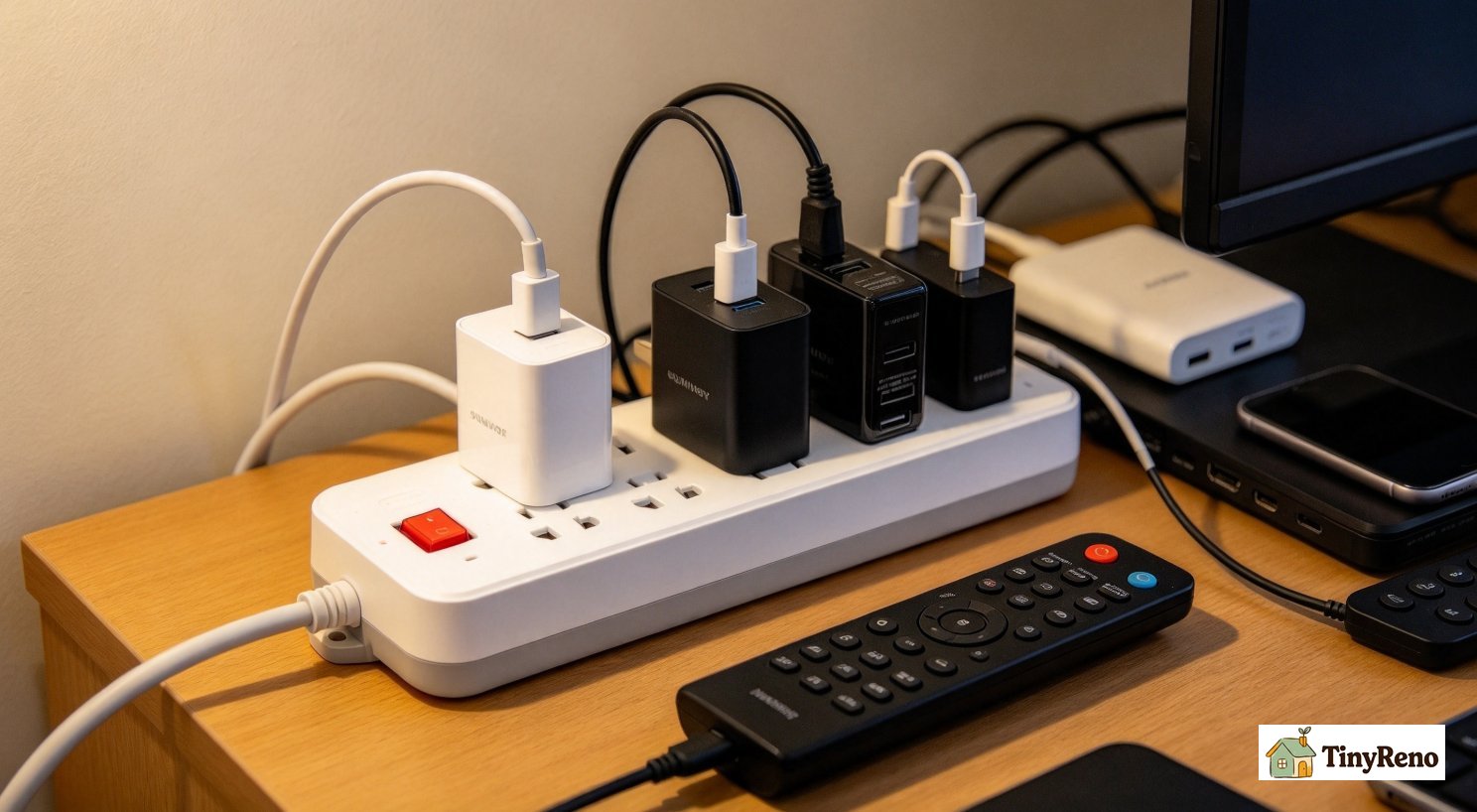
This is the one people write off entirely because each individual device draws so little that it feels almost insulting to count. A laptop charger. A television on standby. A router. A games console. A phone charger left in an outlet all night.
Individually these are a few watts. Collectively they can be a meaningful share of a small apartment's total. You cannot estimate this by eye, which is exactly why it is worth a plug-in meter. It is also the easiest of all the always-on loads to fix, because none of it needs anything bought. It only needs unplugging.
The building problem
And the fourth category is not really a tenant problem at all. It is worth separating out so you know when to stop measuring and start writing to your landlord.
Immersion and storage water heaters that constantly reheat because the cylinder insulation is degraded. Pipes that lose heat because they are poorly lagged. Pumps and fans running continuously in a building with a complicated heating system. You can measure your own appliances until you are bored and these will not show up, because they are not on your side of any outlet.
If your measured total is far below your bill, that gap is the building. And that is a conversation, not a purchase.

What to change, in the order that actually pays off
Everything in this list costs nothing and is entirely within your control. I have put it in the order that it actually pays out, because the order is not the order people try things in. If you only do the first one, you will have done most of the available saving.
- Find out what is running that you did not put there. Walk through the apartment with the meter and check the things that are not in the rooms you use. Cupboards. The hall. The airing closet. Under the stairs. Behind the sofa. In my apartment that walk took forty minutes and it found a fridge, a dehumidifier somebody had left plugged in behind a curtain, and a halogen light in a closet that was on because the switch was behind the door. None of those were in a room I would have thought to check.
- Switch off what does not need to be on. The cheapest saving in any apartment is the plug you never needed. There are two kinds. Appliances you genuinely use and can live without when you are out, and standby and always-on loads, which as a category is a large share of a small apartment's consumption and which you can eliminate almost entirely with a power strip that has a switch on it. One switch. One action. Six devices off.
- Put a timer on anything that heats. A space heater. A towel rail. An immersion heater you control. A hot water cylinder schedule. The point is not the timer itself, it is that a timer converts a decision you might forget into a decision you made once. I set my hot water to come on in the morning and go off in the evening, and the difference on my bill was larger than anything I did with the plug-in meter. Which tells you something about how much of an apartment's consumption is a timer left on its default factory setting.
- Decide whether you need the thing at all. This is the one that requires you to be honest with yourself. A second fridge. A freezer. A dehumidifier in an apartment that is not actually damp. A second television. A meter turns that from a feeling into a number, and a number makes the decision easy. A chest freezer that draws 70 watts continuously, in an apartment where you buy food a shop at a time, may not be worth the convenience. It can be a second electricity bill running quietly in the background. Once you have seen the figure you will not unsee it.
- Look at the tariff, not just the consumption. If you are on a standard variable rate and your usage is concentrated in the expensive hours, shifting the timing of the things you can time — the washing machine, the dishwasher, the immersion heater — moves money around without using less of it. It is worth a few dollars a month and it is a real option, but it is the smallest effect of the five and it is the one people do first. Which is backwards.
What you can and cannot touch
Start with what is entirely yours, because there is more of it than people assume. Everything you plug in yourself is yours to change, and the changes cost nothing. Unplug the chargers and the standby loads. If you need a charging point, a power strip with a switch on it means one switch instead of six plugs. Put a timer on anything that heats. And if you are not sure whether an appliance is worth keeping, the meter gives you the number that makes the decision obvious. A fridge drawing 90 watts when it is supposed to be drawing 50 tells you something a label never will.
Then there is the question of the fixed wiring, and the answer here is unambiguous. Anything that plugs into an outlet is fine. Anything that needs to be hardwired, or that involves opening a plug, or that involves touching an outlet, a breaker panel, or any part of the fixed installation is not yours to do. In any circumstance. For any reason. However simple the job looks.
Fit a smart plug and you are using a consumer device plugged into an outlet, which is fine. Wire a device into a fixed outlet and you have altered the electrical installation of a property you do not own, which is a safety question and may be a breach of your tenancy. A landlord who finds it at check-out will not treat it as a favour you did them.
What you can do about the building is ask. This is where measurement becomes useful as a document rather than a hobby. A landlord who receives a note saying your own appliances total about 300 watts, that your February bill of 380 kWh works out to roughly 550 watts of continuous average draw, and that there appears to be a second fridge running in the hall closet, is being given a specific and checkable claim. That is a very different conversation from "my bill is high."
I sent exactly that, with a photograph of the fridge in the closet. The fridge was gone within three days. The hall closet was empty. That was the end of the problem. A measurement is a much better tool in that conversation than a total ever was.
And be clear with yourself about what you are optimising, because this is where a renter can talk themselves into a bad decision. A lower bill is not automatically a better apartment. If your building is poorly insulated and your heating is the only thing keeping the place at a livable temperature, then reducing it saves money and costs you health. The sensible order is health first, then comfort, then everything else. The always-on appliances are the right place to start because they cost you nothing to give up.
At the end of the day, it comes down to four things:
- Work out which kind of missing information you actually have. A total and a per-appliance figure are not the same thing, and no device gives you both at once.
- Look at the free stuff first. The account graph and the shape of your year. Then use a plug-in meter on whatever runs continuously, because that is where the surprises live and a meter finds them in an afternoon.
- Change what is yours. The unplugging, the timers, the switchable power strip. And never touch the fixed wiring. That boundary is absolute.
- If your measured total does not explain your bill, the answer is in the building. At that point the right move is a written note with your figures in it, not another piece of equipment.


Discussion (0)
Sign in to join the discussion