

The closet in my apartment came with the place. The rail is a single thin pole held by two brackets, and it is not mine to replace. I spent the first month assuming the answer was to buy better hangers, and it was not, because the problem was never the hangers. The problem is that a rail gives you one dimension, and I was trying to solve a storage problem that needed more than one. Everything that made my closet work came from accepting the rail as fixed and changing everything around it.
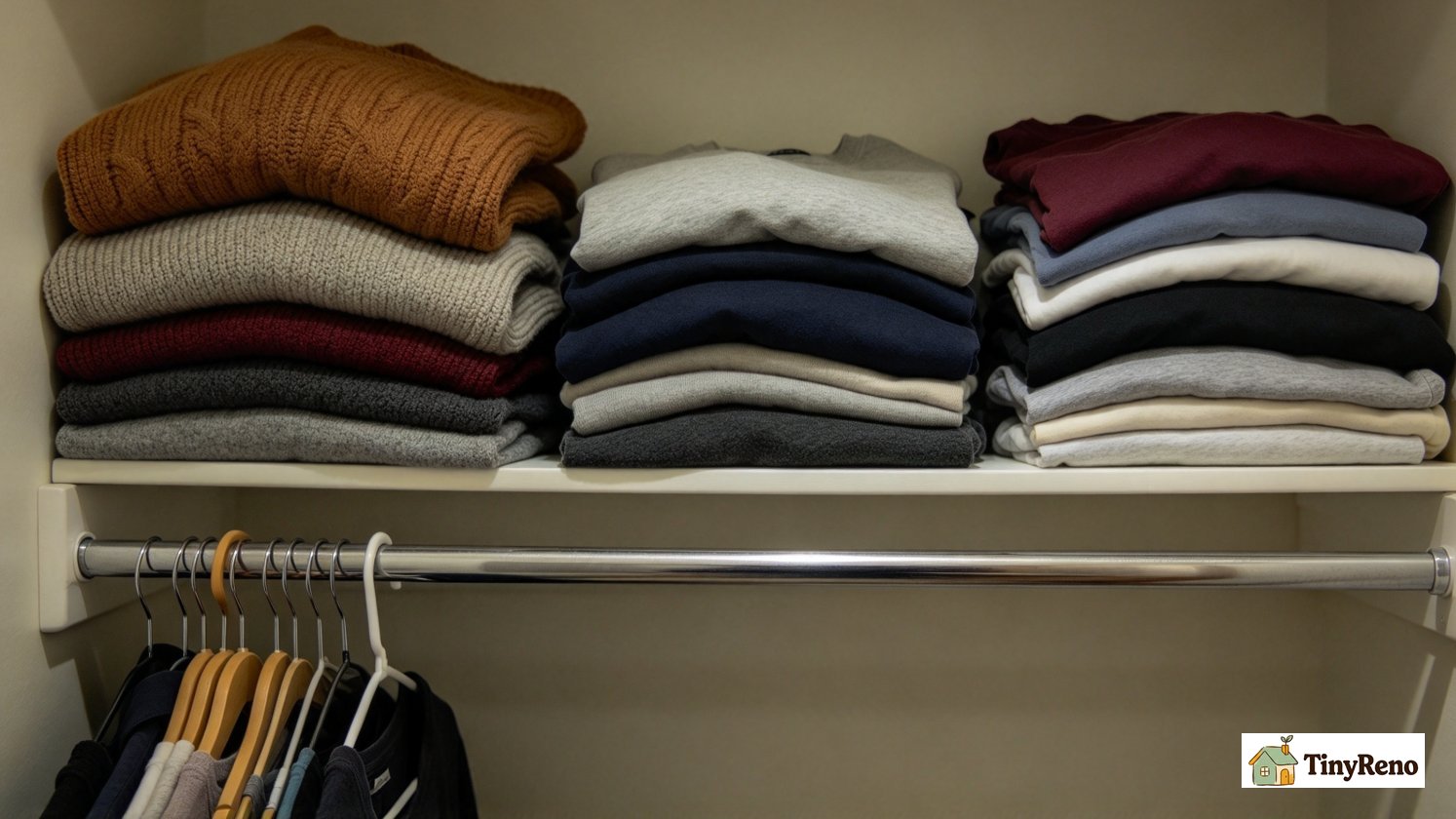
What changed it was simple. I moved about half my clothes off hangers and onto the shelf. It feels backwards at first, because a closet seems designed for hanging, but it freed a lot of rail space. Then I added a second rail below the first, which I did with a tension rod that cost less than a takeout meal, and then I started hanging the things I wear most on the back of the door. Those three changes took a closet that could hold about forty garments and made it hold a season's worth of clothes, and none of them touched the rail, the brackets, or the paint.
The closet rail question is really about which dimension you are using. A rail gives you length. A shelf gives you area. A door gives you a surface for hooks or over-door hangers. Most renters use the rail and ignore the other two. The rest of this guide is the practical version of that, including the four changes that actually work, the one that does not, and the buying advice that is worth taking and the buying advice that is not.
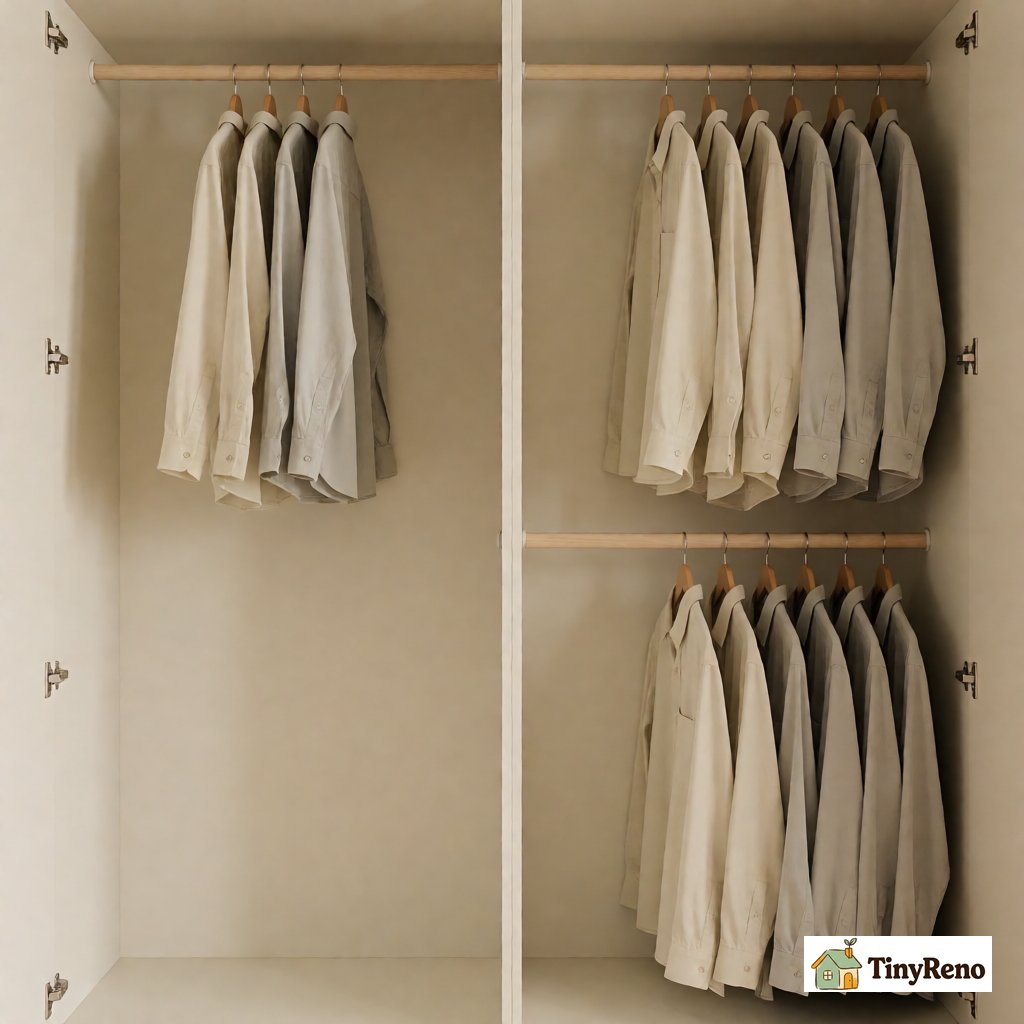
What the rail is actually costing you
Before changing anything, it is worth understanding why a full rail of clothes looks fuller than it is, because the reason is the thing you can actually fix. A shirt on a hanger takes up about an inch of rail length, which does not sound like much, but the garment itself is only about half an inch of that — the hanger is the rest. So a rail holding forty shirts is really holding forty hangers and forty thin garments, and roughly half the volume of that closet is air between the shoulders of the hangers.
There is a second and larger cost, and it is that most of what people hang does not need hanging. A sweater, a pair of trousers, a t-shirt, a folded cardigan, all of them occupy rail length that could hold three folded garments on a shelf, and the shelf is a dimension you have not used at all. If your closet has one rail and one shelf, you are using a fraction of it. If your closet has one rail and four shelves, you are probably using most of it and the rail is not the constraint you thought it was.
And a third thing to check, because it is free and it is often the real answer. Look at where your rail actually is, and how far the hanging space extends down. In a lot of fitted wardrobes the rail is set high, and there is a large empty volume between the bottom of the hanging clothes and the floor. That gap is often the most useful unused space in the closet. A tension rod fitted across that gap, at a height where a shirt or a coat clears the floor, is a fifteen minute job and it is the change that doubled my usable hanging space.
There is one more measurement worth taking before you buy anything, and it is the one that determines whether a second rail is even possible. Measure the vertical distance from the existing rail down to the floor, and then measure the length of your longest hanging item, which for most people is a coat or a long dress. If the gap is smaller than your longest item plus a couple of inches, a second rail is not the answer and you should be looking at shelving instead. Measuring first costs nothing, and the second rail is the one fix that people most often install and then have to take out again.
The four changes that work
Ranked by how much they change and how much they cost, and the order is not the order most people would guess.
First, take half your clothes off the rail and fold them onto the shelf. This often frees more rail space than people expect, because folded clothes stack and the rail is then available for things that genuinely crease. The clothes that should stay on hangers are shirts, jackets, anything in a suit, and anything with a shape that a hanger destroys. Everything else is better folded, and some of it is better rolled, which takes up even less space and comes out without a crease.
Second, add a second rail below the first, if the measurement allows. A tension rod is the version that needs no permission and leaves no mark, because it is held in place by its own ends pressing against the side panels, and it can be a wooden dowel, a steel rod, or a purpose-made tension rail. It has to be a genuine tension fit rather than a shelf bracket with screws, because screws into a landlord's closet are a modification. Screw the two ends into the side panels, and you have drilled into a closet that is not yours, which is both a deposit problem and potentially a breach of your tenancy. A friction fit that you can pull out in ten seconds is the thing to look for.
Third, use a multi-hole hanger, which is a small block with holes down its side, and you hang your clothes from it sideways so that they stack along the rail rather than across it. This one is not as common as the other two and it is worth knowing about because it works in a shallow closet where a second rail would not fit. The trade is that the clothes on it get creased across the shoulders from folding over, so it suits things you wear loosely and does not suit a shirt you need to look sharp in.
Fourth, and this is the one that solves the daily problem rather than the storage problem, use the back of the door. A closet door takes a hook or over-door hanger and holds a coat, a scarf, a hat, or a bag, and it takes the things you actually reach for every morning off the rail entirely. In a rental this is also the safest option of the four, because an over-door hook leaves nothing behind when it comes off. What you should not do is stick anything to the door with adhesive, because closet doors are often the surface with the most finishes on it, and they are the part of the closet most likely to be replaced at check-out.
What to buy, and what to ignore
The buying advice for closets is mostly bad, and the reason is that the expensive products solve problems that small apartments do not have. A multi-rail closet organiser with several tiers costs a serious amount of money and is designed for a big closet in a house, not for a fitted rail in a rented bedroom. It also usually needs screws, which is exactly the thing you cannot do.
What is worth buying, in the order I would buy it. A tension rod for the second rail, which is a few dollars and does the most work. A set of good wooden hangers, because cheap hangers are wide and set in ridges in the shoulders of a coat, and you will replace the coat. A few shelf dividers, if you have a shelf, because they turn one shelf into two or three without anything being fixed to anything. And a slim box or two for the small things, which is cheaper than a proper storage system and does the same job in a rental.
What to ignore. Vacuum bags, for clothes you wear, because the volume they save is in the fibres and it comes back the moment you open the bag, so you are compressing clothes every time you want them and the space was never really saved. They are excellent for bedding and for winter coats that live in a box for the year, and that is the whole of their use. Also ignore anything described as slimming, and anything that needs a drill, and anything sold as a set of ten identical hangers where the identical part is the one that matters, because a good hanger for a coat and a good hanger for a blouse are not the same object.
And on the subject of hangers, because this is where people spend money they do not need to: the difference between a ten-pack of wire hangers and a set of ten wooden hangers is not ten dollars, it is whether your coats keep their shape. If you own a coat you care about, buy two good wooden hangers and use them for that coat. The rest can be wire. You probably do not need a full matching set of wooden hangers for a rental closet. A couple of good hangers for the coat you care about is usually enough.
What is allowed in a rental closet
Here is the rule I have settled on after getting this wrong once. Anything that needs a screw, a drill, or an adhesive hook into a painted surface is a conversation with your landlord first. Anything that rests on a surface, hooks over an edge, or is held in place by its own tension is generally fine, and it comes out at the end of the tenancy leaving nothing behind. That is not a legal opinion, it is a practical one, and it is the standard that most landlords themselves apply, because they are thinking about whether the apartment will look the same when you leave.
In practice, what damages a closet is usually small. Adhesive hooks can pull paint off the back panel or shelf edge. A screwed-in rail leaves holes to fill at check-out. A shoe rack can score the shelf, and casters can drag across a painted floor. Overfilling the closet so the door no longer closes can also look like damage, even when it is just crowding.
Two practical warnings while you are rearranging. Take the clothes down before you move the rail or fit anything, because a full rail weighs more than you think and a unit that tips while you are working on it is a genuinely bad afternoon. And check the door swing before you commit to a layout, because the most common mistake in a small rental closet is building a beautiful arrangement that the door cannot close over, which pushes you back to the same problem you started with.

The short version:
Do not hang everything. Use the shelf as well as the rail.
Measure the gap under the rail before buying a second one. If your longest coat does not clear it, use shelving instead.
Fit things without screws. A tension rod and an over-door hook leave nothing behind.
Spend little. A tension rod and a couple of good hangers for the coat you care about are usually enough.


Discussion (0)
Sign in to join the discussion