

A Smelly Fridge in a Rental Apartment Is Usually Not a Food Problem really about food, and I wasted most of a Saturday finding that out. The fridge in my second rental smelled like old fish and damp cardboard. I emptied it, threw away half of what was in there, washed every shelf and drawer in hot soapy water, wiped the door seals, and put everything back. That evening it smelled worse than it had that morning. Two days later I took a garbage bag of my own food to the corner of the street and started again from the outside, and that is when I finally looked at the part of a fridge nobody looks at.
There is a defrost drain pan somewhere on most fridges. On many models it sits near the compressor at the bottom or rear of the cabinet, not directly under the crisper drawer. Water from the defrost cycle drains into it and is supposed to evaporate. If the pan is misaligned, cracked, or full of standing water, or if the drain tube is blocked, that water can become the smell. The exact location depends on the model, so check the manual or look near the compressor before pulling drawers apart. Nothing you scrub on the inside shelves will reach a pan or tube that is behind a panel or under the appliance.
So this is the part that actually saved me: there are five common sources of a fridge smell, and food is only one of them. I went through them in the wrong order, which cost me most of a day and about forty dollars of groceries, and I have thought about the order since every time I have moved into a place that smells on arrival. I want to lay them out here in the order that actually saves you time, and then be specific about which of them you are allowed to touch in a place you do not own.

What the smell is actually coming from
There are four candidates, and they are worth telling apart because each one has a different fix and a different owner:
- The drain pan. The single most common cause in rented apartments. The clue is that the smell is strongest when you open the door, and it seems to come from the bottom of the cabinet rather than from a particular shelf. A food smell is strong in the food area and fades as you move away from it. A drain smell is low and follows the cold air, because cold air falls and the tray is at the bottom.
- The defrost drain tube. The small hole that runs from that tray up and through the back of the cabinet, and its job is to carry the water out to the pan so it can evaporate. It gets blocked with crumbs, a bit of a plastic bag, and a surprising amount of food packaging film, and when it is blocked the water does not reach the pan to dry, it just sits in the tube and in the foam around it. The clue here is that the smell is worse near the back of the cabinet, and that you sometimes notice water in the very bottom of the crisper area. You cannot see the tube without moving the appliance, which is why most people never find it.
- A mechanical problem. This is the one that people mistake for a cleaning job. When a compressor or a fan motor is running but is not working correctly, the smell is hot and metallic rather than food-like, and it tends to be present even when the fridge is completely empty, which is the giveaway. A smell that persists in an empty, freshly wiped fridge is not coming from the food and it is not coming from the drain, because you have just removed both. That is the point at which you stop cleaning and start making a phone call.
- A chemistry problem. The one to take seriously. A sharp, chemical, solvent-like smell is not bacterial, and no amount of scrubbing touches it. It can come from a refrigerant leak, which is why it matters that this one gets reported rather than cleaned. My rule for the whole guide is a smell that is food-like or damp is a cleaning and reporting problem, and a smell that is sharp, sweet, hot, or chemical is a stop-using-it-and-report problem. That distinction is the most useful thing I learned, and it cost me a weekend to work out.
What you can clean yourself in a rental
Everything in this section is tenant-level work. None of it changes how the appliance functions, none of it requires opening a sealed panel, and all of it is safe to do in a place you do not own. That distinction is what makes this something you can actually finish in an evening. I did all of it in my second apartment and I did it badly the first time, so the order below is the order that works.
Start by taking everything out and leaving the door open for a full day, which sounds too simple to be worth writing down but it is the step people skip, and it is the step that makes everything after it work. Cold, closed air lets bacteria settle into the surfaces. Open air and a warm cabinet dry the surfaces, and a dry surface is a surface bacteria cannot establish itself on. If you do nothing else on this list, open the door and leave it open, and put your food in a cooler or a bag with ice.
Then wash the removable parts in hot water with a drop of dish soap. The shelves, the drawers, and the crisper trays are all removable on almost every fridge, and they are also the parts that get washed least often, because they are fiddly and because people assume the dishwasher is too hot for plastic. Many plastic shelves are not dishwasher-safe, and a dishwasher may leave residue or warp the plastic. Wash them by hand unless the manufacturer says otherwise. Wipe the door seals, rubber gaskets, and the inside of the door with a cloth and a mild baking soda solution. Seals are often damp and can trap residue, which can contribute to smells.
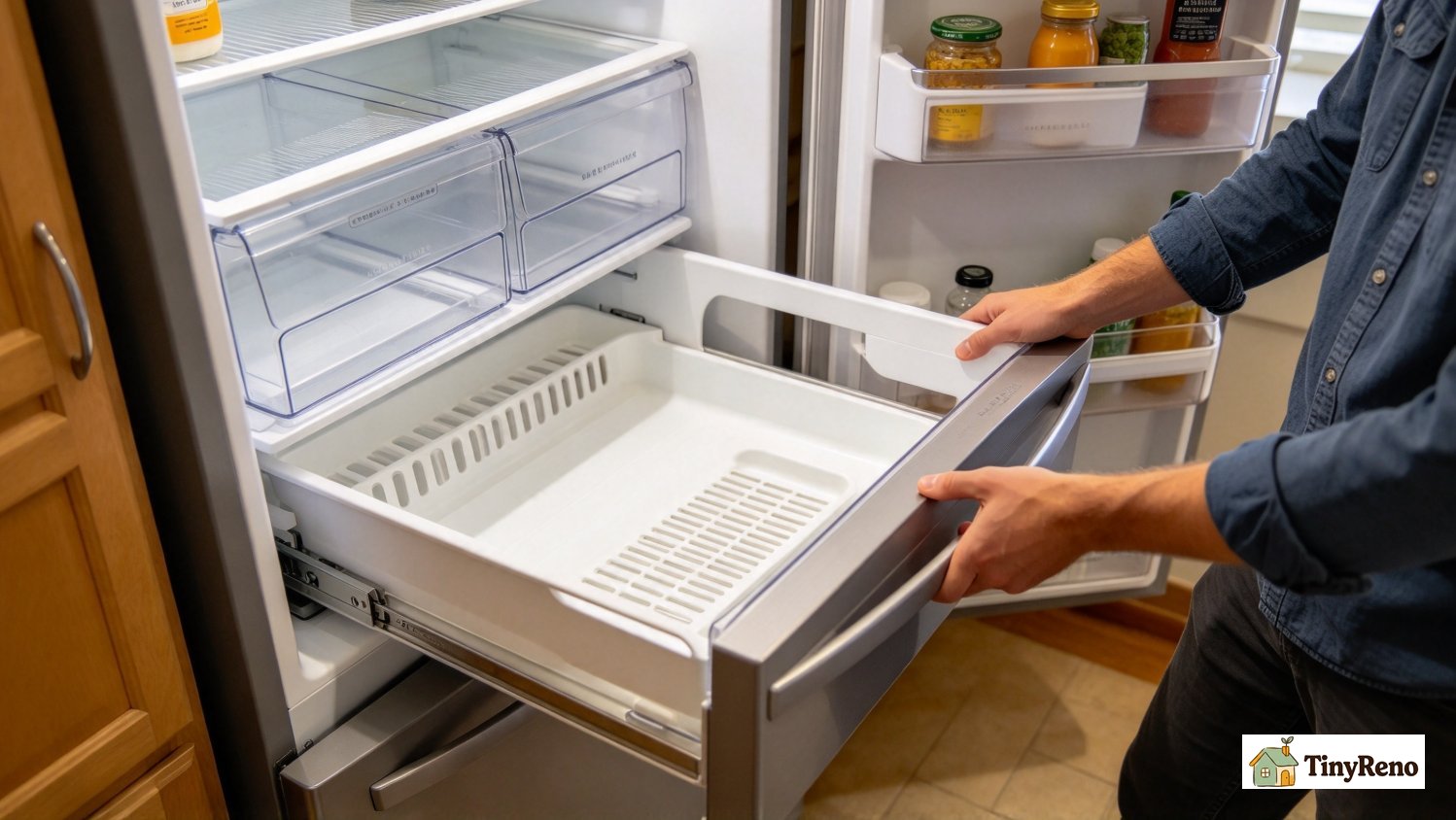
Then locate the defrost drain pan and tube. Check the manual or look near the compressor; on many models the pan is at the bottom or rear, not behind the crisper drawer. If the pan is accessible, wipe it out and clear any debris from the tube. Make sure the pan sits where the manufacturer intended, and check that the tube is not kinked or blocked. I have seen misaligned pans and clogged tubes in more than one rental, but the exact layout depends on the model.
Finally, wipe the coils on the back and underneath if you can reach them without pulling the appliance out, and put a small tray of dry baking soda in the back corner on the lowest shelf. Replace the baking soda every three months, and throw it out when the smell starts again rather than waiting, because it works by absorbing slowly and a saturated box stops working exactly when you need it. I buy a large box of the cheap kind rather than a small branded one, and the cheap one is not a worse product, it is simply a different size of the same thing.
Whose problem it is, and what to write down
Here is the part that decides how much time and money you spend. It depends entirely on who owns the appliance, and you can usually answer this in one minute by looking at your lease and your move-in paperwork, and I wish I had done that before I threw away forty dollars of food. The ownership question decides everything else, so it is worth the minute it takes.
If the fridge came with the apartment, it is the landlord's appliance, and the landlord is responsible for repairing it. Report it in writing, describe the smell, and give a date. If you brought the fridge yourself, then it is your appliance and the landlord owes you nothing about it, and you should work through the cleaning steps above and, if the smell persists, look up a repairer or an engineer. The confusing middle case is a fridge that was in the apartment when you moved in and that the lease does not mention, and the right move there is still to report it, because you do not know and the landlord does. Describe what you observed and ask who is handling it, rather than making a claim you cannot back up.
What to write is short. Four things: the date, the appliance and where it is in the kitchen, a description of the smell in ordinary words, and what you have already done. That last part matters more than people expect, because a landlord whose first response is that you have not cleaned it is a landlord you have to argue with, and a landlord who receives a note that says you emptied the whole unit, washed the removable parts, cleaned the drain pan, left the door open for a day, and the smell is still there is a landlord who has nothing left to say. Keep the receipt for anything you buy. That is all the documentation you need, and it takes four minutes to write.
And take a photograph, which sounds like an odd thing to photograph until you have needed it. A phone picture of the open empty fridge, dated, with the pan pulled forward, is a document that shows a clean unit, and it is worth more than a paragraph of description because it cannot be argued with. In my second apartment the landlord sent someone within a day of getting a photograph and a note. In my first apartment I sent three emails with no photographs and heard nothing for a month.

Keeping it from coming back
Almost every recurrence I have seen traces back to one of three things, and all three are free or nearly free to fix. The first is the drain pan drifting out of position, which I have now watched happen in four separate kitchens and which is the reason my list above ends with a sentence about seating the pan at the front of its slot. The second is the door seal, which is the only permanently damp warm surface in the appliance and which most people wipe once a year if they wipe it at all. The third is the defrost tube, and the good news about that one is that if the pan is seated correctly and the back of the unit is reasonably clear, most of the debris never gets there in the first place.
There is also a fourth thing worth knowing, which is that a fridge works harder and smells worse when it is packed solid with no air moving between the items. A fridge full to the door cannot circulate cold air properly, which means it works more, which means the compressor runs longer, which means the warm parts of the appliance are warm for longer, and the whole environment that breeds the smell stays favourable. I am not telling anyone to leave their fridge half empty. I am saying that a fridge with a little space in it is not only cheaper to run but also easier to keep clean, because you can see the surfaces.
And this is the part that connects back to where this all started for me, because the third rental I moved into had a fridge that smelled faintly of fish on the day I arrived, and I did not want to deal with it because I had spent an entire weekend on the previous one. I opened the crisper drawer, pulled the pan forward, wiped it, and it was gone in about ten minutes. Four years and three kitchens later, that is the whole of what I would tell anyone who asks me about a smelly fridge: pull the pan out first, because it is the one thing nobody thinks to look at, and it is the one thing that fixes most of it.


Discussion (0)
Sign in to join the discussion