

Power strip safety in a rental apartment is not really about electricity. It is about a specific line on your lease that you have probably never read, and about a device you bought yourself, and about who pays when it goes wrong. I learned this the worst possible way, on a January evening, when I plugged a space heater into a power strip I had bought in a store that autumn, and ten minutes later the plug was hot enough that I could not keep my hand on it.
Nothing caught fire. That was luck, and the margin was smaller than I understood at the time. The heater was drawing close to 1,500 watts, the strip was rated for the 15 amps that my old building's circuit allowed, and the plug and the strip were both warming up because the current was flowing through more connections than the strip's thin cord gauge and flimsy contacts were built for.
So the framework I use now has three parts, and none of them are really about which brand to buy. The first is what a power strip actually does to a circuit, because most people do not know and that is where the mistakes come from. The second is the short list of things that never go on one. The third is the part I had ignored completely, which is that the strip is yours, and the electrical system it plugs into is not.
What a power strip actually does, and what it does not
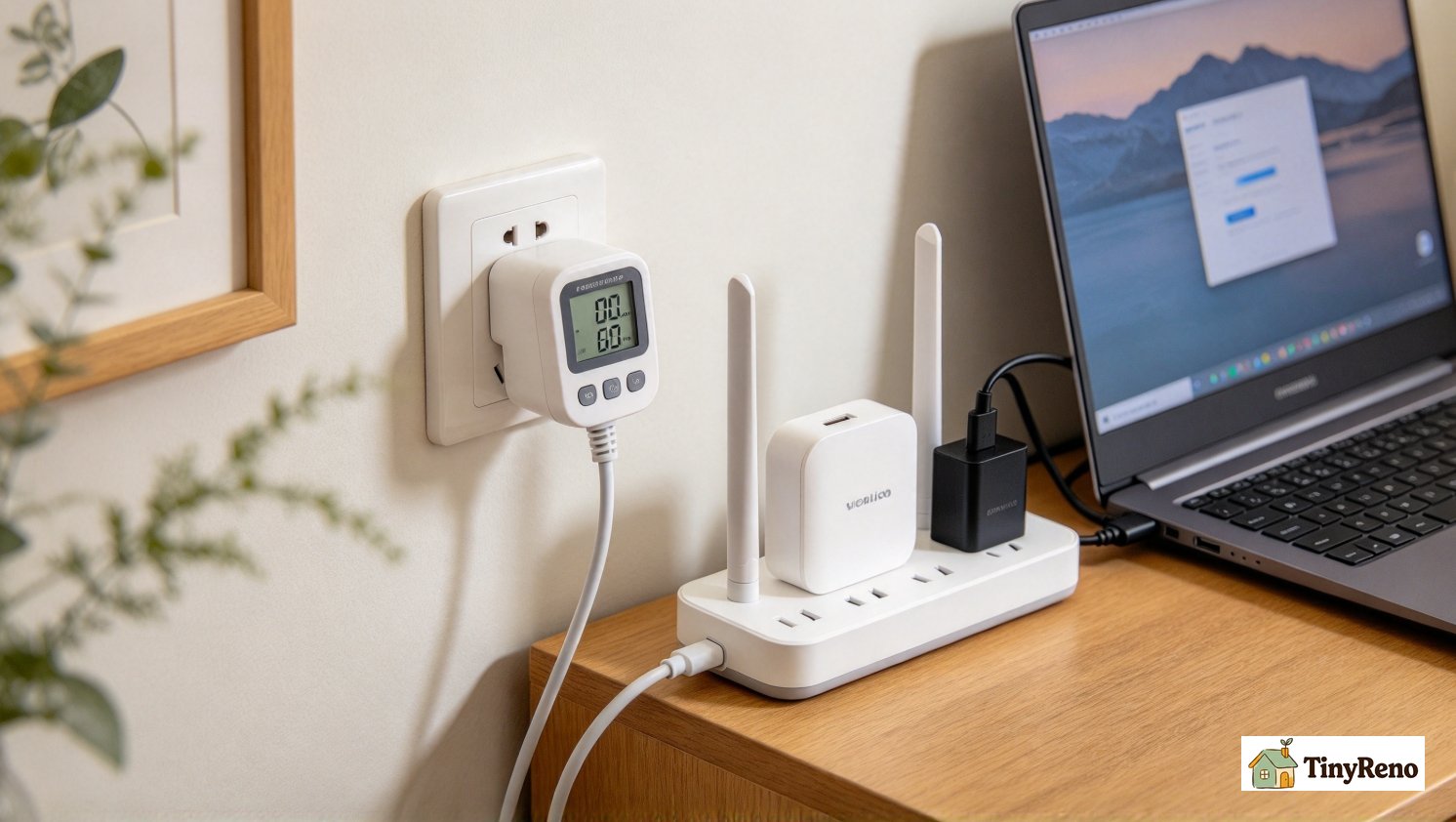
A power strip is a box with five or six outlets in it and one cord that runs back to a plug. When you plug it into a wall outlet, the wall outlet stops feeding one device and starts feeding the strip, and the strip feeds the devices. That sounds like a neutral description, but the consequence is the part people miss: everything you plug into the strip is now drawing from the same 15-amp circuit that the outlet was on, and the strip's internal wiring is now part of that path.
Here is the arithmetic that changed how I think about it. A standard residential circuit in the United States is 15 amps at 120 volts, which is 1,800 watts for the whole circuit. That is the total budget for the outlet, the strip, and everything plugged into the strip combined. Now take a kettle at 1,500 watts, a laptop at 60 watts, and a space heater at 1,400 watts. Together that is nearly 3,000 watts, which is almost double the budget. The strip does not add capacity. There is no capacity to add. It is a distribution point on a fixed budget, and the budget was set by the wiring in the wall, not by what you plug into it.
Now the second thing the strip does not do, which is the one the "surge" in surge protector confuses people about. A surge protector contains a small component, usually a metal oxide varistor, that clamps a voltage spike and diverts it to ground. That is genuinely useful for a specific event, such as the building's main breaker being thrown or a lightning-induced spike, and it will save your electronics from that. It does nothing at all about overload, and it does not increase your circuit's capacity. A surge protector is not a heavier-duty power strip. It is a power strip with one extra protective component, and the two are otherwise the same box.
The dangerous misreading is that people assume a surge protector is a more serious piece of equipment and therefore a safer place to plug a heater. It is not. The heater current goes through exactly the same internal bus, and the extra component sits on the line but carries no meaningful load.
The three rules that matter most
This is the part of the advice I would put on a poster, because it is short and it prevents most of the bad outcomes:
- Space heaters, hair dryers, toaster ovens, kettles, anything with a heating element. Never a space heater, never a hair dryer, never a toaster oven, never a kettle, never anything with a heating element in it. These are high-draw devices and they belong in a wall outlet directly. The reason is not only that they can trip a breaker, it is that when a high load runs through a strip's internal connections, those connections are the weakest link in the chain. A properly certified strip is rated for its stated load, but cheap strips cut corners on cord gauge and contact spring tension, and the weak point is exactly where a heater's continuous draw generates heat.
- Never plug a power strip into another power strip, and never plug one into an extension cord. This one surprises people, because it seems like a reasonable way to get more reach. It is the single most common cause of the melted outlets and scorched wall boxes I have seen in shared apartments, and the mechanism is simple: when you chain them, the current passes through every plug and every joint in the chain, and each of those is a place that can generate heat. A strip plugged directly into a wall has one such joint. Two chained strips have added joints at every connection, each one a potential hot spot.
- Never run a strip under a rug, behind a couch, or anywhere it cannot be seen and cannot get air. Heat needs somewhere to go, and a strip that cannot dissipate heat is a strip that cooks itself. This applies to the extension cord too, and it is the reason people who have had a strip fail usually did not know it was failing, because they had put it exactly where they could not see it.
How to read a plug that is warming up
You do not need tools to identify most of these problems. The most obvious sign is heat that is clearly hotter than normal through the plug body or faceplate. A slight warmth can be normal; a plug that is uncomfortable to touch, discolored, or smells hot is not. The next tier is visual: scorch marks, brown or black discoloration around the plug prongs or around the outlet slots, a faceplate that has yellowed or darkened, or a strip whose plastic near one outlet has gone soft or bubbled. And then there is smell, which is the one that should make you act immediately rather than think about it. Burnt plastic and hot electrical insulation both smell, and people often describe it as fishy, which sounds like a strange thing to say about a plug but I promise you will recognize it.
There is a fourth category, which is not damage but a sign that the connection is loose. A plug that will not seat fully, that you have to wiggle, or that feels loose in the outlet, is a plug with a high-resistance connection. High resistance means heat. That is the whole physics of it, and it is also why a plug that barely fits is a problem even when nothing is burnt yet.
When you find any of these, stop using the device and that outlet. Unplug it and do not tape it, ignore it, or keep swapping strips until it seems fine. The cause could be the appliance plug, the power strip, a loose connection at the outlet, or the wiring behind the wall. If the outlet or faceplate is discolored, hot, or smells burnt, report it to the landlord and ask for an electrician to inspect it. Fixed wiring and outlets are usually the landlord’s maintenance responsibility, but the exact rule depends on your lease and local law. If you replace the strip yourself, you have removed the evidence and the heat source has quietly moved into the wall.
What you can actually do about not having enough outlets
Most people end up here because they have two outlets in a room and six things that need power. Let me separate the things you can do from the things you cannot.
You can add a strip for low-draw devices. Laptops, phone chargers, lamps, a monitor, a router. These are the loads a strip is designed for, and a few of them together will not come close to the circuit limit. If you buy anything, buy a strip with a built-in breaker, a UL listing on the label, and a cord gauge that matches its rating. The flimsiest thing on the shelf is where the internal contacts are weakest.
You can buy a plug-in ammeter, which is a small device that sits between the strip and the wall and shows you what the circuit is drawing. This is the single most useful purchase I have made in this area and it costs very little. It turns an invisible risk into a number, and once you can see the number, you stop guessing. In my case it showed that the heater was drawing 1,420 watts on a circuit that already had the kettle on it.
What you cannot do is add fixed wiring, or run a new circuit, or hardwire anything, and that is the landlord's job. If you genuinely need more outlets in a room, the correct move is to ask. A landlord who receives a clear request, in writing, to add a couple of properly installed outlets is a much easier conversation than a landlord who finds a scorched faceplate and a tenant with a power strip in a closet. And you should keep the request, because the answer establishes that you asked before there was a problem, which is the part that matters later.
The question you should ask your landlord instead
Here is where I would put this whole topic in a single sentence, and it is not about strips. It is about the fact that the moment you buy the strip, the strip is yours, and the wiring is not.
In many US states, a fire caused by a power strip you bought and overloaded with a high-draw appliance may be treated as your responsibility, depending on the lease, negligence rules, insurance, and product liability. The landlord may have had no involvement in the device or the load. At the same time, if the fault is in the building’s fixed wiring, a damaged outlet, an undersized breaker, or aging cable, that is generally the landlord’s maintenance issue. The practical line is: the device you bought and the load you chose are usually your responsibility; the fixed wiring and outlet are usually the landlord’s.
That is not a reason to live with bad wiring. It is a reason to make the request early, in writing, and to let the landlord's electrician do the work. I have now sent that email three times across three apartments, and twice it was answered the same week, and once nothing happened, and in that last case I moved at the end of the year. The point is that the email costs nothing and it is the document that makes the difference between a maintenance request and an accident you are explaining to an insurance company.


Discussion (0)
Sign in to join the discussion