

The Wool vs. Cotton Sock Comparison in a Cold Apartment apartment is one I ran badly at first, because for the first two weeks I only wore wool and assumed the whole question was settled. Then I ran out of wool, put on a pair of plain cotton ones on a Tuesday, and my feet felt worse in a room that had not changed temperature at all. That is what made it worth writing down, because the reasoning behind the result is not what I expected and it changed how I buy socks for a small apartment.
The short version: the two materials behave differently once moisture is involved, and your feet produce moisture even in a cold room. Wool can absorb moisture while still feeling relatively dry and can help keep a layer of still air near the skin. Cotton absorbs and holds moisture, and a damp layer against the foot conducts heat away faster than a dry layer. The surprising part is that this only becomes obvious on a long cold day, which is exactly the day it matters.
So this is the comparison as I actually tested it, in the same apartment, over three weeks, in the same shoes, and with the same mistakes. I have also included the part that made the difference in practice, which is not the fibre at all, it is what you can dry in a rental.
How I actually tested them, and what I got wrong first
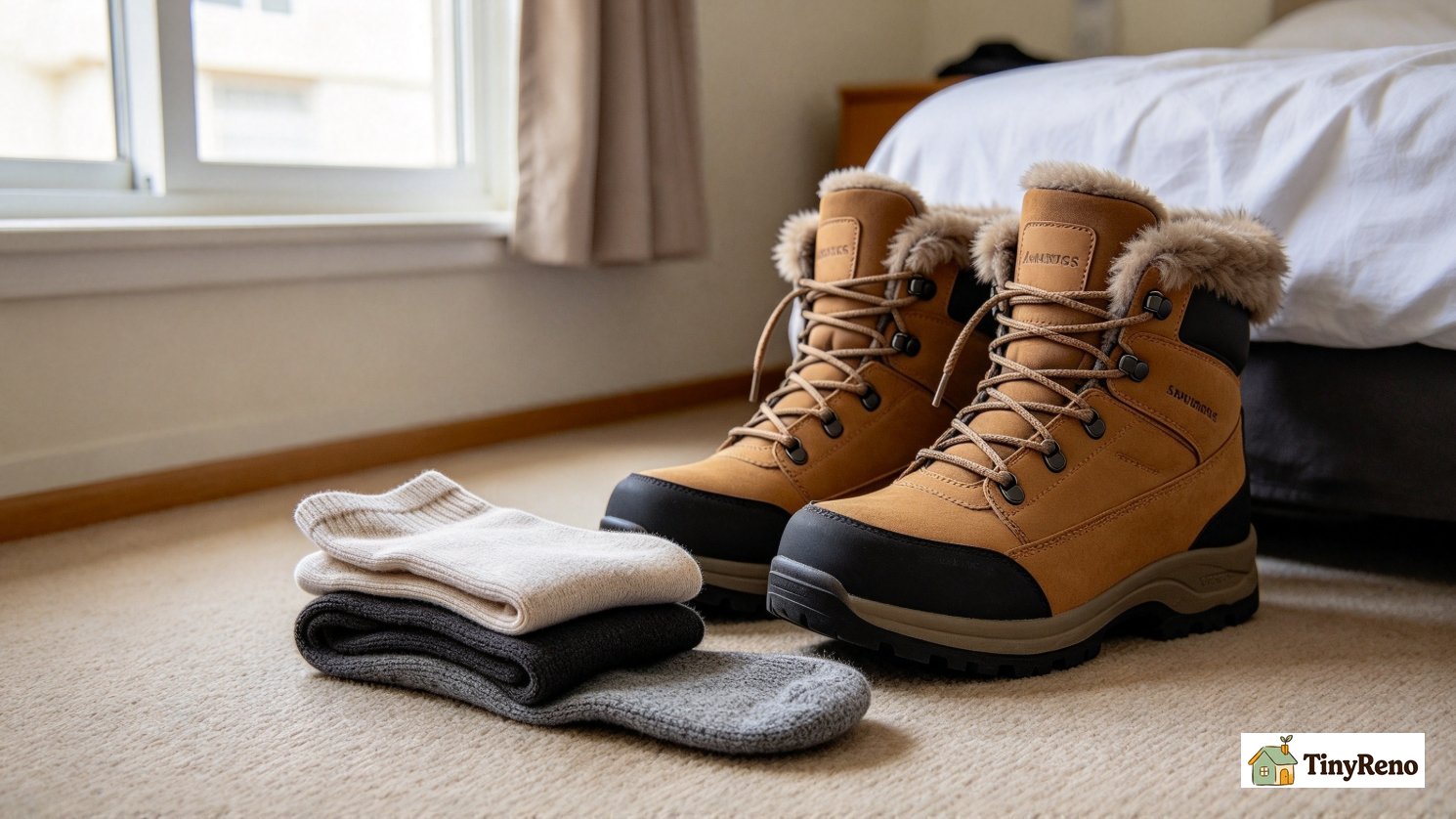
My first attempt was useless. I wore wool for two weeks, felt good, and then swapped to cotton for a day and concluded cotton was worse. That comparison had three problems, all of which are worth naming because they are the same problems people make when they read sock reviews:
- I changed the fibre and the weather at the same time. A cold Tuesday in December is not a fair test against a mild one in January.
- I did not control for how damp my feet were, which turns out to be the entire mechanism, so ignoring it meant I was measuring the weather and calling it the fibre.
- I only wore each pair for a day at a time, which is not long enough to see what happens after a sock has been worn for a full day and then left damp in a boot.
What I did properly the second time was much less impressive but much more useful. Same apartment, same boots, same two-week window, alternating days rather than changing in one jump. I kept a note of three things every morning: how my feet felt getting out of bed, whether the socks were still damp when I took them off, and how long they took to dry on the radiator. Those three numbers turned out to be the whole article.
The mechanism: it is moisture, not fibre thickness
Here is the part that took me the longest to accept, and it is worth getting right because it changes what you should look for in a shop.
Think about what happens to a sock on a foot over eight hours. Your feet sweat, and they sweat more than most people expect, because sweat is the body's cooling system and it does not switch off just because you are cold. A cotton sock absorbs that moisture into its fibres, and it stays there. A damp layer held against your skin conducts heat away from you, and it does it far more effectively than the same sock dry, because water moves heat far better than trapped air does.
Wool does something different with the same moisture. Wool fibres can absorb a large amount of water while still feeling dry to the touch, and the structure of the yarn traps a layer of still air against your skin that does not get pushed out. So the wool sock is not drier, it is just that the moisture is not sitting on your skin as a cold conducting layer.
That is also why thickness on its own is misleading. A very thick cotton sock is a very thick damp layer once your foot has been in it for a while. This is why the comparison in a real test comes out further apart than a shop-floor comparison does, because a shop floor has no eight hours of sweat in it.
What the three weeks actually showed
Three findings, in the order they mattered:
- On a dry morning, in a heated apartment, the difference was small enough that I could not tell them apart. The cotton pair was not cold, it was fine. The gap opened on days when the apartment was genuinely cold, and the gap was not subtle. On the coldest days the wool pair was the difference between feet I could warm up in a few minutes and feet that stayed cold through dinner.
- Both socks were damp after eight hours, but wool dried faster and smelled less. I expected the cotton socks to be damp and the wool ones to be fine. Both were damp. The difference was that the wool pair dried in roughly half the time on the radiator, and it dried without developing that smell that I had assumed was a wool problem rather than a damp problem. That distinction turned out to be the most useful thing in the whole test.
- Wool socks can change how boots fit. A wool sock often has more loft than a cotton sock of the same nominal size, so a boot that was snug with cotton can feel tight with wool. I had a painful toe that month from new boots plus thick socks, which is a bad way to learn this. If you switch from thin cotton to thicker wool, try a thinner wool sock or check the boot fit.
Two pairs beat one thick pair, and this is not a wool thing
Somewhere between the third week of wearing wool and the point where I stopped noticing which pair I had on, I stopped wearing one pair at all. I wear a thin cotton or merino pair next to my skin and the wool pair over the top.
The logic is the same as wearing base layers under a sweater, and it works with any fibre combination. The inner thin layer moves moisture off your skin before it becomes a cold conducting film, and the outer layer traps the air that the inner layer dried your foot enough to let you keep. Two thin pairs ended up warmer than one thick pair in every test I ran, and they dried faster, which in an apartment with one radiator is not a small thing.
There is a second reason to wear two pairs, and it is about how long they take to dry. A single thick pair takes the whole night to dry properly. Two thin pairs can be split, with one drying while you wear the other, which means you never put on a sock that is still damp from yesterday. For anyone whose socks live on a radiator in a small apartment, that rotation is worth more than the fibre difference is.
The part that actually decided it: what you can dry in a rental
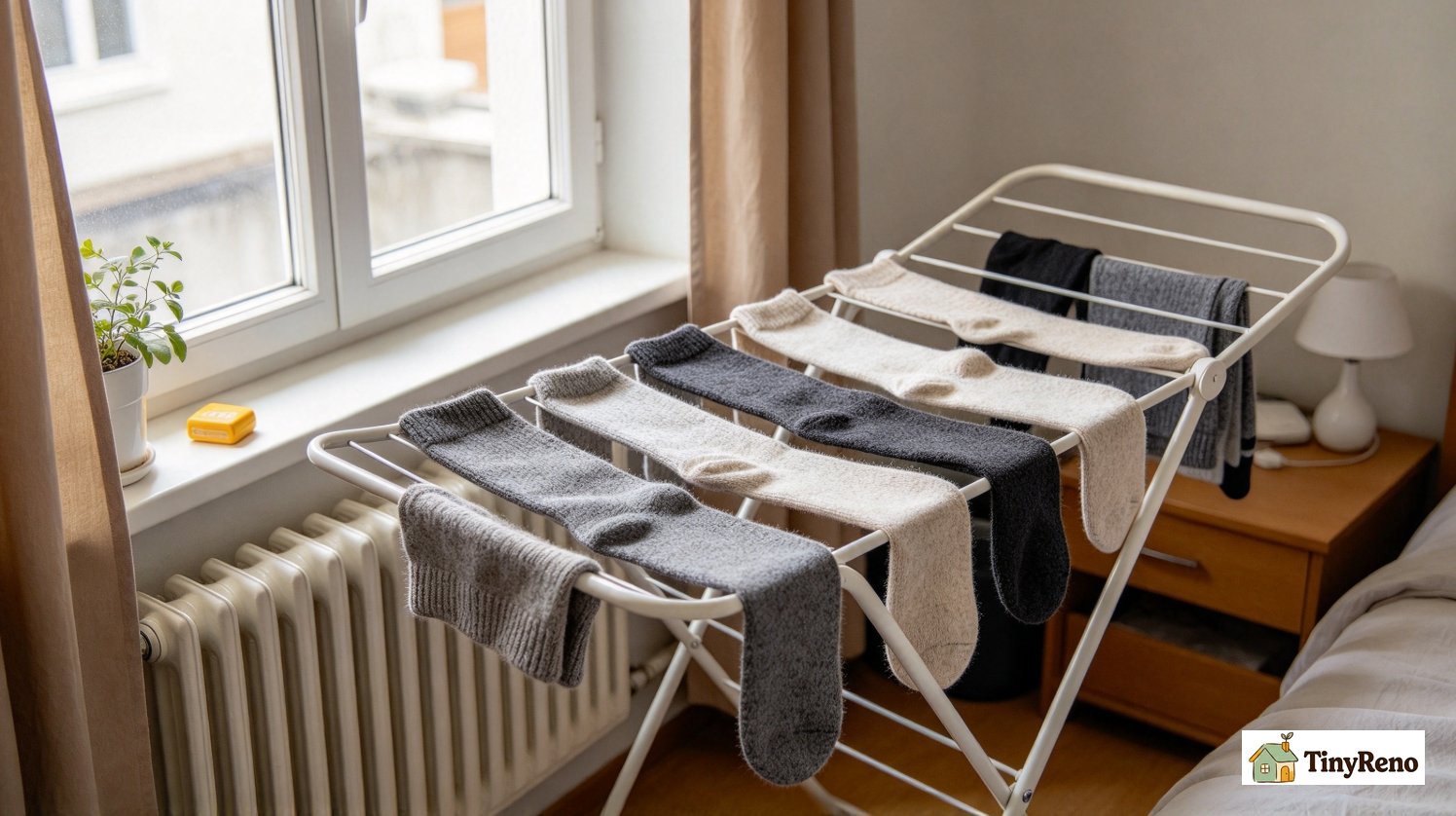
Here is the part that makes this a rental question rather than a materials question, and it is the part I would put first if I were buying socks for an apartment again.
People often say wool socks smell. That can be true, but it is usually a washing and drying issue rather than wool itself. Odor comes from bacteria breaking down sweat in a damp fibre. Leaving a damp sock in a hot, poorly ventilated place, such as on a radiator overnight, can make it worse. A sock dried flat with air moving across it usually smells less.
The routine that helps takes about a minute. Turn the socks inside out, because that is where sweat collects. Wash them cool, around 30°C, on a gentle cycle. Heat and agitation can damage wool and make odor worse. Dry them flat on a rack with air moving across them. Avoid a hot dryer. A short time on a radiator may speed drying, but do not leave them damp and hot overnight.
The constraint is the small apartment. If your socks take a full day to dry, you will end up washing them less often than you should, and a damp sock sitting in a laundry bag or a boot for a day is the actual source of the smell. So the practical advice is to own fewer pairs and rotate them properly rather than owning many and wearing the same three in rotation until they are damp every single day. Five pairs worn properly outlasts ten pairs worn in a cycle, and that is the whole argument in one line.
Where wool is not worth it
I would rather say this than have you spend money on a pair of expensive socks that solve a problem you do not have.
If your apartment has wall-to-wall carpet, working central heating, and feet that are not cold in bed, a decent cotton pair may be fine. You may not need to spend more on wool. The wool advantage in this comparison is mostly about long cold days in an apartment that is not properly heated, and about damp feet. If neither describes your situation, buy the cheaper socks.
Also, if your feet are cold when you get into bed, socks will not fix that. A cold mattress is the problem, and the answer is more bedding or a warmer setup above the mattress, not a different fibre. That is the same point I made in an earlier piece about wearing layers in a cold apartment: the torso and the bed are where the heat goes, and the socks are the smallest part of the question.
Wool is not dramatically warmer when dry. It is more useful when damp, it can dry faster if washed and aired properly, and it costs more. Two pairs of decent wool, rotated while one dries, plus cheap cotton for warmer days, is a reasonable setup.


Discussion (0)
Sign in to join the discussion