

My heating pad safety story starts with an outlet that got too warm. I had run the pad on low for about forty minutes on a cold February night, plugged into an outlet near the head of my bed. When I reached over to turn it off, the plastic faceplate was uncomfortable to touch. Not burning, not smoking, just warmer than it should have been.
I did not know any of this at the time. I had bought the pad at a department store, folded it in half to make it "fit the bed better," and plugged it in. The fold was the problem. So was the outlet choice. So was the fact that I had never once read my lease to see whether personal electric heaters were even permitted. A safety checklist is not something I went looking for. It is something I wish I had, because every single item on it was already true on that night and I could have checked any of them in under a minute.
So here is the list, assembled after six winters of renting, three different buildings, two of them pre-war, and one incident that involved an electrician rather than a landlord. If you are trying to work out heating pad safety for your own apartment, this is the order I would check things in.
Check the lease before you buy, not after
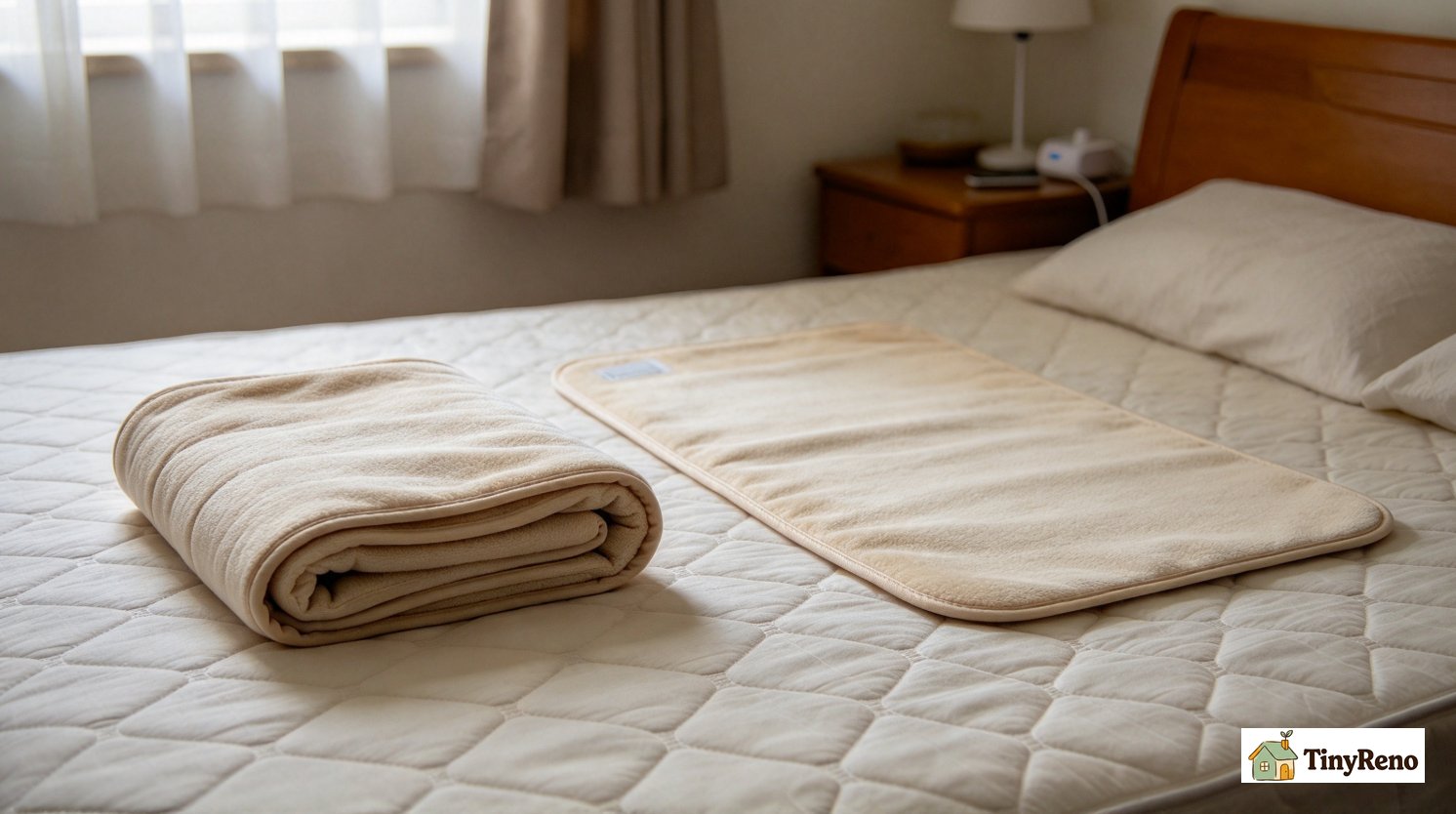
This is the step everyone skips and it costs nothing. Rentals in some buildings forbid personal electric heaters outright, and "heater" language is often drafted broadly enough to catch a pad as well as a fan. Search your lease for heater, appliance, and electrical, then read the actual sentence rather than skimming for the words you expect. A clause that names space heaters specifically is a much narrower ban than a clause that says "any personal heating appliance," and the difference decides whether your pad is fine.
If the wording is genuinely ambiguous, do not guess. Send one email asking the landlord in writing whether a plug-in electric heating pad is permitted, and keep the reply. That converts a later argument into a closed question. Mine came back in about four hours with a yes and a suggestion to keep it off the carpet, which I now do.
What you are not asking about is permission to own the thing. A heating pad is an ordinary movable appliance, not a fixture. Landlords generally cannot stop you from owning a kettle. The question that actually matters is narrower and more practical: can you use it, on which outlets, and at what draw.
Understand what your pad actually pulls
Wattage is where the renter-specific reasoning kicks in, because it is not about how warm the pad gets. It is about whether the circuit behind your wall can take it. Most pads draw somewhere between 40 and 60 watts on low and 130 to 180 watts on high, which on its own sounds trivial against a 15-amp residential circuit rated at 1,800 watts. The problem in an older building is rarely the pad by itself. It is everything else already on that same circuit.
In my case, the circuit also fed the kitchen counter, so the pad shared a 15-amp line with a kettle and a toaster. Nothing tripped. But the warm faceplate told me something was wrong. A heating pad alone, at 180 watts, is unlikely to overload a 15-amp circuit. The more likely cause was a loose plug, a worn outlet, or a high-resistance connection inside the wall box. A breaker trip usually means too much total load. A warm faceplate can mean a bad connection, which is a fire hazard even at low wattage. But if the kettle and toaster were running at the same time, the shared circuit load could also have contributed. Either way, a warm outlet is a report-and-stop-using issue, not something to solve by swapping the pad.
Plug the pad directly into a wall outlet, not into a power strip or extension cord. A heating pad runs for long stretches, and strip contacts can heat up under continuous draw. If you do not know which outlets share a circuit, you can map them by turning off one breaker at a time and noting what goes dark. Do this only if you are comfortable opening the panel door and flipping the switch. Do not touch any wiring inside the panel, do not do it with wet hands, and if you are unsure, ask the landlord or an electrician. And remember that a 15-amp circuit should not be run at its full 1,800 watts for long — the convention is to design for about 80 percent, so around 1,440 watts of continuous load is the realistic ceiling.
Never fold it, and never store it folded
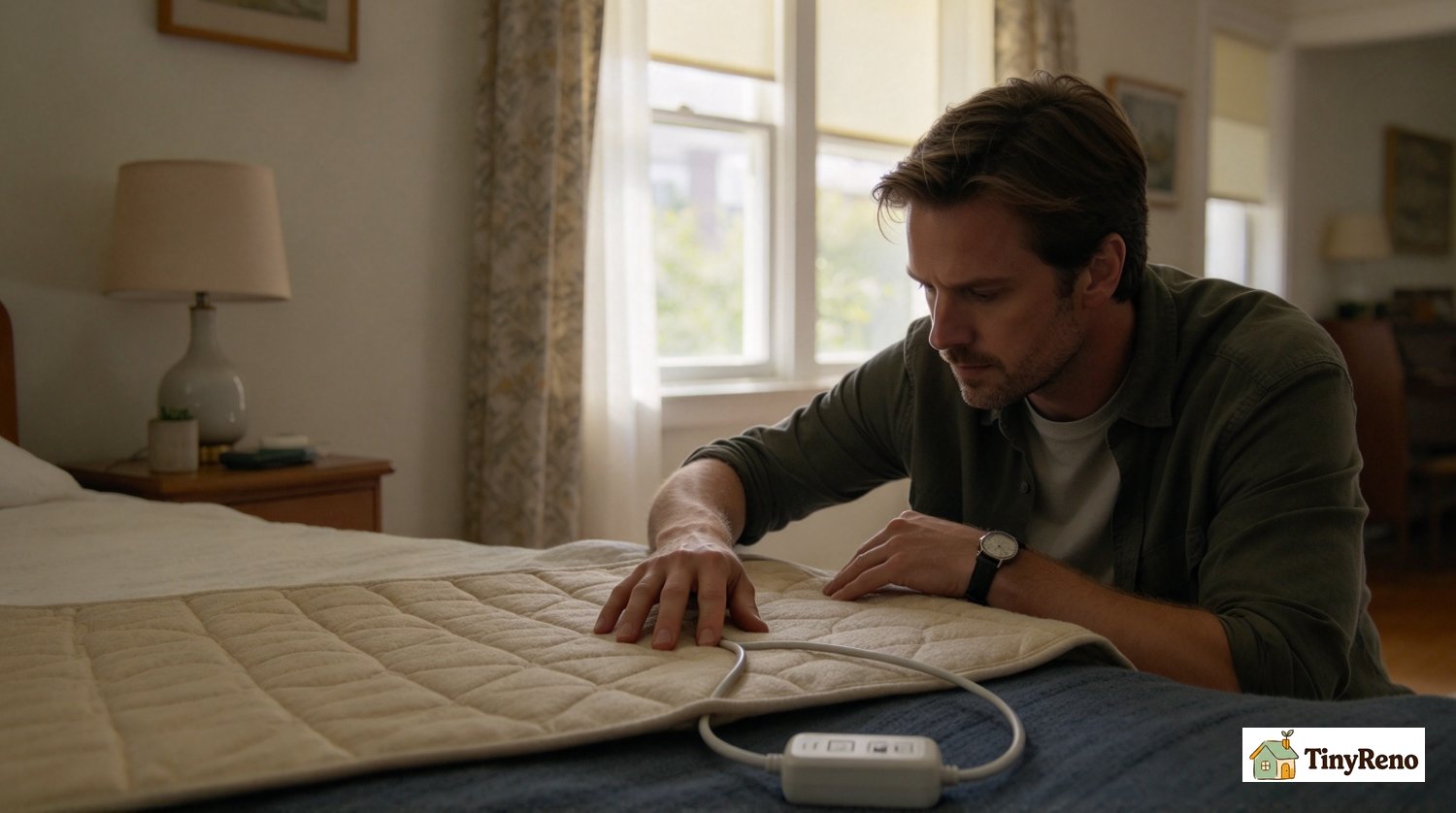
This is the single most important mechanical fact about these things, and it is also the one that caused my warm outlet. A folded pad creates a thick double layer in the middle. The heating element in that area has no fabric above it to move heat away and no gap for air to circulate, so the temperature at the fold climbs well past what the thermostat intended. Most modern pads have an NTC sensor that cuts power if the local temperature gets too high, but a fold that creates a gradual, uneven hot spot rather than a sudden spike can slip past that protection, especially on an older pad.
The failure is gradual rather than dramatic. The pad does not catch fire from a single fold. It gets a little hotter each session, the fabric in the folded band slowly scorches, and the smell eventually reaches you as a faint chemical sweetness rather than as smoke. Which is exactly why it goes unnoticed, because you are asleep and the pad is under a blanket insulating the heat even further.
So: flat when in use, rolled or loosely folded when stored, and never creased hard along a seam. If you have one of the older pads where the controller snaps into a pocket, make sure the pocket edge is not folded over itself. That is the same problem in a smaller area. Every conversation I have had with friends about heating pad safety eventually arrives at this point, and it is the one that prevents fires rather than merely reducing them.
The timer is the safety feature, so use it
Modern pads have an automatic shutoff, typically 30, 60, 90, or 120 minutes. Buy one that has it, and set it before you lie down rather than when you get comfortable. The reason to use the timer is not that you are forgetful. It is that you are asleep, and an asleep person does not smell a scorched cover, does not feel a slowly rising temperature, and does not wake up in time to pull a plug.
Which leads to the advice I feel strongest about. Do not sleep with the pad under your body weight. Waking up on a warm pad is fine and is what they are for. Sleeping on one means your body weight presses the pad against the mattress, which is a compression of exactly the kind that concentrates heat, and it means you cannot respond to the first warning signs. The standard safe routine is to use it to warm the bed for ten to twenty minutes before you get in, then turn it off and leave it at the foot of the bed or take it off. If you do use one while sleeping, use one with a firm auto-shutoff, on the lowest setting, and never under your body rather than beside you.
There is a version of this that skips all of this by simply buying a pad you can run at its lowest setting for a fixed short window and then forget about. That is what I do now. Low setting, timer set to 30 minutes, bed pre-warmed, pad switched off while I sleep. The pad lasts longer, my electricity use is unmeasurable, and nothing in the room can reach a temperature I am not awake to notice.
One group I want to call out specifically, because it is the part of the warning label people skip: heating pads are not recommended for infants, young children, elderly people, or anyone with diabetes, reduced sensation, nerve damage, or a skin condition that blunts temperature awareness. If you cannot feel that the pad is too hot, you cannot self-regulate, and the timer becomes your only safety. That is not a scare story, it is on the warning label of every consumer pad sold, and it is the reason people in those groups should use a pad to warm the bed rather than wear it.
Clear the surface and check the cord
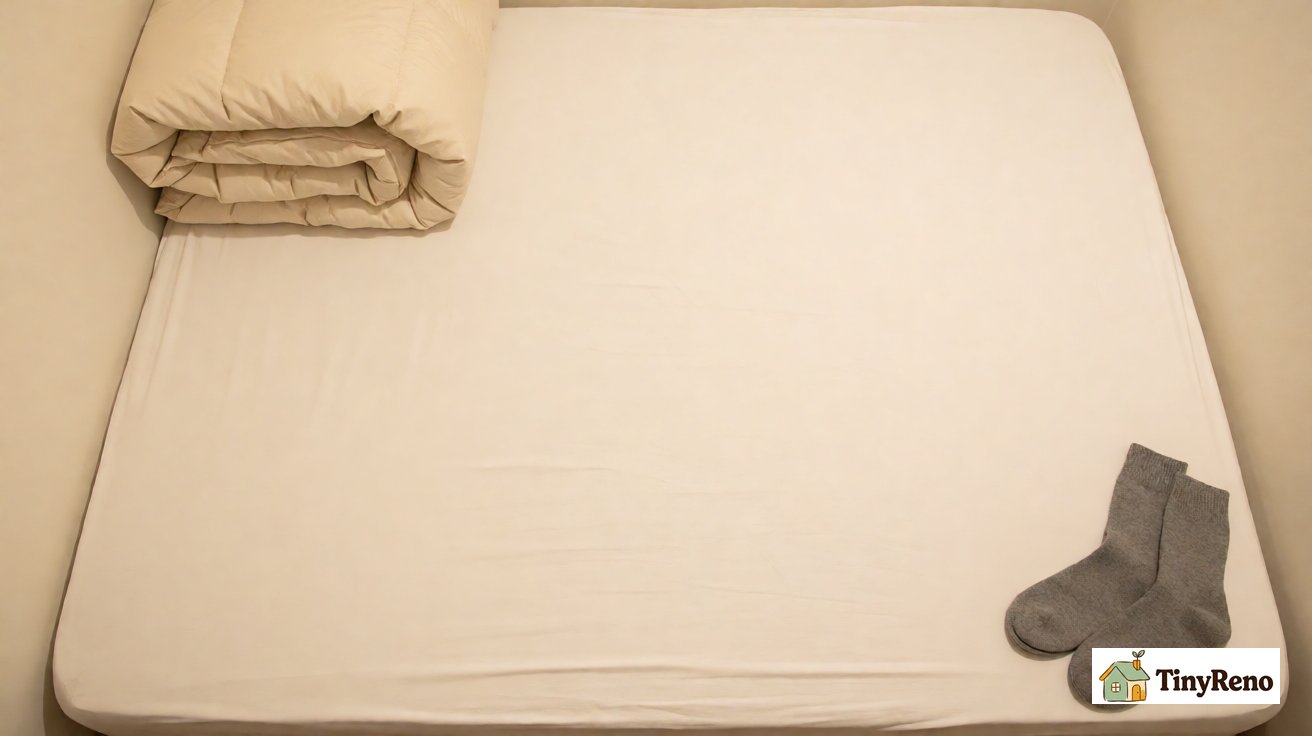
Fabric against fabric is the other mechanism, and it is the one that shows up most in rental settings because of how people actually sleep. A pad on a mattress with a fitted sheet is fine. A pad under a heavy comforter, a fleece blanket, or a pile of clothing to warm a specific patch of the bed is a different situation, because all of that insulation sits on the side that is supposed to shed heat. Heat that cannot leave the pad stays in the pad.
Run your hand along the cord and the pad itself before each use. Look for a stiff section, a kink, a place where the cable meets the controller and the insulation looks stretched or cracked, or a spot on the pad that feels different in temperature from the rest when you plug it in briefly. Any of those means stop using it. The failure mode of a damaged heating wire is a local hot spot, and a local hot spot is precisely the thing that starts a fire without any involvement from folding or overheat protection.
Keep the pad away from the edge of the mattress and away from any radiator or baseboard heater. It does not belong in a pile with laundry on the floor either, even for ten minutes while you fold clothes, which I have certainly done and which is a habit I would not recommend repeating.
What it costs, and why that is not the deciding factor
A pad at low setting runs roughly 40 to 60 watts. A small fan-forced space heater runs 500 to 1,500 watts. If both are running for the same hour, the difference in electricity is real but modest in absolute terms, and I am aware that arguing kilowatt-hours at midnight is not the persuasive angle. The stronger reason to prefer the pad is control: it heats one spot you choose rather than the entire room, which means you can turn it off the moment you are warm instead of waiting for a thermostat to react and overshoot.
There is a real caveat, and it is the one that surprised me. A pad warms surface temperature quickly and has almost no effect on air temperature. If your actual problem is a cold room rather than a cold bed, a pad will make your bed comfortable while leaving the rest of the apartment as cold as it was. People expect it to heat the room and then conclude it is a bad product. It is doing exactly what it is designed to do, and it is just not designed for that job.
The short version: read the lease, plug directly into a wall outlet, keep the pad flat and uncovered, set the timer, do not sleep with it under your body, and check the cord before each use. Also make sure the smoke alarm in the room works. Those steps cost nothing and cover most of the risk. The rest is detail.


Discussion (0)
Sign in to join the discussion