

The decision between a knob thermostat and a smart one in a rental apartment took about a year in my apartment, and almost none of that time was spent choosing. It was spent finding out what was behind the wall. Here is the timeline, including the $140 I wasted.
Bottom line before the details: pull the cover off your wall first, and the choice makes itself.
The starting position was a 1960s radiator thermostat: a knob with numbers, no schedule, no app, and a January heating bill that made me want to look at this properly.
October: I assumed this was a shopping decision
I started the way everyone starts, which is by reading about features. Scheduling, learning algorithms, phone notifications, energy reports. I built a shortlist and I was fairly convinced I wanted the smart one.
What I had not established was whether I could install one, which turned out to be the only question that mattered.
November: the box opened, the wall did not
The thermostat I bought was a low-voltage unit that requires a 24-volt common wire, called a C-wire, to power it constantly. Some low-voltage thermostats can steal a little power from the heating circuit, but not all can, and power stealing can cause problems on some systems.
So I took the cover off the existing thermostat. That was the step I should have taken before buying. The old unit was not a standard 24-volt thermostat. It appeared to be a line-voltage thermostat powered by the heating circuit, and a C-wire is a low-voltage term that did not apply to it. I should have photographed the wiring and asked the landlord or an electrician to identify the system before ordering anything.
Here is the part I would have paid money to know in advance. That original thermostat runs on power from the heating system itself. When the heat turns off, it turns off too. That is why it works at all in a building from 1960 without a transformer, and it is also why it can only do one thing: show you a temperature and wait for you to turn the heat back on.
There was no C-wire to find because the system was not a standard low-voltage setup. A low-voltage wire could be added only with landlord permission and an electrician, and that is not tenant work.
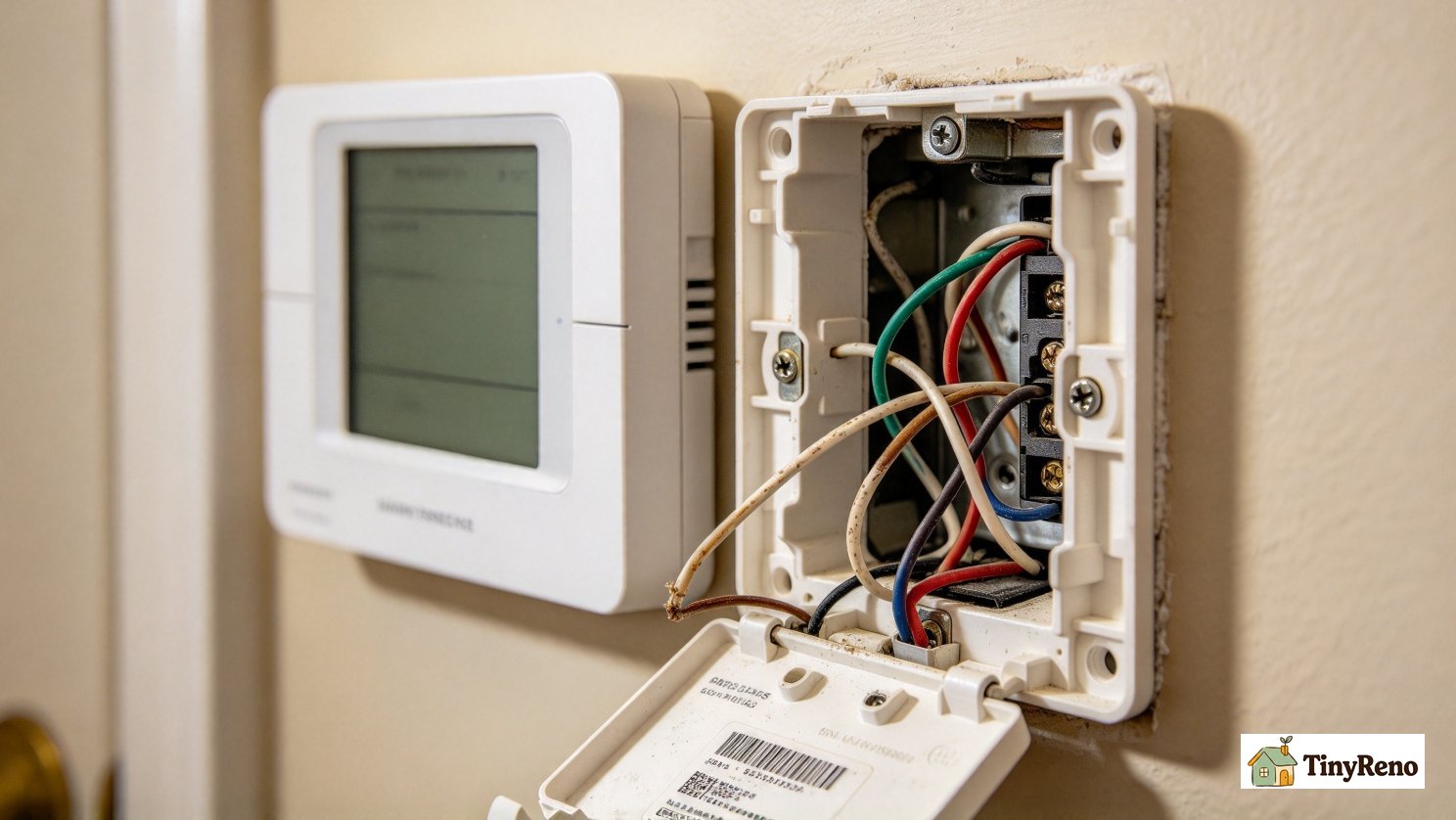
December: the three options that were actually available
Once I understood the wiring, the choice stopped being about features and became three specific paths:
- Option one, keep the knob and change my habits. This is the free option and it is better than most people give it credit for. The knob thermostat is not a bad device, it is a manual device. The number on it does exactly what it says. The entire problem with a knob thermostat is that it forgets everything the moment you leave the room, and the fix is a routine rather than a gadget. Mine is a piece of paper on the fridge. Morning it goes to 68. Everybody out, it goes to 60. Night it goes to 66. Three numbers, three times, no app, no account, no learning curve. In an apartment with a radiator system and an exterior wall, that schedule is worth more than most smart thermostats.
- Option two, a smart thermostat that is actually compatible with the existing system. Some low-voltage thermostats are designed to work without a C-wire, often with a power module or adapter. Not all of them are compatible with line-voltage heating, and not all no-C-wire units work reliably on every system. Check the manufacturer’s compatibility guide, or ask the landlord or an electrician, before buying.
- Option three, ask the landlord to install one. This is the option I did not take and I think I was wrong. Here is what changed my mind, and it has nothing to do with features. The landlord pays the heating bill for the common areas and, in some buildings, has a responsibility for the heat being delivered. A building where every unit has a working thermostat is a building where nobody complains, and a landlord would rather prevent ten complaints than respond to them. I sent one email in January saying the wiring could not support a modern unit and asking whether the building had considered upgrading. I got a reply in two days: the owner had already had three of them installed in other units, and mine was scheduled for the following month at no cost.
January: the cost of doing nothing
While that was pending, I ran the paper schedule for six weeks to see whether it made a difference before anyone installed anything.
Compared with my previous habit of leaving the heat at 70 all day and turning it down at night when I remembered, the paper schedule appeared to cut my heating usage by roughly a fifth during those six weeks. That was not a controlled test; the weather changed, and six weeks is short. The likely reason is simply that the 60-degree daytime setting did most of the work.
The honest version: a smart thermostat does not create the savings. It removes the need to remember. If your memory is fine, the savings are the same without it.
February: it got installed, and then I did not use it
The unit went in for free, properly wired, with the landlord's electrician. It is a good one and it works.
I set it up, connected it, ran the learning cycle, and then I realised within two weeks that I had begun using the paper schedule again instead of the app, because the paper is on the fridge and the app is on my phone and I look at the fridge roughly six times a day.
Which is the honest finding of this entire experiment. The device I was given for free is not the thing that makes my apartment warm. The three numbers on the paper are.
Two things the installed unit does that the paper does not, and both turned out to matter. It tells me what the outdoor temperature is, which makes the daily decision about whether to open the window in April obvious instead of a guess. And it showed me a usage graph, which made one thing obvious: my bedroom runs noticeably colder than my living room at the same setting, so I close that door at night now. I did not know that was a pattern.
March to September: what I would actually tell a renter
All of it, condensed, and in the order I would say it:
- Take the cover off your existing thermostat before you buy anything. Ten minutes, and it decides your entire purchase.
- If there is no C-wire, filter your search to units that explicitly say they work without one. Do not buy first and discover later.
- Run a paper schedule for six weeks before spending money. If the paper schedule does not change your bill, the device will not either.
- Email your landlord. Mine installed one free in under a month, because three other units already had them. It is a cost-spreading argument, not a favour.
- Check the lease before you touch any wiring. Some leases make this explicit and some make it implicit, and the implicit ones are the ones that cost you the security deposit.
- If one room is consistently cold, fix the airflow, close the door, or add a remote sensor. Do not just raise the whole-apartment setpoint to make the cold room comfortable; that overheats the rooms that are already fine.
What it cost, honestly
Total spent by me: $140 on the first smart thermostat. I bought it in November, never installed it, and it is still in a drawer. I should have checked the return window before opening the box.
Total spent by my landlord: a wired install in three units, which is the number that actually matters and I was never going to pay.
Monthly change in heating usage between the old always-on habit and the schedule: about twenty percent. That number came from the paper, not the app.
What I got from the whole fourteen months, stated plainly: a working thermostat I did not have to pay for, one $140 mistake in a drawer, and the discovery that my bedroom is four degrees colder than my living room and always has been.
Bottom line
The comparison comes down to a wiring question before it comes down to anything else, and the wiring question takes ten minutes to answer with a screwdriver and no cost.
If your building has the wire, a smart thermostat is genuinely useful and worth having. If it does not, the device that fits your wall is a limited one, and your best options are a schedule on the fridge or asking the landlord, who in my case did the thing no retailer was going to do for me.
About a year for that answer, $140, and a thermostat I barely touch. The paper on the fridge does most of the work.
The lesson fits into one screwdriver and ten minutes: take the cover off and identify the wiring before you buy anything.


Discussion (0)
Sign in to join the discussion