

Kitchen sink ice buildup in winter is usually not caused by the cold alone. It often starts with a drain that was already slow, and the cold finishes the job.
We cook most nights in a one-bedroom in Chicago, and our double-basin sink drained slowly from about November. I called it a habit. In January, during a stretch where the apartment sat below 40°F for nine days, the left basin froze solid twice, and the second time it split the trap.
The interesting part is the sequence, because the ice was the last thing that happened and it is the only thing everybody warns you about.
What actually happens, in order
- Step one: the drain slows. Not stops. Slows. Two or three weeks of a drain that takes eight seconds instead of two, and you learn to stop noticing. This is where nearly every frozen sink begins, and it is entirely ordinary household behavior, not bad luck.
- Step two: the standing water becomes the problem. A slow drain leaves water in the basin and in the trap. Standing water in an unheated cabinet in a 40°F apartment cools toward freezing, and once it starts forming ice, the ice has nowhere useful to expand into, so it expands into the pipe walls instead.
- Step three: the block forms at the trap. The U-shaped section under the sink is the narrowest point and the furthest from the warm room. That is why it is where it fails, and why it is also the part you can open with a basin wrench and no plumber at all.
- Step four: thawing reveals the damage. This is the part people misread. Ice expands when it freezes, and that expansion can already crack a trap or loosen a joint. When the ice melts, the crack leaks and becomes visible. If the drain is still blocked downstream and water keeps running, pressure can also work on a weakened joint. Our split was most likely caused by freezing expansion, then found when it thawed.
Cost, compared honestly
Four ways people deal with this, with real numbers from our own mistake and what the alternatives would have cost.
- Do nothing until it breaks. Cost: $340. This is what we did, and it is the most expensive option while looking like the cheapest. A plumber's minimum call in Chicago ran $145, plus $195 to replace a cracked chrome trap and the slip joint behind it. If you have already paid the emergency call, the parts are the smaller half. A plumber arriving at the moment of a burst, at 9 p.m. on a Sunday in January, quoted more than $400. The same repair, scheduled calmly on a Wednesday, cost about $340.
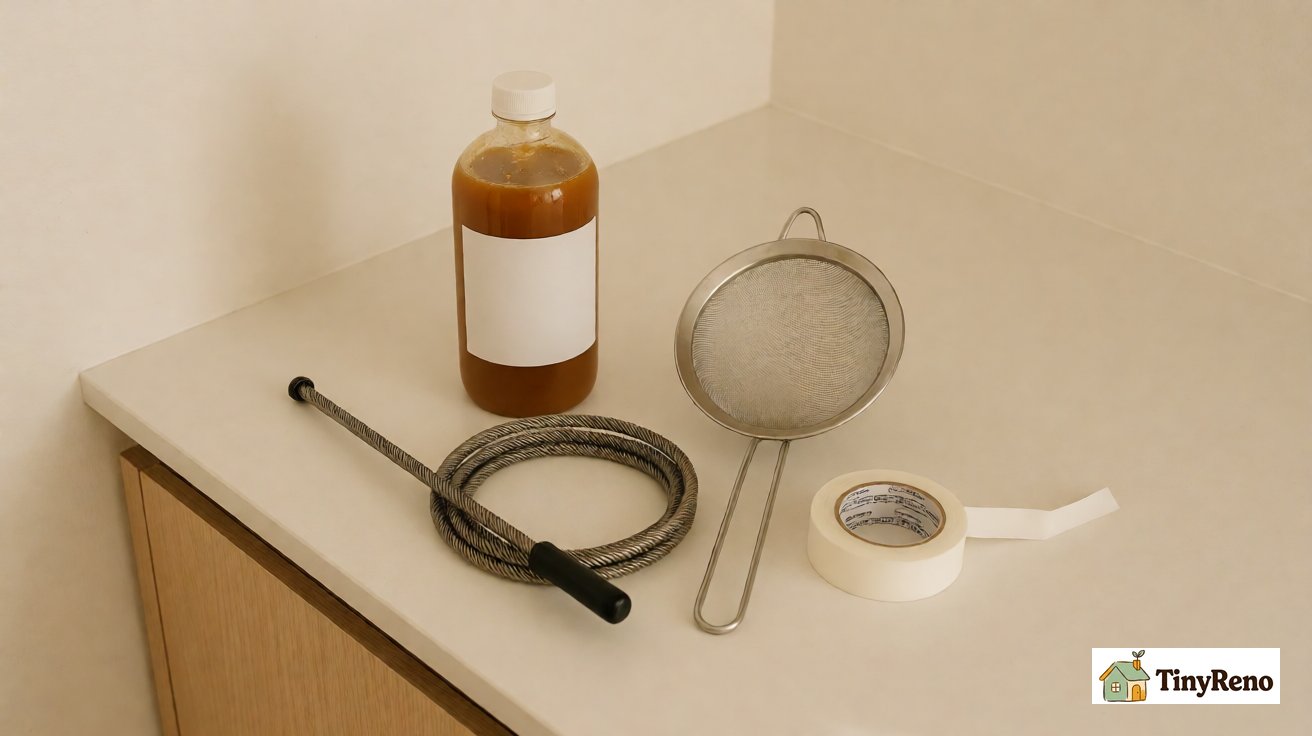
- Catch the slow drain early. Cost: a few dollars and twenty minutes. This is the correct answer. Start with a drain snake or a physical clean-out for hair and food film. Chemical drain cleaner can help with grease, but it can damage older pipes and plastic parts, so use it only if the label and your landlord allow it. Our January repair would have been unnecessary if I had spent twenty minutes in October.
- Add a heat trace cable. Cost: $45 to $120. A heating cable taped along the trap and supply lines can work, but for a renter it is usually not the right first move. It needs power inside or near the cabinet, and plug-in versions add an electrical device in a damp space. Ask the landlord before installing one.
- Leave the cabinet open overnight. Cost: $0. Genuinely useful and nobody recommends it. Leaving the under-sink cabinet door open lets room air reach the pipes. It looks odd and it works. In our apartment the cabinet already had a gap because the baseboard does not meet it, which is likely why our slow drain froze at all while the neighbors did not report the same problem in the same week.
What to open first, in order, with a wrench
This is the sequence that avoids both a plumber and a flooded cabinet:
- Put a shallow basin under the trap, and a towel down first. There will be water in it.
- Loosen the slip nut at the top of the trap with a basin wrench. Counter-clockwise, and it is usually hand-tight plus a quarter turn.
- Pull the U-bend straight down and out. Let it drain into the basin.
- Clear the small debris inside the bend. This is where the actual block usually sits, and it is almost always a paste, not a solid plug.
- Check the sink tailpiece above it while you are there, since you already have the wrench out.
- Reassemble according to the manufacturer’s instructions. Some plastic slip joints do not need PTFE tape, and over-tightening can crack the nut. Hand-tight plus a small turn is usually enough.
If you only take one thing from this list, take the last instruction. Over-tightening a plastic slip joint cracks it a week later when the metal expands, and a cracked slip joint fails slowly and continuously rather than all at once, which is a much worse way to learn this lesson.
What never to do to a frozen pipe
This is the part that should be on the bottle of every drain cleaner but is on nobody's list: do not use an open flame on a frozen pipe. No blowtorch, no lighter held under the sink, no space heater pressed against the cabinet wall. Pipes in apartments are often PVC or flexible supply lines, and a flame can melt them, scorch the cabinet, or start a fire. People do this because they think heat = thaw, and they forget that localized high heat on a frozen section can also split the pipe faster than the freeze did.
The safe way to thaw a visible frozen pipe is a hair dryer on its lowest setting, held a few inches away and moved constantly, or a hot towel wrapped around the section, changed out as it cools. Open the faucet first so the water has somewhere to go as it thaws. This is slow and it works, and it does not involve fire under a sink.
What to stop pouring
Boiling water. This is the standard advice and it is wrong in a way that costs money.
Boiling water on a slow drain clears grease, and it also moves the blockage deeper into the pipe where you cannot reach it, and on older PVC it can warp the joint. Warm water, not boiling, is the safe version. If the drain is slow enough that you are considering boiling water, that is the point where you use the wrench above, not the kettle.
What to send the landlord
Send it in writing, the same day you notice the slow drain, not after it has split. The message is short: the drain under the kitchen sink has been slow for two weeks, I have cleaned the trap, and I want the building plumbing inspected before the weather gets colder. That is it. You are not asking permission, you are documenting that you flagged it.
Be equally clear that calling a plumber on your own dollar is not an admission that it was your fault. We paid for the first repair and sent the receipt, and the reply was thank you for flagging it, we have added it to the building log. Which is the entire reason it is worth sending. In many US states, landlords are required to maintain plumbing in working order, though the exact standard and timeline vary. A written record that you reported a slow drain before it burst is useful if the issue becomes a repair or deposit dispute.
There is a version of this where you close the under-sink shutoff valve and call the landlord in the morning. Use it. I want to be direct that the sequence above assumes the whole trap assembly sits inside your apartment and is reachable, which is true in most rental kitchens and false in a decent number of older buildings where the trap is behind a finished wall or shared with the unit below. The test is whether you can see your own trap with a flashlight. If you cannot see or reach the trap, stop and call the landlord or a plumber. The wrench is not the difficult part; access and liability are.
Next time, in order
Six things, cheapest to most expensive, in the order I would do them:
- Put a strainer in the drain. Twelve dollars, once, and it prevents most of this.
- Clean the trap every October, before the first freeze, while the water is warm and the wrench comes off easily.
- Know where the under-sink shutoff valves are, and confirm you can actually reach them. Those are fixture shutoffs, not necessarily the building’s main water shutoff.
- When the drain slows in winter, treat it as urgent rather than cosmetic, because slow is the precondition for frozen.
- Open the under-sink cabinet on the coldest nights. It looks ridiculous and it is free.
- If a pipe is already frozen, thaw it with a hair dryer on low or hot towels, never with a flame.
- Write down the plumber's number in the cabinet door, because at midnight nobody wants to search for it while holding a basin under a leaking trap.
Every small kitchen sink freeze follows the same order, and ours was no exception. The slow drain came first, the ice came second, and the money went out on a Sunday night. We spent three hundred and forty on the version where nobody opens anything until it is too late.


Discussion (0)
Sign in to join the discussion