

An entryway bench with shoe storage is a fifteen-inch-deep piece of furniture trying to solve a five-foot-wide hallway. Here is the math, including the two benches I bought and the one I returned.
We are three people in a two-bedroom in Jersey City. In January the entryway became the place where wet boots went to sit, and by Sunday evening it was a pile with a coat over it. Two adults and a seven-year-old generate a genuinely unreasonable volume of outdoor gear for a hallway that is 62 inches wide and 8 feet long.
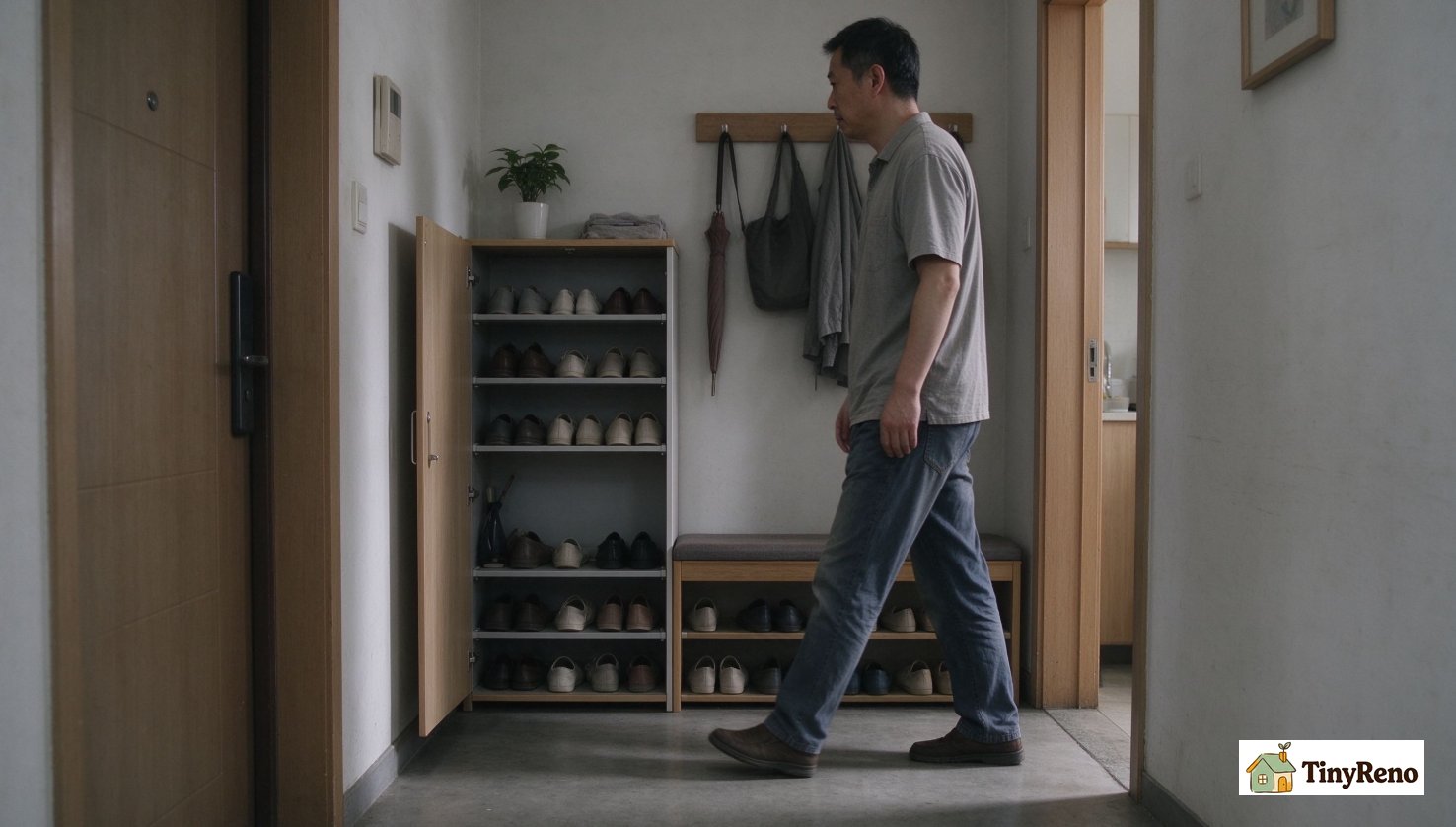
Case one: the closed cabinet bench
The first thing I bought was the obvious version. A tall narrow cabinet, 13 inches deep, 36 inches tall, with two flip-down doors and an open cubby on top for keys. It looked correct in the listing photo. It fit the hallway in the sense that a refrigerator fits a hallway, which is to say it occupied the space without improving it.
Three problems, all of them structural rather than aesthetic.
The doors are the problem. Every shoe going in or out required a door to swing. An 18-inch door swinging into a 62-inch hallway turned every shoe change into a small traffic event in the one place where people walk single file carrying things. We lasted eleven days.
The cubby holds almost nothing useful. Keys, one wallet, a mask, a phone charger. About six square inches of horizontal surface, and it sits at 36 inches, which is exactly eye level for a seven-year-old and therefore the height where things get left. Within a week the cubby held a card game, three hair ties, a subway card and a toy dinosaur.
The shoes were not the problem, the shoe count was. Interior. I counted on a Sunday: 34 pairs across three people. A 36-inch-tall cabinet holds 12 pairs if you stack them two deep and do not care about visibility. So we were buying a small container for a large problem, and the overflow was going to end up back in the hallway no matter how nice the cabinet looked.
I returned it. That decision cost me the $30 restocking fee and saved me the next six months of pretending.
Case two: the open bench that worked
The version that worked is not a cabinet at all. The math said one object: a bench 15 inches deep, 18 tall, 42 long, with an open underside and a thin pad.
Those numbers matter more than the style, so let me give you the reasoning for each one, because these are the measurements that broke the problem.
Fifteen inches deep is the minimum that works, and 18 inches is better. An adult shoe is often around 12 inches long; a child’s is closer to 8 to 10. A 12-inch-deep shelf holds shoes but leaves your heel hovering at the back when you slide them on. At 15 inches, the heel can reach the back and you can pull your foot out without re-balancing. I would not go past 18 inches in a hallway, because past 18 you are eating into the walking lane.
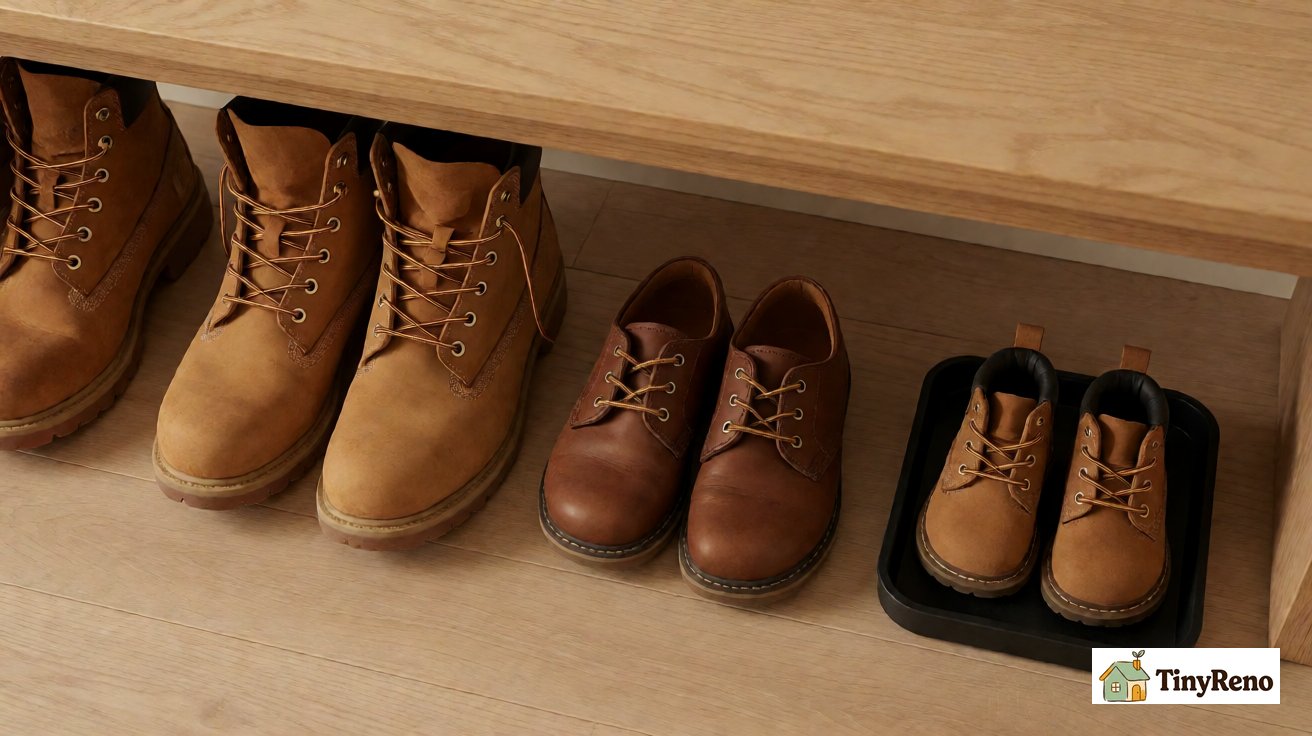
Open underneath is not a style preference, it is the whole trick. A closed cabinet hides the mess but requires a door every time. An open underside means shoes go in sideways and come out sideways, with no mechanism and no swing. You can put four pairs under an 18-inch-tall bench in two rows without lifting anything.
18 inches tall is the seat height that a seven-year-old and an adult both use. Standard dining chair height is 18 inches. That sounds wrong until you realize the alternative is a 12-inch-tall bench, which is a stool, which a seven-year-old will fall off of. At 18 inches, shoes come off at adult height and kids can sit on it to pull their boots on, which is the single highest-value thing that seat does.
Forty-two inches long is the smallest length that covers a real household. Under 40 inches, you are down to roughly 8 pairs, which is fewer than one person in our household owns. At 42 inches, you get about 10 pairs under the seat with room at the ends for a boot tray.
Underneath, in one row: my work boots, my everyday sneakers, my backup pair. My wife takes the second bay. The kid's section is a boot tray that slides out, so his boots do not migrate into adult territory, which they had been doing weekly since October.
The top of the bench is the part I resisted most. A bench with a padded cushion reads as a shoe bench, and its top surface becomes a drop zone for keys, mail, and the mask I keep looking for. I put a shallow wooden tray on the far end, 8 inches by 11 inches, with a lip. That is now where keys and mail live, and it is the only horizontal surface in the entryway that anything is actually placed on deliberately.
Total: one bench, one boot tray, one shallow tray. Three objects for the daily shoes and one seven-year-old’s routine, with the rest stored seasonally.
The hallway math, in real numbers
Here is the part I wish someone had drawn for me in an apartment listing.
- Hallway width: 62 inches. Minimum walkway to keep two people from turning sideways: 36 inches.
- Bench depth: 15 inches. Walkway remaining: 47 inches.
- Bench length: 42 inches against a 96-inch wall. Wall remaining for coat hooks: 54 inches, enough for five hooks at 11-inch spacing.
- Bench height: 18 inches. Wall above bench for hooks: unlimited, since hooks at 68 inches are reachable by an adult and by most seven-year-olds.
The 47-inch remaining walkway decided it. A bench deeper than 18 inches would leave less than 44 inches. In a narrow hallway, that is where passing someone carrying laundry starts to feel tight. I measured twice because I did not believe the first number either.
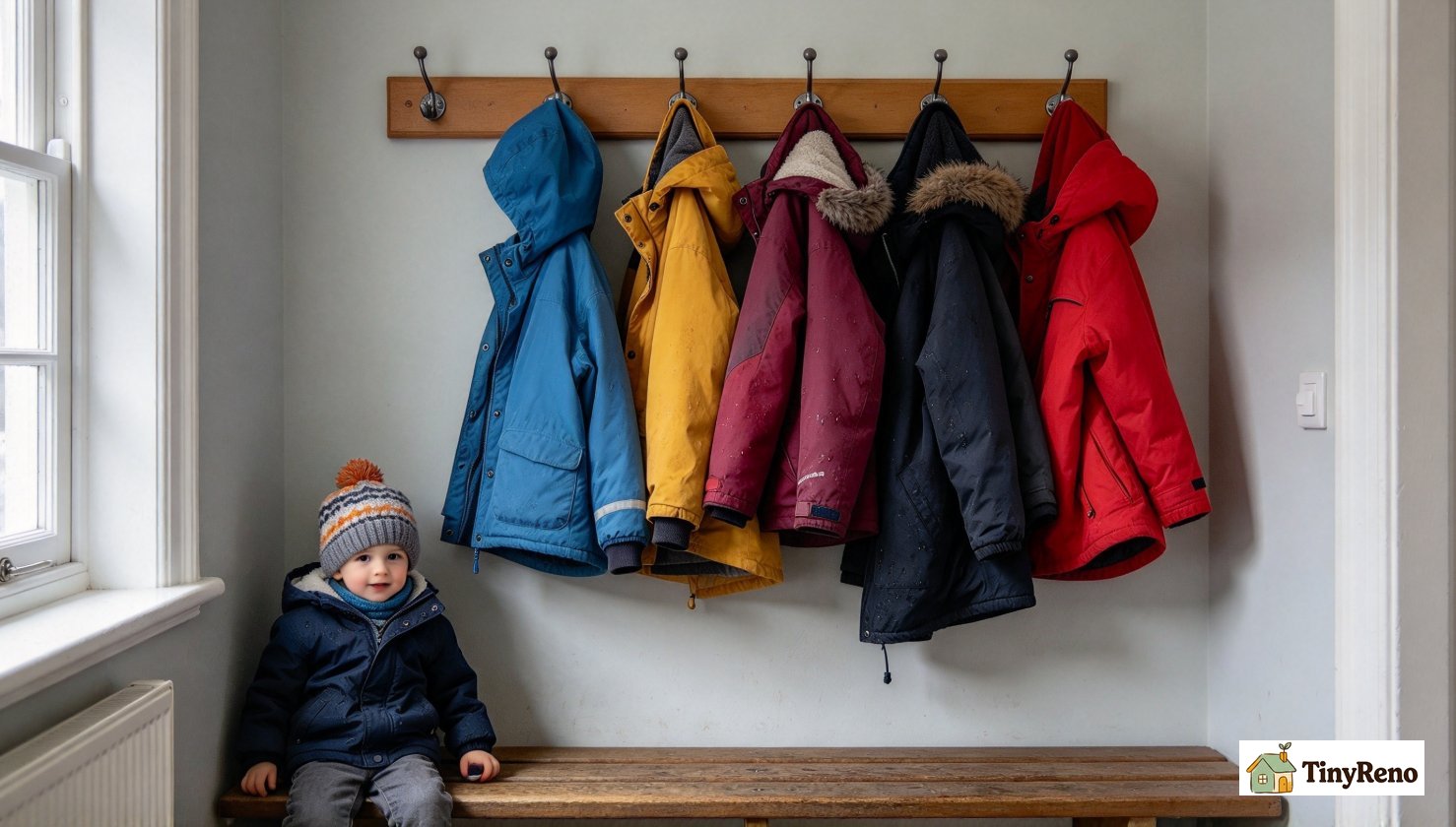
Coat hooks went in at 68 inches on the wall segment past the bench, five of them, with the middle two at a lower height for the kid. This matters: hooks above a bench means a coat hangs down over the shoes, which means a wet coat drips onto the shoes you put there to dry. Hooks on the adjacent wall segment is a ten-dollar decision that prevents a monthly mildew problem.
What I would skip entirely
Three things I bought or considered that earned nothing.
Hooks that rely only on adhesive strips or back into drywall without anchors. A coat hook carries the weight of a wet wool coat, which can exceed the adhesive strip’s rating. The failure mode is a hook pulling out, a mark on the paint, or a damaged wall the landlord counts as damage. I used toggle anchors, but only after getting the landlord’s written permission. In a rental, ask first or use a no-drill over-the-door or tension-mounted hook where possible.
A shoe cabinet with a pull-out drawer on a track. Tracks are where shoes die. A drawer that needs force to open gets opened with force, and eventually the drawer drops its load in the hallway, which is a worse version of the original problem.
Over-door organizers. The back of a door in a hallway is prime real estate, and it is also where the hall closet does not have. Our door opens against the wall and the organizer would have blocked the closet entirely. Measure the swing direction before buying anything door-mounted, including the hook version of the bench, which is why I did not consider a wall-mounted bench at all.
What I would buy instead, in priority order, if I were starting over: the 15-by-18-by-42 bench with an open underside, then five hooks with proper anchors, then a boot tray. Everything else is optional and the entryway will still function.
Six months later
It works, and I want to be honest about the limit of what works. A bench does not create space. It moves a pile off a floor surface that blocks the hallway onto a 15-inch-deep footprint that does not. That is the entire claim.
The Sunday pile is gone. Boot migration into adult territory stopped in the first week, which I attribute entirely to the boot tray and not to the bench at all. And the bench has become the spot where my son sits to pull his boots on, which is a function I did not design for and would not trade for the storage capacity.
The one thing it cannot solve is overflow. A 42-inch bench holds roughly 10 to 12 pairs in daily use, not all 34. We kept the current-season shoes underneath and rotated the rest into a lidded bin under the bed. That seasonal swap is the difference between a hallway that works in January and one that stops working by November.
Measure your hallway width first, buy the open underside, and put the hooks on the wall past the bench rather than above it. That is the whole plan in three decisions.


Discussion (0)
Sign in to join the discussion