

Where to Store a Snow Shovel in an Apartment With No Parking Storage Cost Me $285
The question of where to store a snow shovel in a rental with no assigned parking cost me $285 in February. The answer should have been obvious before the first storm. Here is what happened, and what I do now.
Let me be precise, because the version that went around the resident chat was not quite right. My building posts snow instructions on the lobby board every December. This year the board said, in the middle of a paragraph about sidewalk salt, that residents with cars in the unassigned lot should clear their own vehicles before 7 a.m. Nobody mentioned where to put the shovel.
I assumed the trunk. It is the obvious place. It is also where I keep my emergency kit, my work boots, and, until that January, a decent amount of road salt.
January: the instruction that started this
The building has 34 parking spaces behind a low gate. Eleven are officially assigned. The other 23 are unassigned, first-come, and during a storm they fill by 6:30 a.m. with cars that have nowhere else to go. So the shovel question was really a parking question in disguise, and nobody in the lobby meeting wanted to say that out loud.
I asked the super in the elevator, casually, the way you ask when you already half know the answer. He said the trunk was fine. He also said the storm would probably be light.
He was wrong about both, and I want to be fair to him. He was not being careless. He was repeating what the management company had been saying in writing for years: unassigned spaces are first-come, and overnight storage is not guaranteed. Nobody had reconciled that policy with the shovel instruction. The two sentences sat a few inches apart on the lobby board and contradicted each other.
February: the tow
Four inches fell on a Tuesday. I left for work at 6:15 a.m. with the shovel folded in the trunk under my emergency kit. I came back at 7:40 p.m. to find my car gone and a bright orange sticker on the gate post.
The tow sheet said the violation was failure to display a valid permit. Not snow. Not blocking a fire lane. The permit sticker had been sun-bleached until the number was unreadable, and I had been meaning to replace it since the previous summer. The shovel never appeared on any paperwork. The shovel was not the legal reason for the tow. It was the reason my car was parked in that spot for eleven hours during a storm, but the tow itself was a permit problem.
The tow was $285. The permit replacement was free, but only at the management office during business hours, and the office was closed for two days after the storm. So for two days I had a snow shovel, a rental with no assigned parking, and nowhere to put the shovel. That is a particular kind of helpless you only experience in Queens in a February wind.
While the car was gone, a neighbor I barely knew asked where I kept mine. I said the trunk. She said hers was in her hallway closet because her lease treated anything stored in the corridor as a violation. Then she said the quiet part: her building had never once asked her to clear a car. We stood there in the cold realizing we were solving a problem handed to us by a notice nobody had read to the end.
March: what the lease actually says
This is the part nobody reads carefully enough. My parking clause is two lines long:
- Assigned and unassigned spaces are for resident vehicles only, properly registered and displaying a valid permit.
- Unassigned spaces are not guaranteed and are not to be relied upon for overnight storage.
There is no line about shovels. There is no line about storage of any kind in common areas, the hallway, the utility closet, or the vestibule. If the shovel is in my car, the car falls under the parking rules and the overnight-storage clause can be read to cover a vehicle you are relying on overnight. If the shovel is in the hallway, I have violated the fire egress clause, which is a far worse problem than a parking permit.
That is the trap in snow shovel apartment no parking storage: every obvious answer is either explicitly prohibited or completely unspecified, and unspecified in a lease almost always resolves against the resident when someone behind a desk gets tired of the conversation.
April: the four options that survived
I spent the spring testing arrangements on my own time and my own dime. Four worked without needing management's permission. One of them required a written note I should have asked for before the first storm, not in April.
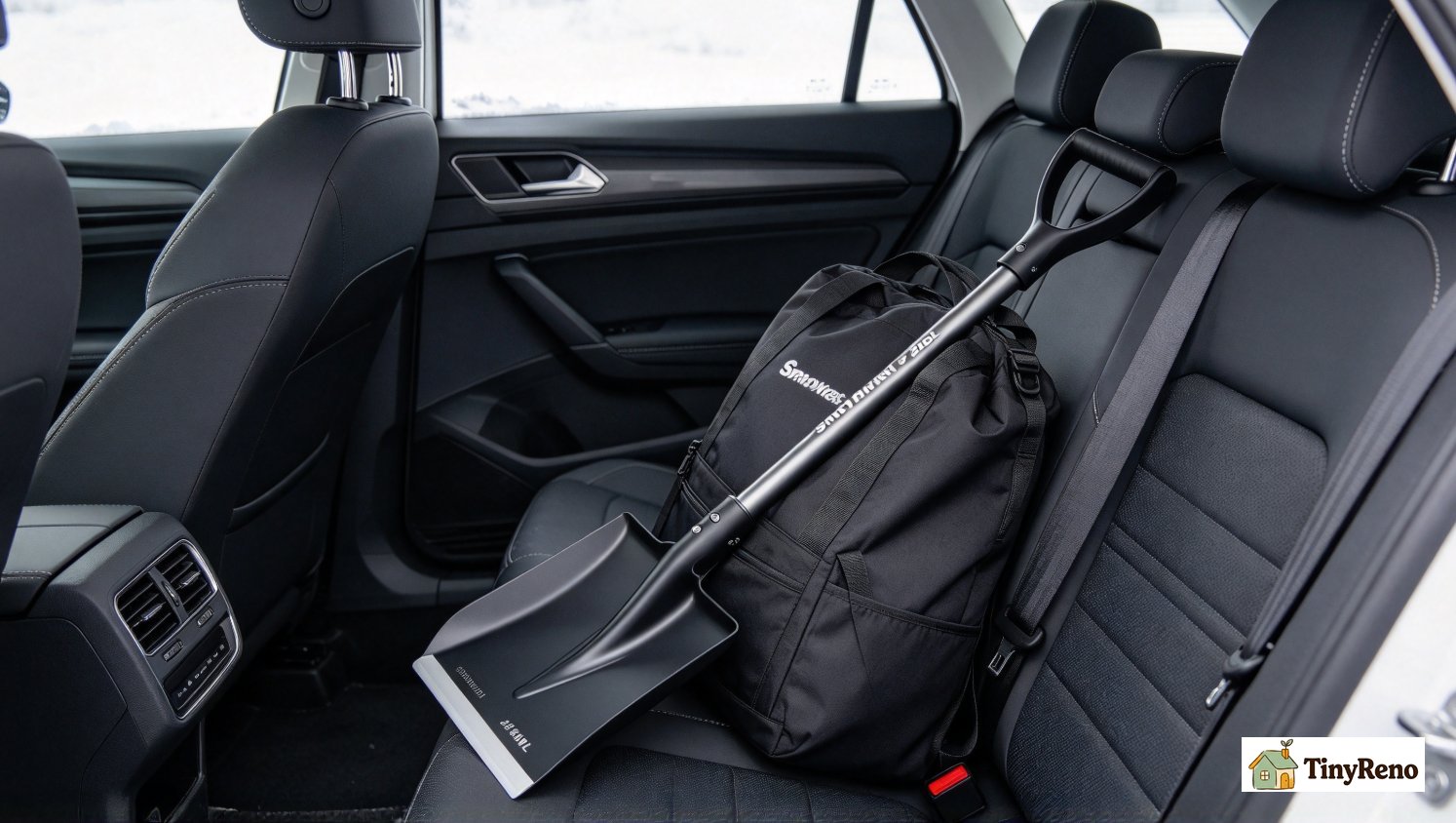
Option one, the foldable shovel in a duffel behind the passenger seat. This is what I use now. A poly snow shovel with a D-grip handle folds roughly in half. Mine lives in a 20L duffel that slides behind the front seat without shifting anything else. Total footprint is about a third of the trunk space. No door opens into a wall, nothing pokes out, no one in the building can tell it is there, and the car stays legally parked with a permit taped flat to the inside of the windshield where a parking officer can read it without a flashlight.
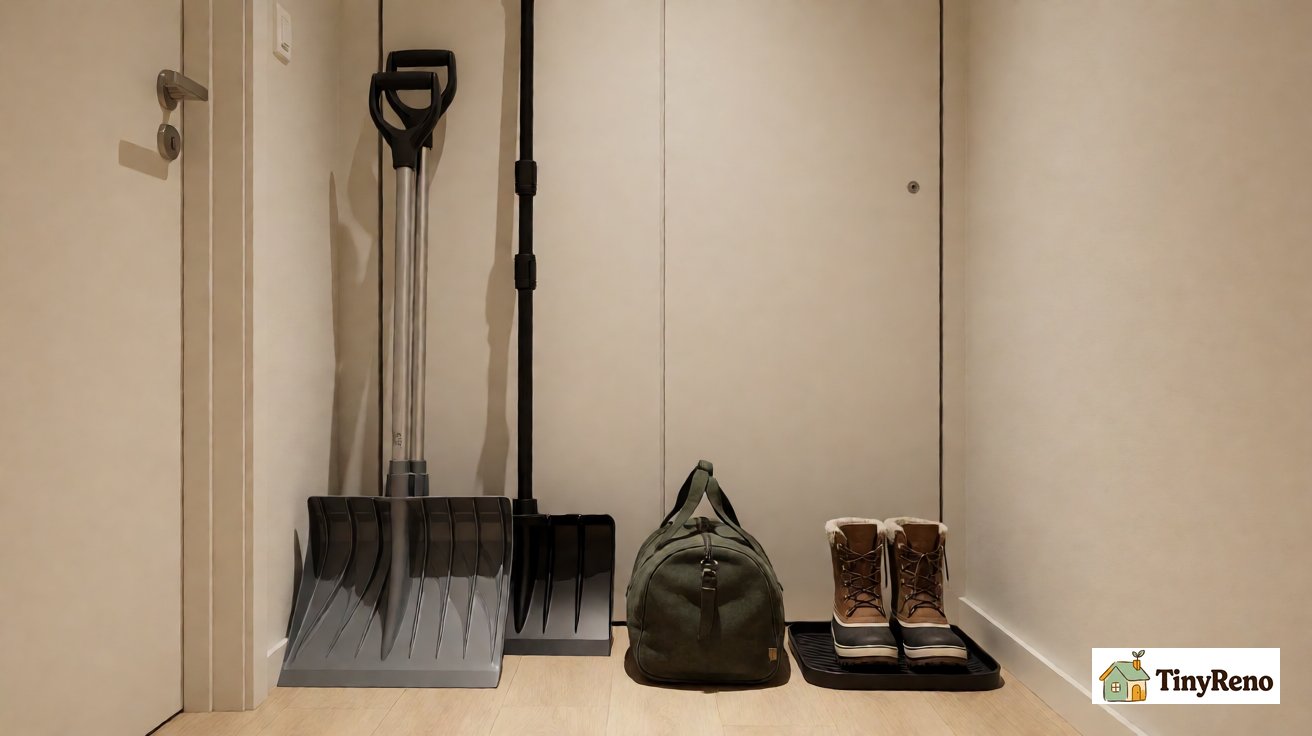
Option two, the telescoping shovel in the rear footwell. Slightly smaller than the duffel option because the shaft telescopes down. This is the compromise answer. It works in cars with almost no trunk, but you end up crouched in a parking lot at 6am pulling it out from under a seat, which is exactly the moment you least want to be crouching in a parking lot at 6am.
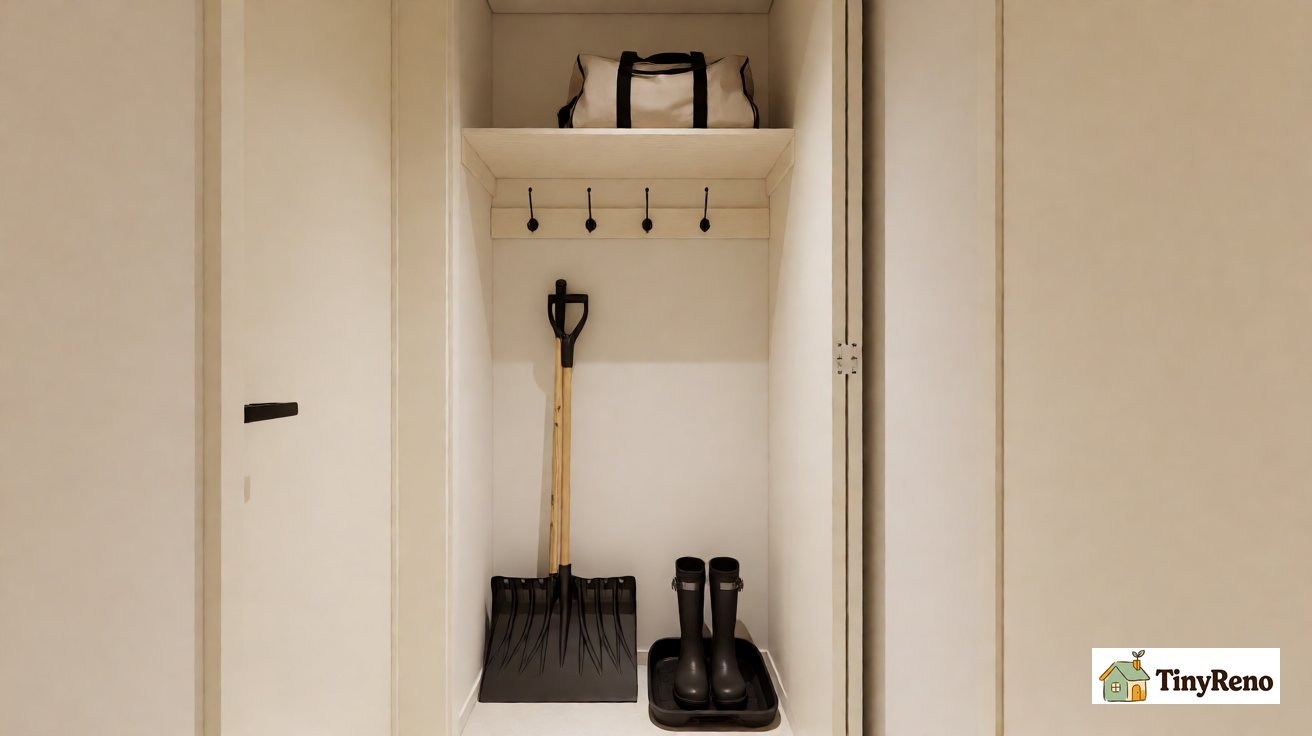
Option three, the building storage locker, if your building actually has one. Mine has four, reserved for registered residents, free, and roughly the size of a carry-on suitcase. I asked the manager about this in April, four months after I should have. If your building has lockers, that is the correct answer and it costs nothing. If it does not, do not assume you can install one. A locker in a shared corridor is a common area modification and falls under the same clause that makes hanging a shelf without written permission a lease issue.
Option four, buy two. This sounds extravagant and it is the cheapest option on this list. An $18 poly shovel, kept at the bottom of your building's mailroom if your building allows that, plus one at home. Nobody can cite a lease against a shovel in your own apartment. On the days I work from home and do not need to clear a car, the home shovel is what I use on the sidewalk my landlord is contractually responsible for maintaining.
May: the five questions to ask before the first snow
I keep this list on my phone and I have walked five different neighbors through it. Ask in a text or email, so there is a record you can point at later.
- Is there resident storage locker space available, and is it assigned per apartment?
- Does the building supply shovels, and if so, where do they live between storms?
- Are unassigned spaces guaranteed overnight, or must cars move during a declared snow emergency?
- Who is responsible for clearing the sidewalk directly outside each building entrance?
- Is there a designated place for resident tools and outdoor equipment?
Question three is the expensive one. If the answer is that cars must relocate during a snow emergency, then you need a plan that does not depend on a shovel at all, because a shovel inside a car that has to be moved at 4am is a liability rather than an asset. It adds weight, it adds a reason to dig through the car, and it does nothing about the actual problem, which is that you cannot reach the car.
Question four matters more than people expect. I have watched two buildings on my block argue about sidewalk responsibility for a full winter, and the argument cost both buildings more time than shoveling ever would have. When the answer is ambiguous, write it down.
June: the rules I actually live by now
Three winters, one tow, one $285 receipt, and a set of rules assembled from trial, error, and a long email thread with a property manager who eventually admitted the lobby board was wrong.
The shovel now lives behind the front passenger seat in a duffel. Never the trunk, never a hallway, never a stairwell landing, never leaning against the radiator cover where someone will trip over it at midnight. The permit sticker sits flat against the inside of the windshield and gets replaced every September, when the office is open and nobody is annoyed. The home shovel stays home. The building sidewalk is the landlord’s job, and when it is not done, that becomes a maintenance request with a date attached, not something I quietly solve alone at 6 a.m.
None of this is clever. It is just the answer to where a renter should store a snow shovel when there is no assigned parking, settled by a tow sheet that finally made everyone ask the question out loud.


Discussion (0)
Sign in to join the discussion