

Ceiling fan versus tower fan in an apartment bedroom was the comparison I ran for 90 days this summer. My lease allowed a ceiling fan only because the ceiling already had a fan-rated metal junction box and a dedicated switch loop, and the landlord approved the install in writing. I wanted to know whether the ceiling fan I had been thinking about since I moved in was actually better than the tower fan I had been using all spring. I bought a 52-inch Hunter ceiling fan, installed it with landlord permission, ran it side by side with my existing Dreo 42-inch tower fan for three months, and measured airflow, noise, energy use, bedroom fit, cleaning effort, and the one category nobody talks about: what they do to a room when no one is using them.
This is what 90 days of testing looked like across seven categories that matter for an apartment bedroom. The result depended more on the renter than on the fan. The ceiling fan scored higher on paper. The tower fan was easier to live with in a rental.
How I Tested
I kept both fans running in the same 12-by-12 bedroom with a 9-foot ceiling, one south-facing window, and a return air vent in the corner. I measured:
- Airflow drop: room temperature before and after 30 minutes on each fan's highest setting, using a Govee hygrometer thermometer at desk height on the opposite side of the room.
- Noise: a NIOSH SLM smartphone app at pillow height on the lowest usable setting, measured in decibels.
- Energy use: a Kill-A-Watt meter plugged into the wall outlet for the tower fan; for the ceiling fan, I used the manufacturer's published wattage at each speed setting (52W on high, 8W on low).
- Cleaning effort: minutes per week to dust each fan and the surfaces it affects.
- Bedroom fit: how much usable floor or wall space each fan took, and how it changed when not in use.
I rated each fan on a 1 to 5 scale per category. The totals are below. Neither fan "wins" across the board; that is the point of running them both.
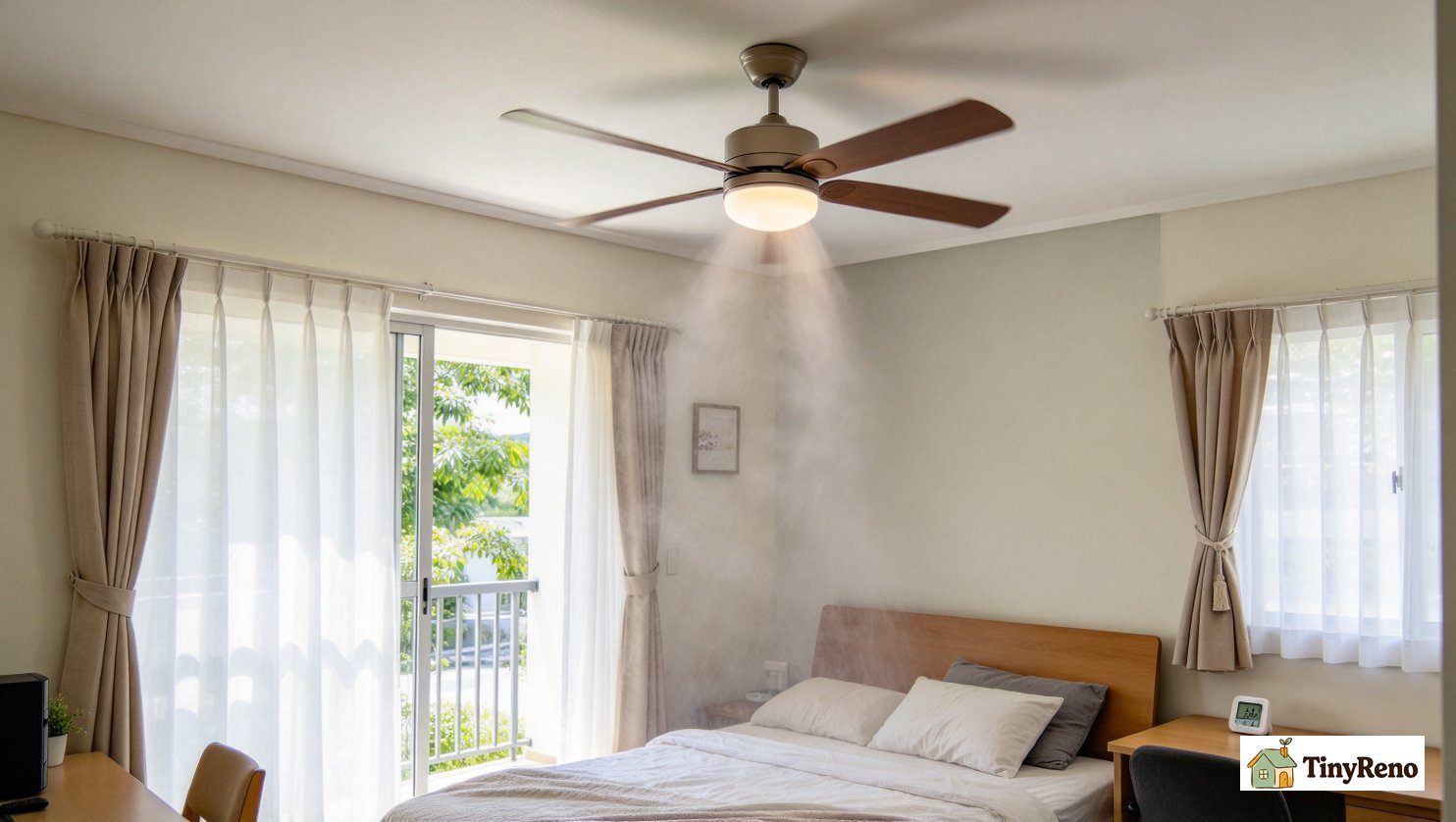
Category 1: Airflow (Ceiling Fan 5, Tower Fan 3)
The ceiling fan dropped the bedroom from 84°F to 76°F in 18 minutes on high. The tower fan dropped the same room from 84°F to 78°F in 28 minutes on high. The ceiling fan moved air across more of the room, which is why the temperature reading at desk height fell faster. The tower fan moved air in a narrower column. Temperature drop is not the same as measured airflow, but for a bedroom the ceiling fan clearly mixed the air more evenly.
The ceiling fan also creates a wind-chill effect at the skin level, which means you feel cooler than the thermometer says you are. In practice, I could set the thermostat 2°F higher with the ceiling fan and feel as comfortable as I did at the lower temperature with just the tower fan. That 2°F difference translates to about a 7 percent reduction in AC energy use over a summer.
If raw airflow is your only criterion, the ceiling fan wins without contest. The tower fan is better at targeted cooling (cooling one person while they sit at a desk), but the ceiling fan is better at whole-room cooling, which is what bedrooms need.
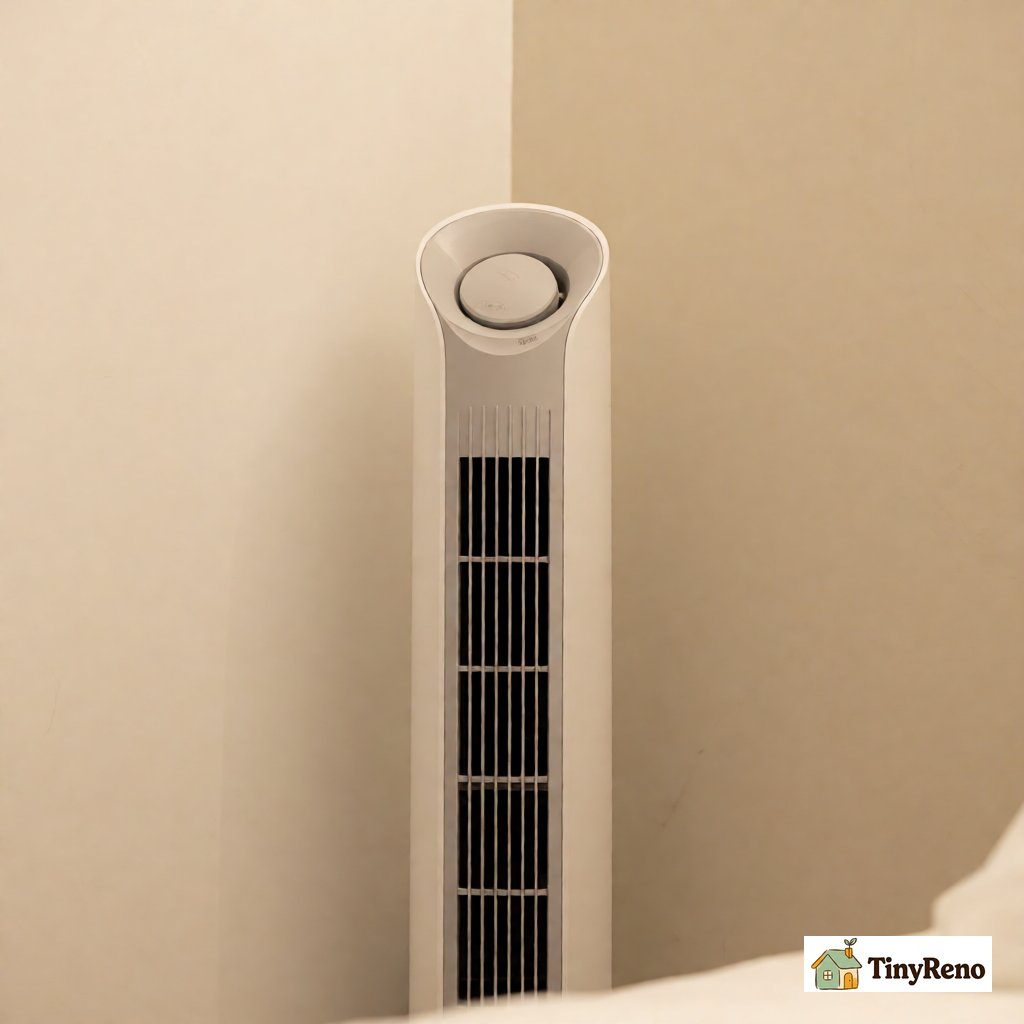
Category 2: Noise (Ceiling Fan 5, Tower Fan 4)
On the lowest setting, the ceiling fan measured about 28 decibels at pillow height on the phone app. The tower fan measured about 36 decibels on its lowest setting. Both are quiet, but the ceiling fan was noticeably quieter. The phone app is not a calibrated sound meter, so treat the exact numbers as approximate.
The reason is mechanical. A ceiling fan on low is a slow-moving motor and four large blades cutting air. There is no high-frequency whir, no motor vibration at close range, no hum. A tower fan has a smaller motor spinning a smaller blade column, and the smaller blade has to spin faster to move the same amount of air, which produces more high-frequency noise.
The 8-decibel difference sounds small but is noticeable. In a quiet bedroom at night, the tower fan is a soft whoosh in the background. The ceiling fan is essentially silent until you stand under it and feel the air.
If you are a light sleeper, this category matters more than airflow in any ceiling fan vs tower fan apartment bedroom noise decision. The ceiling fan wins on noise.
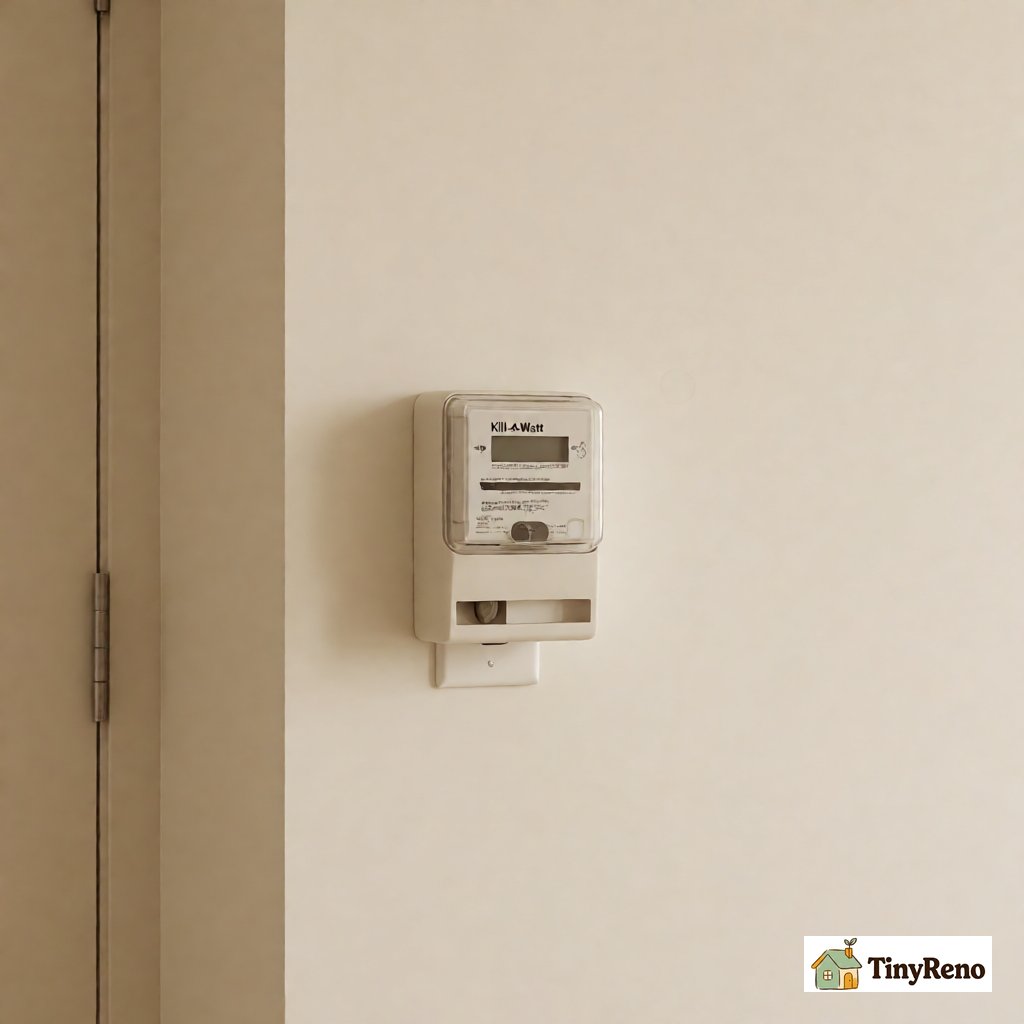
Category 3: Energy Use (Ceiling Fan 5, Tower Fan 2)
The ceiling fan at high speed uses about 52 watts. The tower fan at high speed uses about 45 watts. On low, the ceiling fan uses about 8 watts, and the tower fan uses about 30 watts. Across an 8-hour night, the ceiling fan uses about 0.064 kWh, and the tower fan uses about 0.24 kWh.
The ceiling fan uses less energy on low, but the dollar saving depends on your electricity rate and how many nights you run it. At 15 cents per kWh, the difference is about 2.6 cents per night, or about $2.40 over 90 nights. At a higher rate, the saving is larger. The $4.50 figure depends on the rate you pay.
The ceiling fan also has a much longer effective range of useful speeds. The lowest setting is so gentle it does not register on the energy meter; you can leave it running 24 hours a day for the cost of a single 60-watt bulb. The tower fan on low is still pulling 30 watts because the motor has to overcome its own friction.
Category 4: Bedroom Fit (Ceiling Fan 4, Tower Fan 3)
The ceiling fan takes no floor space and no wall space. It hangs from the ceiling, where the space is otherwise unused. The tower fan takes about 1 square foot of floor space, which in a small bedroom is a real cost (a nightstand, a laundry basket, a cat's water dish could all fit in that square foot).
Where the ceiling fan loses points: it has to be installed (with landlord permission), it requires a fan-rated junction box, and it changes the look of the ceiling. If you are renting a unit where the ceiling is a design feature (exposed beams, a statement light fixture, a high vault), the ceiling fan is an interruption.
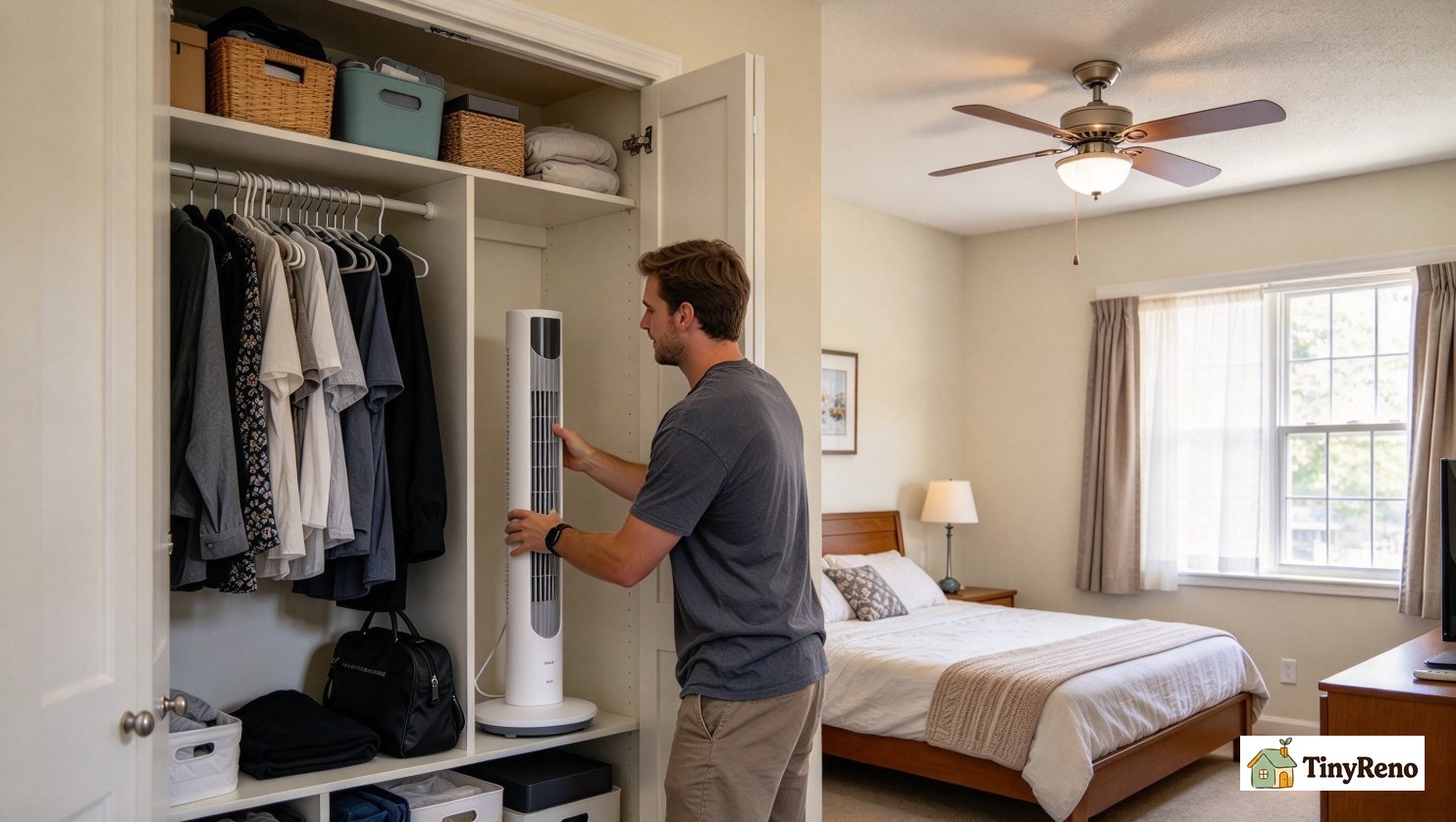
The tower fan can be moved between rooms, stored in a closet for winter, and replaced if it breaks. The ceiling fan is a permanent fixture for the life of the lease. That flexibility counts.
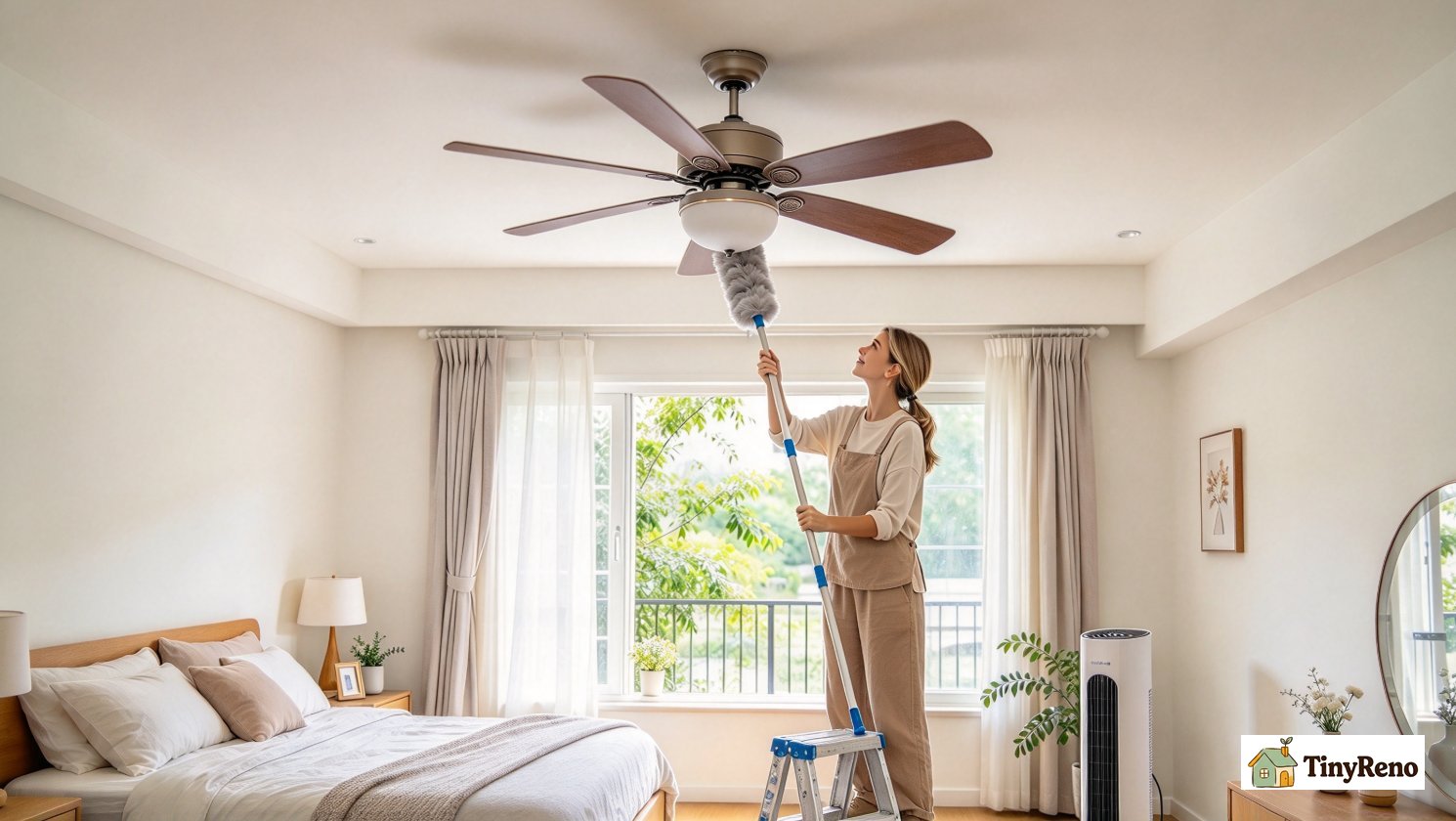
Category 5: Cleaning Effort (Ceiling Fan 2, Tower Fan 4)
This is the category that made me use the ceiling fan less during the test. A ceiling fan collects dust on the top of every blade. You cannot easily reach the top of the blade without a ladder or a special duster. If you do not clean it regularly, running the fan can disturb some of that dust. That dust settles on surfaces in the room, including the bed and nightstand.
I measured cleaning time over 12 weeks. The ceiling fan averaged 8 minutes per cleaning (the blade duster gets most of it, but you have to do all four sides). The tower fan averaged 2 minutes (you wipe down the front grille with a damp cloth). Across a year of weekly cleaning, that is 6 hours per year on the ceiling fan versus 1.5 hours on the tower fan.
If you have dust allergies, the ceiling fan is a real liability. I did not have allergies before this test. After 90 days of running a ceiling fan in a dusty bedroom, my morning congestion was noticeably worse. The tower fan's smaller surface area makes it a less aggressive dust distributor.
Category 6: Look (Ceiling Fan 4, Tower Fan 3)
A modern ceiling fan with a clean blade design looks like part of the room. The Hunter I bought has simple wood blades and a brushed nickel motor housing. It does not look like an appliance. It looks like a ceiling feature.
A tower fan, even the most attractive one, looks like an appliance. It is a column of plastic and metal that sits in the corner. You can color-match it to the room (some brands sell white, black, and wood-tone versions), but it is still visibly a fan.
Where the ceiling fan loses points: it adds visual complexity to the ceiling. In a small bedroom with a low ceiling, the fan blades can feel close to your head when you sit up in bed. The tower fan is invisible at eye level when you are sitting.
Category 7: Off-Season Storage and Removal (Ceiling Fan 1, Tower Fan 5)
The ceiling fan cannot be stored. It runs year-round or it sits there unused for 6 months, gathering dust. When I moved out of my last apartment, I had to take the ceiling fan down and patch the ceiling, which took an afternoon and cost me part of my security deposit because the patch was not invisible.
The tower fan goes into a closet for winter, or behind the couch, or in the corner of the guest room. It costs nothing to store. At move-out, it goes in the moving truck. Total damage: zero.
This is the category that, for renters specifically, matters more than any other. A ceiling fan is a permanent modification. A tower fan is a movable object. If your lease is short, if you move frequently, or if you are not sure you want a ceiling fan for the full lease, the tower fan is the lower-risk choice.
The Totals
| Category | Ceiling Fan | Tower Fan |
|---|---|---|
| Airflow | 5 | 3 |
| Noise | 5 | 4 |
| Energy use | 5 | 2 |
| Bedroom fit | 4 | 3 |
| Cleaning effort | 2 | 4 |
| Look | 4 | 3 |
| Off-season storage | 1 | 5 |
| Total | 26 | 24 |
By the score, the ceiling fan wins by two points. By the lived experience, it depends on what you weight. If you live in the apartment for 3+ years and do not move often, the ceiling fan is the right call. If you move every 12 to 24 months, the tower fan's flexibility outweighs the ceiling fan's airflow advantage.
The One I Stopped Using
I stopped using the ceiling fan on day 60. The reason was not the airflow, the noise, or the energy use. The reason was the dust.
I ran the ceiling fan in a small bedroom with a south-facing window, and the window was open much of the summer. Pollen, dust, and outdoor particles came in through the window and settled on the blades. After about 60 days, my morning congestion had gone from occasional to daily. I cannot prove the fan caused it. The open window, seasonal pollen, and the fan could all have contributed. But the timing was enough to make me switch back to the tower fan at night.
I switched back to the tower fan, ran it on low through the night, and the congestion cleared within a week. The tower fan has a smaller blade surface and a washable front grille. It does less to the air quality of the room.
If you have allergies, asthma, or a dust-sensitive household, the tower fan is the better bedroom fan even though the ceiling fan wins on paper. The category-by-category comparison is real, but the category that matters most for sleep quality is the one the score does not capture.
What I Use Now
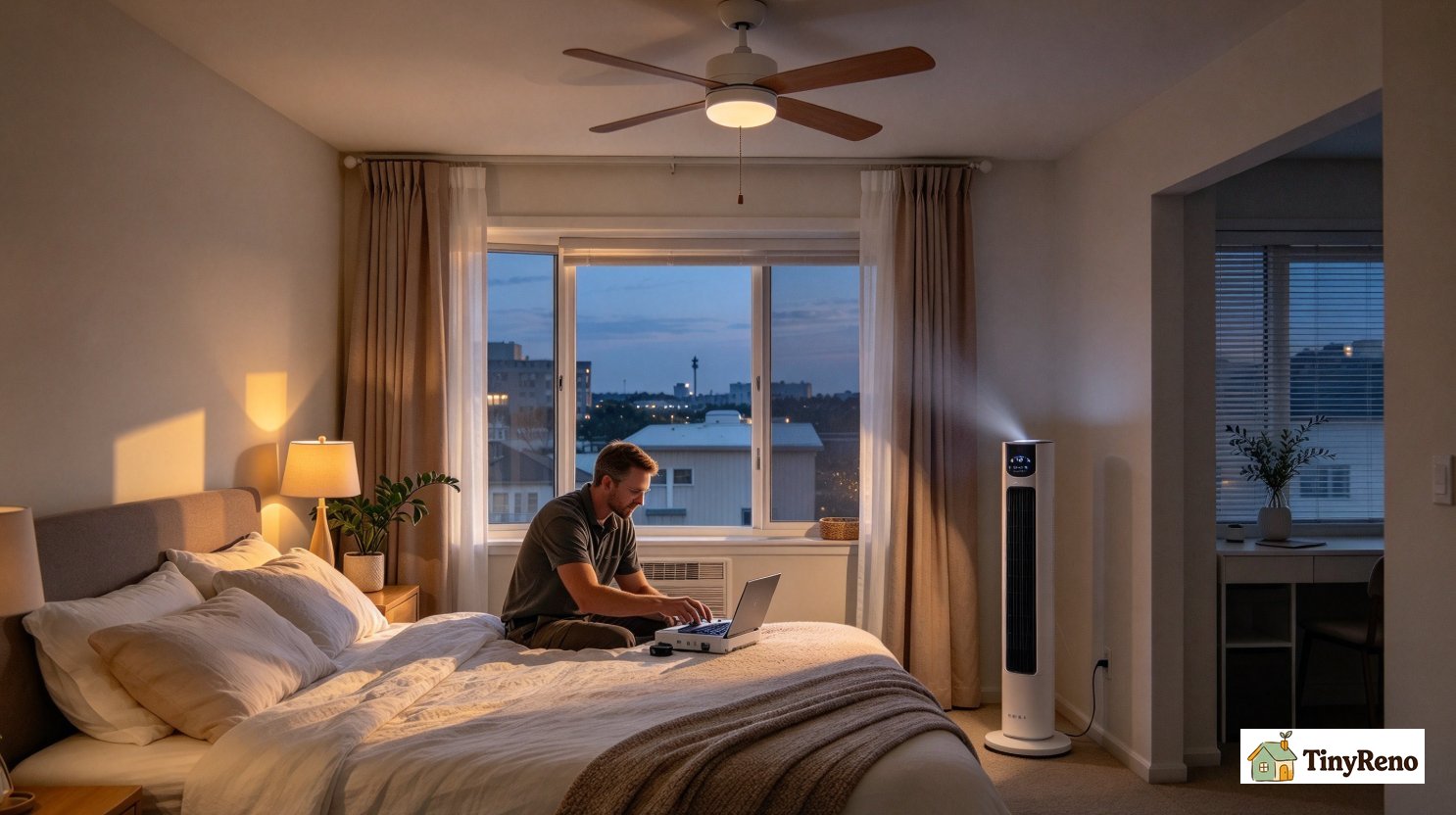
The ceiling fan is still installed. I run it on low during the day when I am not sleeping, to keep the room air moving. At night I run the tower fan on low, pointed at the bed. The combination gives me whole-room air movement during the day and quieter, easier-to-clean cooling at night.
This is not the answer most ceiling fan vs tower fan apartment bedroom noise articles land on. Most articles recommend the ceiling fan because of the airflow and energy numbers. They are correct, on those numbers. For renters specifically, and for people who care about bedroom air quality specifically, the tower fan still has a place.
The Bottom Line
If your rental already has a fan-rated junction box and a switch loop, and the landlord approves the install in writing, a ceiling fan can be the better bedroom fan for whole-room air movement. It uses less energy on low and looks like part of the room. Do not install one yourself unless you are qualified to do electrical work; a ceiling fan needs a fan-rated box that can support the weight and vibration.
If you move frequently, have dust allergies, or live in a unit where a ceiling fan is not possible (no junction box, no permission, vaulted ceiling you do not want to drill into), the tower fan is the right answer. The 8-decibel noise difference matters less than the flexibility and the air quality.
If you can run both, do it. The category that decides it for you is the one you cannot score until you have lived with both: how much dust the fan moves, how often you clean it, and how easy it is to remove at move-out.


Discussion (0)
Sign in to join the discussion