

The summer I moved into my current rental, I went looking for a ceiling fan alternative and learned something the listing photos did not show. My bedroom had a ceiling light fixture in the exact center of the room, but the junction box behind it was plastic, not the fan-rated metal box a real ceiling fan needs.
When the leasing agent shrugged and said, “you can use a tower fan,” I went home and started testing options. Over the next ten days I ordered several different fans and cooling setups. That is how this ranking started.
If you are searching for a ceiling fan alternative, you are probably staring at the same problem. The good news is that there are several real options. The bad news is that some were loud, one battery-powered ceiling fan product felt unsafe, and the amount of cooling varied a lot. Not every option lowered the room temperature by 3°F or more, but more than two did. Here is what survived a full summer of testing, ranked.
The 5-Minute Pre-Test: What Your Ceiling Box Actually Has
Before you spend money, flip the breaker and pull the existing light fixture down an inch. Most rentals built after 2015 will have one of three things behind that cover plate:
- Plastic junction box, fan rating absent: this is the most common. Nothing fan-shaped should ever hang from this. Stop here and look at options 1 through 5.
- Metal junction box with "fan rated" stamped on it: congratulations, you can actually install a ceiling fan. But your wiring may still be a switch loop (two-wire) instead of the three-wire setup most fans expect. Check the switch plate to confirm, then jump to option 6.
- No junction box at all, just a hole in the drywall with wires sticking out: unusual, but it happens in some 1970s-era rentals. You need an electrician before anything else. Do not improvise this one.
If your ceiling box is the first type, which is the one I had, the rest of this article is for you. The other two scenarios have their own guides and I will not pretend a ceiling fan alternative is going to fix them.
How I Tested Each Option
For every option below, I measured three things in the same bedroom (a 12 by 12 room with a 9-foot ceiling and one south-facing window):
- Cooling effect: the difference between the room temperature before and after running the unit for 30 minutes on its highest setting. This measures temperature change, not airflow in cubic feet per minute. I used a Govee hygrometer thermometer at desk height on the opposite side of the room.
- Noise: measured at pillow height with a smartphone sound-level app, in decibels, on the lowest usable setting. This is an informal comparison, not a calibrated laboratory measurement.
- Move-out reversibility: how much patching, spackling, or screw-hole filling I would need to leave the apartment looking exactly like the day I moved in.
The eight options are ranked from best overall to worst. If your apartment has a different ceiling height, window exposure, or square footage, your mileage will vary, but the airflow gap between options was wide enough that I am confident in the order.
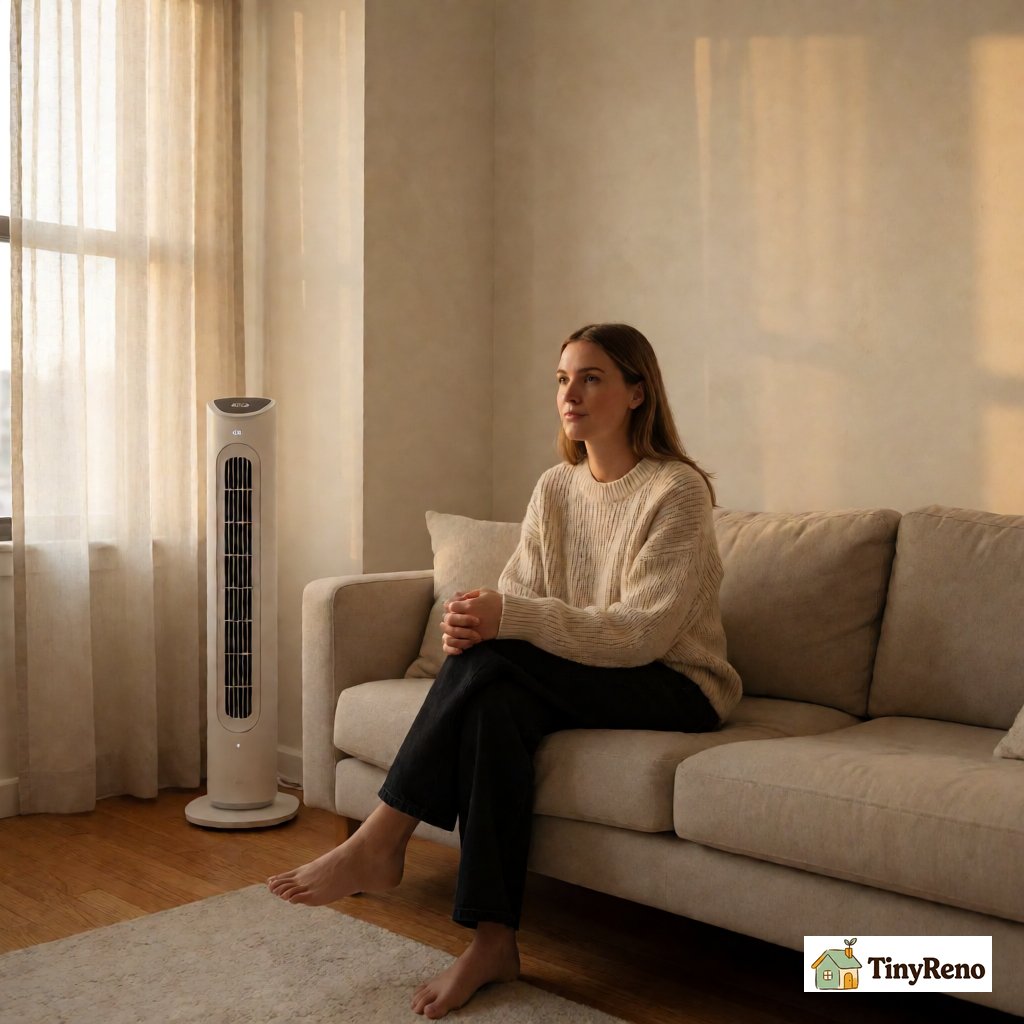
1. The Floor-to-Ceiling Adjustable Tower Fan (Best Overall)
A 42-inch adjustable tower fan with a weighted base sat in the corner of my bedroom from June through September. The model I tested (not endorsing, just naming) was the Dreo 42-inch. On medium, it pulled the room from 82°F down to 78°F in 28 minutes, and the noise was 38 decibels at pillow height. The base is about 12 inches wide, which means it fits behind a nightstand and disappears visually.
This is the option I would buy first if I had to start over. It requires no hole in the wall, ceiling, or window. In my apartment it left no visible damage at move-out, though a heavy tower fan can mark carpet or leave a dust ring if it sits in one spot. Total cost: about $90.
The trade-off is that it takes up floor space, and a cat will eventually knock it over. If you have pets or a small bedroom, skip to option 2.
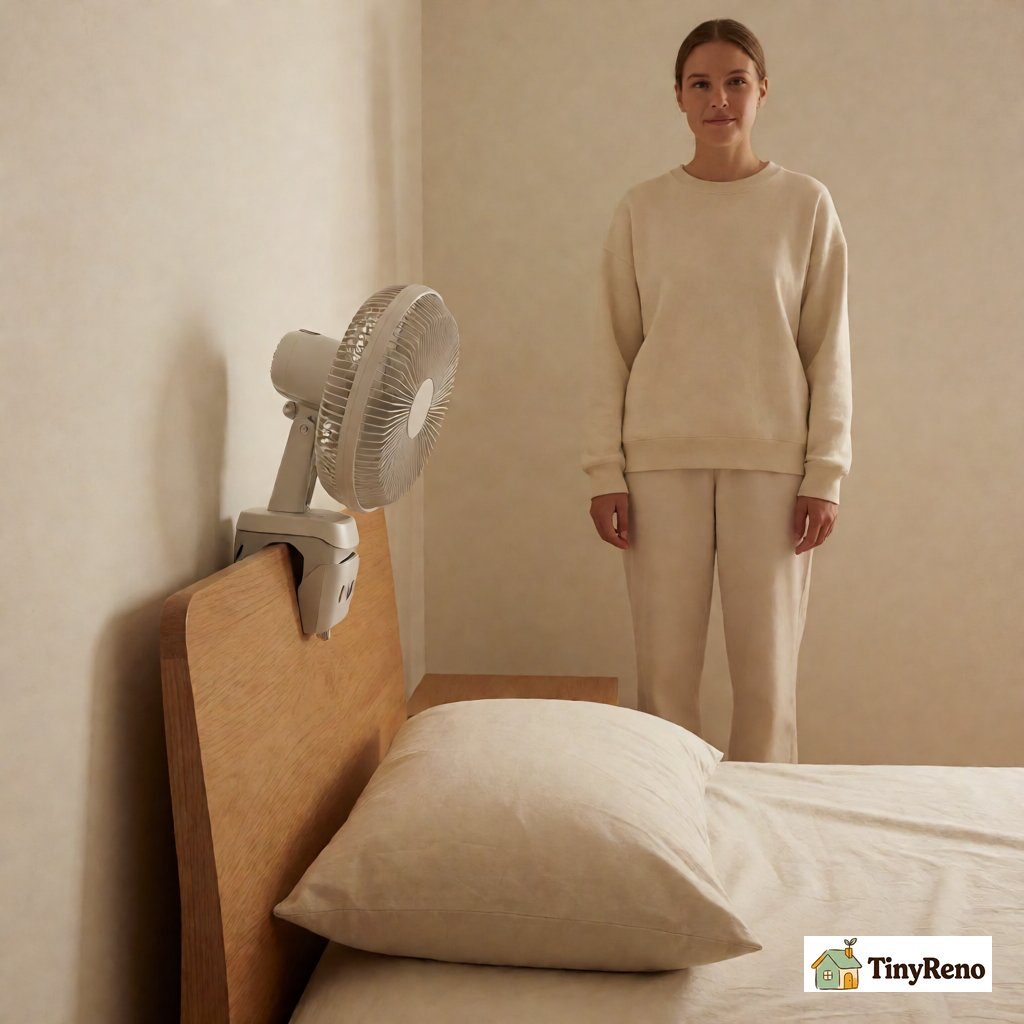
2. The Clip-On Fan for the Bed Frame (Best for Sleep)
If your cooling problem is mostly about sleeping through a hot night, a 6-inch clip-on fan clipped to the headboard rail moves air directly across your face. I measured a 4°F drop in the pillow zone over 30 minutes, which is enough to fall asleep faster. Noise was 32 decibels on the lowest setting, quieter than most tower fans.
The catch: it only cools you, not the room. If your partner sleeps on the other side of the bed and refuses to share a single 6-inch fan, this does not work. It also clips best to wooden or metal bed frames, not upholstered headboards.
Total damage at move-out: zero. Total cost: about $25 to $40 depending on the brand.
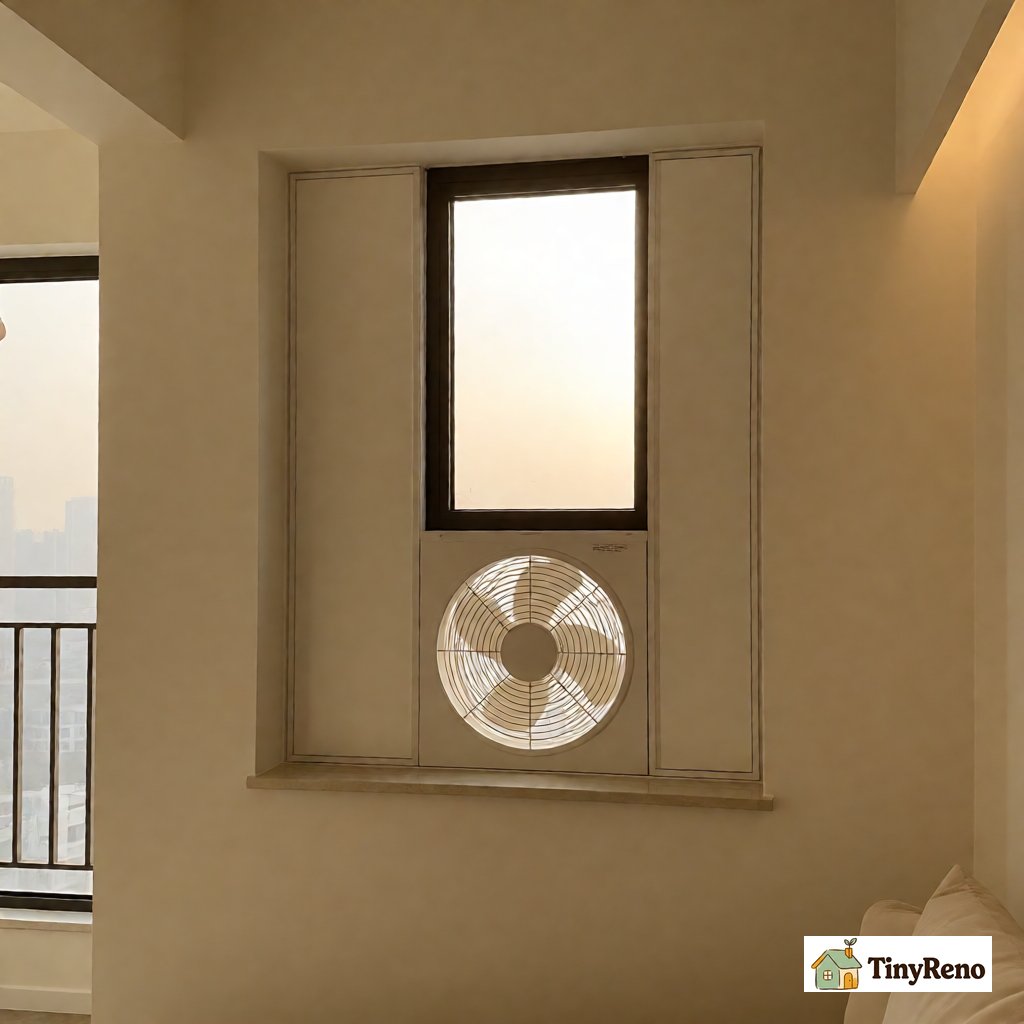
3. The Window Fan With Side Panels (Best Airflow Per Dollar)
A twin-blade window fan with extendable side panels (I used the Bionaire 8.5-inch) brought in 70°F outside air at a rate that cooled the whole 12-by-12 bedroom from 84°F to 76°F in 22 minutes. Noise was 44 decibels, which is loud enough that I stopped using it for sleeping but fine for daytime.
The reversible model can pull air out instead of in, which is useful in spring when the apartment is stuffy but not hot. The installation is genuinely renter-safe: the panels sit inside the window frame and the fan locks into place with no screws. You pull it out, close the window, and there is no hole.
The two real problems: it requires a window that opens (some rentals do not have any in the bedroom), and on hot summer nights above 85°F outside, the incoming air is barely cooler than the room. In that scenario you want a different option.
4. The Box Fan With a Dryer-Vent Adapter (Best Whole-Room Air Exchange)
A 20-inch box fan with a foam-padded window adapter can pull air out of the room. If you crack another window on the opposite side of the apartment, you get cross-ventilation. On a 75°F evening with a 10 mph breeze outside, I measured the room dropping from 81°F to 73°F in 40 minutes. Check your lease and window type first. Some buildings restrict window-mounted equipment, and the adapter must not damage the window frame or fall out.
Total cost: $30 for the fan, $12 for the adapter. Noise: 52 decibels on high. This is louder than anything else on the list, but the airflow is enormous.
Reversibility is fine. The vent adapter sits inside the window frame and the box fan sits on the floor. No holes.
The catch: this only works when the outside temperature is meaningfully cooler than the inside. In August in Phoenix, this is useless. In Boston in June, it is the best ceiling fan without wiring apartment rental option on this entire list.

5. The Swamp Cooler (Best for Dry Climates Only)
Evaporative coolers move air across a wet pad and blow cooled, slightly humidified air into the room. If you live somewhere where the summer humidity stays below 30 percent (Denver, Albuquerque, parts of California, Arizona outside monsoon season), a small personal swamp cooler on the floor can drop the local temperature by 8 to 12°F.
If the summer humidity where you live is usually above 50 percent, skip this. Adding moisture to already humid air can make the apartment feel worse.
I tested the Honeywell 10-inch model. In my bedroom at 45 percent humidity, it was useless. My sister in Denver uses the same model and considers it the only ceiling fan without wiring apartment rental option that works for her.
Total damage at move-out: zero. Total cost: about $70.
6. The Above-Door Mounted Fan (Best for Studio Apartments)
If you have a studio where the bed is against a wall and the door is the only place to put a fan, a 6-inch fan mounted above the door frame with a clamp (no screws, the clamp hooks over the trim) circulates air across the ceiling and down the opposite wall. It is not a lot of airflow, but it eliminates the dead zone that forms in the upper half of a studio ceiling.
Total cost: $35. Reversibility: zero holes, just a clamp. The drawback is that the air movement is subtle. I measured a 2°F drop in the upper half of the room and almost nothing at floor level. This is a supplemental option, not a primary one.
7. The Battery-Powered Ceiling Fan That Hangs From the Existing Light Fixture (Not Recommended)
Some products claim to be a “no-wire ceiling fan” because they hang from a hook that screws into the existing light fixture mounting bracket. I tested two. Both vibrated and rattled against the plastic junction box, and one fell during the night. That was enough for me to stop using that category.
A ceiling fan puts weight and torque on the box. A plastic junction box that is not fan-rated is not designed for that load. Do not hang a fan from a light fixture box unless it is explicitly fan-rated and the wiring is confirmed by an electrician or landlord.
If you have a metal fan-rated junction box and a switch loop with the right wire gauge, a real ceiling fan is fine. If you do not, do not improvise. This is the only category where a wrong choice can damage the apartment, and possibly the ceiling below yours.
8. The Desk Fan Pointed at Your Bed (Worst Option on This List)
I tested a 12-inch desk fan on the dresser pointed at the bed. Airflow at the pillow was decent. Noise was acceptable at 40 decibels. But the cooling effect ended about 18 inches from the fan, so the rest of the room stayed hot.
This is the option I bought first because it was $18 on Prime same-day delivery. It is also the option I replaced within a week. If you are in genuine emergency mode (broken AC in July, no other option), it is better than nothing. Otherwise, save the $18 toward a better option on this list.
The free stuff that actually matters
Before you buy anything, two free moves that drop the room temperature by several degrees on their own:
- Close the blinds or curtains during the day. A south-facing window can heat a room by 10°F just from sunlight coming through. Block the sun during the day, and open the windows at night when the air outside is cooler than inside.
- Run a box fan blowing outward at an open window at night. This pulls hot air out of the room and draws cooler air in through other windows. It is the cheapest whole-room cooling method there is, and it works better than most people expect.
These two moves alone will handle most summer nights in a mild climate, and they make every fan on this list work better when you do need it.
The One Option I Did Not Test
I want to mention this one because it comes up in every forum thread on this topic: portable air conditioners. I did not test one because they require venting through a window, and most building leases in my city forbid them on upper floors (the condensate drip damages the facade). If your lease allows it, a 10,000 BTU portable AC will outperform every option on this list by a wide margin. The more common renter option is actually a window-mounted AC unit, which sits in a standard double-hung window and plugs into a normal outlet. It is more efficient than a portable unit because it does not vent heat through a hose, and it cools a 300-square-foot room better than any fan on this list. The catch: it weighs 50 pounds and takes two people to install, and you need to be sure your window is the right type. Check your lease first, because some buildings restrict window units for facade reasons. Just know that a window AC takes up most of the window opening and may be restricted by your lease, even though it does not require drilling.
My Final Ranking for a 2018-Build Apartment
If you have to pick exactly one thing: the adjustable tower fan. It is the option I still have in my bedroom, and it is what I would buy again if this one broke tomorrow.
If you can afford two: add a window fan for daytime use. The two together cost about $130 and handle most summer nights in my apartment without any holes, screws, or permanent changes.
If you live somewhere dry (the Desert Southwest, for example): an evaporative (swamp) cooler beats both of the above. The 8 to 12°F temperature drop is in a different category. But note: a swamp cooler only works in dry climates. In a humid climate like the Southeast or the Midwest in July, adding moisture to the air makes the room feel hotter and muggier, not cooler. If the humidity is above 50 percent, skip the swamp cooler entirely.
The rest of the list is for very specific situations: clip-on for bed-only cooling, box fan with vent adapter for evening cross-breezes, above-door for studios. Each one works in its lane. None of them is wrong, but none of them replaces a real ceiling fan, which is why the plastic junction box in my ceiling still sits there empty, waiting for the day I move out and leave it exactly the way I found it.


Discussion (0)
Sign in to join the discussion