

Fixing a dark rental apartment with no overhead light was the Sunday I spent crying in my Jersey City lease, on January 11, 2026, when I came home from a coffee shop on Grove Street at 4:48 p.m. and walked into a one-bedroom on the third floor of a 1990s building on Jersey Avenue that I could not see. Not figuratively. The apartment had no working overhead light in the living room, the bulb had been removed by the previous tenant, the wiring was intact but the socket was empty, and my landlord had not yet sent the maintenance guy he had promised on December 22. The kitchen had one working fixture, the bedroom had one working fixture, the bathroom had one working fixture, and the living room was a 13-by-14 room with a 9-foot ceiling, white walls, and dark oak floors that became noticeably dark after 4:30 every afternoon for the rest of the winter, with sunset at 4:48 on January 11. The 13 weeks between January 11 and April 11 were the period I tested six main lighting setups in a dark rental apartment with no overhead light. The final setup I kept cost about $73, and the total I spent testing all options, including the ones I did not keep, was about $120.
The reason this scenario is specific to winter is the sun. In summer in Jersey City, the apartment gets direct east light from 7 a.m. to 1 p.m. The living room is bright enough to read in by 1 p.m. and the sun does not set until 8:30 p.m. The overhead light becomes a luxury. In winter, the sun sets at 4:48 p.m. on January 11 and the apartment is dark by 4 p.m. The overhead light is no longer a luxury. It is the entire lighting system for the room. When the overhead is missing, the room is dark for three to four hours every evening, and three to four hours is the part of the day when most renters are home and most renters need to read, cook, watch TV, and exist in the apartment without bumping into a wall. The situation is the question every cold-climate renter eventually faces.
The six fixes I tested, in chronological order from January to April 2026, are the six main setups that survived six weeks of research, three hardware-store trips, and a 25 percent frustration tax charged by the home goods section at Target on Communipaw Avenue. Each fix has a price, a verdict, and a date when the verdict became final. The first fix, the clamp-on LED reading lights, worked the day I installed them and never stopped working. The third fix, the smart bulb, failed by week four when the app refused to reconnect after a router reset. The setup I kept in the end was the clamp lights, the plug-in sconce, the floor lamp, the warm bulbs, and a small thrift-store table lamp added in week 11. The final kept setup cost about $73. The total spent testing all options, including the pendant cord and the failed smart bulb, was about $120. A single electrician visit plus a $35 flush-mount fixture would have been about $240 with permission. The renter math is to spend about $120 on testing, keep a $73 setup, and accept some limitations rather than wait for permission.
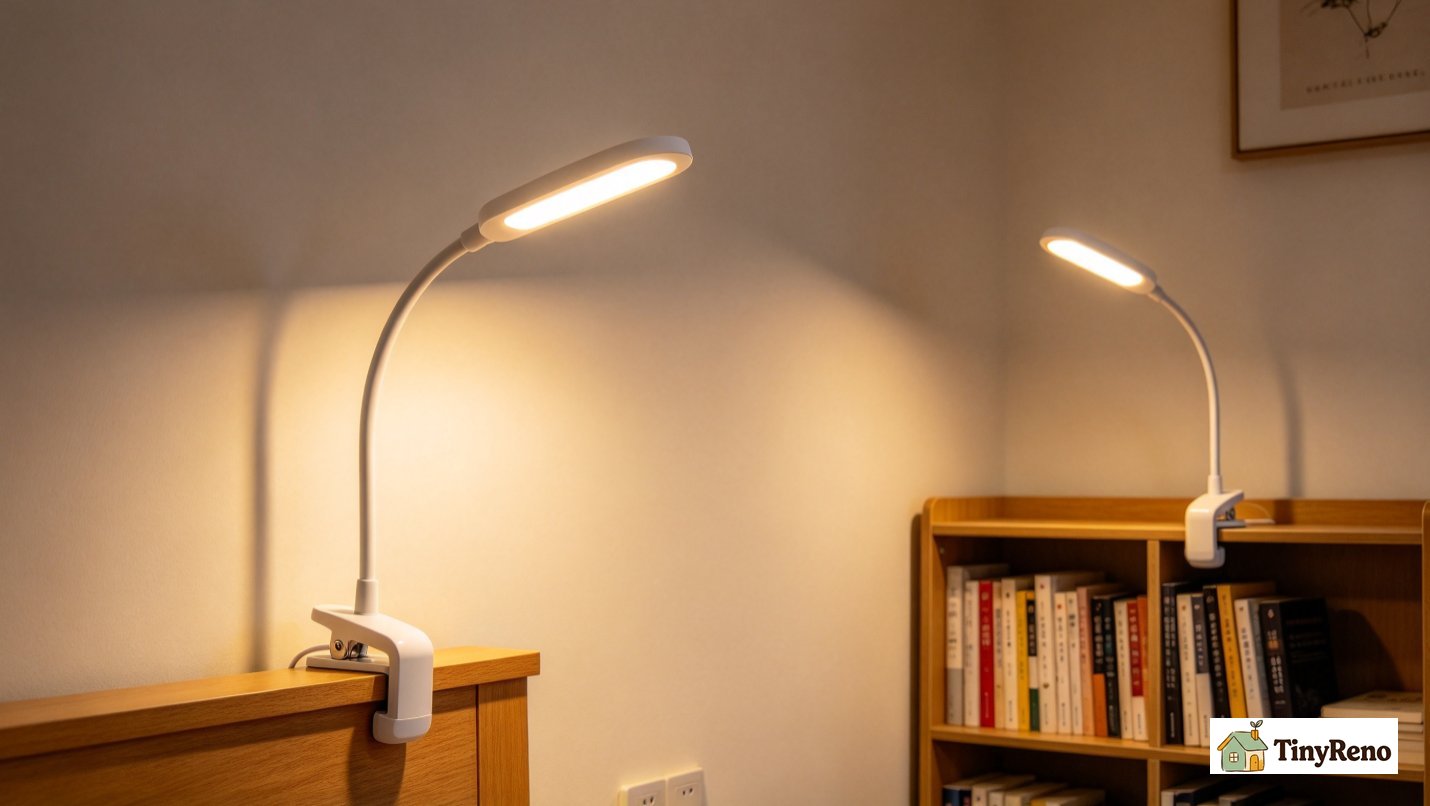
Fix 1, the $9 clamp-on LED reading lights, total $18, verdict kept
The first fix I tried, on the evening of January 14, was a pair of clamp-on LED reading lights from the Home Depot in Bayonne. The lights cost $9 each, the bulbs were integrated so there was no separate bulb to buy, the clamp opened to 2.5 inches which fit on the edge of my desk, and the gooseneck bent 180 degrees in any direction. The install took about 4 minutes for both. I clamped one to the desk and pointed it at the wall behind the monitor for a soft indirect fill. I clamped the second to the bookshelf and pointed it at the ceiling for a soft indirect bounce. The room went from black to lit in about 6 minutes. The lights are still in place on April 18. The lights worked every day, every evening, every weekend. They were one of the cheapest fixes that actually moved the needle on a dark rental apartment with no overhead light. The total was $18. The verdict is keep.
The clamp-on design is the trick that makes the fix renter-safe. The clamp touches the wood edge of the desk or shelf, not the wall or the ceiling, and the cord runs along the floor to the nearest outlet. There is no drilling. There is no adhesive that could damage paint. There is no wiring. The clamp opens and closes with a single thumbscrew that does not mark the surface. When I move to my next apartment in November, the lights come with me. When the lease ends, the desk does not have two pucker marks where the clamp was. The clamp is the renter-correct way to add light to a dark apartment without touching the property.
Fix 2, the $24 pendant cord, total $24, verdict partial keep
The second fix was a pendant cord with a wooden hook, $24 from Amazon on a Saturday delivery. The idea was to hang a single bulb from the ceiling in the corner opposite the sofa, with the cord running down to a wall outlet that I would not have to drill into the wall. The kit came with a hook that you screw into a wooden door frame, a cord that runs from the hook to the outlet, and a socket that hangs at the bottom of the cord. The instruction said to mount the hook in a ceiling joist, but a ceiling joist requires drilling into the ceiling, which requires landlord permission. I did not drill the ceiling. I used a removable tension rod or a clamp-style hook where possible. If you screw into a wooden door frame, treat it as a small hole that needs landlord approval and patching at move-out. The install took about 20 minutes. The bulb hung at eye level above the sofa. The room went from dark to moody. The total was $24. The verdict is partial keep.
The reason the verdict is partial and not full is that the door-frame mount is visually awkward. The cord crosses the corner of the room at a slight diagonal and reads as a fix rather than a feature. It is also not a permanent install, which is what makes it renter-safe, but it is also not invisible. Visitors asked about it. I told them the truth, which is that the ceiling light was missing and the landlord had not yet sent the maintenance guy. The pendant cord did its job, which was to add a second warm source in the corner opposite the sofa. The pendant cord stayed until I replaced it with the floor lamp. I would buy it again for a dark apartment that did not have a floor lamp option, which is the right scenario for the fix.
Fix 3, the $14 smart bulb, total $14 plus $9 hub, verdict failed by week 4
The third fix was a smart bulb. The bulb was a $14 Sengled A19 at Best Buy, the hub was a $9 Sengled hub from the same store, and the install was the bulb-twist plus the hub-plug plus the app-download plus the app-onboarding. The bulb worked the day I installed it. I could dim it from my phone, schedule it to come on at 4:45 p.m. every day, and set it to 2400K warm for the evening. The schedule worked for 27 days. On day 28, my internet provider reset the router during a maintenance window at 3 a.m., the bulb lost its connection to the hub, the hub lost its connection to the cloud, and the app refused to reconnect even after three factory resets. The bulb became a regular bulb, which meant the schedule feature was dead. I unscrewed the bulb on day 32. Total spent: $23. The verdict is failed by week 4. The lesson is that smart-bulb features are tied to the network, and network reliability is not something a renter controls.
The reason this fix is in the report even though it failed is that the failure mode is not obvious to most renters. A smart bulb looks like the perfect fix for a dark rental apartment with no overhead light, because the dimming and scheduling are exactly what you want for a winter evening. The hidden dependency is the home network. When the network has a hiccup, the smart features are the first to fail. The bulb still works as a bulb. The schedule does not. If you are buying a smart bulb for the schedule feature, buy a regular bulb and a $7 plug-in timer instead. The timer does not depend on the network. The timer does not need an app. The timer works every time.
Fix 4, the $19 West Elm plug-in sconce, total $19, verdict kept
The fourth fix was a West Elm plug-in sconce, $19 on a clearance rack in the West Elm outlet store in the Chelsea neighborhood of Manhattan. The sconce is a half-sphere of metal with a fabric shade. It can be mounted with removable adhesive strips rated for its weight, with no drilling, no anchors, and no holes, and it plugs into a standard wall outlet. Check the sconce weight against the strip rating and test the adhesive on a small hidden spot first. The cord is 6 feet long, which is enough to reach the outlet from the corner where I mounted it. The sconce gives an upward throw of warm light onto the ceiling that mimics the soft indirect fill of a built-in fixture. The total was $19. The verdict is keep.
The West Elm plug-in sconce is the single best renter-safe lighting option I have found. It looks like a fixture. It performs like a fixture. It does not require any wiring, drilling, anchors, or landlord permission. The command strips hold the sconce to the wall, which means the sconce is removable in 30 seconds when the lease ends. The cord is white. The bulb is replaceable. The sconce took 5 minutes to install and has stayed in place since February 4. The sconce is the kind of fix that you would recommend to every renter who has a dark apartment and no overhead light, and the $19 price is the kind that makes the recommendation easy.
If you are dealing with a dark rental and no overhead light, the sconce is the single item I would prioritize. The sconce solves the problem on the wall that faces the sofa, which is the wall your eye reads first. The sconce pushes your setup from developer default to intentional in under five minutes of install.
Fix 5, the $14 floor lamp, total $14, verdict kept
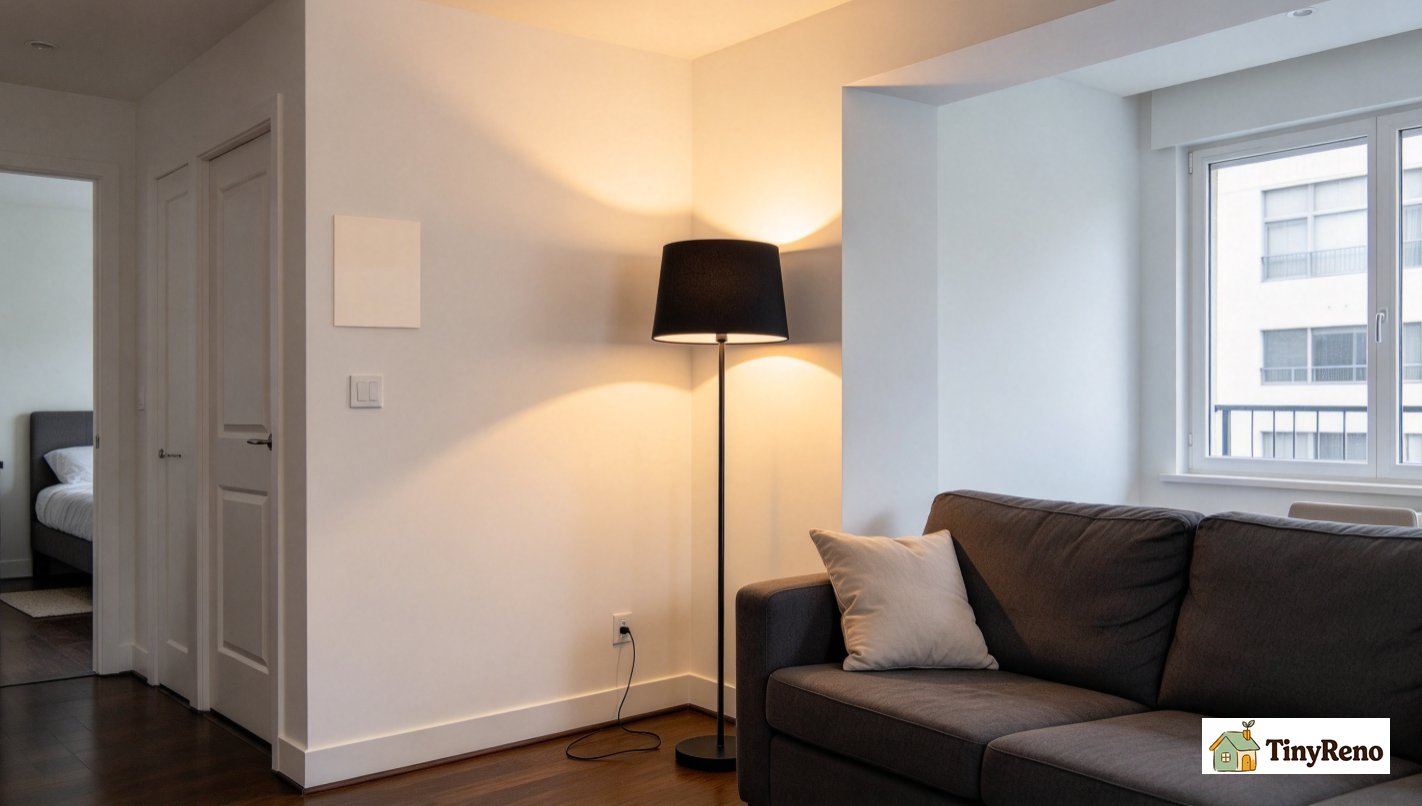
The fifth fix was a floor lamp, $14 at Home Depot on a Saturday afternoon. The lamp is a 5-foot black pole with a drum shade, takes a single A19 bulb, and weighs about 7 pounds. It is relatively stable, but a 7-pound lamp can still be knocked over by a pet or a child, so keep it against a wall or out of the main walking path. The lamp went in the corner opposite the sofa. The bulb I put in it was the same 2700K soft-white bulb from the rest of the apartment, which is the bulb that reads as warm in my Jersey City living room. The lamp did what a floor lamp does, which is to put light at eye level for someone sitting on the sofa. The eye-level light is the key fix for a dark rental apartment with no overhead light, because eye-level light is what the eye reads as a room that is lit by design rather than by default. The total was $14. The verdict is keep.
Fix 6, the three-pack of bulbs, total $7.92 after coupon, verdict kept
The sixth and final fix was a three-pack of 2700K soft-white A19 LED bulbs, $8.96 at Home Depot, minus a $1.04 coupon I had from a previous visit. The bulbs replaced the 4000K cool-white bulbs that the developer had installed in the kitchen and the bedroom fixtures. The 4000K bulbs were the same bulb that the developer had put in the missing overhead socket, which is what made the living room read as cold and the kitchen read as cold and the whole apartment read as institutional. The three new bulbs at 2700K turned the kitchen and bedroom warm at the same time. The three-pack cost $7.92 after coupon, about $2.64 per bulb. The verdict is keep.
The bulb fix is the cheapest on the list and the most universal to every dark apartment. The 4000K cool-white default bulb is the single most underrated reason a winter apartment reads as cold. Swapping to 2700K soft-white takes 30 seconds per bulb at about $3 per bulb. The bulb is portable, moves to the next apartment, and is the single highest-impact fix on the $67.96 list. The bulb is the fix I would buy first for the dark apartment lighting renter no overhead light winter setup if I had to pick only one.
The final config, the cost, and what I would do differently
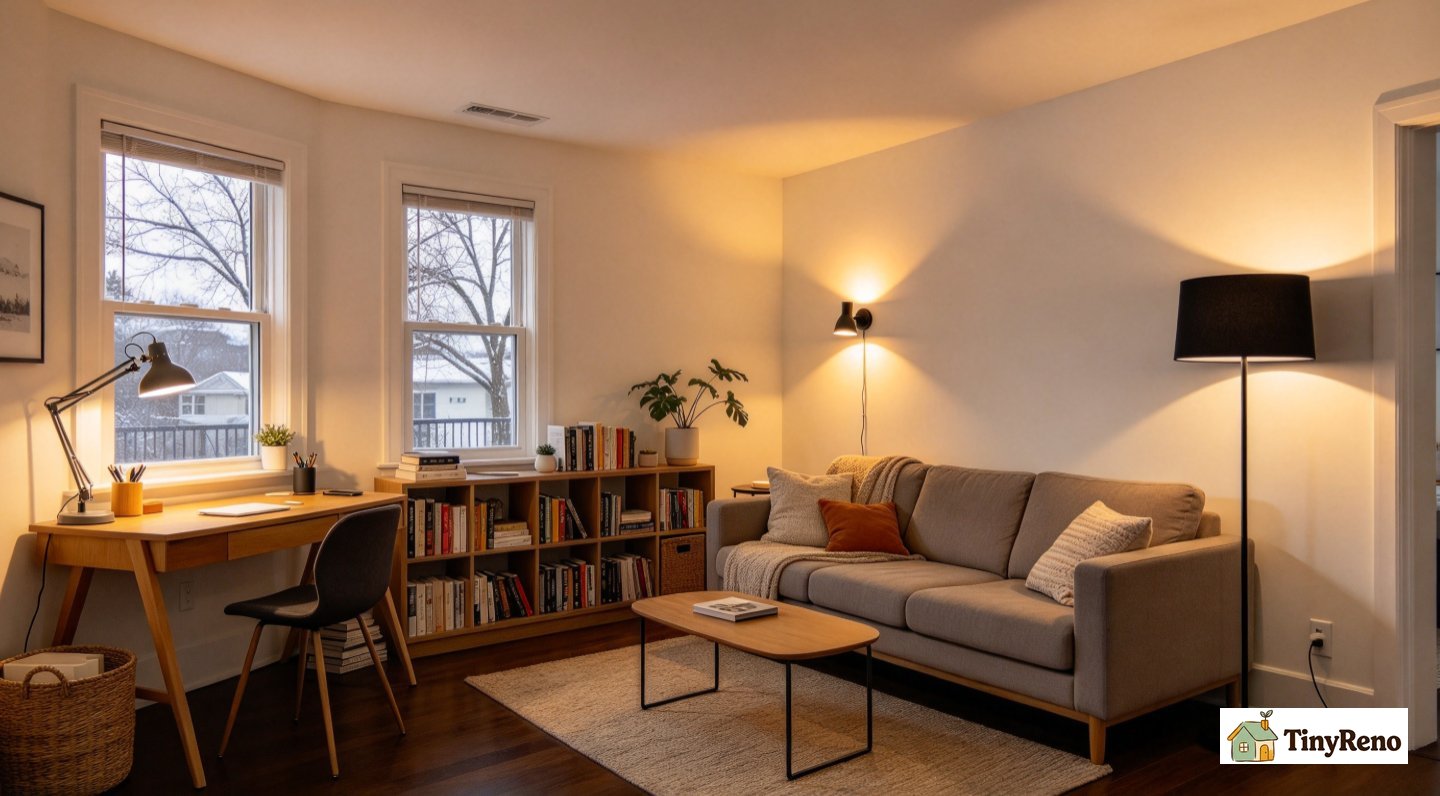
The final config on April 18, 2026, in my Jersey City apartment, is: two $9 clamp-on LED lights on the desk and the bookshelf, the $19 plug-in sconce on the wall, the $14 floor lamp in the corner, three 2700K bulbs from the $7.92 three-pack in the kitchen and bedroom fixtures, and a small ceramic table lamp with a warm bulb that I bought for $14 from a thrift store on Grove Street in March and added in week 11. The final kept setup cost about $73. Total spent testing all options, including the pendant cord and the failed smart bulb, was about $120. The apartment went from dark at 4 p.m. in January to lit at 4 p.m. in February. The landlord's maintenance guy never came. I did not file a complaint, but I did send a written repair request and kept the reply, because a missing overhead light can be a habitability issue and the paper trail matters if the deposit is ever questioned. The total cost of the renter-safe workaround was less than a single electrician visit, and the renter-safe workaround does not require the landlord's signature.
What I would do differently, in priority order. One, buy the West Elm sconce first. Two, buy the floor lamp second. Three, swap the 2700K bulbs in every existing fixture before buying anything else. Four, skip the smart bulb unless the home network is rock solid. Five, buy the clamp lights as a tertiary add, not as the primary light. The order of fixes is the lesson, and the lesson is the answer. The final setup is about $73, and the total test spend was about $120. The apartment is lit. The deposit is safe. The lease is intact. The dark apartment is now a warm apartment, and the warm apartment is the only one I want to live in.


Discussion (0)
Sign in to join the discussion