

Making my rental feel warm in fall was the project I tackled my second October in this Long Island City lease, when the sun started setting before 6 p.m. and my one-bedroom apartment on 47th Avenue started feeling like the inside of a refrigerator every evening between 5 and 8. The apartment is a 2018 new-construction box, 612 square feet, with picture windows facing east, white walls the landlord had painted Benjamin Moore Decorator's White, and four overhead fixtures that the developer had installed with 4000 Kelvin cool-white LED bulbs. The cool-white bulbs were the lease default. They are often the cheapest bulb a developer can buy in bulk, and they read as institutional in every room of the apartment. The first October I lived here I bought a single warm-white bulb, replaced the kitchen overhead, and thought I had fixed the problem. The second October I made five swaps — three lamps and several warm bulbs — and spent about $105 total at Target and Home Depot on Vernon Boulevard. If I had thrifted the floor lamp for about $10 instead of buying it new for $39.99, the total would have been about $75. Either way, I turned the same apartment into a place that finally felt like fall without changing a fixture. Here is what worked, what did not, and the order that mattered.
The reason fall is different from summer in a rental is not the temperature, it is the angle of the light. In June the sun sets after 8:30 p.m., the apartment stays bright until 9, and a single warm bulb is enough to bridge the gap. In October the sun sets at 5:46 p.m. on the 31st, the overhead light goes on at 5:30, and that overhead is on for the next four hours. If the overhead is 4000K cool-white, those four hours read as a clinic waiting room, not as a home. The fix, for a renter who cannot change fixtures, is to remove the 4000K cool-white from the equation and replace it with warm-white bulbs in the same socket and add layered light from lamps that sit on the floor and the side tables. Fixtures stay the same. The apartment feels different. The deposit stays safe.
The chronology of my second October went in five swaps, ordered from cheapest to most expensive.
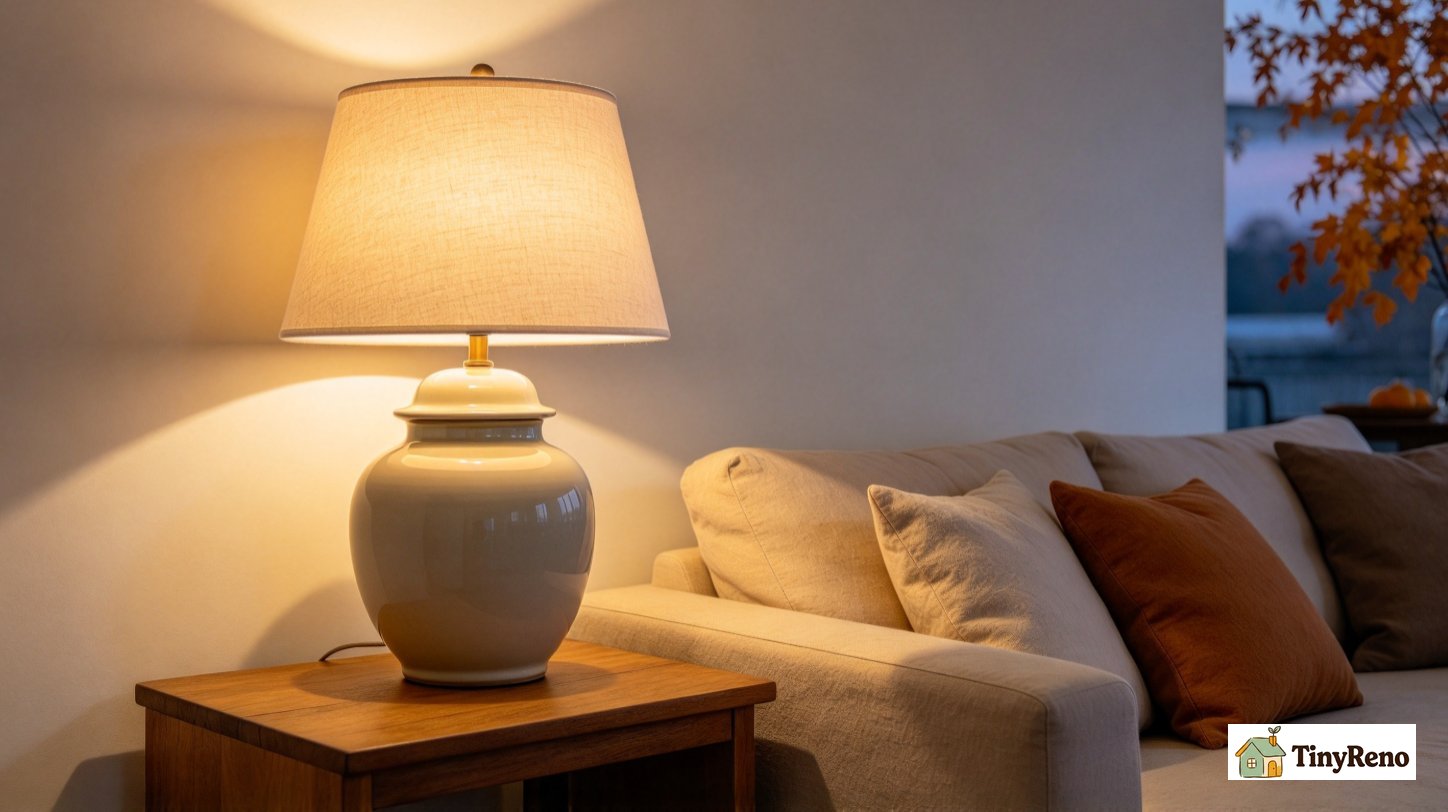
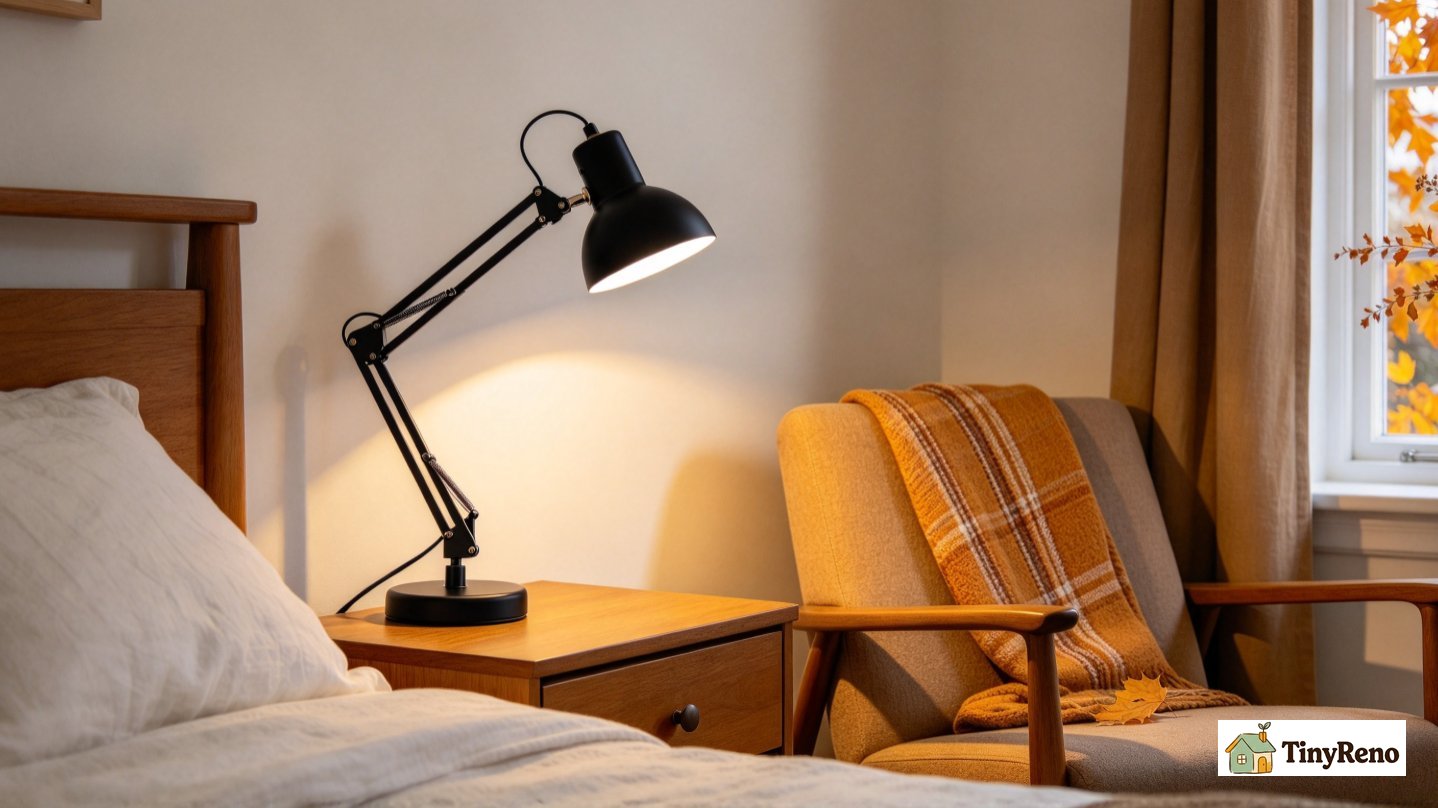
Swap one was a single GE 2700K soft-white A19 bulb for the kitchen overhead, $4.97 at Target. Swap two was a pack of three West Elm Warm 100 LED bulbs at 2400K for the three remaining overhead fixtures, $14.97 at Target. Swap three was a 60-inch brushed-nickel floor lamp with a linen shade from the Threshold line at Target, $39.99. Swap four was a ceramic ginger-jar table lamp for the side table next to the sofa, $24.99 at Home Depot on Vernon Boulevard. Swap five was a small matte-black pharmacy-style lamp for the bedroom dresser, $19.99 at Target.
The total with the new floor lamp was $104.91. If you find a floor lamp at a thrift store for about $10 instead of $39.99, the total drops to about $75. I quote both numbers because the floor lamp is the one item a renter can reasonably thrift. The bulbs and small lamps are the load-bearing part of warm lighting for a rental in fall without changing fixtures.
Why 4000K reads cold even when the apartment is warm
Color temperature is the part of the lighting industry that most renters never learn and most landlords rely on for cost. A 2700K bulb puts out a yellow-orange light, like an incandescent bulb from the 1970s. A 3000K bulb is whiter, like a halogen. A 4000K bulb is common in apartments because it is cheap and reads as bright in a model unit. The problem with 4000K in a fall apartment is that human eyes read it as institutional even when the room is comfortable. The walls reflect the cool cast back at the room. The floor reflects the cool cast back at the ceiling. By the third hour of an October evening, the cumulative effect of 4000K reflection in a beige room reads as a pharmacy waiting area, not as a home. The fix is to remove the 4000K source from the room, which means swapping the bulb, which costs $5 and 30 seconds of twisting. The fix does not require changing the fixture. The socket stays. The apartment stays. The bulb changes.
The trick is the color temperature number on the bulb package, not the wattage. Most renters in October buy a higher wattage, thinking more light will make the room feel warmer. More light at 4000K makes the room feel brighter, which makes the institutional cast more obvious. The right number is the same wattage in 2700K or 2400K, which is what most bulb manufacturers call "soft white" and "warm white." The package is identical in size to the existing bulb. The cost is identical. The only change is the kelvin number on the label. A renter who swaps four bulbs is spending about $20 and 2 minutes of unscrewing. The apartment reads warm the same evening.
The five swaps, in the order I made them, with the prices that mattered
Swap one was the GE 2700K A19 bulb, $4.97 at Target on Vernon Boulevard in October 2025. I stood in the lighting aisle for about 15 minutes because the bulb labels have a wide range of numbers and the bulb names overlap. The bulb I wanted was the one labeled "soft white" with a kelvin number of 2700. The bulb I avoided was the one labeled "daylight" with a kelvin number of 5000, which is what people who work from home buy for their office and is not what you want in a fall living room. The kitchen overhead, which was the highest-traffic fixture in the apartment, was the first one I changed. The difference was visible within the first evening. The kitchen went from pharmacy white to a soft amber that matched the dining table my landlord had left behind.
Swap two was a three-pack of West Elm Warm 100 LED bulbs at 2400K, $14.97 at the same Target. The Warm 100 line is the West Elm house brand and it is the most affordable 2400K bulb on the market. The 2400K rating is one full step warmer than the 2700K in swap one, which is why I bought it for the living room and bedroom fixtures and not the kitchen. Living-room fall lighting wants to lean warmer than kitchen fall lighting, because the kitchen is for work and the living room is for sitting. The two bulbs cost $0.50 more per bulb than the cheapest 2700K bulbs and the difference in the evening light is significant. The living room went from cool to warm the same evening. The bedroom went from cool to warm the next morning.
Swap three was the floor lamp. $39.99 at Target, in the Threshold line, brushed-nickel pole with a 60-inch height and a linen shade. The floor lamp was one of the most important changes in a fall rental because it does what the overhead cannot: it puts the light source at eye level when you are sitting on the sofa. Overhead lighting, by definition, throws light down at the tops of heads. Eye-level lighting is what makes a room feel cozy. The position is the trick. The lamp itself can be any color, any finish, any material. The position is the variable that matters. The floor lamp went into the corner opposite the sofa, which is the corner that the overhead does not reach, and the corner went from black at 6 p.m. to a soft amber pool of light.
Swap four was a ginger-jar ceramic table lamp, $24.99 at Home Depot on Vernon Boulevard, 18 inches tall, with a drum shade in oatmeal linen. The ginger-jar shape is what designers call a "warm" shape because the curves soften the look of the table it sits on. The ginger jar went on the side table next to the sofa. The total cost of swap one plus swap two plus swap four was $45, and the change in the room was the difference between feeling like a rental and feeling like a home. Swap five was the small pharmacy-style lamp, $19.99 at Target, for the bedroom dresser. Use LED bulbs that do not exceed the lamp’s rated wattage, and keep floor and table lamps out of walking paths so they are less likely to tip. The pharmacy lamp is the lamp shape that designers keep around because the arm pivots and the bulb can be pointed at whatever you are reading. The bedroom reading chair is now lit at 2400K from arm-level instead of 4000K from ceiling-level. The light is warm, the arms do not get tired, and the room reads as a retreat.
The layered light rule that makes one lamp not enough
Lighting designers have a name for the configuration that makes a room feel warm to a human eye: layered light. Layered light is what you get when a room has three or more light sources at three different heights, casting light in three different directions. A single overhead is one layer. An overhead plus a floor lamp is two layers, which is better than one but still reads as room-with-lamp, not as a warm room. An overhead plus a floor lamp plus a table lamp plus a dresser lamp is four layers. For me, four layers was the point where the room stopped reading as a room with lamps and started reading as a warm room. The fifth swap in my apartment was the move from three layers to four layers, and it is the one that pushed the room past the threshold.
The order of the five swaps was important, not because any swap required another, but because the cheap swaps had to come first to prove the warm-cast was the actual answer. If I had bought the floor lamp first, I would not have known if the room was warmer because of the bulb or because of the lamp. By swapping the bulb first and only the bulb, I could see the warm-cast effect on its own. Then the second swap added the rest of the overheads. Then the lamps added the layered effect. Each swap built on the last. The total bill was $104.91 with the new floor lamp, or about $75 if you thrift the floor lamp for about $10, which is a real assumption in Long Island City where there are six thrift stores within walking distance of the 47th Avenue building. The $75 figure is the comparison point for a renter who thrifts the floor lamp.
What warm lighting in a fall apartment does and does not change
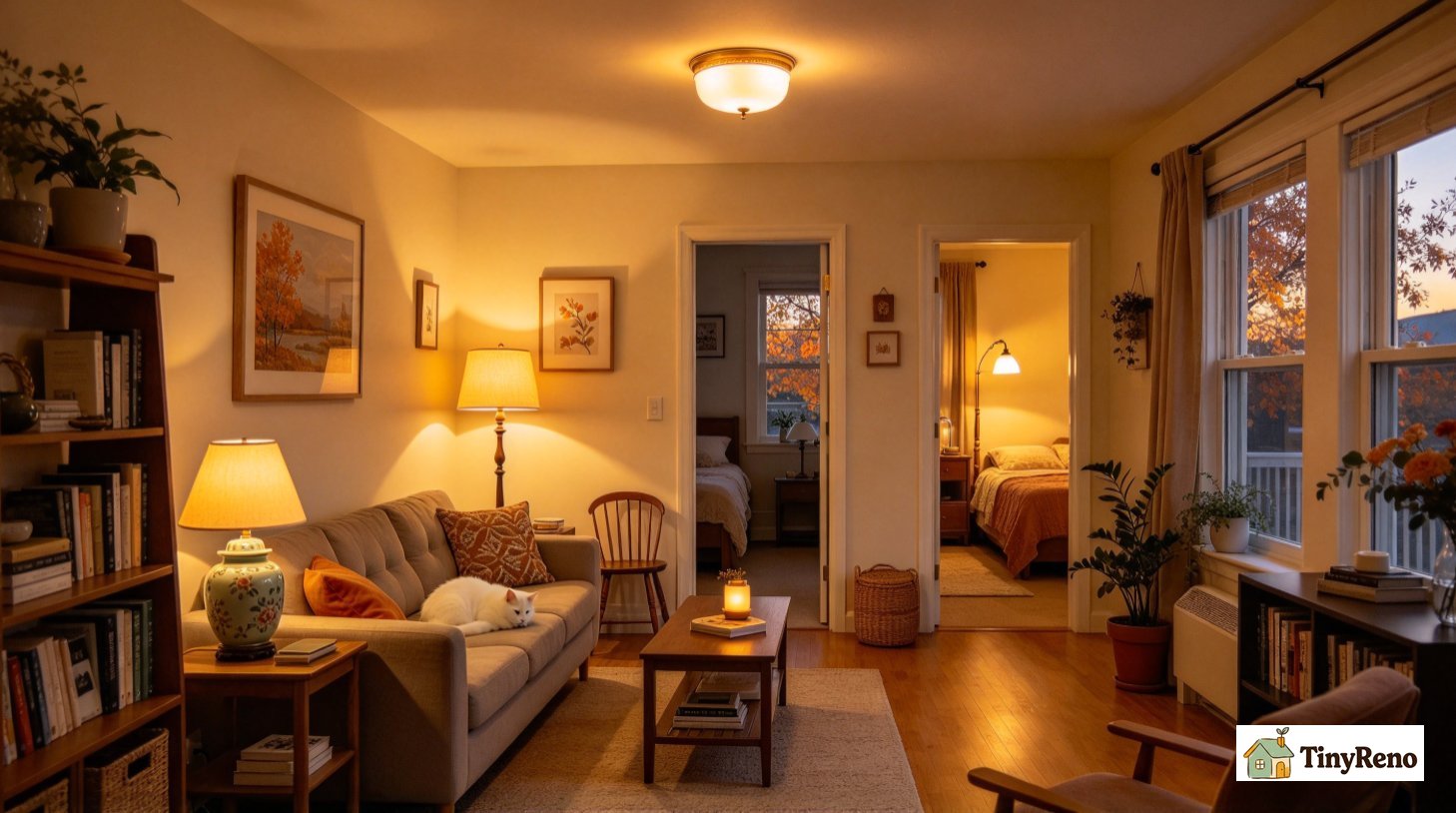
Warm lighting does not make the apartment bigger. It does not insulate the windows. It does not replace the missing overhead in the bathroom, which is a separate complaint I will write about another year. What warm lighting does is change the way the apartment feels between sunset and bedtime. The walls stop looking white and start looking beige. The sofa stops looking gray and starts looking oat. The cat, Mochi, stops looking like a small white cat and starts looking like an actual cat. The change is psychological, it is real, and it costs about $105 with a new floor lamp, or about $75 with a thrifted one, plus a few trips to Target and Home Depot.
For my lease, which forbids fixture changes, the five swaps were the practical limit. You cannot rewire the apartment. You cannot install a dimmer. You cannot move the overheads. The five swaps are the toolkit. The toolkit buys a fall that feels like fall, an evening that feels like evening, and a $105 receipt, or about $75 with a thrifted lamp, that changed the room more than a much larger renovation did for my landlord's lobby. The apartment is the same apartment. The light is different. The deposit is safe. The lamps come with me to the next place, which is the one financial note worth keeping: the lamps and bulbs are portable assets. When I move next October, the lamps move with me. The bulbs move with me. The next apartment will be warm by the second evening, not by the second month. That portability is the entire point of the project, and it is the answer to every renter who has ever asked me what to do about a cold-feeling fall apartment without violating the lease.


Discussion (0)
Sign in to join the discussion