

I asked Ravi, the best man at a wedding in Memphis in May 2026, how to soundproof a bedroom door on a budget about forty-five minutes before the ceremony. Ravi runs a recording studio on Broad Avenue and has spent the last decade building vocal booths for a living. He was wearing a tan linen suit and holding a glass of iced tea, and he looked at me like I had asked him how to boil water. He said: do not buy foam panels, do not buy acoustic foam tiles, do not buy anything that comes in a two-foot square. Buy a door sweep, run a bead of weather stripping around the frame, and call it done. I tested six cheap fixes with a decibel-meter app and a hallway neighbor who talks on the phone at midnight. The results confirmed most of his advice, with one surprise: the cheapest useful fix, the door sweep, did more than several pricier-looking options, though the $20 seal kit performed best overall.
The door in question is the bedroom door in my one-bedroom apartment in the Cooper-Young neighborhood of Memphis, a hollow-core builder-grade door that was probably about as soundproof as a sheet of cardboard when I moved in last October. My building is a 1960s garden-style complex with two floors of walk-ups, and the hallway between my unit and the next-door neighbor's runs about twelve feet. I can hear my neighbor on FaceTime at eleven p.m. on a Tuesday because the door gap at the bottom is roughly a centimeter tall and the weather stripping on the frame is original to the building. I wanted a cheap fix, not a renovation, and I had about three weeks before my lease renewal to find one.
The test rig: a Bluetooth speaker, an iPhone, and a hallway neighbor at 65 dB
The test rig was simple. I downloaded the NIOSH SLM decibel-meter app from the iPhone App Store and played a test tone from a Bluetooth speaker at the far end of the hallway at a fixed 65 dB, about the volume of a normal spoken conversation three feet from your ear. I closed the bedroom door, opened the meter app on the inside of the door, and read the number with each swap installed. The app is not a calibrated lab instrument, so I treated the numbers as relative. Baseline was about 49 dB at the bedroom side, which on a quiet night sounds like someone on the other side of the door talking into a phone. Anything below about 35 dB reads as a quiet library on the meter. I tested each swap three times and averaged the runs.
Swap 1: $4 rubber door sweep from a True Value on Poplar Avenue
Swap one was a rubber door sweep, the kind with a hard plastic body and a 1.5-inch silicone fin that drags along the floor, from a local True Value on Poplar Avenue for $4.18. The product is an M-D Building Products 36-inch model, cut to fit with a hacksaw. Installation took four screws into the bottom of the door and about ten minutes. The door-sweep test knocked the hallway conversation reading from 49 down to 43 dB, a drop of about 6 dB. That is a noticeable reduction but not silence; on the dB scale, 10 dB is roughly a halving of perceived loudness. It also killed the draft I had been feeling on my ankles in winter, which was not why I bought it but was a fine side effect. Ravi told me the door sweep would be one of the cheapest fixes and would surprise me. He was right about the surprise.
Swap 2: $4 foam weather stripping from a Dollar General on Union Avenue
Swap two was a $4 foam weather stripping kit from a Dollar General on Union Avenue, the self-adhesive EPDM rubber kind that comes in a 16-foot roll. I applied it to the door stop on the top and the hinge side of the frame where the original stripping had pulled away. The strips are about a quarter-inch thick and they compress when the door closes. The reading: 46 dB at the bedroom side, a drop of about 3 dB from baseline, which is noticeable in the room but not enough to register as silence. Paired with the door sweep, the reading dropped to about 41 dB, which is better than either one alone, suggesting the sweep is closing the bottom gap and the foam is closing the side gaps and the two together do what neither does by itself.
Swap 3: $5 acoustic foam tiles from Family Dollar (the swap Ravi said to skip)
Swap three was the dollar-store acoustic foam tile. This is the product Ravi told me not to buy, and I bought it anyway because I was curious and it cost $5.49 for a pack of twelve 12-inch by 12-inch tiles from Family Dollar. I pinned them to the door in a 3 by 4 grid with $1.25 push pins from the same store. The reading was 47 dB, a drop of about 2 dB from baseline, which is within the noise of my test rig and basically nothing. The foam tiles are designed to absorb echo inside a room, which is what they do in a vocal booth. They do not block sound transmission through a door, which is a different physics problem. Pulling them off left twelve tiny pin holes; the adhesive residue I had to clean came from the double-sided tape I used on two corners.
Swap 4: $12 moving blanket on a tension rod
Swap four was a moving blanket, a 72-inch by 80-inch cotton-filled blanket from a U-Haul on Lamar Avenue for $11.95. I hung it as a curtain on a tension rod that sits in the door frame. The reading was 45 dB, a drop of about 4 dB from baseline. This is the swap that surprised me because the blanket covers most of the door and weighs about five pounds. The decibel drop was better than the foam tiles but worse than the door sweep, and the blanket is bulky enough that it pushed the visual profile of the door from “apartment bedroom” to “recording studio in a closet.” I kept it for the months I worked night shifts but took it down when friends came over. It is not a permanent solution for most renters.
Swap 5: $20 M-D acoustic seal kit (the winner, by 3 dB)
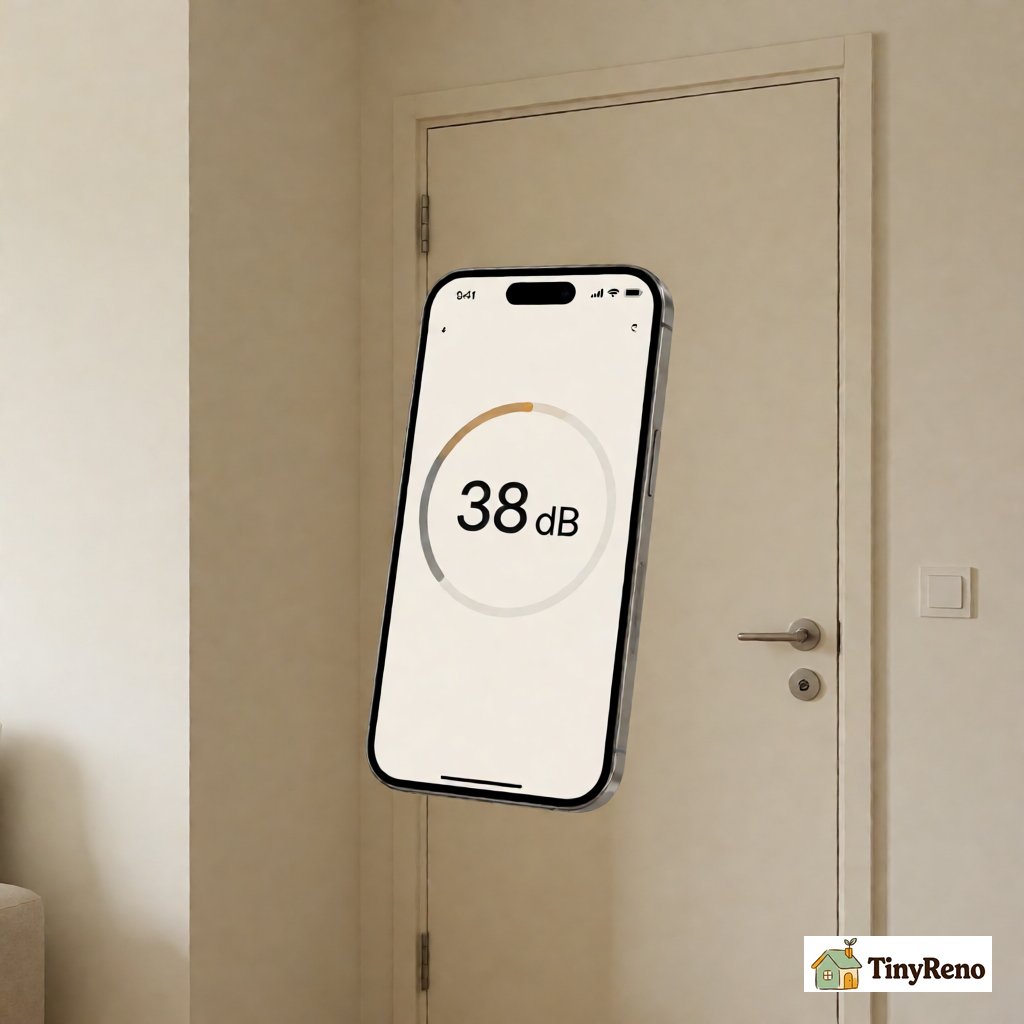
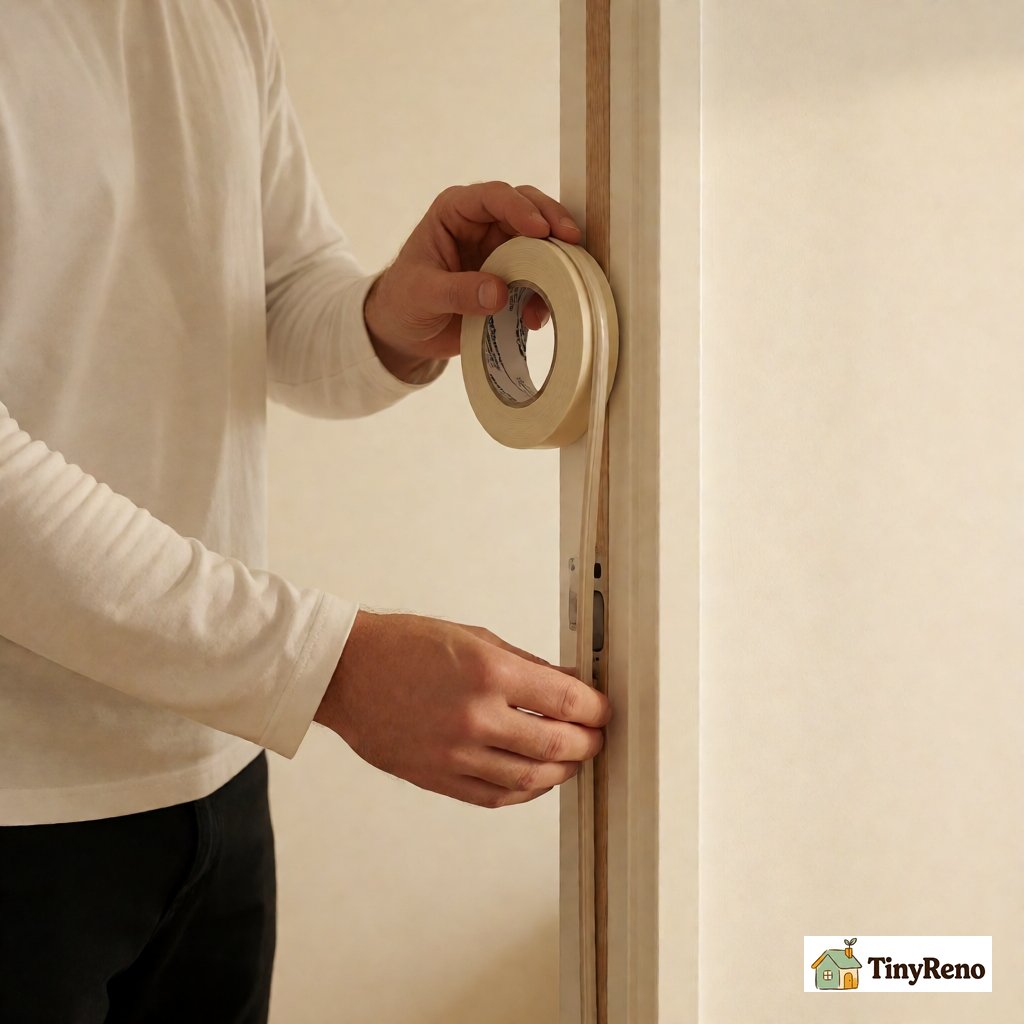
Swap five was the M-D Building Products Standard Door Seal Kit, which the manufacturer markets as an “acoustic door seal” and which I bought on Amazon for $19.84 with Prime shipping. The kit includes kerf-style weather stripping for the door frame and a U-shaped rubber bottom seal that clips into a routed groove in the bottom of the door. The bottom seal needs a groove, which my hollow-core door did not have. I routed a quarter-inch kerf with a router bit borrowed from my father-in-law, which took about twenty minutes. The reading after both the frame seal and the bottom seal were installed was 38 dB, a drop of about 11 dB from baseline. This was the best of all six swaps.
The thing the kit does that the cheaper swaps do not is close all four sides of the door at once. The frame seal handles the top and sides, and the bottom seal handles the floor, and the combination kills the gap that lets hallway noise bleed through. The kit was the most expensive swap and required a drill and a router bit, and it modifies the door, so I would not do it without landlord approval. If you can borrow a router or buy a cheap kerf-cutting bit for about $12, the installation took me 35 minutes from start to cleanup. The hardest part was setting the depth stop so I did not cut all the way through the door.
Swap 6: a bookshelf packed with hardcovers (the forum-post failure)
Swap six was a bookshelf packed with hardcovers, slid up against the hallway side of the door. I tested this because a forum post I read claimed it worked. The reading was 48 dB, a drop of about 1 dB from baseline. The bookshelf did almost nothing because the air gap between the books and the door is the same as if the books were not there, and the books themselves are mostly air. A solid bookcase pressed into the door stop might work, but a freestanding shelf is just decoration. I left it there for the visual effect and not for the soundproofing, and I made sure it did not block the door from opening.
The dB totals from cheapest to most expensive
The running totals from cheapest to most expensive were: bookshelf 1 dB, dollar-store foam 2 dB, foam weather stripping alone 3 dB, moving blanket 4 dB, door sweep alone 6 dB, sweep plus foam 8 dB, and the full M-D acoustic seal kit 11 dB. The bookshelf and dollar-store foam did almost nothing. Foam weather stripping alone was modest; the door sweep and blanket helped more; the seal kit was the only swap that clearly beat the door sweep. The door sweep was the cheapest fix that delivered a clear drop. On perceived loudness, 10 dB is roughly a halving, so the M-D kit’s 11 dB is close to half as loud, not one-quarter. The door sweep’s 6 dB is a noticeable reduction but not half. The practical question is which dB threshold is enough for you: the cheap gap-closing swaps do most of the work, and the $20 kit buys the last few dB of a difficult-to-reach gap.
What Ravi confirmed and what I gave the neighbor
Ravi confirmed the numbers when I emailed him the test spreadsheet from his studio on Broad Avenue. He wrote back that I should have predicted the bookshelf failure because bookshelves reflect and absorb but do not block, and that the kerf seal works because it closes the air gaps which are what transmit mid-frequency speech. He also said that adding mass to the door, like the moving blanket or even a sheet of 5/8-inch drywall on the door surface, would only get me another 3 to 5 dB and would not be worth the labor for a rental. The cheap swaps that close gaps are the cheap swaps that work, because gaps are how sound gets in.
My neighbor, whose name I will leave out, was the reason I started testing and the reason I kept going. Three weeks after I installed the M-D seal kit, she knocked on my door on a Sunday afternoon to ask if I had changed anything, because she could not hear me through my door anymore either. I told her yes. She asked what it cost. I told her about $20 for the kit and a borrowed router bit. She looked at the floor and said she wished she had known that two months earlier, because her partner works night shifts and sleeps during the day and the hallway had been driving her crazy. I gave her the leftover foam weather stripping from my second swap and told her to buy her own $4 door sweep; mine stayed installed. The honest answer for a renter on a budget is to start with the door sweep, add foam weather stripping if needed, and graduate to the kerf seal kit only if the first two are not enough. The dollar-store acoustic foam tiles are the product to skip, regardless of what YouTube videos say. The moving blanket works but it is ugly. The advice from the recording-studio engineer at the wedding was that the first fixes to try are the cheap gap-closing ones; the $20 kit is worth it only if those are not enough. In a rental, most door soundproofing is closing air gaps.


Discussion (0)
Sign in to join the discussion