

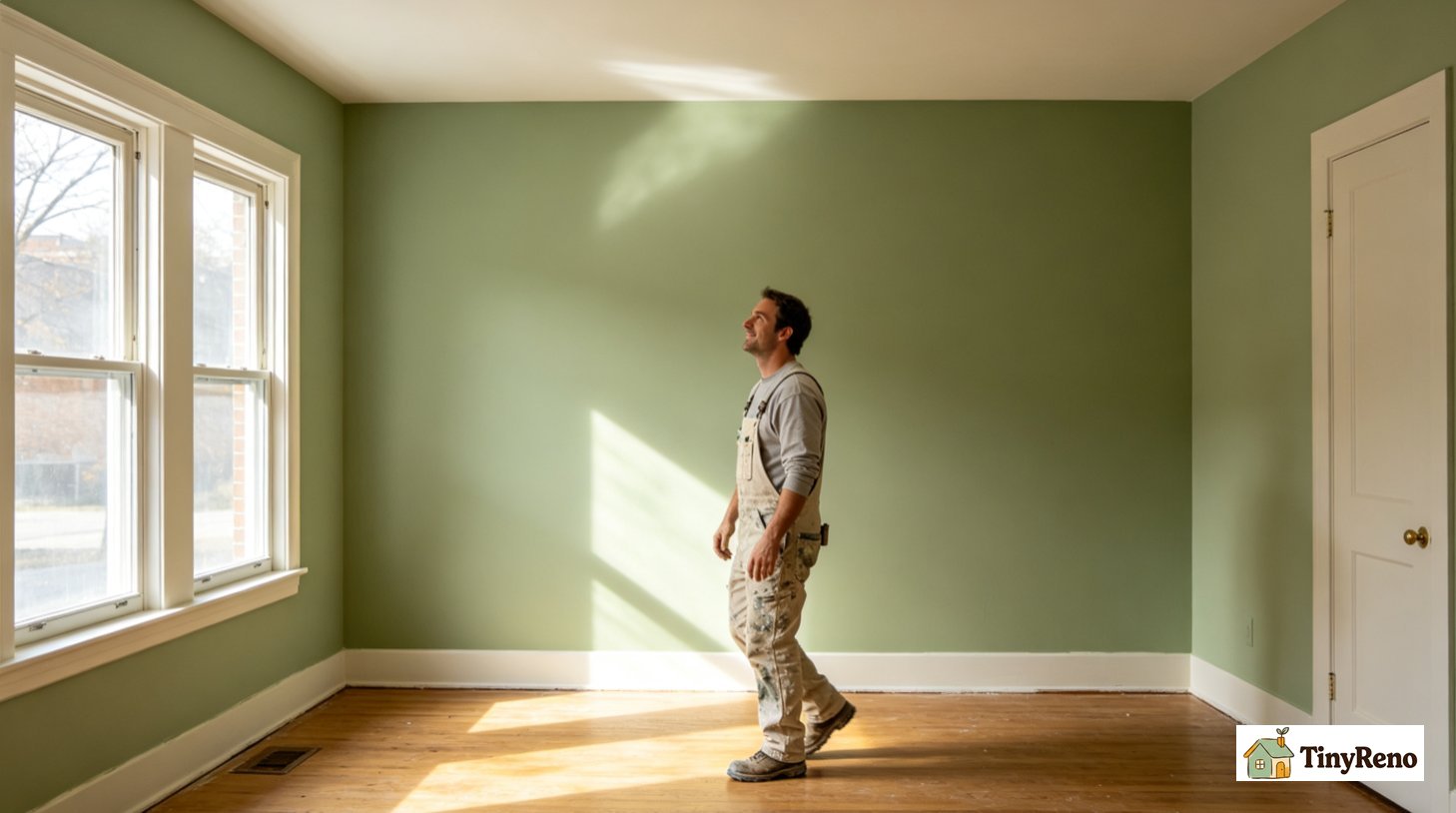
I asked Sam Renner which accent wall color to use in a small bedroom on a Sunday morning in March 2026, after I had taped off the wall opposite the window in my bedroom in a 1920s brick two-flat in Bay View, Milwaukee, and realized I had six Behr swatches and no idea which one to commit to. The bedroom is 10 feet by 11 feet, with a single east-facing window that gets morning sun, an original plaster wall with a faint crack near the outlet, and a landlord who allowed painted accent walls if I returned the wall to off-white within 30 days of move-out. Sam had been painting apartments in Milwaukee for nineteen years, and he had a rule: “Never pick the swatch you are most excited about in the store, because the one you forget is often the one that works.” I tested his rule over six weekends on the same wall, with the same primer, in the same room, and the winner was a muted sage green I almost did not test because it looked boring on the paint chip.
Navy, Charcoal, and the Three Swatches That Made the Room Feel Smaller
The first swatch I tested was a deep navy blue, Behr Blueprint S470-7, because navy was what every apartment magazine seemed to recommend in 2025 and I had a navy pillow with a thin white stripe. The room has a queen bed on the south wall, a dresser on the north wall, a small desk under the window, and the wall opposite the window, across from the bed, where the accent would go. Sam taped off the wall Friday night, primed Saturday morning with Zinsser Bulls Eye 1-2-3, and rolled the navy on with a 3/8-inch nap cover in eggshell finish on Saturday afternoon. By Sunday morning the navy was dry, and I sat on the bed to look at it. The room felt noticeably smaller—subjectively, about 20 percent. The morning sun, which usually filled the room by 7 a.m., made the navy wall read dark until well past 8:30. The window light bounced off the navy and turned the ceiling grey. Sam came over at 9 a.m. and said, “The room is shrinking.” He was right. Navy at full saturation in a small east-facing bedroom is a wall that eats light. I primed over it Sunday afternoon with two coats before the next swatch.
Swatch 2 was a charcoal grey, Behr Carbon 770F-7, because I had read on a design subreddit that charcoal was the new navy. Sam primed over the navy with two coats on Sunday, and we rolled the charcoal on the following Saturday. The charcoal read as a darker version of the original plaster shadow under the window. When the morning sun hit the wall, the charcoal turned a flat matte black. The room felt even smaller than with the navy, not because the color was darker but because the charcoal had no warm undertone to bounce the morning light back. Sam told me charcoal in a small east-facing room is “a wall that does not know what time of day it is.” The charcoal was forgettable by Sunday afternoon. Sam primed over the charcoal on Sunday; the primer needed two coats because charcoal can bleed through one coat even with a stain-blocking primer.
Swatch 3 was a warm terracotta, Behr Terra Cotta 2004-8, because I had a woven rug from the Milwaukee Public Market that was terracotta and I thought the wall would pull the rug forward. The terracotta was the first swatch that did not make the room feel smaller. The morning sun hit the wall at 7 a.m., and the terracotta glowed. The room felt warmer. Sam came over Sunday morning and joked, “This is the one your hypothetical wife is going to want.” I did not have a wife; Sam had been making that joke since I told him in February that I was painting the wall for myself. The terracotta was the swatch I would have picked on Sunday afternoon if I had stopped there. Sam told me to keep going. He had a rule: “Never pick the first one that makes the room feel warmer, because the first warm color is the color you want to like, not the color the room wants.” I primed over the terracotta Sunday afternoon with two coats and rolled swatch 4 the following Saturday.
The Sage Green I Almost Did Not Test and the Rose My Sister Liked
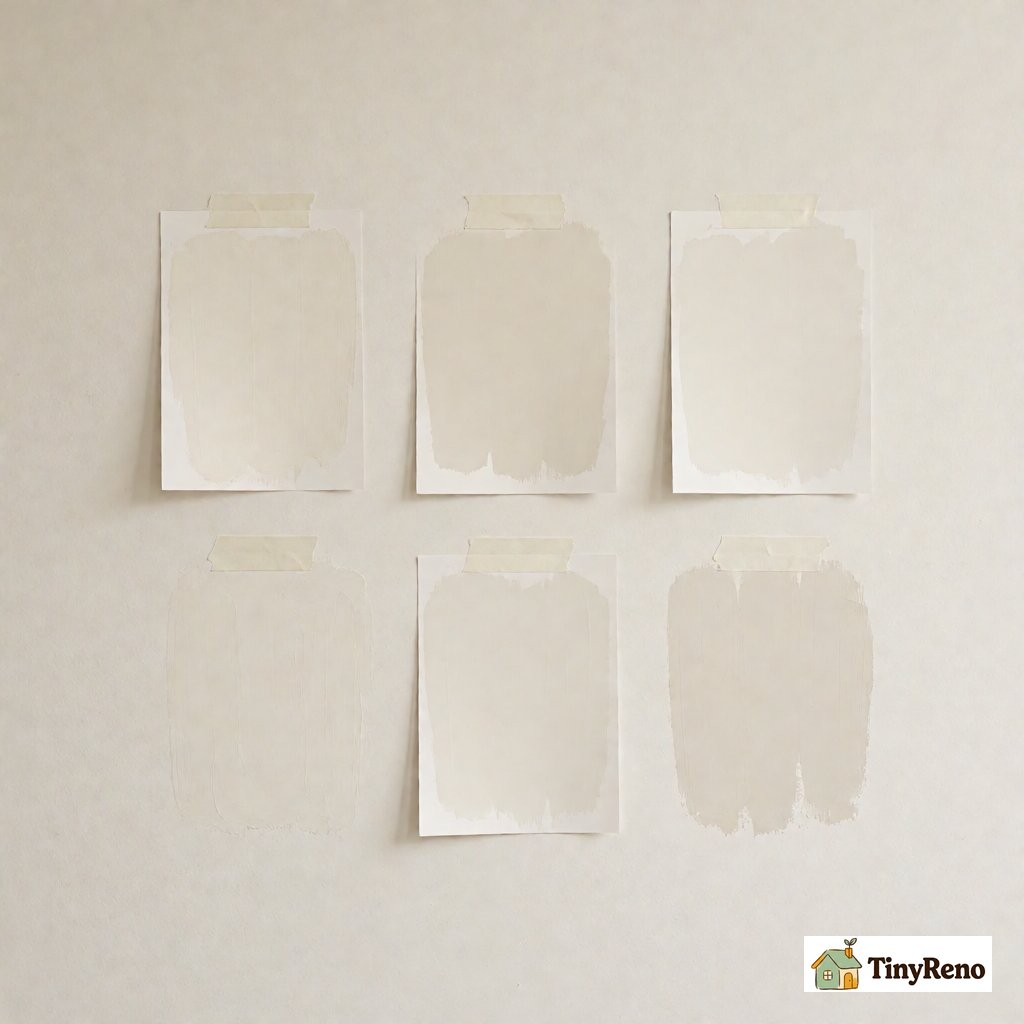
Swatch 4 was a muted sage green, Behr Silver Drop 760C-2, because it was on the second-tier rack at Home Depot on Holton Street and I almost did not pick it up. On the chip it looked like a grey-green that might read as a hospital wall. Sam primed over the terracotta Saturday morning and rolled the sage on Saturday afternoon. By Sunday morning the sage was dry, and I sat on the bed to look at it. The morning sun hit the wall at 7 a.m., and the sage glowed the way the terracotta had, but cooler. The room felt about 10 percent larger—again, subjectively—not smaller. The window light bounced off the sage and turned the ceiling a faint creamy white instead of grey. Sam came over Sunday morning and said nothing for two minutes, the longest Sam had been quiet since I met him. Then he said, “This is the one the room wants.” He said the sage was the only swatch that did not try to become the focal point of the room. It read as a wall color rather than a statement.
Swatch 5 was a dusty rose, Behr Poetry Plum 140B-4, because my sister had painted her bedroom in Madison in a similar color and said it was the best decision she had made for the room. The dusty rose went on Saturday afternoon and was dry by Sunday morning. The morning sun hit the wall, and the rose turned a flat pink that I had not seen on the chip. The room felt warmer than with the sage but smaller than with the terracotta. The rose competed with the woven rug from the Public Market instead of pulling it forward. Sam came over Sunday morning and said, “This is the one your sister wants.” I had mentioned my sister once, but I was still surprised he remembered. The rose was the swatch I could have been talked into by anyone who liked dusty rose, and it would have been the wrong choice for this small bedroom accent wall.
Swatch 6 was a soft buttercream, Behr Vanilla Cream 320C-2, because Sam had told me on the third visit that the best accent wall color for a small bedroom is sometimes the one that is not technically an accent wall. The buttercream was a low-saturation yellow that on the chip looked like off-white with a hint of yellow. Sam rolled it on Saturday afternoon, and it was dry by Sunday morning. The morning sun hit the wall, and the buttercream turned a creamy ivory. The room felt the largest of all six swatches. The wall was barely there. The buttercream was forgettable in the way the charcoal had been forgettable, but for the opposite reason: the charcoal had nothing to say, while the buttercream had nothing to prove. The buttercream tied with the sage for the winner, and the tiebreaker was the sage’s ability to make the room feel warmer in the evening when the east window was dark and the overhead light was on.
The Behr Can I Returned Twice and the Zinsser Primer That Saved the Timeline
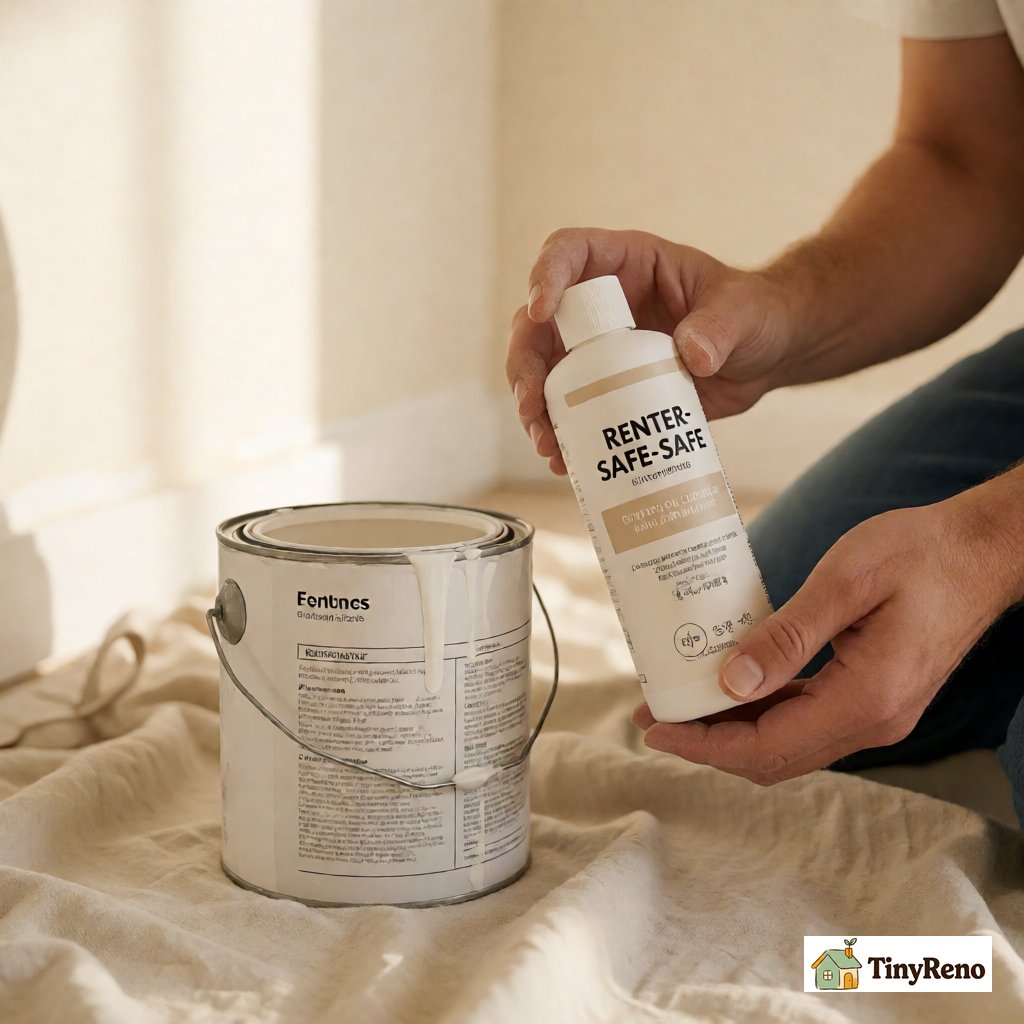
The brand I returned twice was Behr, not because Behr is wrong, but because the first two Home Depot runs gave me the wrong sheen or a badly mixed can. The first can of Behr was satin finish, which I had assumed was the same as eggshell. Sam rolled a test patch on the back of the closet wall and showed me the difference in five minutes. Satin reflects too much light and shows every roller mark. Eggshell reflects just enough light to keep the color bright without showing the imperfections in the plaster. I drove back to Home Depot on Holton Street and exchanged the satin for eggshell, which cost the same. The second return was for a can of Behr Premium Plus that had been shaken so hard at the store that the color had separated. Sam opened the can, showed me the separated pigment at the bottom, and said, “This is what happens when they shake the tint too hard.” I exchanged it for a second can, which the associate mixed by hand. Sam told me to always check the bottom of the can before I leave the store.
The renter-safe primer I used was Zinsser Bulls Eye 1-2-3, which Sam has used in Milwaukee apartments for fifteen years. Bulls Eye covers a previous color in one coat if the previous color is light (sage, rose, buttercream) and in two coats if the previous color is dark (navy, charcoal, terracotta). The primer dries in 30 minutes between coats, and the paint can go on top 60 minutes after the last primer coat. Sam and I painted six swatches over six weekends, one swatch per weekend, with a primer coat between every color change. The test used about two gallons of primer and two gallons of paint, roughly $124 in materials; the off-white return took one coat of primer plus one coat of the original wall color, about 90 minutes and one can of each.
The Three-Light Test, the Six Swatches Ranked, and the Winner That Wasn't the One I Picked
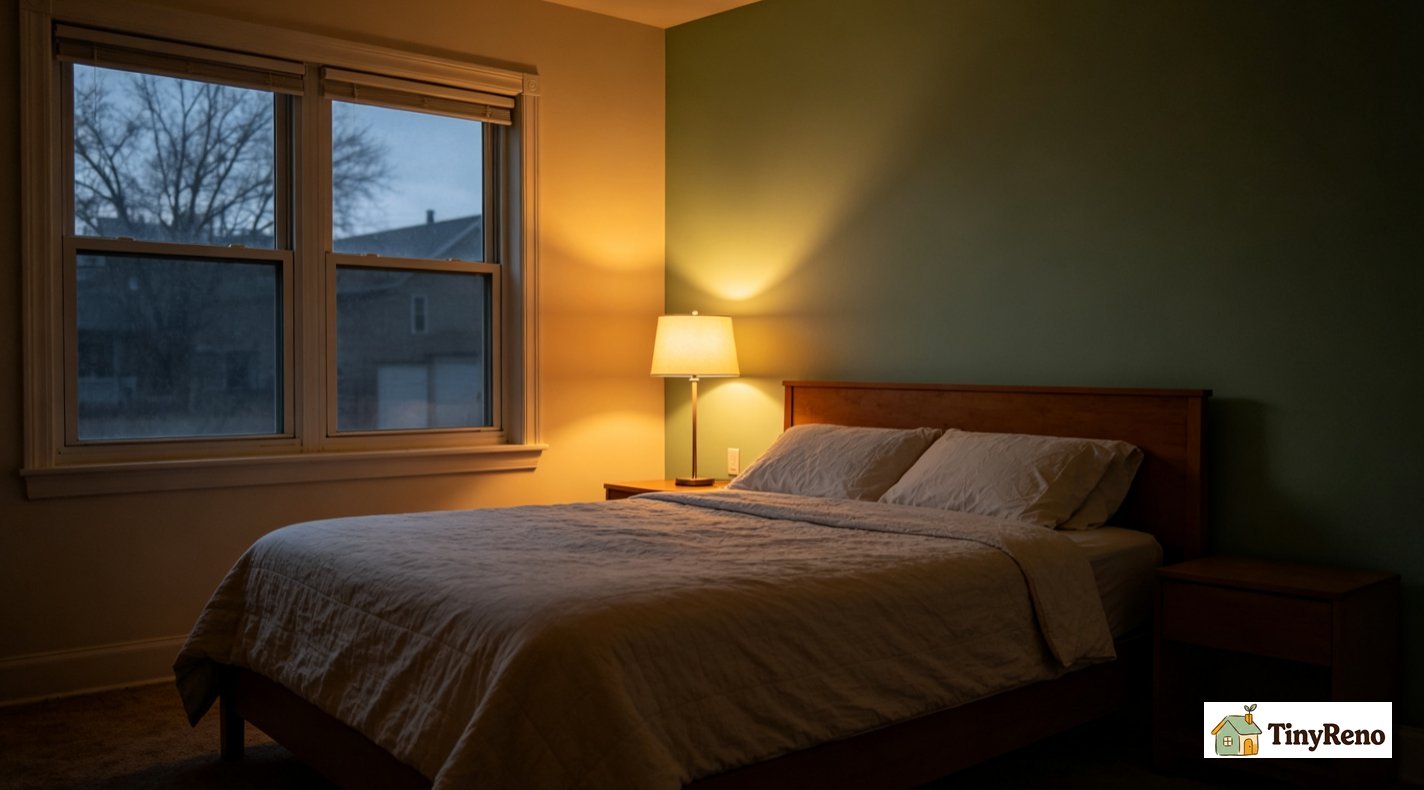
The lighting trick that changes how the color reads at night is the bulb in the bedside lamp. Sam told me on the third visit that the sage would look green at night under a 2700K bulb, which is the warm-white bulb I had in the lamp. He was right. The sage read as a true green at 7 a.m. under the morning sun, as a cooler grey-green at noon under cloud cover, and as a warmer green at 9 p.m. under the 2700K bulb. It stayed in the green family rather than shifting to another hue. The terracotta read as orange at night. The rose read as pink at night. The buttercream read as yellow at night. The sage was the only swatch that stayed recognizably the same color family in three lights, which is the test for an accent wall in a room with one window and one lamp. Sam called this the “three-light test,” and he said he uses it on most bedroom accent walls he paints in Milwaukee.
The six swatches, ranked: 1) Behr Silver Drop 760C-2 sage green, eggshell, the winner. The room felt about 10 percent larger, the morning light bounced, and the sage passed the three-light test. 2) Behr Vanilla Cream 320C-2 buttercream, eggshell, the tiebreaker. The room felt the largest of all six, and the wall disappeared. 3) Behr Terra Cotta 2004-8 terracotta, eggshell, the runner-up. The room felt the warmest, and the rug pulled forward. 4) Behr Poetry Plum 140B-4 dusty rose, eggshell, the one my sister liked. The room felt warmer but smaller. 5) Behr Carbon 770F-7 charcoal grey, eggshell, the forgettable. The room felt even smaller than with the navy. 6) Behr Blueprint S470-7 deep navy, eggshell, the worst. The room felt noticeably smaller.
The lesson for a small bedroom accent wall is that the answer is often not the swatch you are most excited about in the store. It is the swatch you almost do not test. The sage was on the second-tier rack at Home Depot; I almost walked past it, and Sam almost did not suggest it. The terracotta was the swatch I could have been talked into by anyone who likes warm colors, and it would have been the wrong choice for this small bedroom. The sage is on the wall opposite the window in my Milwaukee bedroom now, under the morning sun, under cloud cover, and under the 2700K bulb. The room feels larger, the window light bounces, and the wall passes the three-light test. Sam painted it, Behr supplied the paint, and Zinsser supplied the primer. I would not have picked sage from the chip, but the room made the choice easy, and I would pick it again tomorrow.


Discussion (0)
Sign in to join the discussion