

I woke up in Salt Lake City on January 4, 2025, with a nose that felt sandblasted and a humidity gauge reading 14 percent inside my sixth-floor apartment on 2100 South. The baseboard heat was running flat-out, frost had formed on the inside corners of the windows, and every exhale produced visible breath even with the heat on. I bought a $14 hygrometer from the Macey’s on 3300 East that afternoon and started a one-month log in a composition notebook. Over the next thirty-one days I tested six swaps under $20 each: two moved the needle, two did almost nothing, and the cheapest one came close to matching the Honeywell humidifier my downstairs neighbor Marcy runs from November through March. The idea for that cheapest swap came from a respiratory therapist I sat next to on a January 11 flight to Phoenix. Salt Lake City in January is not “6 percent humidity” outdoors; measured outdoor relative humidity is usually in the 75–85 percent range. The dryness indoors comes from heating: cold outside air holds very little water vapor, and warming it to room temperature drops its relative humidity sharply. That distinction matters for every fix below.
The setting matters here. Salt Lake City in January sits in a valley where cold air pools, and the outdoor relative humidity is often high—75 to 85 percent on average—but the absolute moisture content is low because cold air cannot hold much water vapor. My apartment is a 1990s two-bedroom, about 600 square feet, with baseboard hot-water heat. Baseboard heat does not dry the air as aggressively as a forced-air system, but it still pulled indoor humidity down to 12–16 percent once the thermostat was running. ASHRAE and EPA guidance puts the comfort range at roughly 30–50 percent relative humidity, with ASHRAE Standard 62 allowing up to 60 percent; below about 25 percent, dust becomes airborne more easily, wood can crack, and mucous membranes dry out[reference:9]. I started logging because my rescue cat Mishka had been sneezing for two weeks and my Oura sleep score had dropped from an 82 average in December to 71 in the first week of January. The data came before any swap.
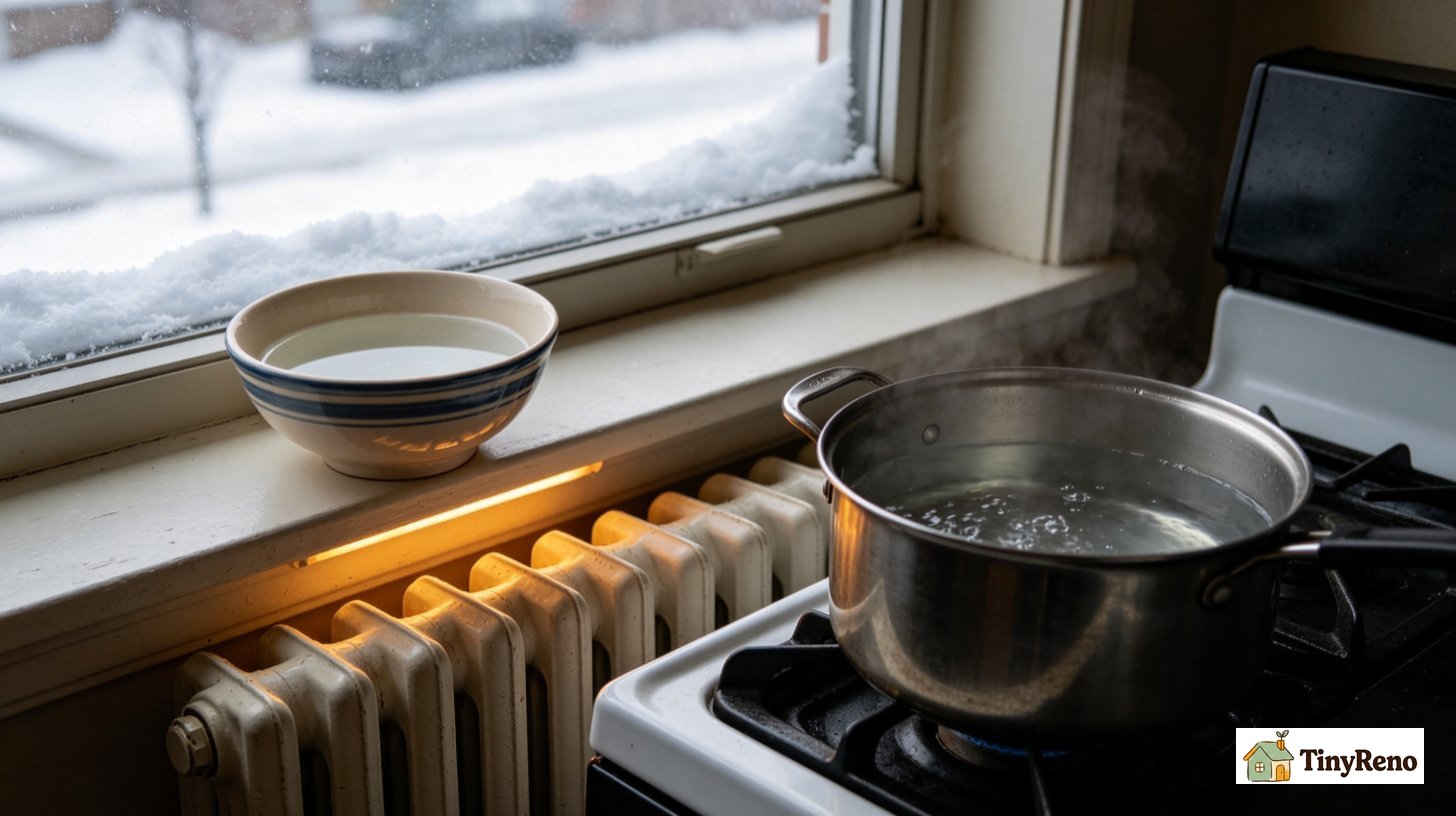
The first three swaps I tested in the first week
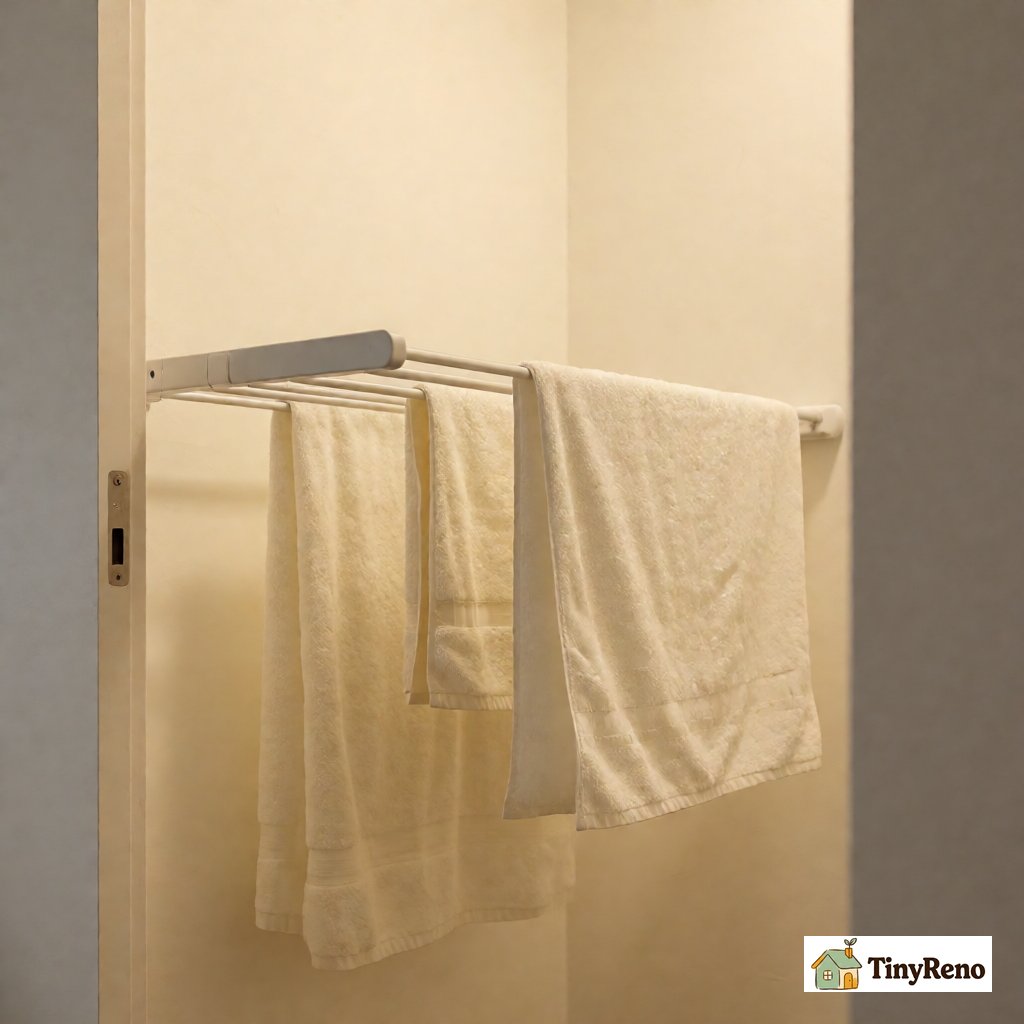
Swap one was a stovetop pot of water on low for two hours. On January 5, humidity moved from 14 to 19 percent while the pot simmered, then fell back to 15 percent within forty minutes of turning the burner off. It works while it is running, but it does not hold. Swap two was a wide ceramic bowl of water on the radiator cover, the classic advice. I left it on the warm-air register for three days, and the reading moved from 14 to 15 percent. The $14 hygrometer has a stated accuracy of about ±5 percent relative humidity, so a one-point change is indistinguishable from instrument noise; the radiator cover simply did not get hot enough to drive meaningful evaporation. Swap three was a wet bath sheet hung on the back of a wooden chair about four feet from the hygrometer, with the bedroom door closed. Within ninety minutes the room rose from 14 to 23 percent, the highest reading since the log started. Within two hours it had fallen back to 17 percent. The towel works while it is wet, which in a 600-square-foot apartment with the heat running is about four hours before it needs rewetting.
The respiratory therapist's plant idea that beat the forums
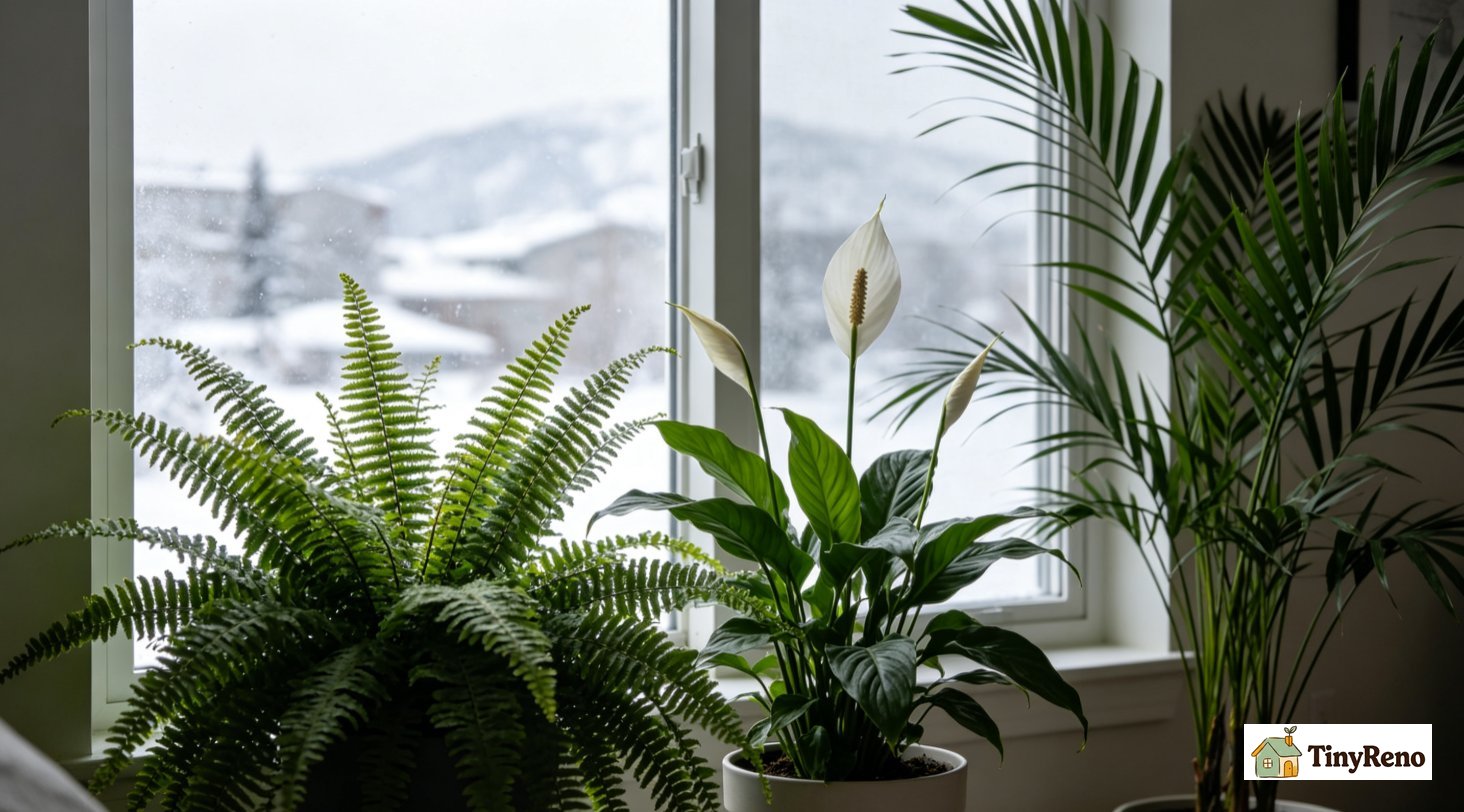
The fourth swap came from Kara, a respiratory therapist at LDS Hospital in Salt Lake who sat in 14B on the January 11 flight to Phoenix and could hear me blowing my nose in 14A. She asked one question: “Have you tried plants?” I had not, because most forums dismissed them as placebo. Kara said the forum consensus was too dismissive, but the effect is smaller than the old houseplant books claim. Research suggests indoor plant transpiration runs roughly 35 grams of water per plant per day in winter, with higher values under warm, bright conditions; a Boston fern can approach a cup a day in ideal light, but that is an upper bound, not a typical apartment figure[reference:12][reference:13]. Three or four plants contribute moisture in grams per day, not pints per day. Even so, she recommended Boston fern, peace lily, areca palm, and English ivy as the higher-transpiring species. I bought a Boston fern at Home Depot on January 12 for $14, a peace lily at Trader Joe’s for $12, and an areca palm from a local nursery for $18. By the third week the apartment was holding 28 percent humidity, though the plants were one input among several and I cannot isolate their exact contribution from the rest of the log.
The cheapest swap: a free habit change after every shower
Swap five was the cheapest, and the one Kara pushed hardest: leave the bathroom door open after a hot shower for twenty minutes with the vent fan off. Most renters run the fan on a timer, which exhausts the moisture outside in about eight minutes. With the fan off and the door cracked, steam migrates from the roughly 50-square-foot bathroom into the rest of the apartment and can lift the whole unit by 4–6 percentage points over an hour, depending on shower length and door position. One caveat: this only adds net moisture when the outdoor absolute humidity is lower than indoors. In a leaky apartment, a bath fan creates negative pressure that pulls outdoor air in; if that outdoor air is as humid or more humid in absolute terms, the fan-off trick can backfire[reference:16]. In Salt Lake City in January the cold outdoor air has low absolute humidity even at high relative humidity, so the conditions were favorable. I ran the routine every morning from January 15 through January 29, and the apartment held 25 percent humidity without other intervention. That is close to the range Marcy’s Honeywell HCM350 holds in an identical floor plan; her unit cost about $79 and her wick filters run $8–10 each, changed every one to two months, so her seasonal filter cost is closer to $30–50. I had initially guessed $22 a month, which would have been $66 a season[reference:18]. My routine cost nothing beyond the shower.
The slow sixth swap and the stack that finally held 30 percent
Swap six was the placebo candidate: two 8-ounce clay evaporation trays from Amazon, $16 for the pair, one on each radiator cover. Clay wicks water upward and the increased surface area evaporates it slowly. The reading moved from 14 to 16 percent over six days, which is within or barely above the hygrometer’s error band; I treat it as a small suggestive signal, not a confirmed effect. The trays need refilling every other day. They are not nothing, but they are not the answer alone. What held the apartment in the second half of January was the stack: three plants, the morning shower routine, and a wet towel on the chair on days when humidity dropped below 20 percent. That combination held 26–32 percent from January 18 through January 31, with no electricity cost beyond the shower water heater. I cannot partition the exact share of each component from this log; the stack is what the data shows.
The four-week log: how the apartment moved from 15 to 30 percent
The timeline is the part I want to be honest about. Week one, January 4–10, had no working swap: the apartment averaged 15 percent humidity, my Oura sleep score averaged 71, and Mishka sneezed nine times a day, which I counted. Week two, January 11–17, after the flight and the plants arrived, the average moved to 21 percent and the sleep score to 76. Week three, January 18–24, with the bathroom-door routine added, the average held 28 percent and the sleep score reached 80. Week four, January 25–31, averaged 30 percent and the sleep score settled at 82; Mishka sneezed twice that week. This is a before-and-after log, not a controlled trial. The week-two jump coincides with the plants arriving and my trip; the week-three jump coincides with the shower routine. I cannot rule out seasonal changes, behavior changes, or hygrometer drift. The stove pot and radiator bowl did almost nothing. The wet towel worked for about four hours. The clay trays were a slow second-line tool. The stack came close to the $79 machine down the hall.
The Marcy comparison: $0 routine versus $130 season of Honeywell
Marcy lives in 6B, my downstairs neighbor, and runs a Honeywell HCM350 cool-mist humidifier from the first cold day in November to the last in March. She paid about $79 for the unit, her wick filters cost $8–10 each and last one to two months, and she runs it roughly twenty hours a day[reference:20]. Her humidity log, which she showed me on January 22, holds steady at 32–36 percent across her living room. My stack held 26–32 percent across the same square footage. The gap is roughly four to six percentage points, and the cost difference is $0 versus roughly $110–130 for the season once filters are counted. If you live in a one-bedroom with winters like Salt Lake City’s and your lease does not forbid it, the plant-plus-shower stack can get you most of the way there for free. If you need the last few points, in my apartment the clay trays added about two points and the wet towel added about four. The Honeywell is more convenient and more consistent, but not the cheapest way to get to 30 percent.
What forums get wrong about dry-air fixes
Forum verdicts on dry-air fixes often come from single-day tests, and that is the wrong timescale for two reasons. First, plants need several days to establish a measurable transpiration contribution; second, building materials and furnishings absorb moisture before they release it, so a fix that looks weak on day one can show up after a week or more. Studies of hygroscopic buffering show that furnishings can shift indoor humidity by 15–20% for as long as a month, and some materials take weeks to approach equilibrium after a change in ambient humidity[reference:22][reference:23]. That does not mean every plant and every wet towel is secretly powerful; it means the timescale of the test changes the verdict. I started logging because I was tired of waking up with a sandblasted nose, and I kept logging because the notebook told a clearer story than the reviews. The free shower routine did not beat the $79 Honeywell outright; on its own, in my apartment, it narrowed the gap to roughly seven to eleven points. The plants helped, but less than the old houseplant books imply. The order—closing the cheap gap fixes first, then adding mechanical humidification if needed—mattered more than the price tag.
Mishka still sneezes once a day, which the vet says is normal for a cat in a dry climate. My sleep score is back to the December average. The composition notebook is still on the kitchen counter, with the last entry dated January 31. The plants are alive. The bathroom door is open. The radiator covers are empty, and the stove pot is back in the cabinet. Marcy downstairs still runs her Honeywell and still holds a few points more humidity than I do, but she also pays for the machine and the filters. The free and cheap fixes got the apartment into the low 30s in my case, during a Salt Lake City January, in a 600-square-foot apartment with baseboard heat and a hygrometer that could not resolve one-point differences. That is the honest version of the result.


Discussion (0)
Sign in to join the discussion