

I asked my contractor Brad how to fix a small dent in a hardwood floor without refinishing the whole room, from the passenger seat of his truck, while holding a damp towel and looking at a shallow dent in the oak floor of a third-floor apartment in Tampa, Florida. It was a July afternoon, the AC was off, and the windows were open. The dent was the kind a cast-iron pan leaves when it falls two feet from a kitchen counter onto a wood floor: deep enough to feel with a fingernail, but the finish around it was not cracked and the wood fibers were compressed rather than broken. The fix took about forty-five minutes and cost me nothing beyond a towel I later threw away and a call to Brad on his way to a job in Seminole Heights. The whole-room refinishing quote he had given me the week before was $1,100. The actual fix was a wet cloth, a household iron, and the patience that comes from having already panicked about the deposit.
I moved into the Tampa apartment in May: a 720-square-foot one-bedroom with original 1998 oak floors in the living room and hallway. The oak was honey-colored, with a satin finish my landlord had refreshed in 2022. The first thing I unpacked was a twelve-inch Lodge cast-iron skillet I had owned since college. The second thing I unpacked was the same skillet, which immediately fell off the counter at the corner where the kitchen tile meets the oak floor. That corner is exactly where the dent happened. The sound was small, the dent was smaller, and the panic was larger than both. I emailed Brad a photo at 2:14 p.m. He texted back at 2:19 p.m. with three words: steam, cloth, iron. What follows is the process I now send to anyone who texts me the same question.
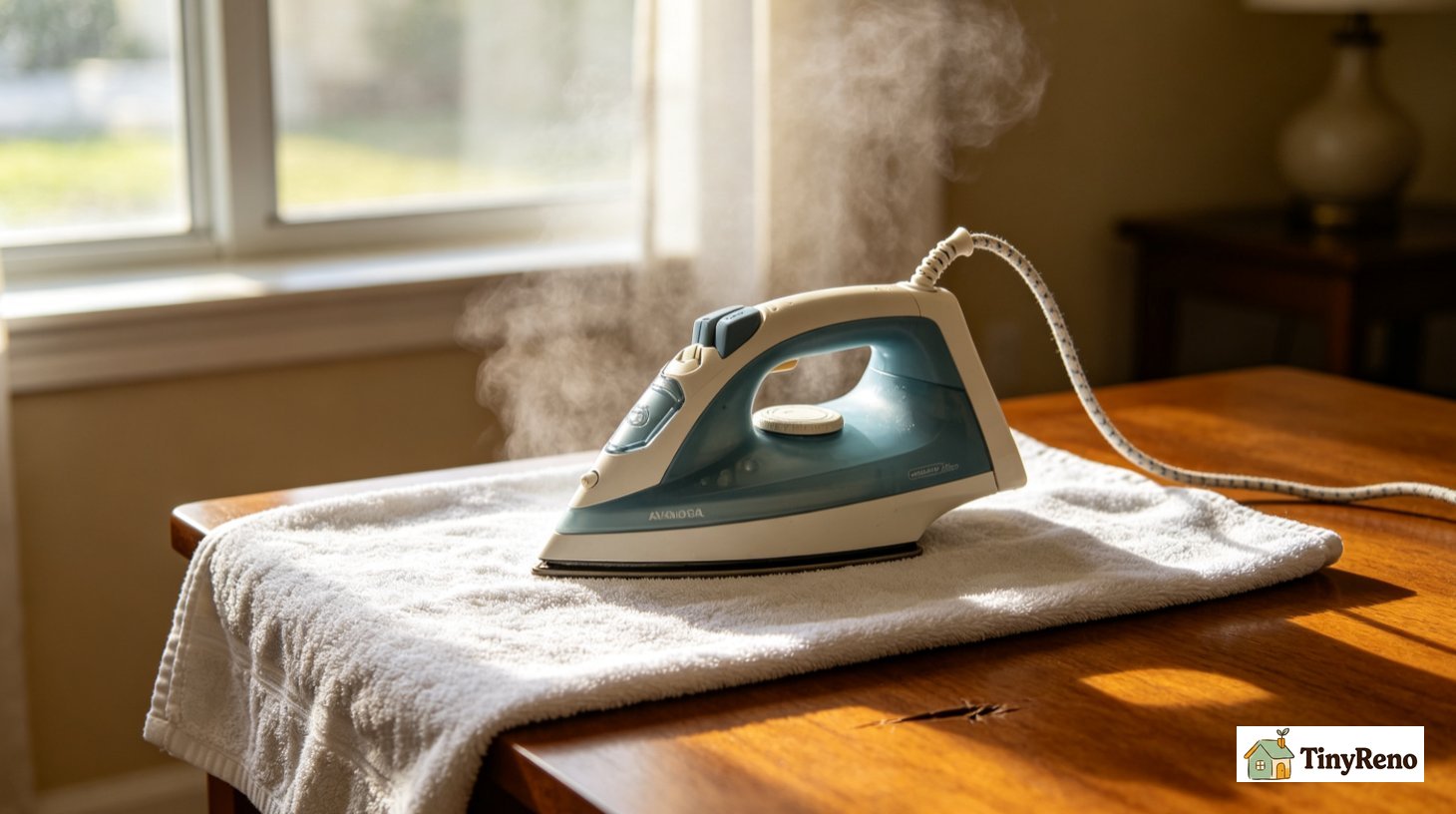
Step one: clean the dent with a dry cloth and check that the finish around it is not cracked. If the finish is cracked or the wood fibers are visibly broken, stop; steam will not fix that. Step two: fold a white cotton towel into a pad thick enough to cover the dent, and fill the iron with water. White cotton is best because any dye transfer from the towel would be obvious. Step three: the first steam pass. I laid the folded towel over the dent, set the iron to its highest steam setting—linen on most irons—and pressed it down over the dent for thirty seconds. I lifted the iron and waited sixty seconds for the steam to soak into the wood and the fibers to swell. Then I wiped the area dry with a clean part of the towel and looked. The dent was still visible, but less so. The wood fibers had started to swell but had not yet reached the surrounding floor level.
Step four: the second pass. Same setup, same iron, same thirty seconds. The wood is already warm and slightly swollen, so the fibers respond more readily on the second pass. After it, the dent was about half gone. It was no longer visible from standing height, but it was still visible from kneeling height and under a flashlight at a low angle. I was tempted to call it done. Brad had warned me about that: the second pass is where most people stop, and the result is a dent that looks gone in normal light but shows under raking light or when the sun hits low. Most oak dents need a third pass.
Step five: the third pass. The third pass is usually where the fibers finish swelling and the surface returns to the level of the surrounding floor. After the third pass the dent was gone from every angle, including under the flashlight. I waited three minutes for the wood to cool, then buffed the area with a dry microfiber cloth to remove any leftover moisture haze. The whole process—photo, text exchange, three passes, and waits—took about forty-five minutes, which matched Brad’s prediction. The towel picked up a water stain, which is why I threw it away; that was the only material cost. The floor had no dent.
What Can Go Wrong And The Boundaries Of This Fix
The boundaries of the steam fix are real. It works best on shallow dents—roughly 1/8 inch or less—where the wood fibers are compressed but not broken and the finish around the dent is intact. A deeper dent, such as a quarter-inch compression, may still improve, but the deeper the crush, the lower the chance of a full recovery; if the fibers are torn or the finish is cracked, steam will not fix it. It does not work on gouges where wood has been removed, on dents with cracked finish and exposed wood, or on floors that have been sanded so thin that swelling risks raising the grain permanently. A dent from a refrigerator dropped during a move is not a candidate. A scratch is not a dent and will not respond to steam. A pet stain that has gone through the finish is not a dent and will not respond to steam. The fix is specific to compression damage to intact wood with intact finish.
Water haze is the most common side effect and the easiest to avoid. It comes from too much water or too little drying time. Buff the area with a dry microfiber cloth immediately after each pass, before the water dries on the surface. If you see haze forming, stop, buff, and let the area dry for ten minutes before the next pass. Haze that has dried into the finish can usually be buffed out with a soft cloth and some elbow grease; haze left for hours may need a professional buffing with a polishing pad or a fine polishing compound.
The other thing that can go wrong is raised grain. Oak and pine, common rental floor woods, can fuzz up slightly when steamed. The fuzz is microscopic wood fibers lifted by moisture. Leave it alone until the floor is fully dry—about four hours—then buff very lightly with a fine-grit sanding sponge, around 400 grit. Brad does not recommend sanding in the first twenty-four hours, because the wood is still settling and premature sanding can remove wood that would have returned to its original level. Sanding is a finishing touch, not a step in the process. Most oak dents do not need it; maple and pine sometimes do.
What Brad Told Me About The Deposit And The Refinishing Quote
Brad gave me the $1,100 refinishing quote in June, when he came out to look at the floors for an unrelated kitchen repair. The quote covered sanding the living room and hallway to raw wood, restaining to match the original honey oak, and applying two coats of satin polyurethane. $1,100 is a normal Tampa rate for a 200-to-300-square-foot refinishing job, and it is the right quote for a floor that actually needs refinishing. It is not the right quote for a single shallow dent. Brad knew that when he gave it to me; he told me later that he quoted the whole-room cost because that was what I had asked for. He did not mention the forty-five-minute steam fix because I had not asked.
The landlord is a property management company called Gulf Coast Homes, and its move-out checklist lists hardwood floor damage as a deduction range up to about $400. A single dent like mine, left unfixed, would likely have landed at the low end of that range—somewhere between $75 and $150, depending on the inspector. The steam fix eliminated the deduction entirely. At move-out, the inspector runs a flashlight across the floor at a low angle; if the dent is gone, there is nothing to charge for. The fix worked because the dent was actually gone, not because the inspector was fooled.


Discussion (0)
Sign in to join the discussion