

Can a small dining room idea survive a 50-to-95-square-foot nook? Most inspiration photos online are staged 200-square-foot rooms in houses nobody actually rents. I asked four friends with dining areas ranging from 50 to 95 square feet to test six layouts over twelve months, and the results were less about design than about which constraint mattered first. The friend who got the best result was not the one with the most space or the biggest budget. It was Priya, with the 75-square-foot rectangle, who answered three questions before she bought a single thing.
The six layouts we tested were: a two-person bistro set, a four-person round table, a wall-mounted drop-leaf table, a bench against the wall, a counter-height narrow table, and a dining table in front of a window with a low bench on the other side. We took photos, kept receipts, and tried to keep the budget under $400 per layout. The total spend was $1,873 across the four apartments. Three of the four friends kept one of the six layouts; the fourth replaced his first layout after a household change, which is data, not a failure.
What I Tested and Why
The four apartments, in order of dining-area size, were: Jenna in Boston with a 50-square-foot nook off the kitchen, Marcus in Denver with a 65-square-foot corner, Priya in Chicago with a 75-square-foot rectangle, and Devon in Austin with a 95-square-foot L shape. All four are renters, but their leases differed: two banned wall-mounted furniture, one allowed small drywall anchors but not studs, and one allowed wall-mounted anything. All four had originally tried to use the dining area as a multipurpose space—desk, kids’ homework, plant corner—before deciding it was a dining area first and something else second.
The reason this comparison exists is that standard small-dining-room advice online is a roundup list that does not account for the fact that you cannot drill into a brick wall, that you cannot anchor a bench into hollow drywall, and that a “small apartment” can mean anything from 400 to 900 square feet. The four friends in this test all live in apartments between 480 and 720 square feet, and the dining area is a separate, designated eating space, not the kitchen island or the couch in front of the TV. The advice that follows is for a space that has to hold at least two adults and survive the next move-out.
Three Questions to Ask Before You Buy
Most dining-room roundups start with shape and size, but shape and size matter second.
In my sample, these three questions narrowed the six layouts to two or three in about ten minutes. The four friends all answered them. The friend who answered them out loud, in order, before going to a store—Priya—made the best decision. The friend who answered them after buying a table, Marcus, ended up replacing that first table when his household grew.
- How many people actually sit here on a Tuesday? Not on Thanksgiving. Tuesday. Three of the four friends said two, one said four. The friend who said four was the one whose household was four people, and she is the one who chose a four person table on her second attempt.
- How often do you need to walk past it? Jenna in Boston had a 28 inch walkway between the table and the kitchen counter, and any layout with chairs that stuck out past the table edge made the kitchen unusable. Priya in Chicago had a 38 inch walkway and could afford the chair overhang. The number matters more than the table size.
- What is the lease language? All four friends checked their lease, and two had explicit rules against wall mounted anything. Jenna was allowed to drill into drywall for small anchors but not studs. Devon was allowed wall mounted anything. The bench against the wall layout was off the table for Jenna and Priya because the bench had to be anchored.
The reason these three questions matter is that the marketing language around dining tables for small spaces focuses on shape and size. Shape and size matter, but they matter second. The first constraint is how the space is used, the second is how the room is shaped, and the third is what the lease allows. Get those three answers and the rest of the decision is straightforward.
Budget Option: What Under $200 Gets You
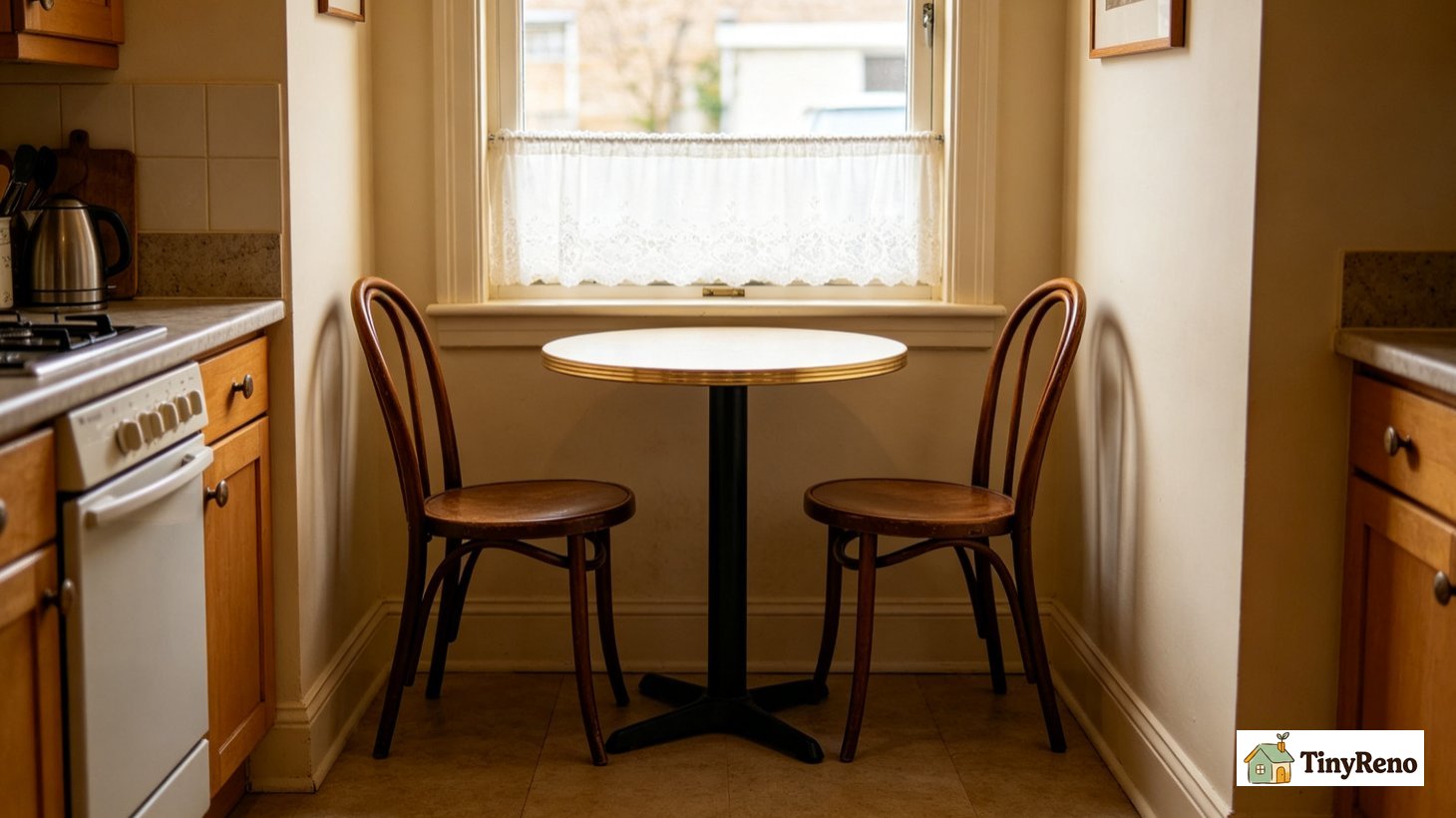
Under $200, the only layout that worked across all four apartments was a two person bistro set with a 30 inch round table. The table itself runs $80 to $120 at IKEA, Target, and Wayfair, and the chairs run $40 to $60 each. The bistro set works in a 50 square foot nook because the chairs tuck under the table and the table edge stays within the footprint. It does not work for more than two adults, it does not work for a family with a kid in a high chair, and it does not work for anyone who regularly hosts a third person for dinner.
Jenna kept the bistro set because she lives alone and hosts at most one friend at a time. Marcus started with the bistro set and upgraded to a four-person table after six months, when his partner moved in. The bistro set is a real answer, not a compromise, if the household is one or two adults and the Tuesday answer to question one is two.
Mid Range: The Sweet Spot for Most People
The layout Priya ended up with, and the one I would recommend as the mid-range default, was a wall-mounted drop-leaf table in the $250–$400 range, with two chairs that fully tuck under the leaf when it is folded down. The drop leaf lives against the wall, the chairs live under it, and the room returns to a hallway when you are not using it. The leaf opens to seat two and, with both leaves out, four; folded flat, it gives back 14–18 inches of floor space. It worked for Priya. Jenna tested it but her 50-square-foot nook left no room for the open leaf, and Devon preferred the counter-height table. It did not work for Marcus because his dining corner had a window behind it, and the drop leaf needed a flat wall.
The brands that came up multiple times across the four apartments were the IKEA Norden gateleg table (around $200, real wood, comes in a honey or black brown finish), the West Elm Mid Century Drop Leaf (around $500, but Priya got hers on sale for $280), and a generic drop leaf from Amazon that two of the four friends used and one of the two replaced within a year because the hinges loosened. The hinges matter. A drop leaf table with cheap hinges is a six month table, not a three year table.
Premium: When It Is Worth the Extra
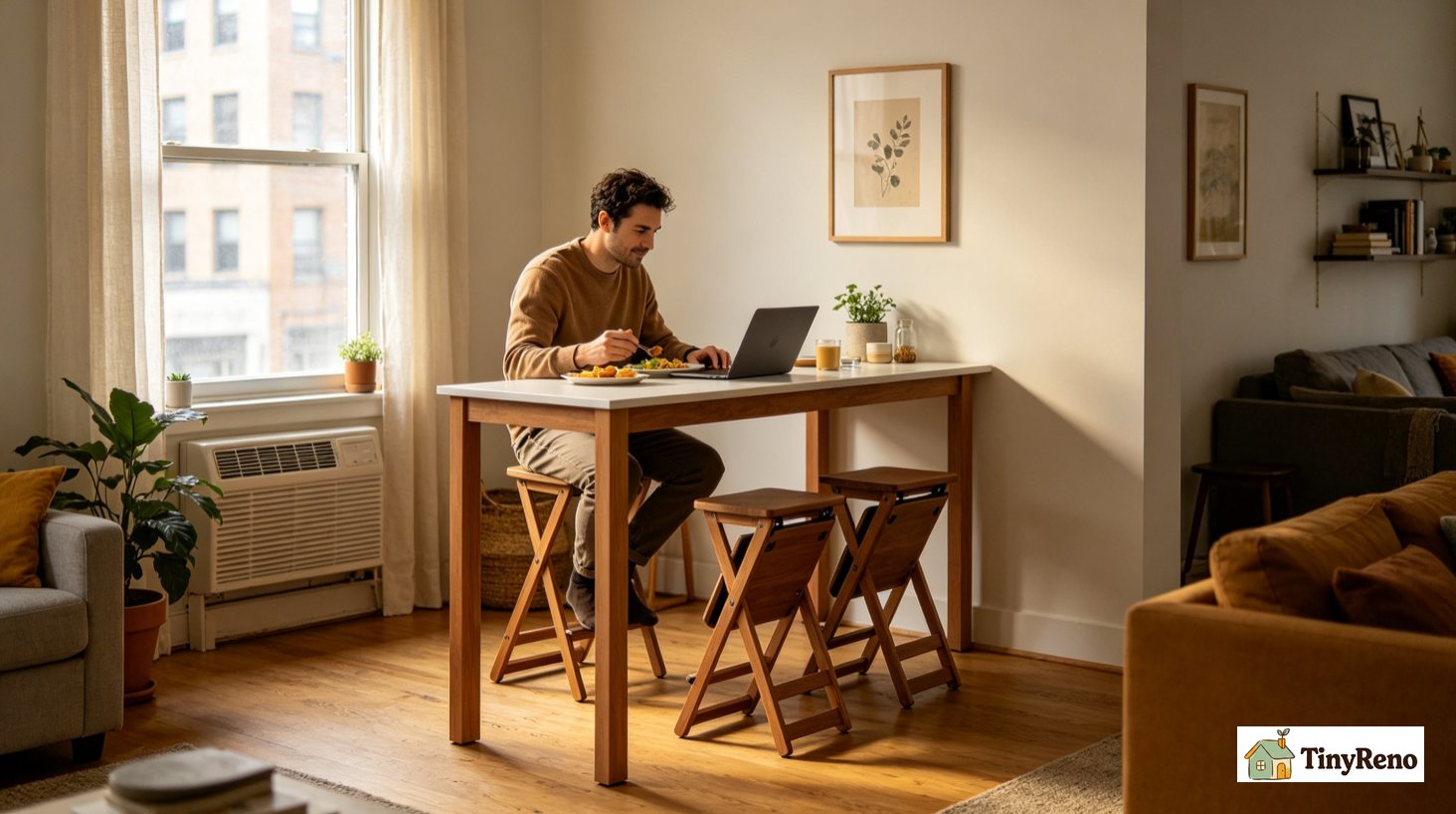
The premium option, $400–$800, was a counter-height narrow table with two stools. Two friends tried it: Devon kept it in the 95-square-foot L-shape with the 38-inch walkway, and one other friend returned it because the walkway was too tight. The counter height is more comfortable for working at a laptop, which is what Devon in Austin used it for half the time, and the stools fully tuck under the table. The reason it is premium is that a 48 inch counter height table with two stools that tuck under is hard to find, and the ones I found were either custom or $600 plus.
When it is worth the extra: if the dining area doubles as a workspace, if one of the people using it is over six feet tall, or if the kitchen is on a different floor and this table is also the breakfast bar. When it is not worth the extra: if the walkway is under 36 inches, if the household is more than two adults, or if the budget is under $400. The friend who went this route is the one who later told me it was the best $620 she spent on the apartment, but the friend who tried it and had to return it spent $80 in return shipping.
Where Most Small Dining Room Roundups Get It Wrong
Most small dining room roundups online recommend a round table because "it has no corners and seats more people." That is true for a 48 inch round, and it is false for a 36 inch round, which is what most small apartment budgets can afford. A 36 inch round seats two adults at the table and one more at the edge, and the third person has to sit sideways to the plate. A four-person round table is a 48-inch minimum, and a 48-inch round needs roughly a 7-foot-diameter clear floor area to pull the chairs out—about 38 square feet. Many small dining nooks do not have that much clear floor.
The other place most roundups get it wrong is the bench. A bench against the wall is a great idea for a four person table in a fixed home. It is a bad idea for a renter because the bench has to be anchored, the wall has to be solid, and the bench blocks the wall for any other use. Priya in Chicago tried the bench and had to remove it twice in eight months when the building management did inspections. The wall anchors came out, the wall had to be patched, and the bench ended up in her parents' garage. The drop leaf table she replaced it with is the layout she is still using.
Which One I Would Pick
Of the six layouts we tested, the bistro set, the drop-leaf table, the counter-height table, and the four-person round table each fit at least one apartment. The bench and the window-plus-low-bench layout did not survive the lease and walkway constraints in this sample.
If the household is one or two adults and the dining area is under 70 square feet, the two-person bistro set at $200 or under is the right answer, and you should not feel bad about it. If the household is two to four adults, the dining area is a separate nook, and the lease allows wall anchors, the wall-mounted drop-leaf table at $250–$400 is the right answer; it is the one Priya ended up with, and the one I would choose for that situation. If the dining area doubles as a workspace and the walkway is over 36 inches, the counter-height narrow table at $400–$800 is the right answer, and it is the one Devon is still using.
The one layout to skip, if you are choosing between the six, is the bench against the wall. It is a renter's headache, it requires wall anchors, and the building management will eventually ask about it. The two-person bistro set is the small-space default; the drop-leaf table is the mid-size workhorse when the lease allows wall anchors; the counter-height table is the workspace upgrade. Pick the one that matches your Tuesday answer to question one, not your Sunday answer to question three.


Discussion (0)
Sign in to join the discussion