

In December my apartment humidity dropped to 22%, and I started waking up with a dry throat and static shocks on every doorknob. I assumed the problem was low humidity, so I bought a $70 cool-mist humidifier. It ran for a week and lifted humidity to 35%—within the 30–50% comfort range—but the dry throat and static shocks did not fully go away. That was the clue that low humidity was only one piece. Winter apartment air has three common failure modes: low humidity, poor ventilation, and particulates. I monitored all three for a week, and the data showed my main problem was not humidity alone.
The first winter air problem is low humidity, which is what I thought I had. Low humidity happens when cold winter air is heated to room temperature, which drops the relative humidity. Cold air holds less moisture than warm air, so when you heat cold air to 70°F, the relative humidity drops to 10 to 30% depending on the outdoor humidity and the indoor temperature. The fix for low humidity is a humidifier. The humidifier adds moisture to the air. The target humidity is 30% to 50%. Below 30%, you start to see the symptoms I had (dry throat, dry skin, static shocks, dry nose, dry eyes). Above 50%, condensation on windows and mold risk become real concerns—so the goal is a band, not “as high as possible.”
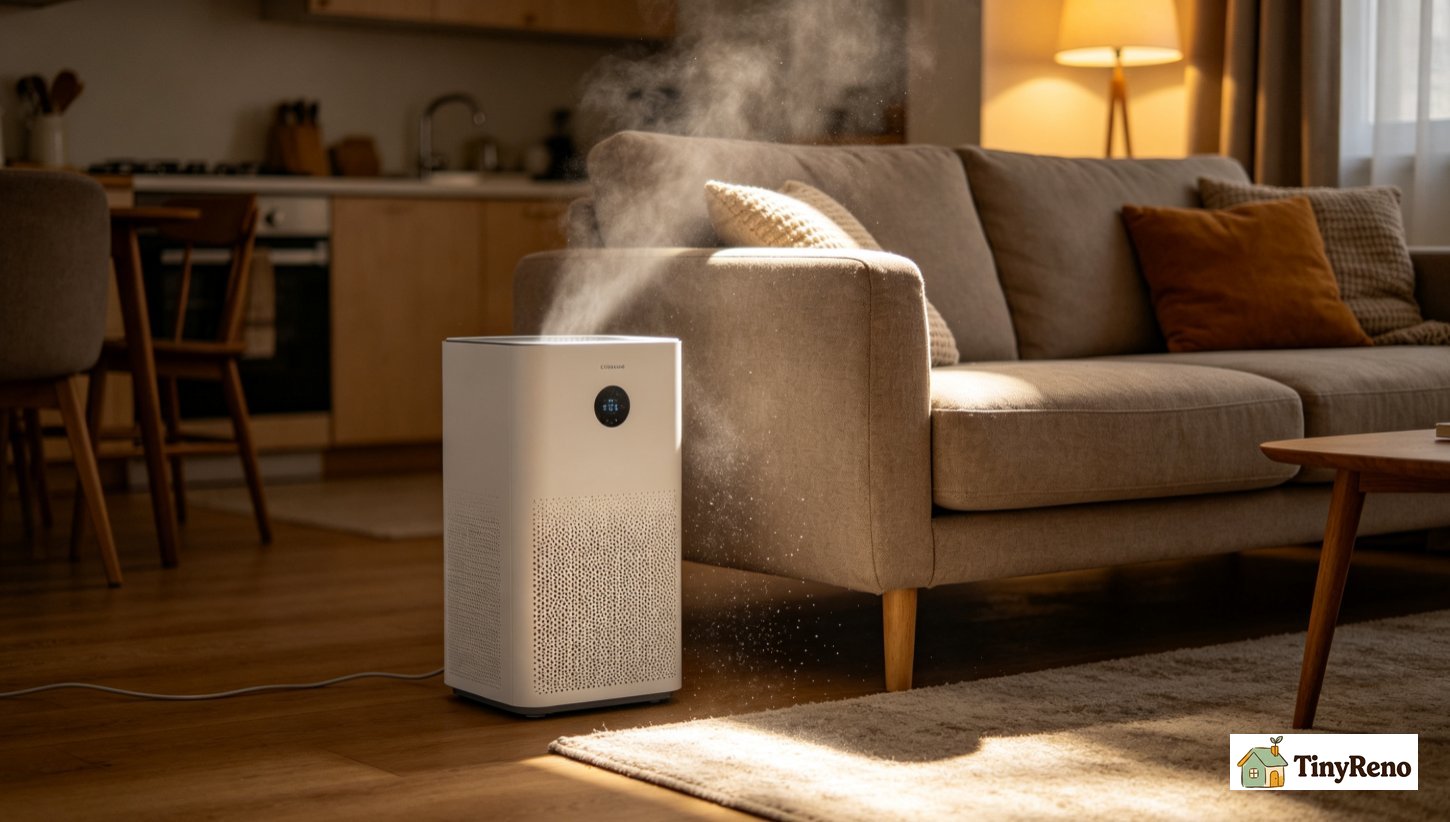
The Three Winter Air Problems, and How to Tell Which One You Have
The second winter air problem is poor ventilation, which is what I actually had. Poor ventilation happens when the apartment is sealed up tight for the winter — windows closed, weather stripping installed, exhaust fans not running — and the indoor air pollutants have nowhere to go. The indoor air pollutants are carbon dioxide from breathing, volatile organic compounds (VOCs) from furniture, paint, and cleaning products, formaldehyde from pressed wood, and dust from textiles. The fix for poor ventilation is to bring in fresh outdoor air periodically. The simplest fix is to open the windows for 10 to 15 minutes a day, even in winter. The more involved fix is to install a heat recovery ventilator (HRV) or an energy recovery ventilator (ERV), which brings in fresh air while recovering heat from the outgoing air. A basic HRV/ERV typically runs $1,200–$3,500 installed; a fully ducted system can reach $2,500–$5,500 or more. Most apartments lack the ductwork for one, so this is more practical for houses than rentals.
The third winter air problem is particulates, which are tiny particles in the air. The particulates include dust, pollen, pet dander, smoke from cooking or candles, and outdoor particulates that leak in through doors and windows. The particulates are measured in PM2.5 (particles smaller than 2.5 microns) and PM10 (particles smaller than 10 microns). PM2.5 is the more dangerous size because the particles can penetrate deep into the lungs. The fix for particulates is an air purifier with a HEPA filter. The HEPA filter captures 99.97% of particles 0.3 microns and larger. The air purifier costs $100 to $500 for a good one (Coway, Blueair, IQ Air are the brands with the best HEPA performance). The air purifier needs to be sized for the room — a 200 square foot room needs a purifier rated for 200 square feet.
How to tell which of the three problems you have is the diagnostic question. If your symptoms are dry throat, dry skin, dry nose, dry eyes, and static shocks, you have low humidity. If your symptoms are stuffy nose, headache, fatigue, difficulty concentrating, and a general sense of stale air, you have poor ventilation. If your symptoms are sneezing, coughing, itchy eyes, asthma flare-ups, and visible dust in the air, you have particulates. If your symptoms are all three, you have all three, which is common in winter apartments because the conditions that cause each problem are related — sealed windows cause both low humidity and poor ventilation, and indoor activities (cooking, candles, cleaning) cause particulates.
The Fix for Each Problem, and the Cost of Each Fix
The fix for low humidity is a humidifier. The humidifier types are cool-mist, warm-mist, and ultrasonic. Cool-mist humidifiers are the most common and the cheapest ($30 to $100). Warm-mist humidifiers boil the water to create steam ($50 to $150). Ultrasonic humidifiers use high-frequency vibrations to create a fine mist ($40 to $200). The humidifier you choose depends on your preference and your climate. Cool-mist humidifiers are safer from a burn standpoint, but they require weekly cleaning because standing water can aerosolize bacteria. Warm-mist units boil water, so they disperse fewer microorganisms, though they do not sterilize the room. Ultrasonic units are the quietest, but EPA notes they can also disperse materials if not cleaned regularly. The humidifier needs to be cleaned weekly to prevent bacterial growth. The humidifier needs to be sized for the room — a 200 square foot room needs a humidifier that outputs at least 1 gallon of water per day.
The fix for poor ventilation is to bring in fresh outdoor air. The simplest fix is to open the windows for 10 to 15 minutes a day, even in winter. The fresh air flushes the indoor air pollutants and replaces them with outdoor air, which is usually cleaner (especially in urban areas where the indoor air is more polluted than the outdoor air). The more sophisticated fix is to install a heat recovery ventilator (HRV) or an energy recovery ventilator (ERV). The HRV/ERV brings in fresh air continuously while recovering heat from the outgoing air. The HRV/ERV costs $1,500 to $3,500 installed. The HRV/ERV is usually installed in a central HVAC system, which most apartments do not have. The HRV/ERV is more practical for houses than apartments.
The fix for particulates is an air purifier with a HEPA filter. The HEPA filter captures 99.97% of particles 0.3 microns and larger, which includes most of the particulates that cause symptoms. The air purifier needs to be sized for the room. The air purifier needs to have a clean air delivery rate (CADR) that matches the room size. A 200 square foot room needs a CADR of at least 100 cubic feet per minute for smoke, 150 for dust, and 200 for pollen. The air purifier needs to have the HEPA filter replaced annually ($50 to $100). The air purifier runs continuously to maintain the air quality. The electricity cost is about $5 to $15 a month depending on the size and the fan speed.
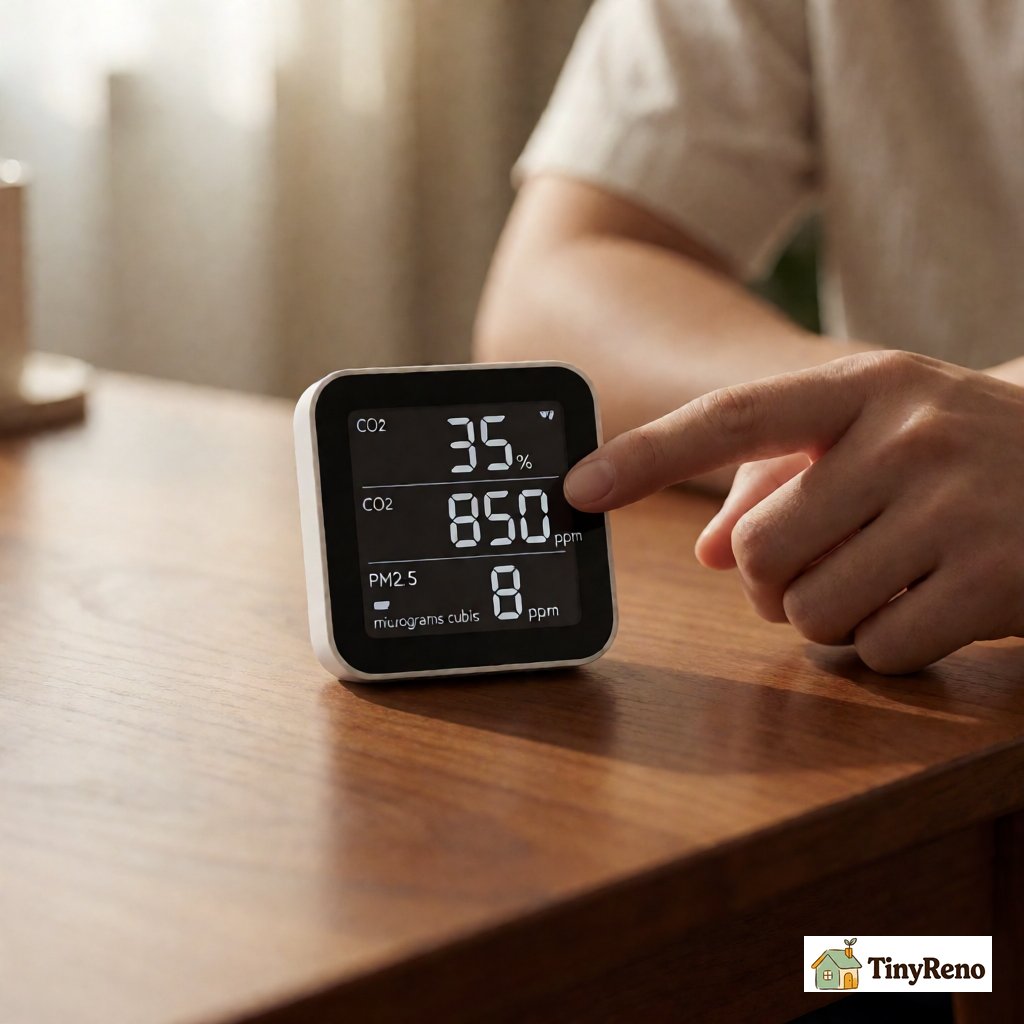
The Quick Classifier to Tell What You Actually Have
The quick classifier to tell which of the three problems you actually have is to monitor three metrics over a week. The first metric is humidity, measured by a $15 hygrometer from Amazon. The second metric is CO2, measured by a $50 CO2 monitor from Amazon (the Aranet4 is the most popular). The third metric is PM2.5, measured by a $30 PM2.5 monitor from Amazon. The data will tell you which problem you have. If humidity is below 30%, low humidity is a likely contributor. For CO2, ASHRAE Standard 62.1 no longer sets an indoor limit; 1,000 ppm is a long-used reference, and 800 ppm is often treated as a signal of inadequate ventilation. For PM2.5, EPA lowered its annual health-based standard from 12 to 9 μg/m³ in 2024. These are not compliance thresholds for a single apartment, but they are useful reference points for interpreting a week of monitoring.
The data from a week of monitoring my apartment was humidity 22%, CO2 at 1,250 ppm, PM2.5 at 8 μg/m³. The humidity was low (target 30% to 50%). The CO2 was high (target below 1,000 ppm). The PM2.5 was low (target below 12). The diagnosis was low humidity plus poor ventilation. The fix was a humidifier for the humidity, plus a daily 10-minute window opening for the ventilation. The air purifier was not needed because the PM2.5 was low. The humidifier was the $70 Target cool-mist I already bought. The window opening was 10 minutes in the morning when the outdoor air was cleanest. After one week, the humidity was 35% and the CO2 was 850 ppm. The symptoms went away. The dry throat was the humidity. The fatigue and the difficulty concentrating was the CO2. The static shocks were the humidity.
The strongest evidence was a paired comparison. On a day with a window open, the 3 p.m. CO2 reading was 650 ppm; on a closed-window day, it was 1,400 ppm. That 750 ppm gap is the difference fresh air makes. The apartment had four occupants exhaling continuously. A resting adult exhales roughly 0.2–0.3 L of CO2 per minute, so four people produce about 0.8–1.2 L/min—not 4 L/min. Over six hours that is roughly 290–430 L of CO2, which in a ~25,000 L apartment is enough to push concentration well above background if ventilation is low. The exact number matters less than the direction: closed windows and continuous occupancy raise CO2, and a short daily flush reverses it.
The Total Cost of Fixing All Three at Once
If you have all three problems (low humidity, poor ventilation, and particulates), the total fix is a humidifier ($70 to $200), an air purifier ($100 to $500), and a daily window opening (free). The total cost is $170 to $700 for the hardware, plus $5 to $15 a month for electricity. The savings is the avoided medical costs from dry throat, sinus infections, and allergy flare-ups, which can be $200 to $500 per winter season for a family of four. The ROI is one to two winters for the hardware.
If you have only one problem, the fix is cheaper. If you have only low humidity, the fix is $70 to $200 for the humidifier. If you have only poor ventilation, the fix is $0 for the daily window opening, or $1,500 to $3,500 for the HRV. If you have only particulates, the fix is $100 to $500 for the air purifier. The cheap fix for each problem is between $0 and $200. The expensive fix is between $1,500 and $3,500. Most renters should start with the cheap fix. Most renters will find that the cheap fix solves the problem.
My humidifier was the right fix for the dry throat, but it did not address the fatigue. The CO2 data pointed to ventilation, and a 10-minute daily window flush brought the 3 p.m. reading from 1,400 ppm down to 650 ppm. The lesson is not that one problem is “the real one”—it is that winter apartment air has three separate failure modes, and a single device usually addresses only one. A $15 hygrometer, a CO2 monitor, and a PM2.5 monitor cost less than a second humidifier and tell you which fix is worth applying. The hardware cost for the cheap fixes is modest; whether it pays back in avoided medical costs depends on your symptoms and your baseline, so treat the comfort improvement as the primary return, not a guaranteed financial ROI.


Discussion (0)
Sign in to join the discussion