

Two Insurance Agents and One Claims Adjuster Explained What Renter Insurance Actually Covers
What renter insurance actually covers is the question I thought I knew the answer to before I bought a policy in March. I thought the answer was “my stuff if it gets stolen or burns.” That was only partly right. The bigger issue was not the total personal property limit. It was the sub-limits inside that limit and the exclusions that the sales conversation did not mention. The agent who sold me the policy gave me the standard summary. The agent who quoted a competing policy added two important distinctions. The claims adjuster who handled my friend’s water damage claim explained the parts that actually determine what gets paid. All three were right about something. The claims adjuster was right about the part that matters most when you file a claim.
The first person I asked was the State Farm agent who sold me the policy. State Farm has been running ads for renter insurance for years, and the agent's office is two blocks from my apartment. The State Farm agent said renter insurance covers "your personal property, your liability, and additional living expenses if you cannot live in your apartment." That is the boilerplate answer. When I asked for the dollar amounts, he gave me three policy tiers. The basic tier was $15 a month, $20,000 of personal property coverage, $100,000 of liability, $2,000 of additional living expenses. The mid tier was $20 a month, $40,000 of personal property, $300,000 of liability, $5,000 of additional living expenses. The top tier was $28 a month, $75,000 of personal property, $500,000 of liability, $10,000 of additional living expenses. The State Farm agent recommended the mid tier. I bought it.
What the Lemonade Agent Added That the State Farm Agent Did Not
The second person I asked was a Lemonade insurance agent I called to compare. Lemonade is a startup that sells renter insurance through an app, and the agent I spoke to was a licensed broker who works from her apartment. The Lemonade agent said almost the same thing as the State Farm agent — personal property, liability, additional living expenses — but she added two things the State Farm agent did not mention. The first was "off-premises coverage," which means your stuff is covered even when it is not in your apartment. The off-premises coverage is usually 10% of the personal property limit, so a $40,000 personal property policy gives you $4,000 of off-premises coverage. The second was "replacement cost vs actual cash value." Replacement cost means the policy pays what it costs to buy a new replacement. Actual cash value means the policy pays what your old item was worth minus depreciation. The Lemonade agent said replacement cost is the default for the mid and top tiers at Lemonade, but it is an add-on for State Farm basic and mid tiers. I did not have replacement cost on my State Farm policy.
Replacement cost vs actual cash value is the single most important distinction in a renter insurance policy. A 5-year-old laptop you paid $1,200 for has an actual cash value of about $400 (after depreciation). The same laptop, under a replacement cost provision, would be paid out at the cost of a new equivalent laptop, which is about $900 to $1,200. The difference between $400 and $1,200 is $800. Multiply that by every item you own that is more than 2 years old, and the difference between replacement cost and actual cash value is several thousand dollars on a single claim. Most renters do not know the distinction exists. Most renters do not have replacement cost on their policies. The State Farm agent did not mention the distinction. The Lemonade agent did.
What the Claims Adjuster Knew That Neither Agent Mentioned
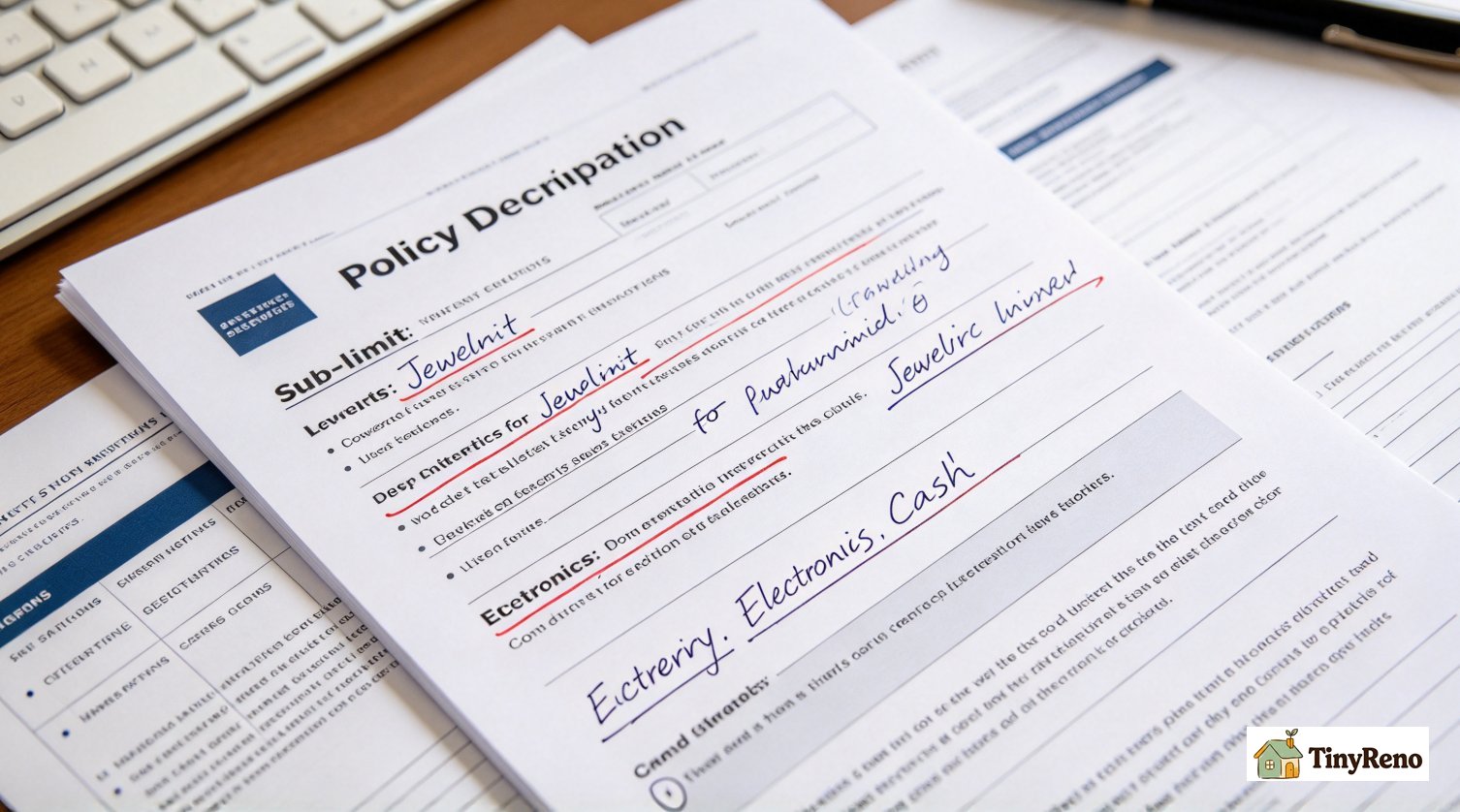
The third person I asked was a claims adjuster at a different insurance company who processed my friend Marcus’s water damage claim in May. The claims adjuster said the two agents had described the broad categories but not the internal caps that determine what actually gets paid. Most renter policies have sub-limits inside the personal property limit. A sub-limit is a cap on a specific category of items, even when the overall personal property limit is much higher. Common examples are jewelry, watches, furs, firearms, cash, and sometimes silverware or collectibles. The exact categories and dollar caps vary by carrier and policy. The adjuster said the sub-limit that catches the most renters off guard is jewelry, because a household may own several thousand dollars of rings, watches, and necklaces while the policy caps that category at $1,000 or $1,500. Electronics are usually not a separate sub-limit; they are treated as personal property and counted against the overall limit, unless the policy lists a specific electronics cap. The declarations page is where you find the actual caps for your policy.
The claims adjuster also said the most commonly missed exclusion is water damage from outside the apartment. A burst pipe inside the wall is usually covered. A burst pipe in the unit above yours that floods your apartment is usually covered. A flood from outside — a river, a storm surge, ground water — is usually not covered under renter insurance. You need a separate flood policy through the National Flood Insurance Program. Most renters do not know this. Most renters do not buy flood insurance because they assume it is included.
The other exclusion the claims adjuster flagged is mold. Mold damage is usually covered up to a sub-limit of $1,000 to $5,000 if the mold was caused by a covered peril (like a burst pipe). Mold caused by neglect (like you ignored a leak for three months) is not covered at all. The sub-limit is enough to clean up a small mold problem from a burst pipe. The sub-limit is not enough to remediate a serious mold problem that has spread through the walls. For serious mold, you need a separate environmental rider or a different policy.
What My Policy Actually Covered, and the $40,000 Gap
So of the three people I asked, the State Farm agent gave me the standard summary, the Lemonade agent added off-premises coverage and the replacement cost versus actual cash value distinction, and the claims adjuster explained the sub-limits and exclusions that determine what actually gets paid. My State Farm mid-tier policy covers $40,000 of personal property. The overall limit was not the problem. The problem was the internal caps. The policy had a $1,500 jewelry sub-limit and no separate electronics sub-limit. My contents are worth about $35,000, including about $6,000 of jewelry and $8,000 of electronics. If the jewelry was stolen, the policy would pay at most $1,500 for that category. The electronics would count against the overall $40,000 limit, subject to the replacement cost or actual cash value provision. The furniture, clothing, and books were covered within the overall limit. The gap was not $40,000. The gap was the difference between what the jewelry was worth and the jewelry sub-limit, plus the depreciation gap if replacement cost was not included.
The claims adjuster also explained how to use the policy so a claim does not get denied on process grounds. Most carriers require a police report within a short window after a theft, photos of the damage, receipts for replacement items bought while the claim is pending, and preservation of the damaged items until the adjuster says they can be disposed of. The adjuster said the most common process failures she sees are missing police reports, thin documentation, and discarded damaged items. She did not give a precise denial rate, and I would not repeat one without the carrier’s data. The practical point is that documentation and preservation matter as much as the policy language.

How to Pick the Right Policy, Based on What You Actually Own
The practical decision framework is to compare your actual contents to the policy’s sub-limits, not just the headline personal property number. If you own jewelry, watches, or other high-value items above the policy’s sub-limit, ask about scheduling those items or adding a rider. If you own a lot of electronics, confirm whether they are subject to a separate cap or counted against the overall limit. If you live in a flood-prone area, understand that renter insurance usually excludes outside flood water and that flood coverage is typically purchased separately through the National Flood Insurance Program or a private flood insurer. FEMA flood maps are a useful risk reference, but they are not the purchase portal. If replacement cost is not included, ask what it costs to add. If you travel with a laptop, camera, or bicycle, check the off-premises coverage limit.
What I would tell anyone shopping for renter insurance, and what I would have told myself in March, is that the policy price is not the most important number. The personal property limit is not the most important number. The most important numbers are the sub-limits inside the personal property limit. A $40,000 policy with a $1,500 jewelry sub-limit is worse for a jewelry owner than a $20,000 policy with a $5,000 jewelry sub-limit. The price difference between the $40,000 policy and the $20,000 policy is usually $5 to $10 a month. The coverage difference is $3,500 of jewelry protection. Read the policy declarations page. Look for the sub-limits. Buy the policy that covers your actual contents.
The question of what renter insurance actually covers is the most important question to ask before you buy. Renter insurance is not one product. It is a bundle of coverage categories with different sub-limits, different exclusions, and different claim requirements. The selling agent is useful for getting a policy. The competing broker is useful for comparing price and spotting add-ons like replacement cost and off-premises coverage. The claims adjuster is useful for understanding what actually gets paid. All three perspectives are useful, but the claims adjuster’s perspective is the one that matters when something happens. The policy price is what you pay. The sub-limits and exclusions are what determine what you get paid. Most renters focus on the price. Most renters should focus on the sub-limits.


Discussion (0)
Sign in to join the discussion