

Four Friends, Four Small Living Rooms, One $400 Budget
Small living room decorating ideas for a rental is the question I get asked most when friends come over to my 380-square-foot apartment in Brooklyn. The living room is 11 by 14, has one window, no closet, and a radiator that takes up four square feet I cannot use. I gave four friends a $400 target, three constraints, and asked them to decorate their own small living rooms. The constraints were no new holes in the wall, everything had to fit in a car at move-out, and the room had to be sleepable on the first night. Two stayed close to the target. One went over. One ignored the budget entirely. Here is what each one did, and which approach matches your situation.
The four friends are Sara, who lives in a 280 square foot studio in the East Village. Marcus, who lives in a 420 square foot one-bedroom in the same building as me. Devon, who lives in a 350 square foot one-bedroom in Jersey City. And Iris, who lives in a 600 square foot two-bedroom in Astoria. I gave Sara the smallest space, Marcus a similar space to mine, Devon a slightly smaller one, and Iris a larger one. The point of the exercise was not to compare what works in different sizes — it was to find the small living room decorating ideas rental that work in a renter's life, which is the same regardless of square footage.
The budget for each friend was $400, with three constraints. No holes in the wall — anything hung on the wall had to use removable adhesive strips or a tension rod, not nails or screws. Everything they bought had to fit in their car when they moved — no furniture that required a moving truck. And they had to sleep in the room the night they finished, not just look at it during the day. Those three constraints are what most renters actually live with. The fourth friend, Iris, ignored the budget, which is part of why her room did not work.
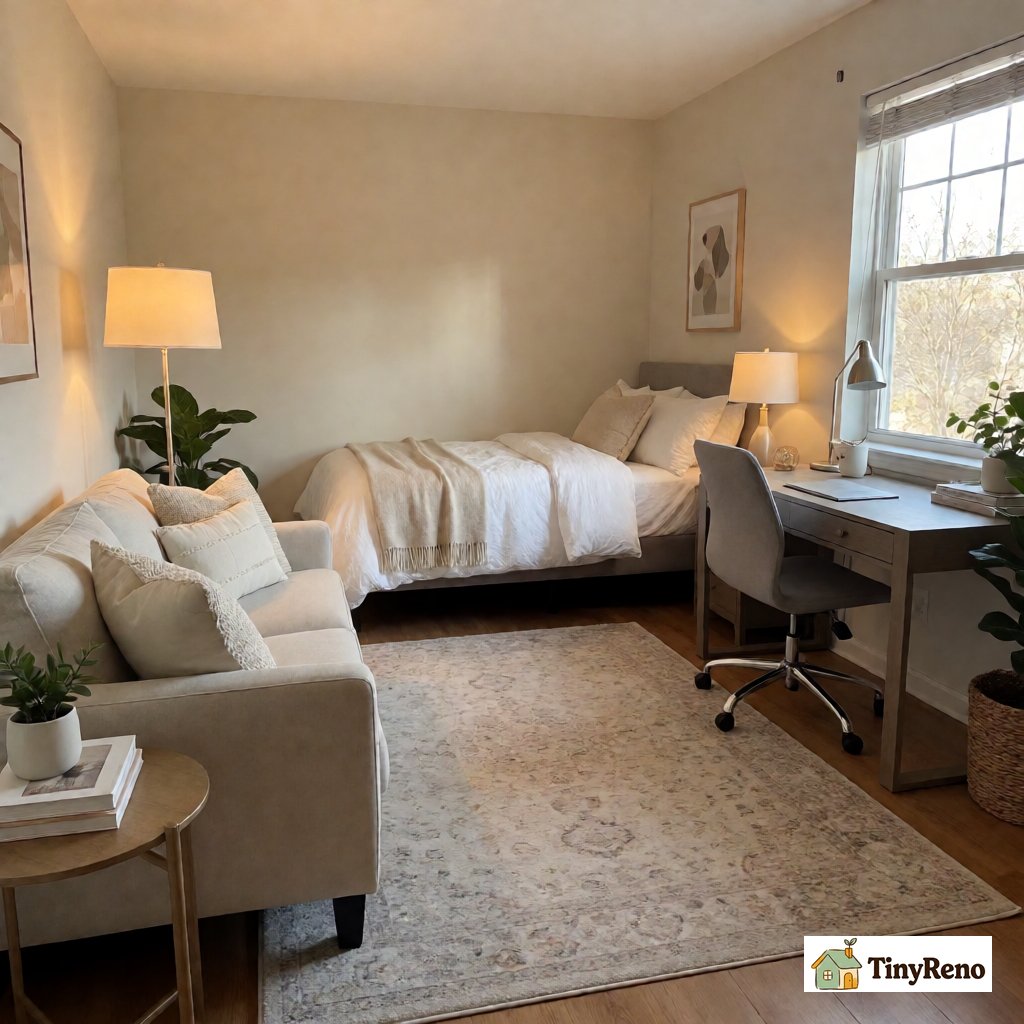
Sara, Who Used One Lamp, One Rug, and One Piece of Art to Define Three Zones
Sara's apartment was the hardest because the entire space had to function as living room, bedroom, dining room, and home office. The 280 square feet was a single room with a kitchen alcove. Sara decorated with three things. A floor lamp with a warm 2700K bulb that she moved around the room based on the time of day — by the desk in the morning, by the sofa in the afternoon, by the bed at night. A rug that was 5 by 7, the largest she could fit, that anchored the seating area. And one large piece of art on the wall above the sofa — a poster from a museum gift shop she had framed at a frame shop for $40. Total cost: $240. Total wall holes: zero. The lamp, rug, and framed art came with her when she moved. Sara's approach worked because she treated the room as three zones, sleeping, working, and relaxing, and used the lamp to move between them.
What Sara did that the other three did not was edit. She started with a list of fifteen things she wanted to buy and ended with three. She did not buy a bookshelf because the room did not have a wall for it. She did not buy a coffee table because the rug was enough to set the seating area. She did not buy plants because she has killed every plant she has ever owned. Her total was about $240, and the later reference to $250 should be read as the same estimate with tax or a small price difference. The discipline of saying no to nine things out of ten is the difference between a room that looks decorated and a room that looks lived in.
Marcus, Who Added a Bookshelf, a Plant, and a Bar Cart to Mine
Marcus's apartment was almost identical to mine in square footage, but the window was on a different wall, which changed where the natural light fell. Marcus decorated with the same three things Sara did, plus two more. A floor-to-ceiling bookshelf that he assembled from a kit and anchored with anti-tip straps for safety. The straps went into studs, which left four small holes that the landlord patched at move-out. That is a safety exception to the no-new-holes rule, not a decorative hole. A plant, a pothos in a hanging basket from a ceiling hook that was already in the ceiling for a previous tenant's light fixture. And a small bar cart that he used as a side table next to the sofa. His total was about $480. Marcus's approach worked because the bookshelf and bar cart gave him storage and surface area that the small room did not have by default. The plant added a soft texture that made the room feel less like a dorm.
The bar cart was the smartest purchase of the four. Marcus used it as a side table next to the sofa, a bar when friends came over, a kitchen prep surface when the kitchen was full, and a plant stand for a second pothos. The cart had four uses and cost $80. The four uses meant it earned its floor space in a way a fixed side table would not. A piece of furniture that has multiple uses is the best kind of furniture in a small room because it earns its square footage.
Devon, Who Bought a Sectional for a Room That Needed a Loveseat
Devon's apartment was the over-furnished case. Devon spent about $480 on a used sectional, a coffee table, a media console, and two side tables. None of it was wrong for a larger room. In a 350-square-foot one-bedroom, the sectional took up most of the seating wall and left a narrow walking path. The coffee table sat close to the sofa because there was no other place for it. The media console blocked part of the only window. The room felt crowded and darker than it needed to. The mistake Devon made was buying furniture sized for the room Devon wanted, not the room Devon had. A loveseat instead of a sectional, a smaller coffee table, and wall-mounted shelves instead of a media console would have cost about the same and worked better. Devon's approach did not work well because the furniture was too large for the room. Small living room decorating ideas for a rental should start with measuring the room and choosing furniture that is one size smaller than you think you need.
The single piece of advice Devon wishes she had received before the shopping trip is this: bring a tape measure to the furniture store. Measure the sofa you are about to buy. Measure the doorway you will carry it through. Measure the wall you will put it against. Most furniture looks smaller in a 10,000 square foot showroom than it does in a 350 square foot apartment. The sectional Devon bought was 9 feet long. Devon's living room wall was 11 feet long. The sectional left a 1-foot walking path on each end, which is what the room needed to walk around the sofa. The room felt like a hallway with a sofa in it.
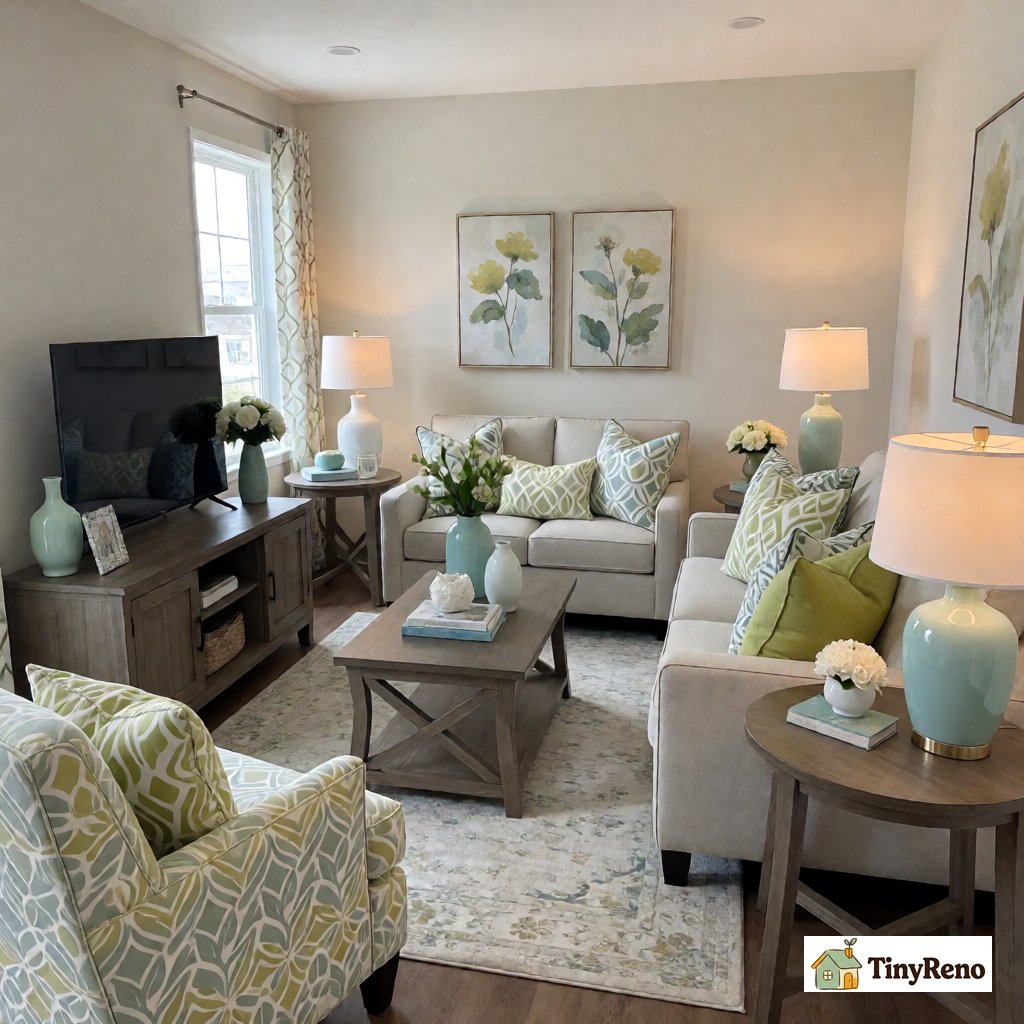
Iris, Who Decorated a Room That Looked Like a Furniture Store
Iris's apartment was not a fair test of the $400 target, because Iris ignored the budget. She had the most space, 600 square feet in a two-bedroom, and she treated the living room as if it were a showroom. She bought a matching sofa, loveseat, coffee table, two end tables, a media console, a rug, six throw pillows, three vases, two lamps, and four pieces of wall art. The total was much higher than the target. The room looked like a furniture store display rather than a place where a person lived. The lesson is not that Iris failed at a $400 budget. The lesson is that over-decoration makes a room feel impersonal even when the furniture is new and matching. A smaller version of the same room, with two throw pillows instead of six, one vase instead of three, one lamp instead of two, and one piece of wall art instead of four, would have felt more personal and cost less.
The mistake Iris made that I want to flag, because it is the most common mistake in decorating, is that she bought a matching set. A matching set is the default in any furniture showroom. The showroom wants you to buy six things that go together because the visual result is impressive for the 10 minutes you are in the showroom. In a room you live in for three years, a matching set makes the room feel like a hotel. The fix is to mix and match. A sofa from one store, a chair from another, a rug from a third. The mismatch is what makes the room feel personal. Iris's matching set was the reason the room felt impersonal even though she had spent more than Sara and Marcus combined.
What Actually Works in a Renter Small Living Room, and Which Friend to Copy
So of the four friends, Sara and Marcus stayed closest to the renter-friendly approach. Devon over-furnished. Iris ignored the budget and over-decorated. The small living room decorating ideas for a rental that work are these. First, measure the room and choose furniture that is one size smaller than you think you need. A loveseat instead of a sectional. A 4-foot table instead of a 6-foot table. Wall-mounted shelves instead of a media console. Second, use one anchor piece that has personal meaning, such as a rug, a framed art print, or a chair you found at a flea market. The anchor piece is what makes the room yours, not just a room with stuff in it. Third, use light to define zones instead of walls. A floor lamp that moves is cheaper and more flexible than a partition. Fourth, keep the number of objects small. Two throw pillows, not six. One lamp, not three. One piece of wall art, not a gallery wall of twelve. Fifth, leave one wall empty. An empty wall gives the room breathing space and makes the objects you do have look more intentional. The empty wall also gives you a place to project movies.
Now, the routing. If your small living room is under 350 square feet and you need it to function as multiple rooms, use Sara's approach: three zones, one floor lamp, one rug, one piece of art. Her total was about $240, and the visual impact was bigger than the dollar amount. If your small living room is between 350 and 500 square feet and you need storage plus surface area, use Marcus's approach: add a bookshelf with safety anti-tip straps, a plant, and a small bar cart or side table. His total was about $480. If your room is over 500 square feet, you have more freedom, but avoid the three anti-patterns described above: oversized furniture, over-decoration, and furniture that blocks windows. Keep one wall empty as a positive rule, not as a fourth anti-pattern.
What I would tell my past self, and what I would tell anyone moving into a small apartment in November, is that the small living room decorating ideas rental that work are not about buying more. They are about buying less and choosing better. The room you have is the room you have. The room you want is a luxury that costs $1,500 to $3,000 in furniture, and most of it will not come with you when you move. The room you have, decorated with three to five intentional pieces, will look like a place where you live. The same room decorated with ten to fifteen pieces will look like a place where you are storing things.
The other thing I would say is that the decorating is the last step, not the first. Before you decorate, decide where the room will function. Where will you sleep. Where will you work. Where will you relax. Where will the natural light fall in the morning and the afternoon. Where will the radiator heat reach. Where will the door swing open without hitting anything. The decorating follows the function. If you decorate first and try to make the function fit the decoration, you will end up like Devon or Iris — a room with furniture in it that does not work for the life you live.
The piece of advice I would give Ryan, who is moving into a 320-square-foot studio in the East Village next month and asked me yesterday what to do first, is this. Measure the room. Draw it on graph paper. Place the three to five pieces you cannot live without, such as a bed, desk, sofa, or dining table. See how much space is left. Spend about $200 to $400 on the three things Sara and Marcus used: a lamp, a rug, and a piece of art. Move in. Live for a month. Then buy anything else. The first month will teach you where the room actually needs things, and where it does not.


Discussion (0)
Sign in to join the discussion