

Are rats scared of humans was the question I asked my roommate Sarah in our Cleveland rental at 6 a.m. on a Tuesday in early November, when I set down the mug of coffee I was holding and pointed at the kitchen floor about four feet from where I was standing. There was a rat on the floor. The rat was not running. The rat was not hiding. It looked at me the way a small animal looks at another large animal it has decided is not a threat, which is to say it looked at me for about as long as I was willing to stand there looking at it, and then it moved on at its own pace, in the direction of the radiator, and disappeared behind it. I went and got Sarah, who had been asleep, and I said, "We have a rat." She said, "Okay. What do we do?" And the first question we both had, before we got to any of the practical steps, was the one I want to answer in this article for anyone who has just seen a rat in their own kitchen: are rats scared of humans at all?
The honest answer, which I want to put up front because most of what you read online gets it half right, is that rats are not afraid of humans the way mice are. Mice, when they realize a human is in the room, will bolt for cover in about two seconds. Rats, once they have decided a space is theirs, will treat you the way a city pigeon treats you—as a feature of the environment. They will not run. They will not hide. They will keep doing what they were doing, let you walk past them, and go back to it when you leave. This is one of the reasons rats are harder to deal with than mice in a rental. A mouse infestation, even a serious one, can often be handled with snap traps, because mice are skittish enough to avoid the trap after the first one is caught. A rat infestation cannot be handled with snap traps alone, because rats will investigate the trap after the first one is caught, and they will learn to avoid it within three or four days.
This is the before-and-after I want to walk through. Before: one rat in the kitchen, on the floor, on a Tuesday morning, not running away. After: a long two months of snap traps that caught nothing, peppermint oil that did nothing, steel wool that did almost nothing, and eventually a call to the leasing office that produced, finally, a maintenance man with a key to the unit above us, who found the entry point in the boiler room, who supplied me with the actual answer to the question are rats scared of humans, which is no, they are not, and which is also the answer to the related question are you going to solve a rat problem on your own, which is also no, not really, not if you are renting. The after is not a victory story. The after is a story about calling the right person at the right time, which in a rental is your landlord.
What "afraid" actually means, in rat terms
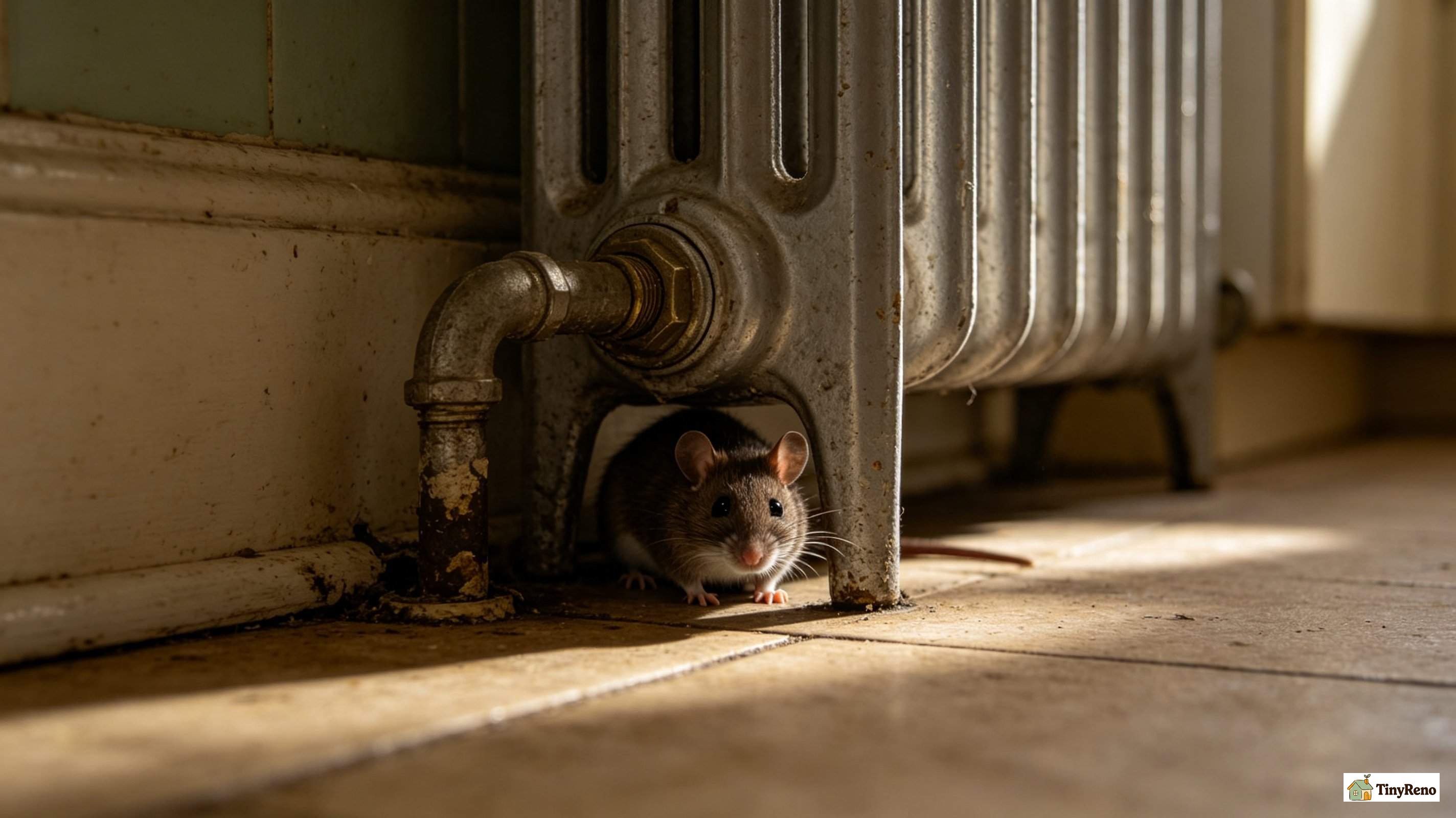
The behavior I saw in my kitchen—the standing, the looking, the not running—is a real thing, and it has a name in the urban pest literature. It is called neophobia, the technical term for "fear of new things," and it is the opposite of what you want when you are trying to trap rats. A neophobic rodent is suspicious of anything new in its environment—new food, new objects, new smells—and it will spend days investigating them before it interacts. A rat in an established territory (and once a rat has been in your kitchen for a week, that is what your kitchen is) has decided that the territory is known, the smells are known, and the objects are known. You are now one of the known smells. You are not a threat. You are furniture.
This is the part I did not understand until I read about it. The reason a rat does not run from you when you walk into the kitchen at 6 a.m. is not that the rat is brave. The reason is that the rat has been in your kitchen for weeks before you saw it. Rats are cautious about new things. They are not cautious about known things. You, in a rat's view of your kitchen, are a known thing. The radiator is a known thing. The dish rack is a known thing. You are somewhere between the radiator and the dish rack, in the rat's classification of the apartment. This is the part of "are rats scared of humans" that the pest-control marketing never quite says out loud — the question is not whether rats fear humans in general, it is whether rats fear this particular human in this particular kitchen, and once a rat has been there a week, the answer is no. This is not a comforting fact, but it is a useful one, because once you understand it, you understand why every product that promises to scare rats away from a space they have already claimed is selling you something that does not work. The rat is not afraid of you. The rat is at home.
What did not work for us, and why
Peppermint oil was the first thing I tried, because it is the first thing on any list. I bought two bottles at the grocery store, soaked cotton balls, and put them behind the radiator, under the sink, and along the baseboard where I had seen the rat go. The peppermint did nothing. I kept refreshing the cotton balls for ten days because I had read somewhere that you have to give it ten days, and at the end of ten days the rat was still using the same path between the radiator and the back of the stove, and the kitchen still smelled of peppermint for us, which was a much milder smell than I had expected but considerably less pleasant than no smell at all. The reason peppermint oil does not work on rats is the same reason it does not work on mice — the published studies are mostly about mice, not rats, and the few that include rats show an effect on the order of "slightly less likely to investigate a new object that smells of peppermint," not "leave the area." A rat that has already mapped your kitchen does not care that your kitchen now smells of peppermint. Peppermint is, at most, a mild novelty.
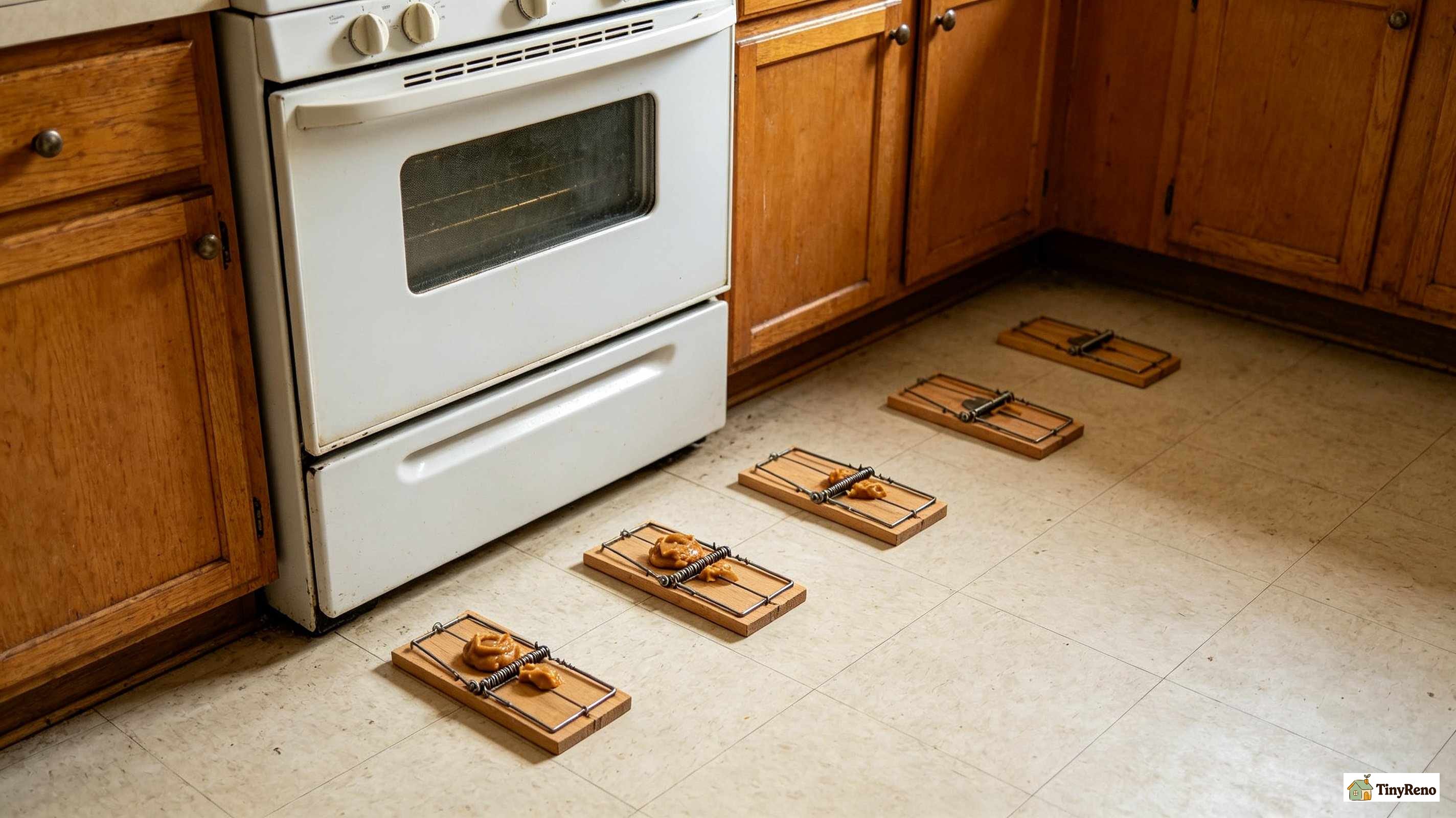
Snap traps were the third thing I tried, after the peppermint and the steel wool, and they were the most instructive failure of the three. I set four snap traps along the path I had watched the rat take, baited with peanut butter, and I caught nothing in the first week. I caught one in the second week, a juvenile, which told me there was more than one rat and at least one of them was not yet fully grown. I caught nothing in the third week. By the fourth week the rats were avoiding the traps entirely, which I confirmed by leaving unbaked traps out and seeing the bait removed without the trap firing. The trap-avoidance behavior is the documented phenomenon, and it is the reason snap traps alone will not solve a rat problem in a rental. The rats learn the trap. They do not learn it because they are watching other rats get caught. They learn it because they are neophobic, and the trap, after a few days, becomes a known thing that does not pay to approach.

What worked, and what would have worked if I had done it sooner
The thing that worked was the leasing office, on day sixty-two, when I finally sent the email I should have sent on day one. The email said three things. It said we have seen a rat in the kitchen. It said I have not been able to solve this with the products I can buy at a hardware store. It said the unit above us may be the source, and the only entrance I can find is in the basement boiler room. I sent it at 7 a.m. on a Tuesday, with two photos attached. The maintenance man was at our door at 9:30 a.m. with a key to the second-floor unit and a key to the basement. He found the entry point in under an hour. He sealed it with a steel wool and caulk mixture that has not failed in the four months since. The rats left on their own within three weeks, because the entry point was sealed and the food source in the kitchen — the dish rack, the open pantry, the unsealed bag of pasta on the counter — had been cleaned up by us in the second week of December. None of this is something I could have done as a renter. None of it required my labor or my judgment beyond the email. It required the email.
The thing that would have worked sooner, and that I would tell any renter who is reading this, is to send the email on day one and not on day sixty-two. Most leases I have read in Ohio and in the other three states I have rented in put rodent control squarely on the landlord, because rodent entry is typically through a structural opening (a gap in the foundation, a hole in the siding, a gap around a pipe) that the renter is neither responsible for nor licensed to repair. Most city and state habitability codes I have looked at say the same thing in different words. The renter's job is to report, promptly, with photos and dates, and to keep the kitchen clean so the rats do not have a food source. The landlord's job is everything else. The traps, the entry-point repair, the bait stations, the follow-up visits — those are not renter jobs, and trying to do them as a renter is the part of this I would skip if I had it to do over.
The short version, before you buy anything at the hardware store

If you see a rat in your rental, and the rat is not running away when you walk in, the answer to whether rats are scared of humans in your kitchen is no—not after the rat has been there for a week. You are not going to scare them with peppermint, ultrasonic plug-ins, steel wool alone, or any of the other things you will see recommended. You are going to do two things, in this order. First, clean the kitchen: sealed containers, no food on the counter, no dirty dishes overnight, no open pantry. Second, email your landlord the same day, with photos and dates, and ask specifically for an inspection of the unit above yours and any common basement or garage space. If your landlord does not respond within five business days, look up your city's habitability code and send a second email referencing the relevant section. Keep a copy. The rats are not afraid of you. The system is afraid of paper trails. Use that.


Discussion (0)
Sign in to join the discussion