

How to pack pots and pans for moving is the question I had on June 9, 2019, when I heard the sound of a $340 Le Creuset Dutch oven cracking against the trunk of a yellow cab while I was holding the door open for a stranger who turned out not to be the driver I had called.
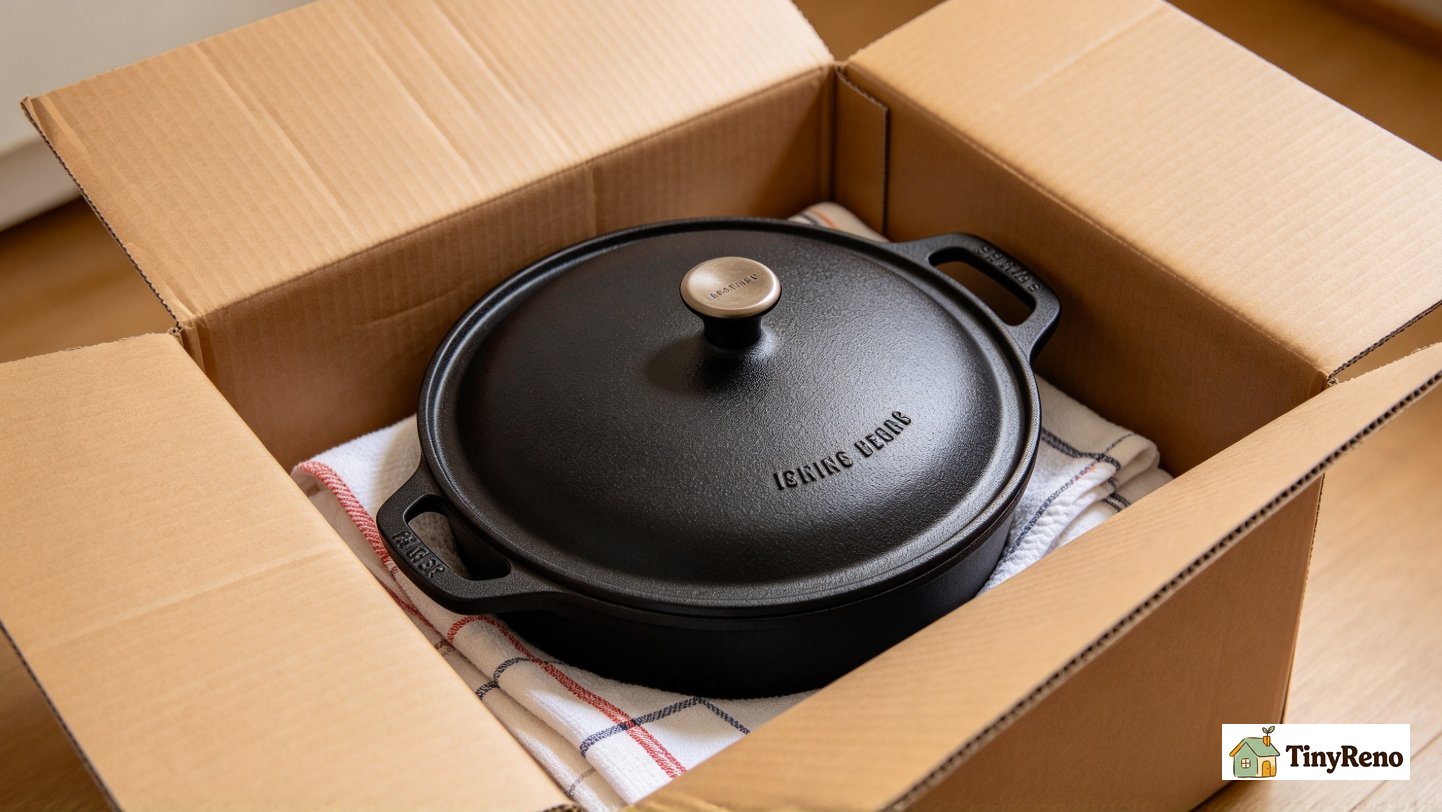
I had packed the Le Creuset on a Saturday night in a 24-inch box, the largest moving box Home Depot sells. I had wrapped it in two dish towels and put it in the middle of the box, surrounded by six paper plates and three coffee mugs. The box was the heaviest of the eight I had taped shut, and I had labeled it KITCHEN HEAVY in Sharpie on three sides because I had read three different blog posts that all said the same thing. None of the blog posts mentioned that the box would be turned on its side by the driver, or that the Le Creuset would land on the trunk lid because the dish towels had compressed by half during the four-block drive from the Sunnyside basement to the yellow cab stand on 36th Avenue.
The 1 Pot I Lost in the Cab
The driver did not help. The driver told me that boxes marked HEAVY were not his problem. He told me that the fare from Sunnyside to Astoria was $14, and that I should stop asking him to lift things because he had a herniated disc. I tipped him $4. He did not thank me. The Le Creuset was in two pieces when I opened the box in my new Astoria kitchen, the crack running straight through the word Le Creuset stamped on the bottom. I taped it back together with ceramic epoxy I bought at the hardware store on 31st Street for $8. I cooked in it twice. The leak came back both times. I put it in a stoop sale on 30th Avenue in October 2019 for $80, and someone took it home, and I never saw it again.
How to pack pots and pans for moving depends on the answer to three questions, and the answer to each one decides the box. The first question is how far the move is. The second question is how many pots you own. The third question is whether you have any pot you would cry over if it broke. I will answer those three questions as I go, and I will tell you what I do now, after five moves and one broken Le Creuset.
The 1 Pot I Lost Was Not the Only Pot I Broke
The 1 pot I lost in the cab is not the only pot I have broken. I broke a $60 Lodge cast-iron skillet in 2017 because I put it in the same box as my plates. The plates shifted during the drive. The skillet hit a dinner plate. Both broke. I tried to glue the skillet back together with ceramic epoxy. It split on the second use. I threw it out. The lesson I learned the slow way is that pots and plates do not go in the same box, because plates will always shift past the heaviest object in the box and break it. Pots go in their own box. Plates go in their own box. Mugs go in their own box. Glasses go in their own box. This is the first rule of how to pack pots and pans for moving and it is not negotiable.
The 4 Methods I Tried, and What Works
The 4 methods I tried, in order of how much they actually helped.
Method one was dish towels, which is what I used for the Le Creuset and the cast-iron skillet and the $18 IKEA pot I bought in 2015 to replace the pot I lost in college. Dish towels compress. They absorb shock on the first day. They do not absorb shock on the second day, because the cotton fibers have already given up. By the time the box is on the truck, or in the cab, or on the dolly, the towels have flattened and the pot is sitting on bare cardboard. The next bump cracks the pot. Dish towels are fine for plates. Dish towels are not fine for the pots you would cry over.
Method two was bubble wrap, which is what my friend Priya, who had moved three times in 2020, told me was the only answer. Priya was wrong about this one thing. Bubble wrap protects pots in transit, but it costs about $14 for a 12-inch by 25-foot roll at Home Depot. That roll is enough to wrap maybe six medium pots, not a full set. By my fourth move, I was spending $40 on bubble wrap for the kitchen alone, and I was still breaking a pot every other trip. Bubble wrap works. It does not work at the price I was willing to pay.
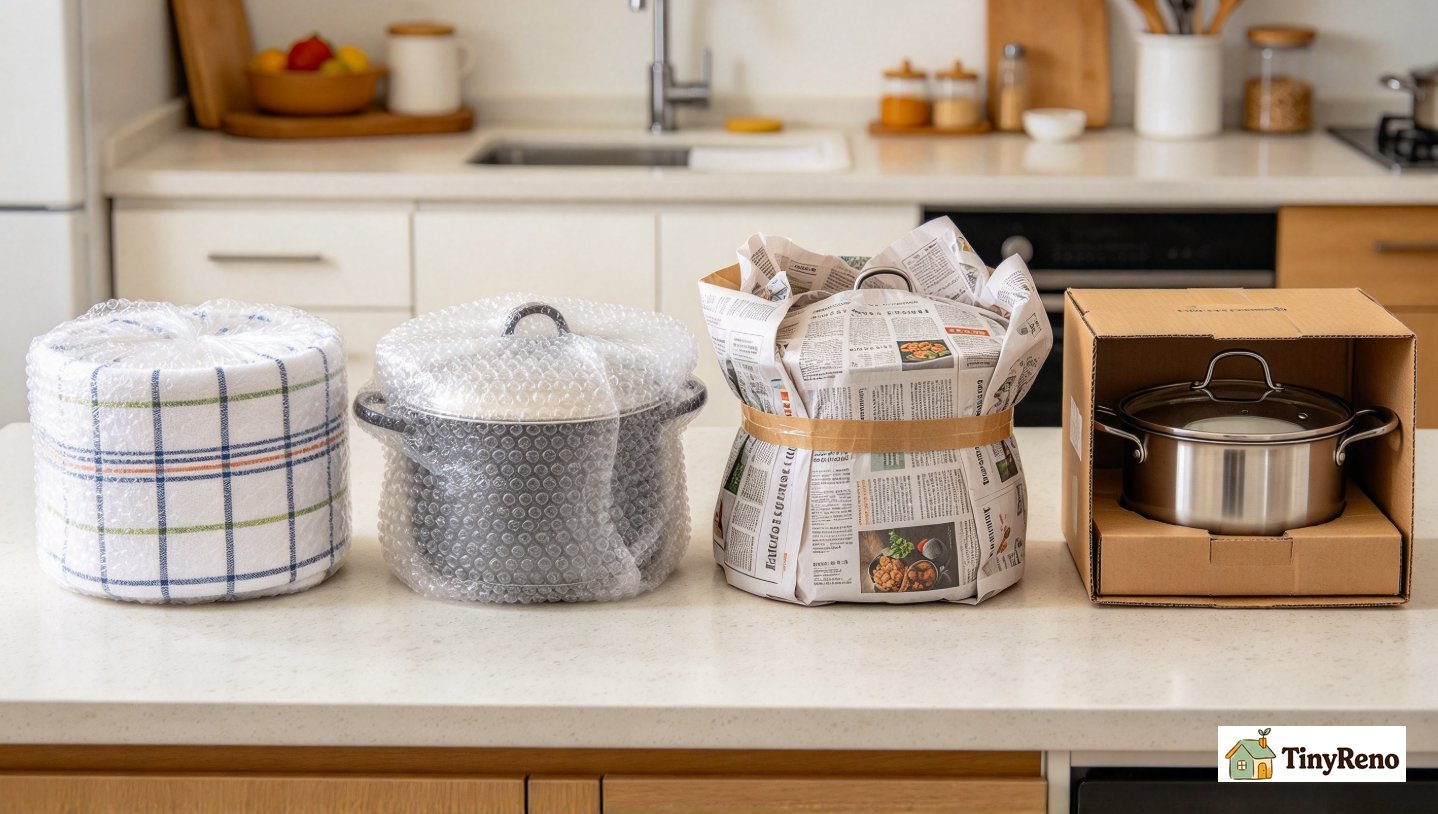
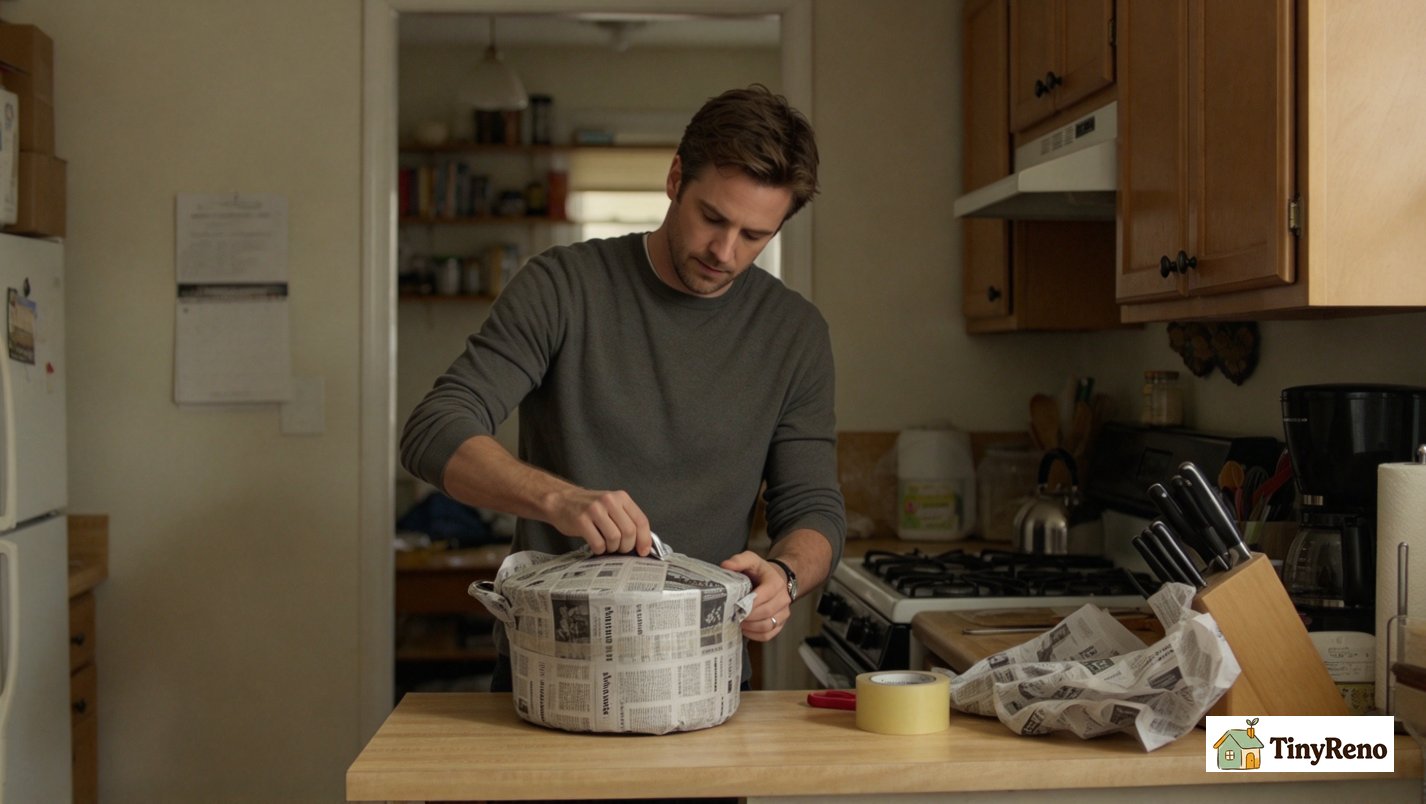
Method three was paper, which is what every moving guide online says is the right answer. You wrap each pot in two sheets of newsprint or unprinted newspaper, you tape the paper closed, you put the pot in a box, you fill the empty space with more paper. This is what I did for the move from the Bed-Stuy walk-up to the Astoria railroad apartment in 2022. It worked. None of the pots broke. The cost was $11 for a ream of newsprint at the office supply store on Steinway. The downside is the time. Wrapping twelve pots took me two hours. Wrapping twenty pots took me three and a half hours. Paper is the cheapest method. Paper is the slowest method. If you have a 3-day weekend, paper is the method I would use now.
Method four was no-wrap, which is what I tried in May 2024 when I moved from Astoria to a 1-bedroom in Long Island City with a boyfriend I had been dating for eight months. We had 14 pots total. We wrapped nothing. We put each pot in a separate 18-inch box, with a single dish towel at the bottom to keep the pot from sliding, and we taped the box shut. We did not break a single pot. The boyfriend and I broke up four months later, which is not relevant to the pot question, but I want to be honest about the timeline.
The Box Size That Actually Matters
The box size that actually matters is the second rule of how to pack pots and pans for moving. Pots go in 18-inch boxes, one pot per box if the pot is heavy, two pots per box if the pot is light. The reason is that a heavy pot in a 24-inch box shifts every time the box is moved, and the shift breaks the pot. A heavy pot in an 18-inch box does not shift, because there is not enough room for the pot to fall more than an inch. The 18-inch box is also lighter, which means the person carrying it can hold it with two hands, which means the box does not get dropped.
The 4 Things You Do Not Pack With the Pots
The 4 things you do not pack with the pots. The first is the wooden spoon. Wooden spoons belong with the kitchen utensils box, not the pot box, because the wood splinters against the cast iron and the splinter ends up in your food for the next six months. The second is the oil. Oils go in the liquids bag, which you carry with you, not in the moving truck, because oils leak in the heat and the leak ruins everything else in the box. The third is the foil. Foil compresses, like dish towels, and the pot sits on bare cardboard by the second day. The fourth is the cleaning rag. Rags smell after three days in a sealed box in a hot truck, and the smell transfers to the pot, and the pot smells like a wet dog for the first month in the new apartment. Skip all four.
The Le Creuset I Almost Repaired and Did Not
The Le Creuset I almost repaired and did not is the last thing I want to tell you about, because the question of whether to repair a cracked Le Creuset is one of the questions that comes up every time a friend asks me how to pack pots and pans for moving. My answer, after three ceramic epoxies and one $80 stoop sale, is do not repair it. A repaired Le Creuset leaks. A repaired cast-iron skillet splits. A repaired pot is not a pot, it is a paperweight you paid $340 for. The repair costs $8. The leak costs you the recipe. The replacement Le Creuset on the Le Creuset website costs $340. The IKEA 365+ Dutch oven costs $40, and it has a 15-year warranty, and the warranty is not a marketing promise, it is a real warranty I used in March 2023 when the lid handle cracked and they sent me a new lid without asking a single question.
If I were doing this over, I would never put a Le Creuset in a moving box. I would keep it with me. I would wrap it in a towel and put it on the passenger seat of the cab. The Le Creuset costs more than the cab ride. The Le Creuset costs more than the $40 IKEA replacement. The Le Creuset is not worth the repair, and the Le Creuset is not worth the cab driver who drops it. The only thing the Le Creuset is worth is the seat next to me on the drive from Sunnyside to Astoria, which is the only thing I did not do in June 2019.


Discussion (0)
Sign in to join the discussion