

The Tuesday Morning Cooper Got the Grape
I learned what makes a non-toxic wood floor cleaner not optional at 7:14 on a Tuesday morning in March, when my sixty-pound dog Cooper licked a green grape off the floor before I could pick it up. Grapes are toxic to dogs. I had read that. Everyone who has ever had a dog has read that, and then gone on with their morning. The dog, of course, has not read that. Cooper got the grape. I got the vet's answering service. While I was on hold—Cooper threw up twice but the vet tech said the amount was small enough to monitor at home, and he was fine by Wednesday—I was also watching my three-year-old niece, who visits most Sundays, crawl across the same floor in the same room, and I was calculating, with the kind of math you do at seven in the morning before coffee, how many times a week a child or a dog or my own bare feet come into contact with whatever I had last mopped the wood with. The answer was: too many times not to know what was in it. So I started learning how to choose a non-toxic wood floor cleaner by calling everyone I knew who had an opinion.
My Mom in Toronto and the 1998 Asthma Attack
My mom was the first call. She is sixty-three, lives with asthma she has had since she was twenty-eight, and reads the ingredient label of anything that touches a surface she might breathe near the way other people read stock reports. She calls from Toronto once a week, and the conversation always starts with whether I am eating, and ends with whether I have checked the VOC label on whatever new product I have brought into the apartment. She said, on that Tuesday morning in March, that the word to look for is "VOC" or "volatile organic compounds," and that anything without a disclosure of VOC content is a product she would not let me use in a house she visits twice a year, let alone one where a sixty-pound dog lives. She said the rule she had followed since 1998, when her asthma first sent her to the emergency room after a landlord had the carpets shampooed with a product the tenant had not been told about, was to never use a cleaner that did not list every ingredient, in English, on the label. She said she had used the same dish soap and warm water mixture her mother had used on the wood floors of the Toronto house she grew up in, and that until I could prove to her that a branded product was safer than that, the dish soap was what she was going to keep recommending. She mailed me a printed page from the Asthma Society of Canada the next day, with two lines underlined.
My Sister-in-Law, the Pediatric Nurse, and the Yellow Highlighter
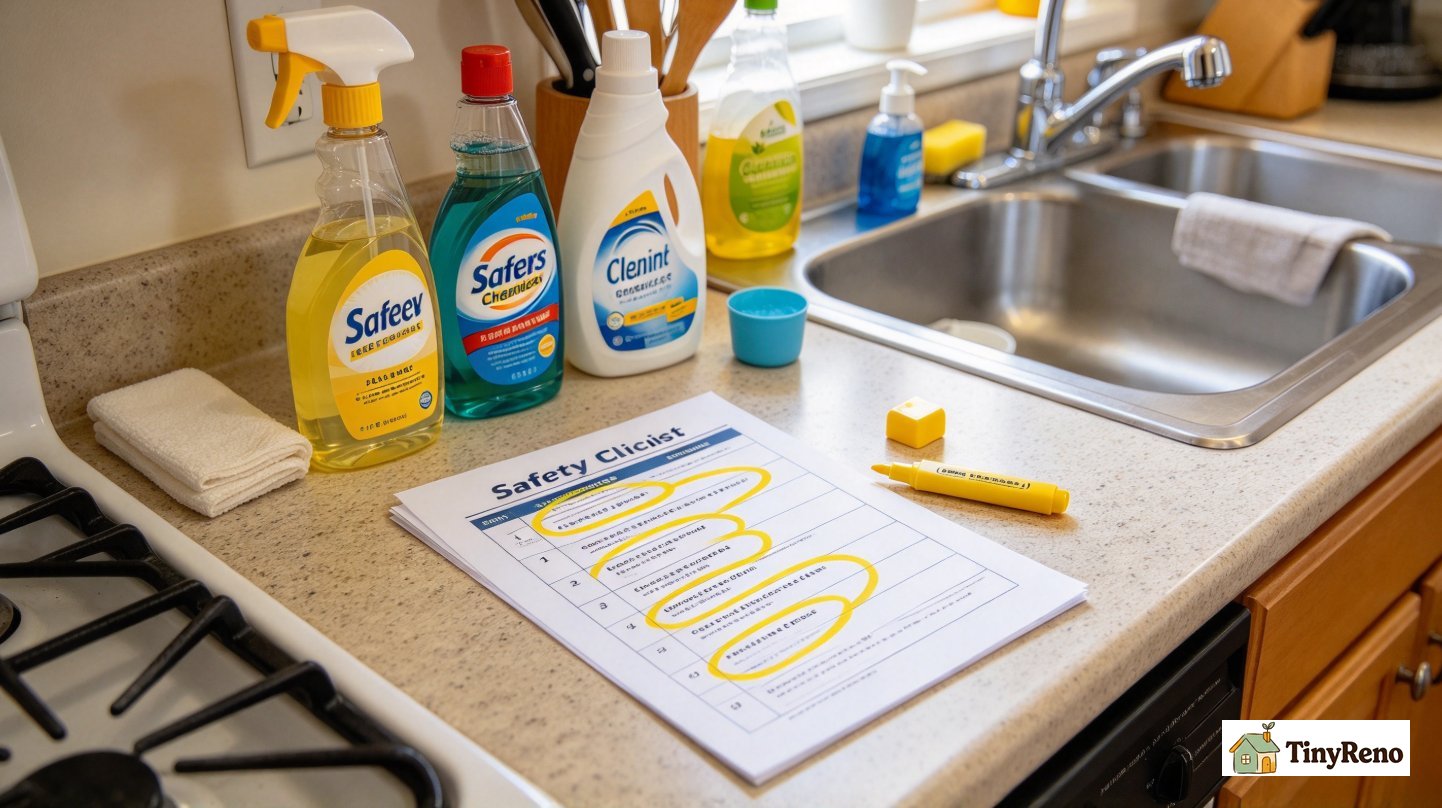
My sister-in-law was the second call. She is a pediatric nurse at a children's hospital in Philadelphia, and she visits New York on Sundays with my niece, who is three and has had two ear infections in the last six months that the pediatrician has said are unrelated to environmental factors but that my sister-in-law has nevertheless started tracking against the cleaning products in my apartment. She handed me, on her last visit, a folded printout from the diaper bag with four categories circled in yellow highlighter. The list came from the Environmental Working Group, and the four categories she told me to avoid, regardless of what the front of the bottle said, were quaternary ammonium compounds, which go by the abbreviation "quats" and are the active ingredient in most disinfectant sprays; sodium hydroxide, which is in most heavy-duty degreasers and is the chemical that gives drain cleaner its bite; chlorine bleach, which I knew about but had not thought about in the context of wood floors; and any product that listed "fragrance" as an ingredient without specifying what the fragrance was made of. She said the rule she followed for her own children, and now for my niece, was that if she could not pronounce the first three ingredients, she did not buy the product, and if the product was being used on a floor where her daughter would crawl within the next twelve hours, she wanted to know what the residue would be in another twelve hours after that. She keeps a copy of the printout in the kitchen drawer when she visits, and she reads the bottle of whatever cleaner is on the counter before she lets my niece sit down.
Dr. Patel at Brooklyn Animal and the Four Essential Oils
Dr. Patel was the third call. She is the veterinarian at the Brooklyn Animal Hospital where Cooper has been a patient since he was a puppy, and she had, on a previous visit, handed me a single sheet of paper with four essential oils that she said were toxic to dogs and that I should not use in any cleaning product in a house with a dog. The four were tea tree oil, which is in a lot of "natural" wood floor cleaners and which dogs absorb through their paws and which can cause tremors and loss of coordination at doses that are not labeled as dangerous on the bottle; eucalyptus oil, which is also in many natural products and which has the same paw-and-snout absorption issue; peppermint oil, which I had been using in a homemade floor spray until Dr. Patel told me to stop; and citrus oil, which is the most common of the four and which is in almost every "lemon scented" wood floor cleaner on the shelf at the hardware store. She said, on that Tuesday morning in March, that the rule she followed for her own patients was that if the product smelled strongly enough to be noticeable from three feet away, it was probably not safe for a dog that walked on the floor and then licked its paws. She said the dose that bothered a sixty-pound dog was about what a child would absorb crawling on the same floor in the same afternoon, and that the dose that bothered the child was about what a parent with a history of asthma would absorb standing in the room while the floor dried. She pinned the four-oils list to the inside of the cabinet under the kitchen sink, where I see it every time I open the door to get the mop bucket.
Forty Minutes in the Aisle on West Fourth Street
With three lists in hand, I went to the hardware store on West Fourth Street and stood in the cleaning aisle for what I now realize was about forty minutes. There were four wood floor cleaners on the shelf that day that were marketed as safe for wood, and a fifth on the bottom shelf that was not marketed as safe for wood but that was the one my mother had used for forty years. The four on the shelf were a do-it-yourself mixture of white vinegar and water, which the label said was safe for sealed wood floors; Bona, which is a Swedish brand and which the bottle said was "specifically formulated for hardwood floors and safe for kids and pets"; Method, which is a California brand and which the bottle said was "plant-based and biodegradable"; and a product called diluted castile soap, which was on the top shelf and which was the one Dr. Patel had told me was the safest thing she could think of for a house with a dog. I bought all four, plus a fifth that was not on my list but that I will get to in a moment, and I went home and tested them on the wood floor of my living room, which is the part of the apartment that Cooper walks on the most and where my niece plays on Sundays. The floor is a 1920s oak, original to the building, dark with age and wax, with the kind of grain that catches the morning light from the south-facing window and that I had been afraid to clean with anything except a barely damp mop since I moved in two years ago.
The white vinegar and water mixture was the first test, because it was the cheapest and because my mother had told me to use it for forty years. The label said one cup of vinegar per gallon of water. I mixed it in a bucket, dipped a microfiber mop, wrung it out until it was almost dry, and ran it across a three-foot section of floor near the south-facing window. The floor looked clean for about ten minutes, which is how long it took the water to evaporate, and then it looked dull. The grain of the oak, which had been catching the light, stopped catching the light. I ran my hand across it and felt a faint residue, which I am pretty sure was the vinegar reacting with the old wax finish. My mother, when I told her on our next Sunday call, was quiet for about ten seconds—the longest my mother has ever been quiet on a phone. She said she had been using the vinegar and water mixture on a sealed floor, not on a waxed floor, and that I should not have used it on a 1920s oak that had been waxed for a hundred years. She was right, and I should have asked her before I went to the store. The vinegar mixture got the floor clean, but it also got the wax off the floor, which is a problem I am still solving three months later with a can of butcher's wax and a soft cloth.
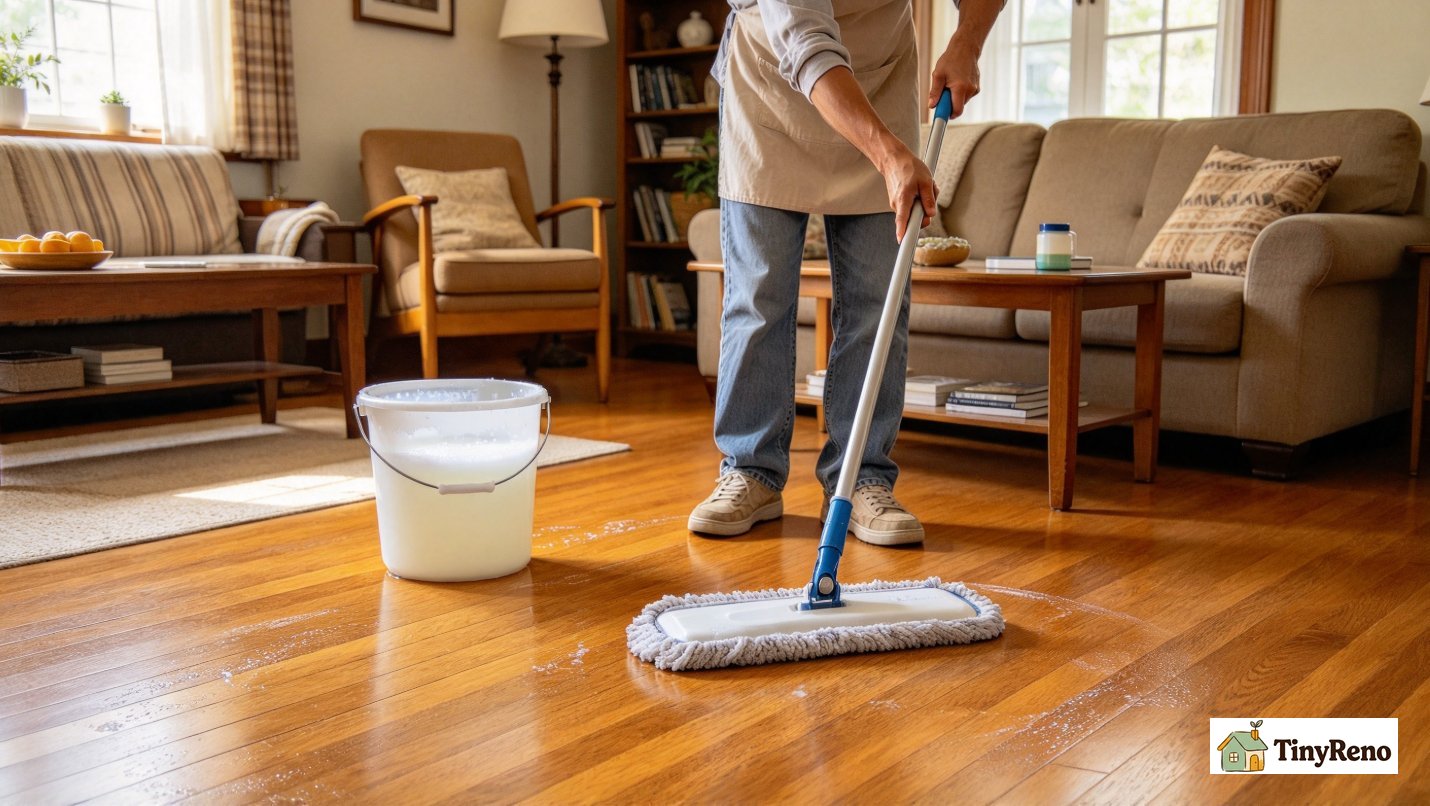
Bona was the second test, because it was the brand the hardware store clerk had recommended and because the bottle said it was safe for kids and pets. I sprayed it on, waited the thirty seconds the label said to wait, and wiped with the same microfiber mop. The floor looked clean and stayed clean. The grain still caught the light. There was no residue I could feel with my hand. I let Cooper walk on it twenty minutes later, which is how long the label said to wait, and he did not lick his paws. My sister-in-law came by on Sunday and read the bottle for about four minutes. She said the active ingredient was a polymer that was not on her EWG list, which meant it was probably fine for the kid pass she had been giving products, but that she would have preferred a list of every ingredient, not just the active one. She said the second ingredient was a surfactant that EWG rates as a moderate concern (3 out of 10). EWG's ratings are not perfect—some scientists criticize their methodology—but they're a starting point for comparing products when the full ingredient list isn't disclosed. She gave it a kid pass but not a dog pass, which meant it was fine for my niece on Sunday but not fine for Cooper on Tuesday. The bottle cost about twelve dollars for thirty-two ounces, and the smell was faint enough that I could not notice it from three feet away, which was Dr. Patel's rule.
Method was the third test, because it was the brand the grocery store clerk had recommended and because the bottle said it was plant-based and biodegradable. I sprayed it on, waited the same thirty seconds, and wiped with the same mop. The floor looked the same as it did with Bona. The grain caught the light. There was no residue. Cooper walked on it twenty minutes later without licking his paws. My sister-in-law read the bottle for about three minutes. She said the active ingredient was a plant-derived surfactant that was rated a two out of ten on the EWG scale, which was better than Bona. She gave it a kid pass on the same logic as Bona. The bottle cost about nine dollars for the same thirty-two ounces, which was three dollars less than Bona, and the smell was a faint pink grapefruit that I could not notice from three feet away but that Dr. Patel said, on her next visit, was strong enough that she would have preferred something with no added fragrance at all. She said the dose was probably fine, but that for a dog Cooper's size, "probably fine" was not the same as "definitely fine," and that the rule she followed for her own dog was no fragrance at all. Method got a kid pass but lost the dog pass, which meant it was fine for my niece but not fine for Cooper.
The One Bottle All Three of Them Cleared Without a Follow-Up
Diluted castile soap was the fourth test, and the one Dr. Patel had told me was the safest thing she could think of. The bottle was a concentrate, and the label recommended one tablespoon per gallon of water for light cleaning, or a quarter cup per gallon for heavier soil. I used the quarter-cup ratio for the first pass and the tablespoon ratio for maintenance. I mixed it in a bucket, used the same microfiber mop, and wiped the same three-foot section. The floor looked clean. The grain still caught the light. There was no residue. Cooper walked on it ten minutes later without licking his paws. My sister-in-law read the bottle for about four minutes and gave it her highest pass, because the ingredients were six things, all of them pronounceable, and none of them on her EWG list. My mother was quiet again—shorter this time—and then said, in the tone she reserves for things she wishes she had said earlier, that castile soap was what her mother had used, and she was sorry she hadn't told me sooner. The bottle cost about fourteen dollars for the concentrate, which made a gallon at the ratio I was using, and the smell was almost nothing. Dr. Patel said, on her next visit, that this was the product she would have chosen if she were me, and that it was the only one of the four that had cleared all three lists without a follow-up question.
After I'd tested the four main products, I went back to the hardware store and bought a fifth—a cheap ammonia-based cleaner that the clerk said contractors use. I tested it on a separate section of floor the following weekend. The floor looked very clean. The grain caught the light. Cooper walked on it an hour later and licked his paws for about twenty minutes—more than usual, though I can't say for certain it was the ammonia. My sister-in-law, when she came by on Sunday, smelled the bottle from across the room and handed it back to me without reading the label. She said the rule she followed for her own children was that if she could smell a cleaning product from three feet away, she did not want her daughter on the floor for at least twenty-four hours. Dr. Patel said ammonia was on her list of products she avoids in homes with dogs, and that she wouldn't use it on a floor a dog walks on. I poured the rest of the bottle down the toilet and gave the empty bottle to my upstairs neighbor, who uses it on his tile bathroom floor and does not have a dog.
Tuesday Mornings, Before Cooper Wakes Up
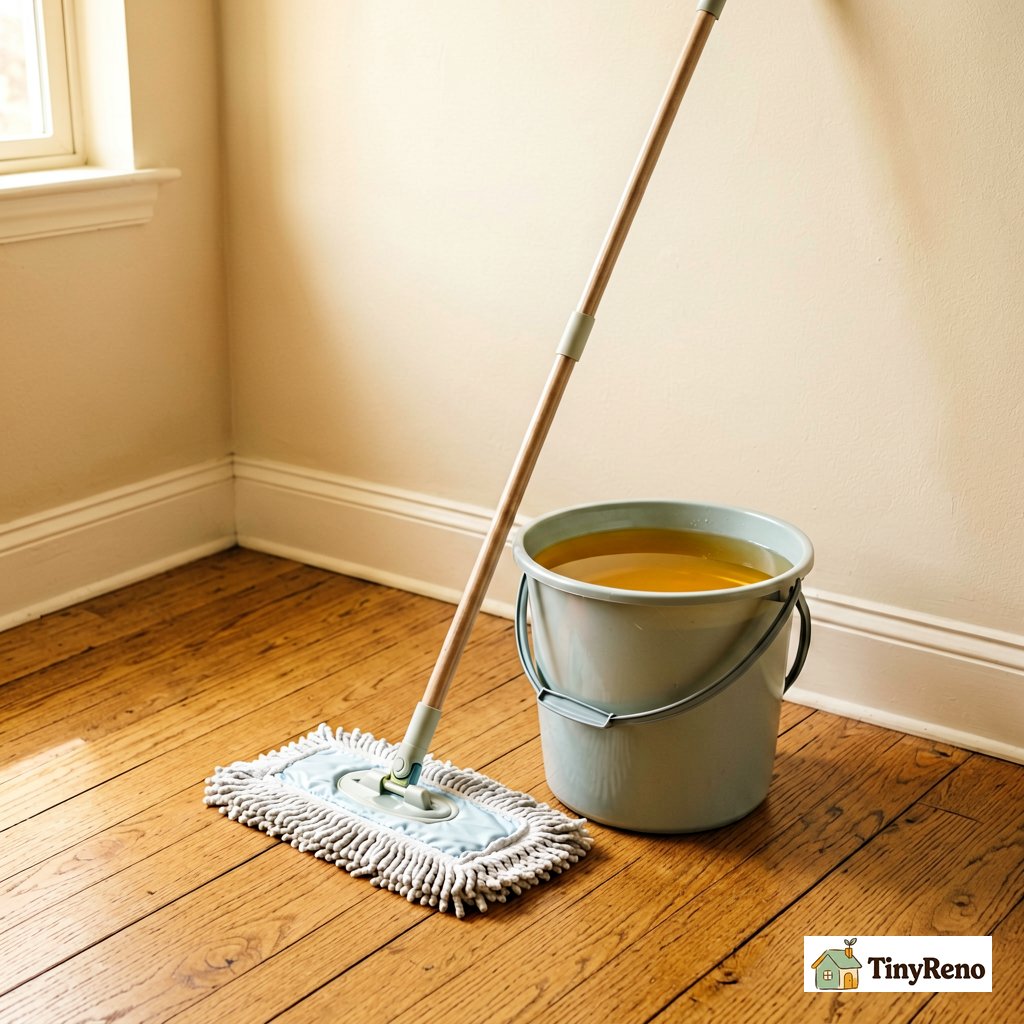
The routine I have settled on, after four months of testing and three months of regular use, is this. Tuesday morning, before Cooper wakes up, I mix one tablespoon of castile soap in a one-gallon bucket of warm water. I use a microfiber mop, wrung out until it is almost dry, and I run it across the living room floor in overlapping passes. I do the kitchen on Wednesday morning, the hallway on Thursday morning, and the bedroom on Saturday morning, before my niece arrives. The total time is about ten minutes per room. The total cost is about two dollars a month for the castile soap. The total smell is almost nothing. Cooper walks on the floor ten minutes later without licking his paws. My niece crawls on it within an hour, which is faster than the Bona or Method label said to wait but which Dr. Patel and my sister-in-law both said was fine for castile soap. My landlord checks the baseboards at the quarterly inspection, and the last time she came by, she ran her finger along the baseboard in the hallway, looked at it, and said nothing, which is the highest compliment a renter can get from a landlord who has been doing this for thirty years.
If you have a dog, a child, or asthma in your household, there are two things to keep in mind. My mother, my sister-in-law, and Dr. Patel have never met each other, and they don't always agree on much. But their advice converged on the same two points: shorter ingredient lists are better, and if you can smell it from three feet away, don't use it around a dog or a child. None of these rules came from a label. None of them came from a brand. All of them came from three people who had spent their lives watching what happened to the bodies they cared about. If you want a non-toxic wood floor cleaner that works in a house where a dog and a child and an asthmatic are all going to be on the floor within twenty-four hours of each other, the bottle should be short, the words should be pronounceable, and the smell should be almost nothing. My routine is castile, but Bona or Method would also pass for a household without a dog, and dish soap would pass for a household without a dog and without a three-year-old who reads labels with her mother on Sundays.
Cooper is fine, by the way. The grape was small, he threw it up, and the vet said the dose was below the toxicity threshold for a dog his size. But the three days I spent watching him for symptoms were three days I spent thinking about what else he was walking on and licking off his paws.


Discussion (0)
Sign in to join the discussion