

Why does my apartment feel humid when the weather outside is dry? Last February I walked into my apartment after a 4-day trip and the air hit me like a wet towel. My first thought was a busted pipe. Then I thought the roof was leaking. Then I thought the upstairs neighbor had flooded their bathroom again. None of those were true. Why does my apartment feel humid on a 22 percent day outside but 68 percent inside? Because the indoor relative humidity had been climbing for days while nobody was there to run the bathroom fan, dry laundry outside, or crack a window for ten minutes.
If you are asking why does my house feel humid, the answer is almost never one big cause. It is usually three or four small ones stacking on top of each other, and you can usually find them with a $10 hygrometer and a 20-minute walk through your place. Here is the checklist I now run every time the air feels off, plus the four things that surprised me when I started paying attention. I have asked the same why does my house feel humid question every winter for the last three years, and the answer has been a different combination of small things each time.
1. Get a Hygrometer and Compare Indoor vs Outdoor First
Before you do anything else, put a hygrometer on your kitchen counter for at least 3-4 days, checking it at the same time each day. Humidity fluctuates with weather, cooking, and showering—a single 48-hour window may not tell the whole story.. Look for one with an accuracy of ±3% or better. The cheapest $10 models can be off by ±5-8%, which is enough to blur the 10-point gap you're looking for. A $20-30 hygrometer is usually accurate enough. The expensive ones with Bluetooth are nicer but they do not change the answer. What you want to know is whether your indoor humidity is higher than the outdoor humidity at the same moment, about the same, or lower.
Indoor higher than outdoor by 10 points or more almost always means something inside is adding moisture. The usual suspects are a slow plumbing leak, a dryer venting indoors, a houseplant collection that has gotten out of hand, or a bathroom or kitchen exhaust fan that died and you have not replaced. Indoor about the same as outdoor means outdoor air is the source, and your fix is going to be about ventilation timing or a dehumidifier. Indoor lower than outdoor means you are fine on humidity and the sticky feeling is probably about temperature, not moisture, which is a different article.
The first time I did this I was genuinely shocked that my indoor was 68% while outdoor was 22%. That 46-point gap told me immediately that something inside was dumping water into the air. It was not a busted pipe. It was a dryer vent hose that had slipped off the back of the machine when I moved in three years earlier and had been venting humid air into the wall cavity the whole time.
2. Check the Dryer Vent and Bathroom Fans for the Obvious Stuff
The dryer vent is the most common invisible humidifier in any apartment or house. If the flexible hose behind the dryer has slipped, kinked, or come loose from the outside vent cover, every load of laundry pumps a gallon or more of water vapor into your living space. Lift the dryer slightly and feel behind it. The hose should be tight at both ends. The outside vent cover should flap open when the dryer runs. If the cover is painted shut or jammed with lint, you have a problem.
Bathroom and kitchen exhaust fans are next. A bathroom fan that moves 50 cubic feet per minute when new moves 30 after five years of dust buildup and almost zero after ten. If your bathroom mirror stays fogged for 45 minutes after a shower, your fan is failing. If you cannot hear it from outside the bathroom door with the door closed, it is barely moving air. Same for the kitchen hood. Run it on high every time you boil water, every time you run the dishwasher, and any time you cook something that steams.
I replaced my bathroom fan motor for $35 and my kitchen hood filter for $12, and that alone dropped my baseline humidity by about 8 percentage points. The cost was less than one month of running a dehumidifier.
3. Look for the Slow Plumbing Leak You Cannot See
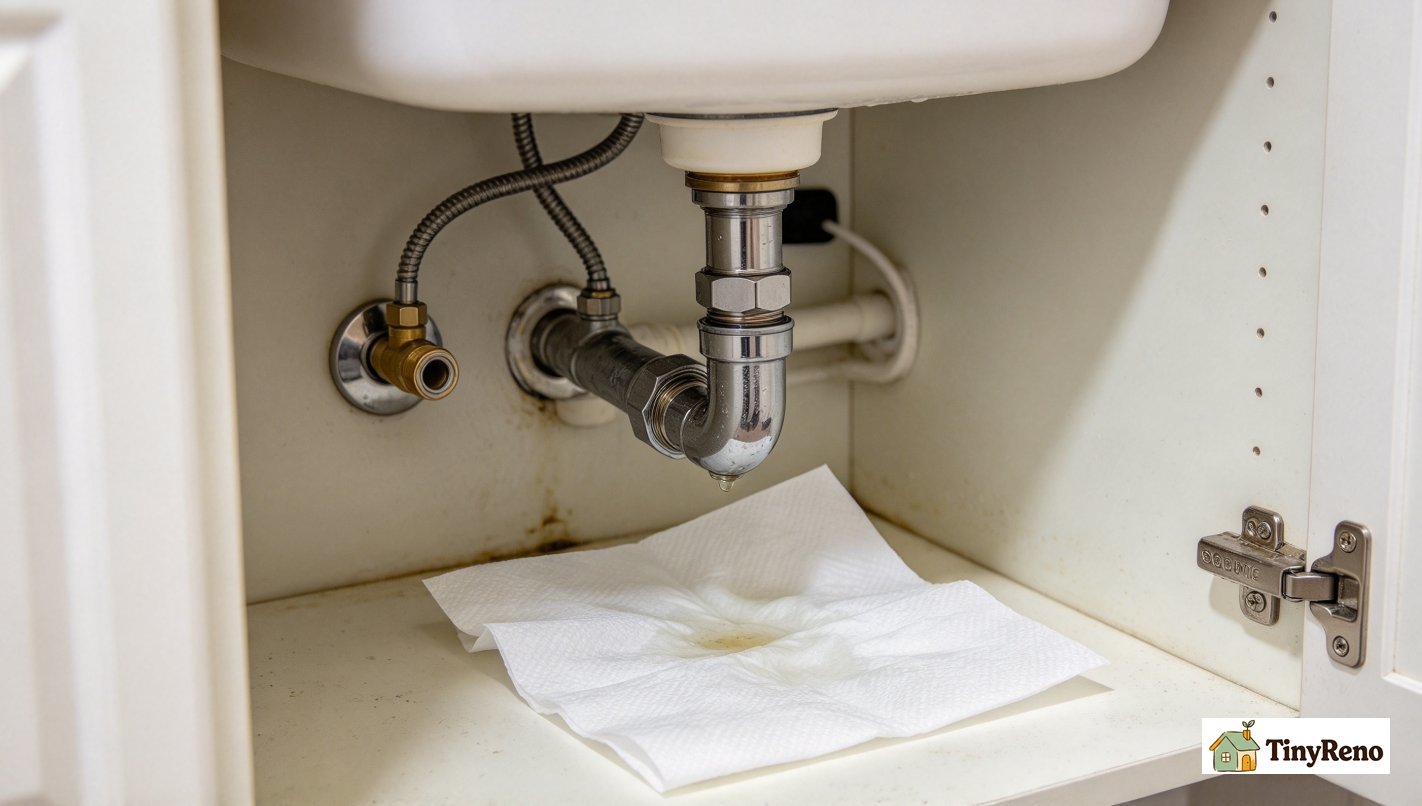
This is the one that scares people the most, so let me walk you through how to rule it out fast. Go to every sink, toilet, and tub in the place. Put a dry paper towel under every supply line connection, every drain, and around the base of every toilet. Wait 24 hours. If any paper towel is damp, you have a leak. You can fix a supply line yourself with a $6 wrench and a $10 part from the hardware store. You can usually fix a slow toilet leak with a $15 flapper. If the dampness is around the base of the toilet and the floor feels spongy, stop and call your landlord.
For the things you cannot see, check your water meter. Turn off every tap, every appliance that uses water, and do not flush for 30 minutes. If the meter dial is still moving, water is going somewhere. In a house, that's your problem to chase. In an apartment, you may not have access to your own meter—if you do, the test tells you whether the leak is inside your unit. If you don't, ask your landlord to run the test. In an apartment, the meter test is still worth doing—it tells you whether the leak is inside your unit or somewhere in the building. Either way, it's your landlord's problem to fix, but you need the documentation.
In my case the paper towel test caught a slow leak under the kitchen sink that had been dripping at the rate of about a quart a day. That quart was evaporating into the air and contributing maybe 4 points of humidity to my baseline. A $4 O-ring fixed it.
4. Count Your Plants and Your Cooking Habits Honestly
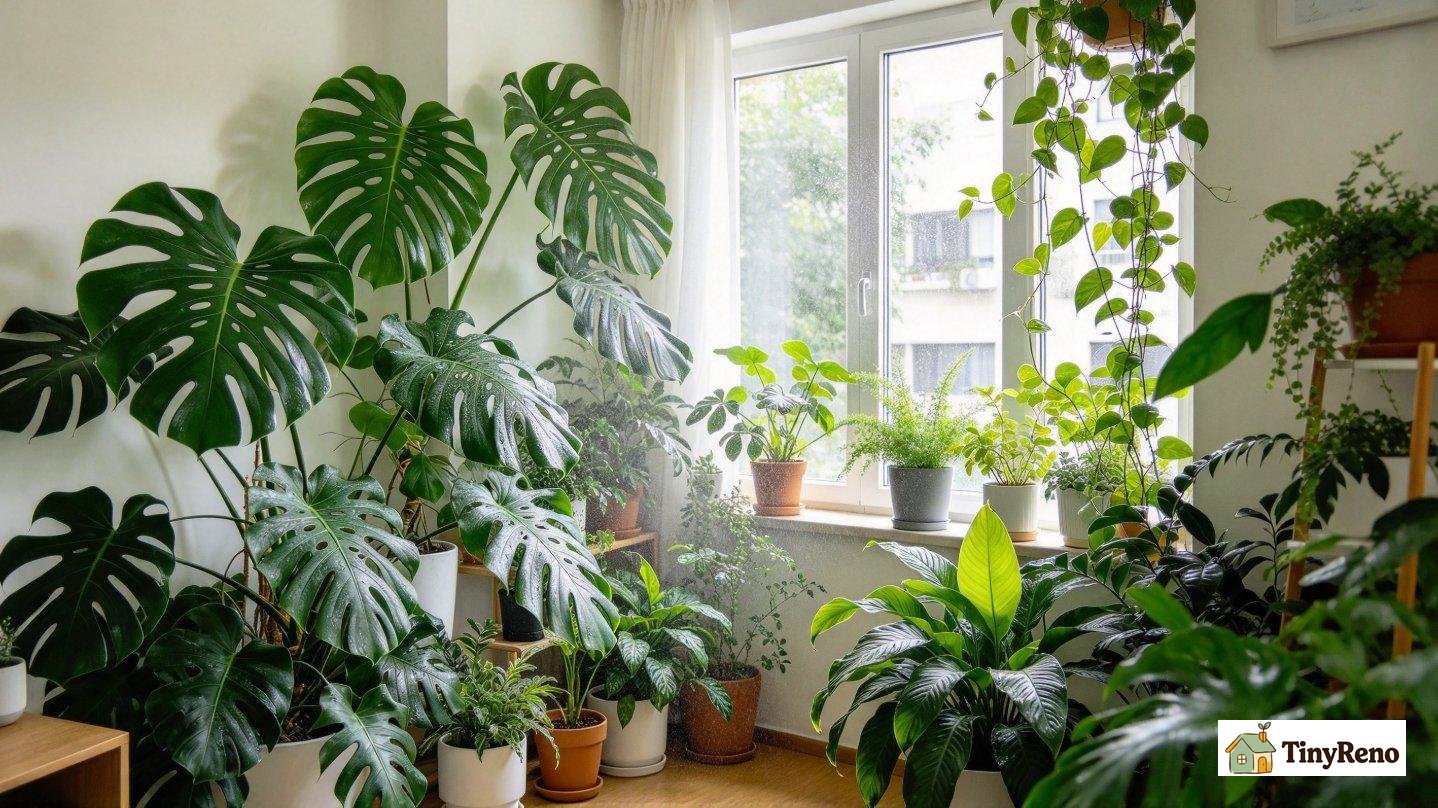
A large houseplant can transpire anywhere from half a cup to two cups of water per day, depending on the species, pot size, and light exposure. Ten large houseplants transpire half a gallon. If your home is starting to feel like a greenhouse, walk through and count. Anything in a pot without a drainage hole is a swamp that is feeding moisture back into the air. Anything sitting in a saucer of water is doing the same. Either fix the pot situation or move the collection to one room and close the door.
Cooking is the other big one. Boiling a pot of pasta releases about a pint of water into the air. Running the dishwasher releases another pint. Running a hot shower releases a quart. None of these are problems on their own if your exhaust fan is working. All of them become problems if your fan is dead or you cook without turning it on.
I am not going to tell you to stop cooking or to get rid of your plants. I am going to tell you to run the exhaust fan every single time for 20 minutes after you finish. The fan is cheaper than a dehumidifier and does the same job for the wet rooms.
5. Run a Dehumidifier Only After You Have Fixed the Causes
A dehumidifier is a great tool and a terrible first move. If you plug one in before you fix the dryer vent, the slow leak, and the dead fans, you are paying 5 to 8 cents an hour to mask the underlying problem. The leak gets worse. The mold risk gets higher. Your electric bill gets bigger.
Once the obvious causes are addressed, a dehumidifier set to 45% in the room you spend the most time in is a reasonable addition for anyone in a humid climate or a basement apartment. The EPA recommends keeping indoor relative humidity between 30% and 50%, with 45% being a reasonable target for most apartments during heating season. Below 35% you start getting dry skin, static shocks, and cracked wood trim. Above 55% you start feeding dust mites and the start of mold growth on cool surfaces.
For a 600-square-foot apartment, a 35-pint Energy Star dehumidifier will pull about 6 pints a day in normal conditions and 12 to 15 pints on the worst days. Empty the bucket every morning or hook a drain hose to a sink if your model supports it. The ones with a built-in pump are worth the extra $40 if your sink is higher than the unit.
The Quick Checklist I Now Use Every Time the Air Feels Off
When my apartment starts feeling humid again, I run through this in order before I do anything else. Hygrometer on the counter for two days, compare to outdoor. Check the dryer vent at both ends. Run the bathroom and kitchen fans during every wet activity. Paper towel test every plumbing connection. Count the plants and the cooking. Only then do I think about a dehumidifier.
Start at the top of the list. The cheap fixes solve the problem for most people. A $15 flapper, a $6 o-ring, a $35 fan motor, and a $12 hood filter will knock 10 to 15 percentage points off your baseline humidity in an afternoon. A dehumidifier for the same job will cost you $200 to buy and $30 a month to run. The fix order is also the cost order, and the two usually line up.
If you do all five steps and the indoor humidity is still higher than outdoor by 10 or more points, you are probably looking at a foundation leak, a crawlspace issue, or a roof problem that needs a professional. At that point the paper towel test, the meter test, and a phone call to your landlord are the right next moves, not another run to the hardware store.
The reason my apartment felt humid that February was not one cause—it was four of them stacked together, plus no one home for four days to run a single fan. Fix the small things first. They usually are.


Discussion (0)
Sign in to join the discussion