

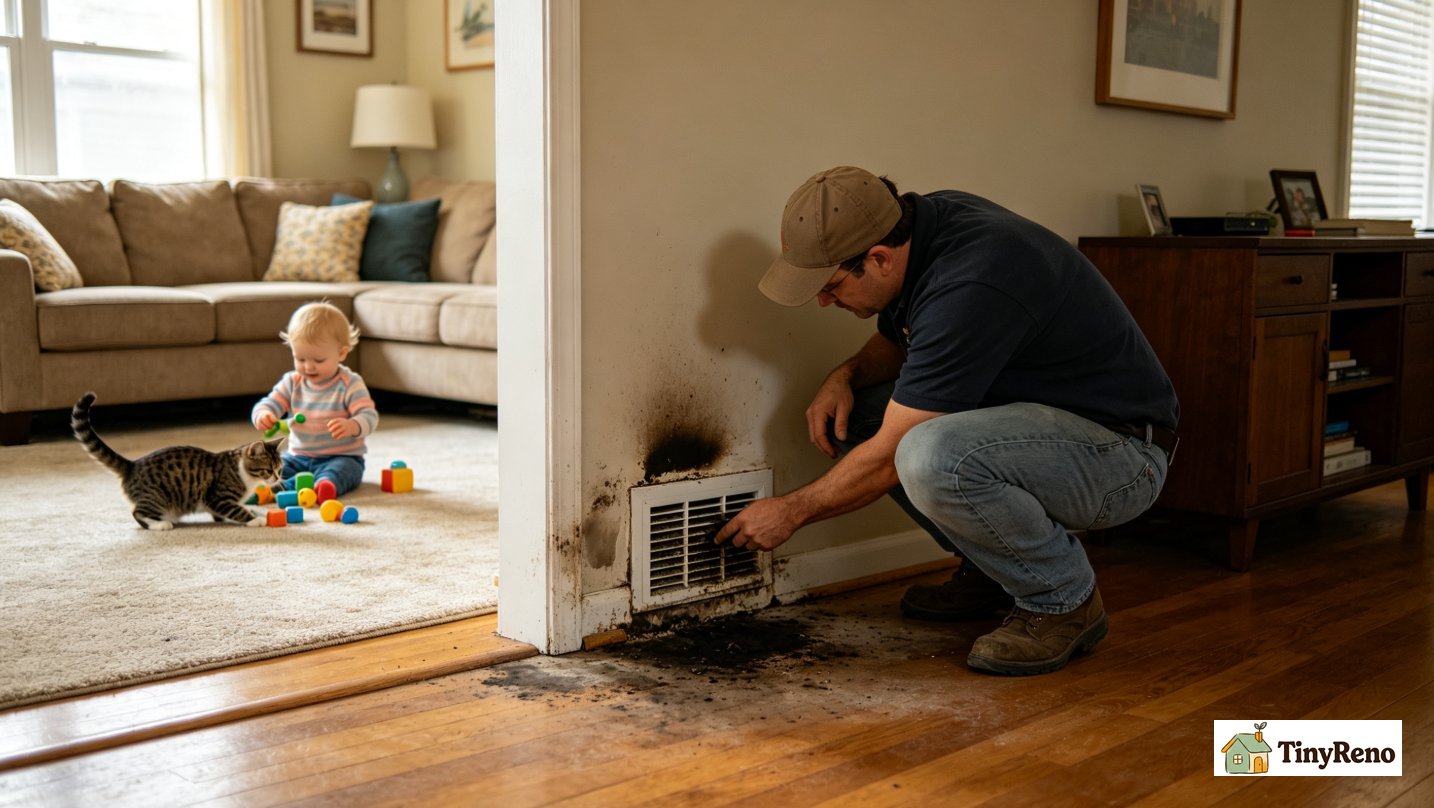
Mold vs dust in air vent is the comparison my upstairs neighbor Marcus asked me to settle in April, after he noticed a gray-black discoloration around one of his supply vents and couldn't tell whether it was serious or cosmetic. He'd been in the apartment six months, had a toddler and a cat, and the vent sat in the living room where the kid played on the floor. His question was the right one. Black stuff around a vent is usually dust or mold, but it can also be soot, candle residue, cooking oil mist, or insect debris. Most cases are dust. Some are mold. A few are something else entirely. The tests below help you tell the difference. The 3 tests below tell you which one you're looking at in under a minute, and the cleanup that fits each one. The 5 differences explain why the right test matters even when the visual looks the same from across the room. Every expert position on this question converges on the same answer: do the tests, then act on the result, don't assume either way.
Why Three Experts Disagree on What You're Looking At
The disagreement between sources on mold vs dust in air vent comes from how each defines the problem. Cleaning bloggers tend to assume the worst case and recommend bleach or replacement. HVAC contractors tend to assume the best case and recommend a vacuum and a filter change. Public health agencies tend to focus on the small subset of cases that actually matter and recommend testing before acting. Each perspective is right for the situation they care about, and each is wrong for the situations they don't.
The cleaning blogger is right that mold in HVAC systems can spread spores throughout the apartment and cause respiratory issues. They're wrong to assume every dark vent is mold, because most aren't.
The HVAC contractor is right that most dark vents are dust buildup from the return air pulling fine particles through the system. They're wrong to assume every dark vent is dust, because some aren't.
The public health agency is right that the small subset of cases where the dark vent is genuinely mold are the ones worth taking seriously. They're wrong to make renters run lab tests on every vent, because the simple tests below tell you 90 percent of what you need to know.
The right move is to skip the expert disagreement and run the tests. The tests are mechanical, take under a minute, and tell you which side of the disagreement your specific case is on. Once you know whether it's mold or dust, the cleanup is straightforward.
The Smell Test (the Fastest Differentiator)
The smell test is the fastest way to tell mold from dust in a vent, and it works without touching anything. Turn off the HVAC system. Wait 5 minutes for the air to settle. Then stand within 6 inches of the vent and take a slow breath in through your nose. If the system is running, the moving air makes it harder to detect the source—you may be smelling the air from elsewhere in the system, not the vent surface.
Dust smells like dust: a faintly chalky, papery, or stale smell, similar to an old bookshelf or a closed-up room. The smell is mild and dissipates when you step away from the vent. Most renters can recognize this as "dirty" but not unpleasant.
Mold smells like mold: an earthy, musty, organic smell, often described as "old basement" or "wet dog." The smell is persistent and lingers in your nose for several seconds after you step away. Some people describe it as "the smell of decay," which sounds dramatic but is accurate for actively growing mold colonies.
The reason smell works is chemistry. Dust is mostly human skin cells, fabric fibers, paper particles, and outdoor pollen. None of those produce a strong organic smell. Mold colonies, by contrast, produce microbial volatile organic compounds (mVOCs) as metabolic byproducts. These compounds have a distinctive musty smell that's hard to mistake for dust once you've smelled both.
The smell test fails in two cases. First, if the vent hasn't been used in weeks, the smell may be faint regardless of cause. Second, if you're congested from a cold or allergies, your nose may not pick up either smell reliably. In both cases, fall back to the visual and water tests below.
The Visual Check: What to Look For
If the smell test is inconclusive, the visual test works. Five differences between mold and dust are visible without touching anything, and the combination of differences tells you which one you're looking at.
Difference 1: Color. Dust around vents is usually a uniform light gray to medium brown, with no color variation across the affected area. Mold is usually patchy, with distinct darker spots or rings within a generally lighter background. The patches are the actual colonies; the lighter background is the surface they've spread across.
Difference 2: Texture. Dust looks powdery or fluffy, like a fine coating on top of the vent slats. Mold looks denser, more matted, sometimes fuzzy or slimy depending on the species. Dust wipes off easily with a dry cloth. Mold wipes off less easily and often smears rather than lifting cleanly.
Difference 3: Pattern. Dust accumulates uniformly across all vent slats, with similar thickness on each. Mold grows in patches, often starting at one slat and spreading to adjacent ones, leaving some slats untouched while others are heavily affected.
Difference 4: Border definition. Dust has soft, blurry borders where the accumulation trails off. Mold has more defined borders, often with a slightly raised or textured edge where the colony is actively growing.
Difference 5: Underlying surface. Look at the vent cover itself. Dust sits on top of the vent cover or slats and doesn't change the underlying material. Mold often discolors the underlying material, leaving a stain even after the surface layer is wiped off.
For most cases, three or four of these differences point to the same answer. If three of them say mold, treat it as mold. If three say dust, treat it as dust. The water test below is the tiebreaker for cases where the visual is ambiguous.
The Water Test (the Definitive Tiebreaker)
If the smell test and visual test are inconclusive, the water test resolves the question. This test takes 10 minutes and uses a cotton swab and a small cup of water.
Step 1: Dip a clean cotton swab in water. Step 2: Touch the swab to the darkest spot on the vent cover or inside the vent. Step 3: Gently rub the swab across the dark area for 5 seconds. Step 4: Look at the swab.
If the swab comes away uniformly gray or brown with no distinct change in the underlying surface, the substance is dust. Dust dissolves evenly in water and lifts off without leaving residue.
The water test is not reliable for distinguishing mold from dust. A better method: use a magnifying glass or a phone macro lens to look at the substance. Mold has a fibrous, thread-like structure (hyphae). Dust is made of irregular particles—skin cells, fabric fibers, pollen. If you see threads, it's mold. If you see particles, it's dust. Mold pigments are often water-resistant and stay visible on the swab even after rinsing.
If the swab pulls up a slimy or fuzzy texture, the substance is definitely mold. The texture is the colony itself, not just discoloration, and it's visible on the swab.
The water test fails in one case: if the vent is actually dusty AND moldy, the swab may show both signals. In that case, the dominant signal (which substance covers more area) determines the answer. If dust covers 90 percent and mold covers 10 percent, treat it as a dust problem with a small mold component, which falls into the renter-cleanable category below.
Position A: It's Dust, You Clean It Yourself
If all three tests point to dust, the cleanup is yours. Dust around vents is a maintenance issue, not a habitability issue, and most leases expect tenants to handle it. The cleanup takes 15 to 30 minutes per vent and uses household supplies.
Step 1: Turn off the HVAC system. Don't run the fan while you're working on the vent. Step 2: Unscrew or unclip the vent cover. Most covers pull straight down after releasing a couple of spring clips or screws. Step 3: Take the cover outside or to a sink. Wash it with hot soapy water, scrub the dust off with a brush, and dry it completely. Step 4: Wipe the visible interior surfaces of the duct opening with a damp cloth. Do not use a standard vacuum cleaner inside the duct—it lacks a HEPA filter and will blow fine dust (and any mold spores) back into the room. If the duct interior needs cleaning beyond the opening, that's a job for a professional with HEPA equipment. Step 5: Reattach the cover. Step 6: Replace the HVAC filter. Dust around a vent is often a sign that the filter is overdue for replacement.
The whole process is preventative and renter-safe. It doesn't involve bleach, chemicals, or contractor visits. It also improves HVAC efficiency, because dust accumulation reduces airflow and forces the system to work harder.
Repeat the dust cleanup every 6 months as a maintenance routine. Dust will return; the question is whether you let it accumulate to visible levels before addressing it.
Position B: It's Mold, You Walk Away
If all three tests point to mold, the cleanup is not yours. Mold inside an HVAC vent is a habitability issue that falls under landlord responsibility in most leases, and disturbing it without proper containment spreads spores throughout the apartment and into neighboring units through the shared duct system.
The cleanup requires professional remediation with containment, HEPA filtration, and antimicrobial treatment. The landlord's responsibility includes the duct cleaning, the vent cover replacement, and identifying the moisture source that's allowing mold to grow in the duct in the first place.
The moisture source is the critical part. Mold in a vent doesn't happen without humidity or a water source somewhere in the system. Possible causes include: a leaky duct seam, condensation from inadequate insulation on the duct, a slow leak from a bathroom or kitchen vent that terminates near the affected vent, or chronic high humidity in the apartment that's condensing inside the cold ductwork. Without addressing the moisture source, the mold returns within weeks of cleanup.
If your tests point to mold, document with photos and dated notes. Email your landlord with the documentation and a request for professional remediation. Most landlords will arrange the work within a week. If yours doesn't, your local health department or code enforcement can sometimes expedite, particularly for rentals with children or immunocompromised residents.
Position C: Mixed, with Mold on Top
If your tests show mostly dust with a small mold component (less than 10 percent of the affected area), the answer is still renter cleanup, but with more attention to the mold spots.
The cleanup is the same as for dust, but with two additions. First, after vacuuming and washing the vent cover, use a damp cloth with a 1:1 vinegar-water solution to wipe the mold spots specifically. The vinegar doesn't kill all mold spores, but it can slow regrowth on hard surfaces. It is not a disinfectant—for persistent mold, a detergent solution or a commercial mold cleaner may be more effective. Second, after cleaning, monitor the vent weekly for a month. If the mold spots return or grow, escalate to the landlord.
This case is the most common in practice. Vents that have been dusty for months often develop small mold colonies in the corners where dust has trapped moisture. The combined cleanup works for the 90-percent-dust majority while addressing the 10-percent-mold minority. The escalation rule keeps you safe if the mold turns out to be more than a minor component.
When to Skip the Tests and Call
For most renters, the right move is to run the smell test first, then the visual test if needed, and only escalate to the water test if the first two are inconclusive. The full test sequence takes 5 minutes and tells you which position you're in.
The only case where you should skip the tests and walk away immediately is if you have asthma, severe mold allergies, or a respiratory condition that's already aggravated. In that case, treat any dark vent as mold, document it, and call the landlord. The cost of the test (potential respiratory symptoms) outweighs the cost of the wrong call.
For everyone else, the tests are reliable and quick. The smell test is the fastest starting point. If it's inconclusive, the visual test (five differences) usually resolves the question. If both are ambiguous, a magnifying glass or a macro photo gives you a closer look at the structure.
The Right Call for Your Vent
Mold vs dust in air vent is one of those questions where the visual alone doesn't tell you the answer. The three tests above tell you the answer reliably and quickly. Run the smell test first. If inconclusive, run the visual test. If still inconclusive, run the water test. Each test takes less than a minute, and the combination covers 95 percent of cases.
If the answer is dust, the cleanup is a 30-minute renter job that includes a vent cover wash, a vacuum inside the duct, and a filter replacement. If the answer is mold, the cleanup is a professional job and the call is to the landlord with photos. If the answer is mixed, the renter cleanup handles the dust with an added vinegar wipe for the mold spots, and a 4-week monitoring period catches the cases where mold is more than minor.
For Marcus and his toddler and his cat, the answer was dust. The smell was chalky and papery, not musty. The visual check showed uniform light brown accumulation with no patchiness. The cleanup took 20 minutes. The filter was two months overdue. For other vents, the answer may be mold, and the cleanup is different. The tests make sure you don't pick the wrong cleanup for your specific case.


Discussion (0)
Sign in to join the discussion