

Why did my smoke alarm go off for no reason? That's the question I asked at 11:47 PM on a Tuesday, standing in my kitchen in socks, looking at a smoke detector on the ceiling that was screaming for the third time in two days. There was no smoke. No fire. No toast burning. The unit just decided to wake the apartment. I did what most renters do: I climbed up, pulled the battery, and went back to bed. The next morning, the alarm was still sitting on the counter, dead and quiet, and I had no idea whether to put it back up or call my landlord. I learned later that the third time it tripped was the lesson: random alarm trips are not random. They are diagnostic signals, and reading them correctly tells you whether you have a $4 fix or a $400 problem. Most false alarms in apartments come down to one of seven causes. They're listed roughly from most to least common, with a fix for each.
The First Time It Went Off (and What I Did Wrong)
The first false alarm happened on Sunday afternoon. I was stir-frying vegetables in a wok with high heat, no lid, and the steam billowed up toward the ceiling-mounted ionization alarm directly above the stove. The alarm went off. I fanned it with a dish towel, it stopped, and I went back to cooking. The second false alarm happened 36 hours later, on Tuesday morning, while I was making toast. Same alarm, same ceiling, no visible smoke. The third one, the Tuesday night incident, happened while I was sitting on the couch with the kitchen door closed, not cooking, not showering, not using any aerosol product. That was the one that made me pull the battery.
What I should have done, in retrospect, is exactly what the diagnostic test below does: count the time between alarms, note what I was doing in the 10 minutes before each one, and look at the alarm unit itself for the manufacture date and type. Pulling the battery was the worst possible response because it left my apartment with no working smoke alarm for three days while I procrastinated about putting it back up. A non-functional alarm is a worse habitability defect than a chirping one, and it's also a lease violation in most rentals.
The lesson I learned the hard way: don't pull the battery. Run the diagnostic first, fix the cause if you can, document if you can't, and let your landlord handle the cases you can't.
The 30-Second Diagnostic
Before you touch anything, collect three signals: how often the alarm trips, when it trips, and where you were. These narrow the seven causes below to one or two likely culprits.
Signal 1: how often the alarm trips. If it tripped once and never again, the cause is almost certainly a one-time aerosol event (steam, cooking smoke, hairspray). If it trips repeatedly with the same interval, the cause is environmental (humidity, dust, insects). If it trips randomly with no pattern, the cause is electrical (voltage, age, real fire).
Signal 2: when it trips. Alarms that go off only during cooking or showering are humidity-driven. Alarms that go off in the middle of the night with no activity are voltage or age. Alarms that go off during the day with no cooking and no showering are the ones to take seriously, because real fire produces exactly that pattern.
Signal 3: where you were. Kitchen-adjacent alarms are more likely to be humidity false positives. Hallway alarms with no nearby source are more likely to be either insect intrusion (small bugs crawl into the sensing chamber), age, or voltage.
These three signals narrow the seven causes below to one or two likely culprits. From there, the fix is mechanical.
Cause 1: Steam (the Most Common False Trigger)
If your alarm is within 6 to 8 feet of a bathroom door, kitchen, or kettle, steam is almost certainly the cause. Photoelectric alarms are more sensitive to steam because the water droplets are large enough to scatter the light beam inside the sensing chamber. Ionization alarms are less likely to be triggered by steam alone, but dense steam can still set them off.
The fix isn't moving the alarm. You can't move it; that's the landlord's call. The fix is changing the humidity path. Close the bathroom door when showering. Run the exhaust fan for 20 minutes after a shower. Use the kitchen fan when boiling water. None of these are guarantees, but they reduce the steam concentration that reaches the alarm.
If steam is genuinely the cause and the false alarms continue despite the fan, this becomes a conversation with your landlord. The lease typically requires the alarm to be functional, but it doesn't require it to be in the optimal location. A landlord can swap an ionization unit for a photoelectric unit, which is significantly less steam-sensitive.
Cause 2: Cooking Aerosol (the Second Most Common)
Cooking produces fine particles that scatter light in a photoelectric sensor or break the ionization field in an ionization sensor. Stir-frying with high heat, searing meat in a pan, broiling in an oven, and toasting bread all produce enough aerosol to trigger an alarm within 6 to 8 feet.
The fix is mostly behavioral. Use the kitchen exhaust fan. Close the kitchen door if the alarm is in an adjacent room. Lower the heat when possible. For really smoky cooking (blackened fish, cast-iron sears), accept that the alarm might trip and have a plan: a dish towel to fan it, or a step ladder to reach the test button.
Don't disable the alarm before cooking. That's how actual kitchen fires go undetected. The alarm is doing its job; you just need to manage the side effect.
Cause 3: Dust Buildup (Especially in Older Buildings)
Dust accumulates inside the sensing chamber the same way it accumulates on every other surface. In older buildings with less filtered air, or in apartments near construction, the buildup happens faster. Dust-induced false alarms tend to increase in frequency over weeks or months.
The fix is compressed air. Three short bursts into the sensing slits, with the unit down from the ceiling, will clear most dust-related false alarms. The fix is described in detail in the article on stopping fire detector beeping, and the same procedure works here.
If dust is the cause and you blow out the chamber and the false alarms return within two weeks, the unit itself is aging out. Move to cause 7.
Cause 4: Insects (the Most Unusual Cause)
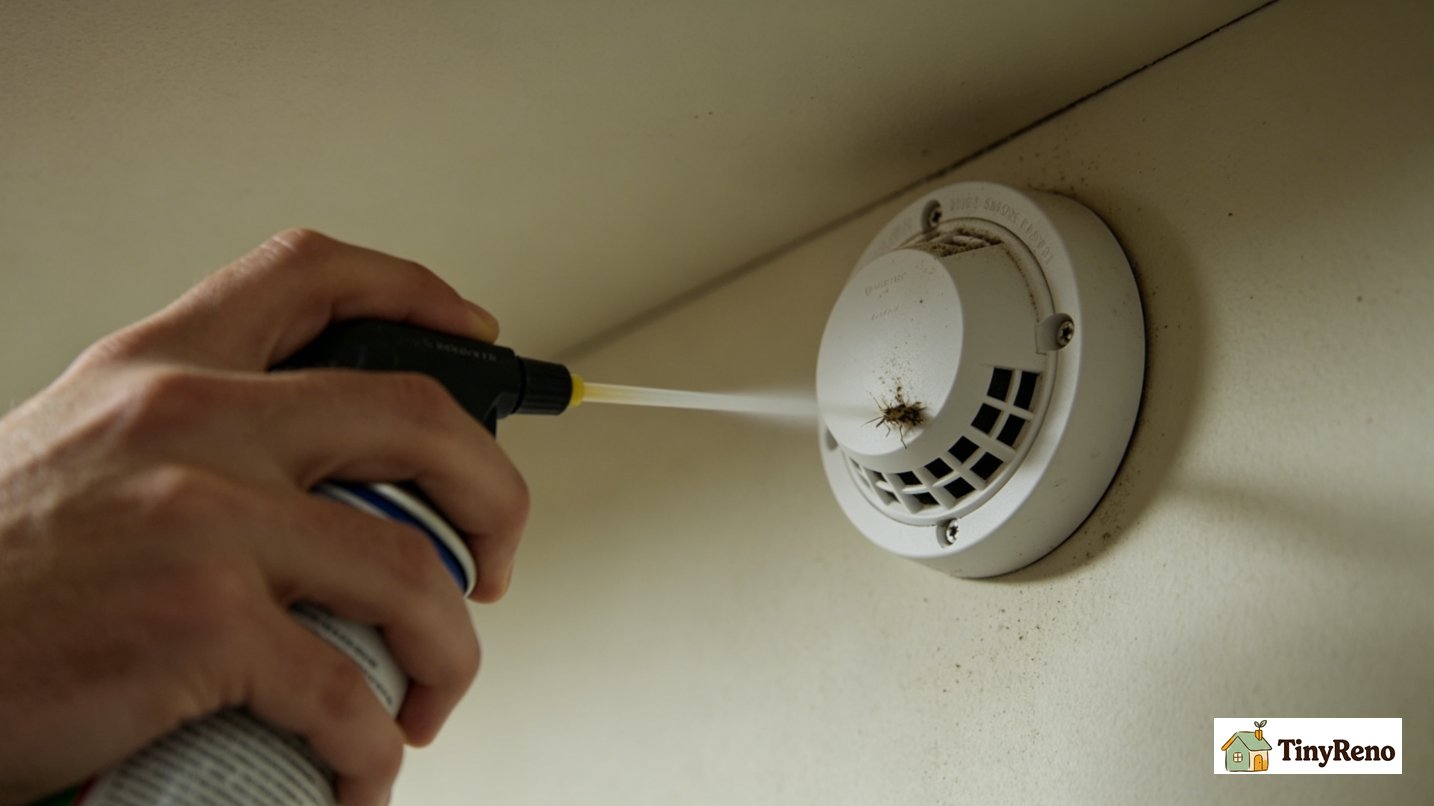
Small insects, particularly spiders and small flies, occasionally enter the sensing chamber through the slits on the side or top of the unit. Once inside, their movement or their presence breaks the ionization field or scatters the photoelectric beam, triggering the alarm.
This cause is rare but real, and it tends to be seasonal. Buildings with more insect pressure (ground floor, near greenery, near dumpster areas) see more of these. The fix is also compressed air, but with more attention to the slits specifically, plus a visual inspection while the unit is down. If you see a spider web inside the chamber, you have your answer.
The prevention is keeping the unit sealed. Newer units have finer mesh over the slits; older units may have larger openings. A landlord can replace an older unit if insect intrusion is a recurring cause.
Cause 5: Humidity and Condensation (Especially in Coastal or Basement Units)
High ambient humidity—above 85 percent—can cause condensation inside the sensing chamber, especially in units near uninsulated attics or exterior walls in winter. This is different from direct steam from cooking or showering, but the sensor reads it the same way: as a buildup of particles.
This cause is most common in summer in humid climates or in winter in apartments with poor ventilation. The fix is reducing humidity in the apartment: run a bathroom exhaust fan during showers, use a dehumidifier in problem rooms, and ensure the kitchen exhaust fan actually vents outside rather than into the attic.
If humidity is the cause and the apartment-level fixes don't reduce false alarms, the landlord can swap the unit for a model rated for higher humidity tolerance. Most modern alarms are rated for 93 percent humidity, but older units may be rated lower.
Cause 6: Voltage Fluctuations (Hardwired Units Only)
If your alarm is hardwired (you can tell because it has a constant green LED indicator and a backup battery), the cause of random trips is sometimes voltage fluctuations on the building's circuit. Brownouts, surge events from large appliances cycling on the same circuit, and aged wiring can all cause momentary voltage spikes that trigger the alarm.
This cause is rare in modern buildings with updated electrical, but common in older buildings. The fix isn't yours to make; it's an electrician's call. Your move is to document the pattern (date, time, what else was running in the apartment) and report it to your landlord.
The distinguishing feature of voltage-induced trips is that they happen with no environmental trigger at all, and they sometimes happen in clusters during times of high electrical demand (early evening when many units run air conditioning or heating).
Cause 7: Real Fire (Rare but Not Impossible)
This is the cause you should not skip over just because the others seem more likely. Real fire produces exactly the same alarm signal as every other cause: a sustained, loud, continuous tone. If you have ruled out steam, cooking, dust, insects, humidity, and voltage, and the alarm continues to trip, the cause is real fire or an aging sensor.
Real fire is rare in a working apartment with no cooking or heating issue, but it's not zero. The pattern to watch for: an alarm that trips at random times with no environmental correlation, that continues after you've ventilated the room, that doesn't respond to a battery reset, and that you cannot otherwise explain.
If you've worked through causes 1 through 6 and the alarm is still going off, treat it as a real alarm. Evacuate, call 911 if you smell smoke or feel heat, and let the fire department confirm.
The other side of "real fire" is aging sensors. Smoke alarms have a 10-year certified life. After that, the sensor itself can produce false positives as components degrade. If the manufacture date stamped on the back of the unit is more than 10 years old, the alarm is end-of-life and needs replacement, which is your landlord's responsibility.
The Reset and Recovery Plan
If you've identified the cause and applied the relevant fix, press and hold the test button for 5 to 15 seconds to clear residual error codes. Press and hold the test button for 5 to 15 seconds. The alarm will chirp once or twice during the hold, then go silent. This clears residual error codes from any of the causes above.
After the reset, give the unit 24 to 72 hours to confirm the fix worked. If the alarm doesn't trip again in that window with the original cause still present, you've solved it. If it does trip, either the cause was misdiagnosed or there are two causes at once (steam plus dust, for example), and you need to apply the fix for both.
If you've worked through the entire list and the alarm is still going off, the recovery is to escalate. Document the pattern with video, audio, and dated notes. Email your landlord with the documentation. Most jurisdictions have a habitability code that requires landlords to maintain functional smoke alarms, and a recurring false alarm with no identifiable tenant-side cause falls under that.
The recovery section is short because the cause list above is the work. Random causes don't exist; unrecognized causes do. The seven causes cover nearly every false alarm a renter will encounter. If your case doesn't fit one of them, you either have a rare combination or a unit that needs replacement, and both are landlord conversations, not tenant DIY projects.
After three false alarms in one week, I learned that "no reason" almost always means one of seven specific causes—and they are not equally likely. Steam, cooking aerosol, and dust account for most false alarms. Humidity, insects, and voltage issues are less common. Real fire is rare but is the one cause you should never dismiss just because the others seem more plausible. Read the cause list, run the diagnostic, apply the fix, and if none of them work, hand the problem to your landlord with documentation. The alarm isn't broken. You're just not yet reading the signal right.


Discussion (0)
Sign in to join the discussion