

The first time I tried to get deposit back, I lost $640 out of $1,400. The landlord emailed me a single photo: a six-inch scratch across the living room floor that, according to his move-out inspection report, was "not noted on the move-in condition report I signed."
He was right. I had signed the move-in report without checking it. The scratch was there. The landlord's evidence was one photograph taken at move-out. My evidence was a verbal claim and a hazy memory of the day I got the keys.
I lost $640 because I had seven habits I should have run throughout the lease, and I ran none of them.
Since then I have gotten deposit back on four consecutive leases. The smallest recovery was $1,400 (full deposit, no deductions). The largest was $2,100 — a landlord tried to deduct for carpet cleaning, a chipped tile, a broken blind, and a stain on the ceiling. I had documentation on all four. He reversed every charge within a week of receiving my dispute letter.
This article is the seven-habit framework I use on every lease now to get deposit back in full. The habits are listed in the order they pay off, and the seventh one — the move-out letter template — has resolved every deposit dispute I've ever had. But it only works if you've done the first six. If you do nothing else from this list, at least build the documentation from habits 1 through 6 and send the letter in habit 7.
Habit 1: Photograph Every Room on Move-In Day, Twice
The single most expensive mistake renters make is treating the move-in condition report like a formality. The report is a legal document. Whatever isn't on it at move-in is what the landlord can claim was caused by you at move-out.
The minimum viable version of move-in documentation is two passes with your phone: one wide shot of every wall, every floor, every ceiling, every appliance, every window, every closet. One close-up of every defect you can find — scuff marks, nail holes, scratches, stains, broken seals, missing handles, worn carpet patches, discolored caulk, water stains under sinks.
Total time for a one-bedroom apartment: 60 to 90 minutes. Total cost: zero.
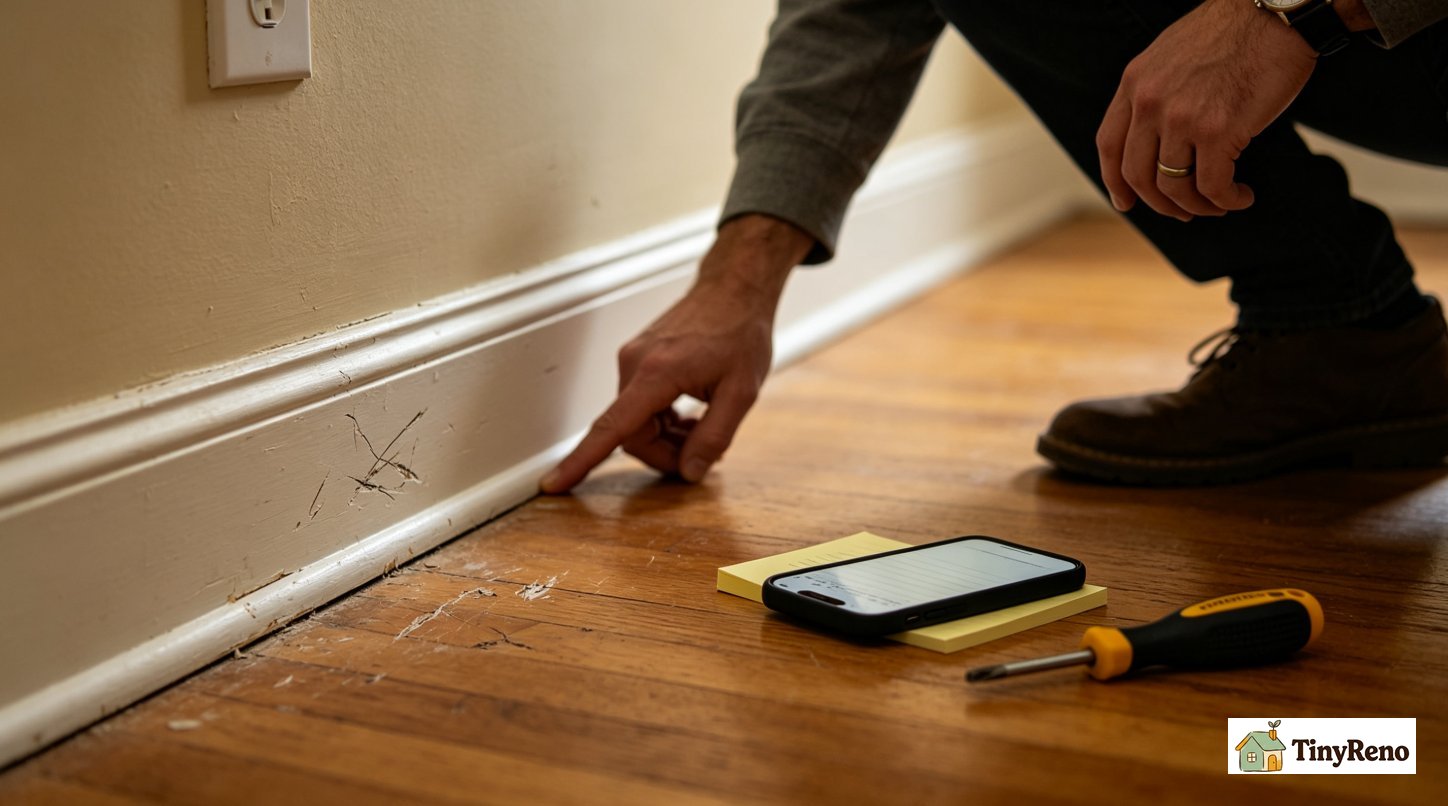
Why two passes? The wide shots prove what was and wasn't in the room. The close-ups prove the condition of the things that were. A landlord can't dismiss one photo as a flattering angle if you have 47 photos and the disputed damage shows up in two of them.
Habit 2: Email the Photos to Yourself Before You Sign the Report
The move-in condition report is almost always due within 48 to 72 hours of getting the keys. The landlord's interest is to get you to sign it quickly so the clock runs out before you can dispute anything.
Your interest is the opposite: get the documentation into a place where the timestamp cannot be disputed before you sign anything.
Email the photos to yourself. Cloud storage works too, but email has two advantages: the timestamp is server-side and signed by your email provider, and the photos arrive in the same thread where you'll later send your move-out dispute letter. That thread becomes your single source of truth for the entire tenancy.
Do not sign the move-in condition report until the photos are uploaded. If the landlord pressures you to sign on the spot, write "signed under protest, photos being uploaded separately" on the report before you sign. This phrase is a recognized legal flag in most states and forces the landlord to either accept your documentation or refuse your tenancy — most landlords will accept the documentation.
Habit 3: Keep Every Repair Request in Writing, With the Date
Habit 3 has a payoff that compounds. The first repair request sets a precedent. The twentieth request is your defense against a landlord who tries to claim "the apartment was always like that."
Every time you email or text your landlord about a repair — a leaky faucet, a broken garbage disposal, a heater that won't turn on, a window that won't stay open — save the thread. Forward it to yourself with the date in the subject line. Keep the chain.
Three reasons this matters when you try to get deposit back:
Reason 1: It proves you reported problems. A landlord cannot deduct for damage you reported in writing and they failed to fix. The repair request is your receipt for "I told you, you knew, and you chose not to fix it."
Reason 2: It proves the timeline. A water stain on the ceiling might look new at move-out. If you have an email from month four reporting "water stain on living room ceiling, getting bigger," the stain is your landlord's problem, not yours.
Reason 3: It builds the case for habit 7. The move-out letter that gets deposits back is built from a chain of dated, written interactions. The repair requests are the links.
If your landlord refuses to communicate in writing, send the request by certified mail. The postmark is your timestamp. The cost is $4 to $7. The deposit protection is uncapped.
Habit 4: Document Pre-Existing Damage in a Separate Email the Day You Notice It
This is the habit that saved me $2,100 last year.
I moved into a third-floor apartment in a building that had just been turned over from a long-term tenant. The move-in condition report was two pages long. I photographed everything I could find. I sent the photos to myself.
Then I noticed a quarter-sized stain on the living room ceiling. I hadn't seen it during the first pass. I took a close-up, dated the photo, and sent a separate email to the property manager with the subject line "Pre-existing damage noticed on move-in day, ceiling living room."
The property manager never replied. The stain stayed the same size for 13 months. At move-out, the landlord tried to deduct $380 for ceiling repair.
I forwarded my own email back to him with the move-out letter. The reply was "OK, no charge."
This habit — sending a separate email with a timestamped photo of any defect discovered after the initial walk-through — is one of the highest-value habits in this list. It costs you three minutes per defect and it adds a paper trail that almost no landlord is willing to dispute.

Habit 5: Photograph Every Repair You Pay For Yourself
If you fix something yourself because the landlord is slow or refuses — a clogged drain, a running toilet, a stripped screw, a missing outlet cover — photograph the before, the during, and the after. Email the sequence to yourself.
This habit has two payoffs:
Payoff 1: You can deduct the cost from your deposit claim. In most states, if you repair something the landlord should have repaired and you notify them in advance, you can deduct the cost of materials from your rent or your deposit claim. The photo sequence proves you did the work and proves the condition that justified the work.
Payoff 2: You can't be charged for the same damage twice. A landlord who sees a dated "after" photo of a repair can't claim the original damage was caused by you at move-out. The photo chain closes the loop.
This applies even to small fixes. The $4 you spent on a new showerhead? Photograph it. The five minutes you spent re-caulking the tub edge? Photograph it. These add up over a lease. At move-out, the photo chain is the difference between a clean deposit return and a fight.
Habit 6: Walk the Apartment 14 Days Before Move-Out and Email the Landlord a Repair List
Most leases give the landlord 14 to 30 days to return your deposit after move-out, and most states give the landlord the right to deduct for damage "beyond normal wear and tear." The word "damage" is where the disputes live.
Fourteen days before your move-out date, walk the apartment. Photograph every defect you find — every scratch, every stain, every nick, every scuff. Email the list to your landlord with the subject line "Pre-move-out repair list — addressing these before final walk-through."
This email does three things at once:
1. It creates a written record of the defects as of T-minus-14. If a landlord tries to claim a scratch is new at move-out, your email from 14 days earlier disproves that claim.
2. It gives the landlord the chance to fix what they should fix. Some landlords will fix a leaky faucet when they get a written notice. Most will fix it when they get written notice 14 days before your deposit is on the line. Either way, you have proof you gave them the chance.
3. It forces the landlord to schedule a real move-out inspection. Most states require the landlord to offer a move-out inspection if you request one, and the inspection is where most deposit disputes are won or lost. A landlord who has received your pre-move-out repair list is far more likely to schedule the inspection properly.
The pre-move-out walk-through is also when you fix the small things you can fix yourself. Patch the nail holes. Re-caulk the tub edge. Clean the oven. Vacuum the carpet edges. Photograph each fix. Email yourself the photo chain.
Habit 7: Send the Move-Out Letter Within 24 Hours of Returning the Keys
This is the habit that returns deposits in my experience, but it only works if you've built the documentation from the first six habits. It's the closing move that determines whether you get your deposit back or fight for it. The move-out letter is a one-page document that does five things at once.
Send it within 24 hours of returning the keys to maximize your chance to get deposit back in full. Send it by email and by certified mail. The email arrives fast and creates a timestamp. The certified mail arrives slow and creates legal proof.
The letter structure I use:
Subject: Move-out, [unit number], final inspection and deposit return request
Dear [landlord name],
This letter confirms my move-out on [date] and requests the return of my $[amount] security deposit in full, less any lawful deductions supported by itemized receipts.
I have attached the following documentation:
1. Move-in condition report dated [date] (signed by both parties if applicable).
- Move-in photo log, 47 photos, dated [date].
- Repair request emails, 8 total, dated between [date] and [date].
- Pre-existing damage report dated [date], acknowledged by management.
- Pre-move-out repair list dated [date].
- Move-out photo log, 38 photos, dated [date].
The deductions I expect to see, if any, are limited to damage beyond normal wear and tear, supported by itemized receipts and comparison to the move-in documentation.
Under [state] law, my deposit must be returned within [#] days of move-out. I expect full compliance with that timeline.
Sincerely,
[Your name]
[Forwarding address]
Three things make this letter work:
1. The attachment list is the evidence. The landlord now knows exactly what you have. Most disputes die when the landlord realizes the tenant has documentation.
2. The "supported by itemized receipts" phrase forces specificity. A landlord cannot deduct $500 for "carpet cleaning" with no receipt. The phrase raises the cost of disputing you above the deposit itself.
3. The state law citation closes the timeline. In most states, the deposit must be returned within 14 to 30 days, and the landlord must provide an itemized list of deductions. Citing the statute signals that you know your rights.
If the landlord does not respond within the statutory window or returns the deposit minus undocumented deductions, the next step is a demand letter (template available from most state attorney general websites). After that, small claims court.

If You Already Lost Your Deposit Once (Recover What You Can)
If you're reading this after already losing a deposit, two moves are still open.
Move 1: File a complaint with your state attorney general. Most states handle landlord-tenant disputes through the AG's consumer protection office. The complaint is free. The AG will contact the landlord. Many landlords settle at this stage because they don't want a complaint on file.
Move 2: Small claims court. The filing fee is $30 to $75 in most jurisdictions. You do not need a lawyer. You do need your documentation. If you have the photo log, the repair request emails, and the pre-move-out list, you will win.
If you didn't run habits 1 through 6, the small claims case is harder. But even partial documentation beats no documentation. Email threads count. Text threads count. Even the photos on your phone from move-in day, with timestamps, count.
What to skip if you already lost the deposit: hiring a lawyer. The cost of a lawyer for a deposit dispute often exceeds the deposit itself. Small claims is the correct forum for amounts under $5,000 to $10,000.
The Short Version (If You're Skim-Reading)
What's the single most important habit? Photograph everything on move-in day, twice (wide and close-up), and email the photos to yourself before you sign the move-in condition report.
What's the cheapest habit that pays the most? Send a separate, timestamped email to the landlord any time you notice a defect that wasn't on the move-in report.
What if my landlord refuses to do a move-out inspection? In most states, you can request one in writing within a specific window (often the last 30 days of tenancy). The landlord must offer it or forfeit the right to deduct for any damage.
What if I lost the deposit already? File a complaint with the state attorney general (free) and consider small claims court (filing fee $30 to $75). Documentation, even partial, wins more cases than it loses.
How long do I have to send the move-out letter? Within 24 hours of returning the keys. Email + certified mail. The letter is the framework that holds the documentation together and the deadline that starts the landlord's statutory clock.
For the full reasoning behind each habit, the seven sections above walk through the timing, the documentation, and the dispute letter. Habit 7 is the one that closes most disputes; the other six are the foundation that makes habit 7 work.


Discussion (0)
Sign in to join the discussion