

Furnace air filter direction is the most common HVAC question on home repair forums, and the answer matters more than most people realize. I installed my first furnace filter backward. The arrows on the frame were pointing at the ductwork, not at the furnace, and I followed them. The filter worked for about three weeks before the furnace started short-cycling — running for two minutes, shutting off for five, running again. The service tech spotted the issue in about five seconds, flipped the filter around, and charged me $85 for the visit. I didn't make the same mistake again, but I've watched three neighbors do it since.
Get the furnace air filter direction wrong and the furnace works harder, the filter clogs faster, and in some configurations the filter collapses inward and unfiltered air bypasses it entirely. Get it right and the filter does its job without anyone thinking about it for the next one to three months. The five-second check that prevents an eighty-dollar service call is the same one every HVAC tech does first.
The "which way does the furnace filter go" question almost always comes down to the arrows printed on the filter frame. The printing is small, the orientation isn't obvious, and there are at least three different arrow conventions depending on the filter manufacturer. You can read the furnace air filter direction correctly in under a minute, every time, regardless of which way the arrows seem to point.
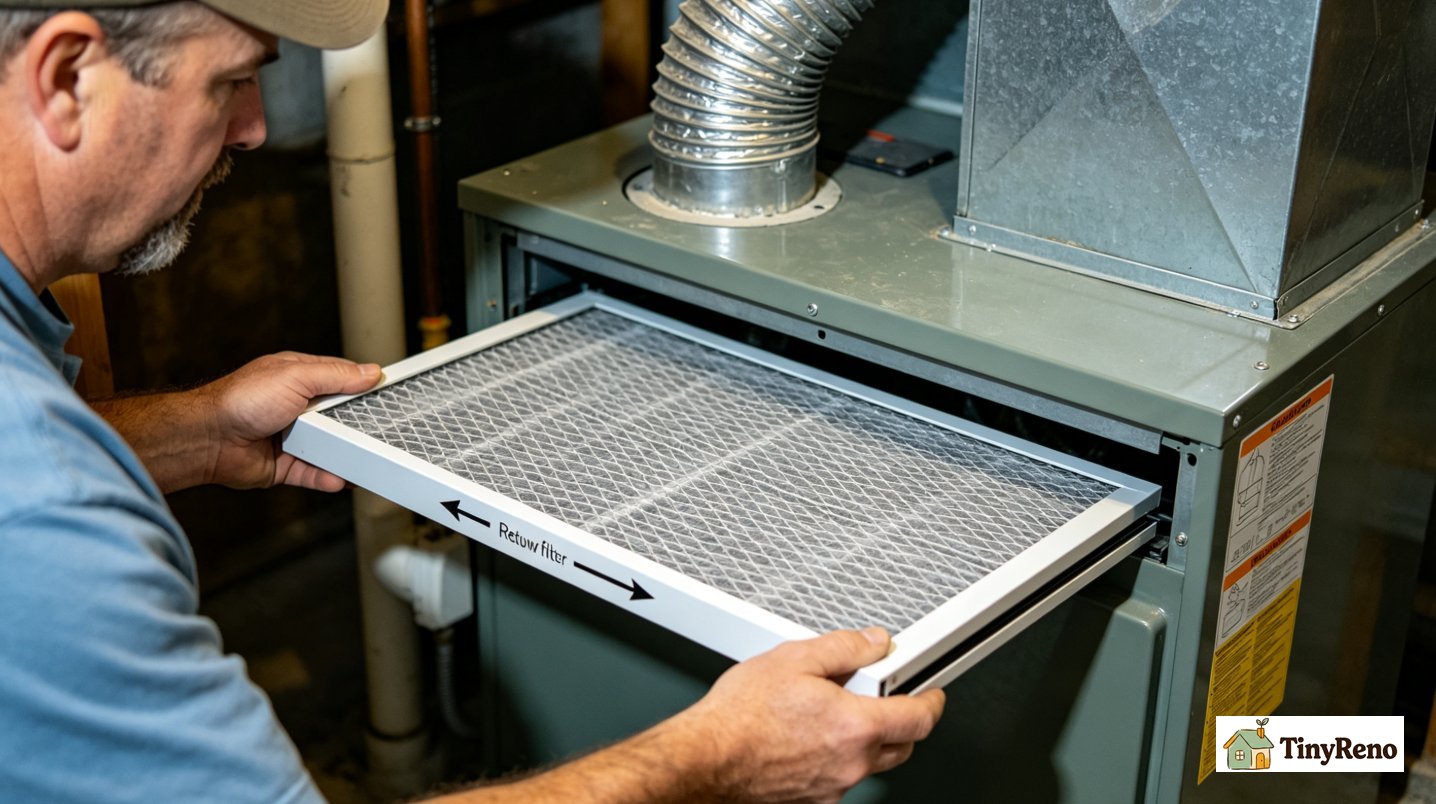
The 30-second test that tells you the right direction
Stand at the filter slot. Look at the filter. Find the arrows. They should point in the direction of airflow — which is from the return duct (the big duct pulling air from the house) toward the furnace cabinet (where the blower lives). If the arrows point toward the return duct, the filter is installed backward.
- If the arrows point toward the furnace cabinet, the filter is installed correctly.
- If the arrows point toward the return duct, the filter is installed backward.
- If the arrows point perpendicular to the airflow direction (for example, along the long edge when the air should flow through the face), the filter is installed sideways and needs to be rotated. Check that the filter still covers the entire slot—if it doesn't, it's the wrong size.
Some filters have arrows that run horizontally across the filter face, and some have arrows that run vertically along the edge. The arrows always point in the direction of airflow regardless of orientation, but a filter installed sideways — where the arrows are perpendicular to the actual airflow — is also wrong, even if the arrows are pointing in roughly the right direction.
What the arrows actually mean
Most furnace filters have arrows printed or stamped on the frame next to the words "AIR FLOW" or just an arrow symbol. The arrows indicate the direction the air should flow through the filter media. Air always flows from the return duct (low pressure, pulling air from the house) into the furnace cabinet (high pressure, blowing air into the supply ducts and back into the house through the vents). The arrows are the visual cue for furnace air filter direction.
The filter sits in a slot between the return duct and the furnace cabinet. The slot can be oriented in any direction — vertical, horizontal, sideways — depending on how your ductwork was installed. The arrows on the filter should always point in the same direction as the actual airflow, which means toward the furnace cabinet regardless of which way the slot is oriented.
If you can't see arrows on the filter frame — older filters sometimes have them worn off, or some budget filters don't print them at all — there's a structural clue. Some pleated filters have a stiffer side with a support grid or a rougher texture on the upstream side. If yours does, that side faces the return duct. But many filters don't have this distinction, so don't rely on it—look for arrows or check the old filter's dust pattern instead. The arrows, when present, point from the rough side toward the smooth side.
What happens if you install the filter backward
A backward filter doesn't stop filtering — it filters air in the wrong direction. The pleated media is designed so that larger particles get caught on the upstream side and smaller particles get caught progressively deeper in the media. When you reverse the airflow, larger particles slam into the back of the pleats, which weren't designed to handle that load. The filter loads up faster and the airflow drops off within weeks instead of months.
A common symptom of a backward filter is short-cycling, though it usually appears after the filter has loaded up with dust. The furnace runs, but the reduced airflow through the clogged filter makes the heat exchanger overheat. The high-limit switch trips, the furnace shuts down, the heat exchanger cools, the furnace restarts, and the cycle repeats every few minutes. The house never reaches the set temperature on the thermostat. The furnace runs constantly without heating effectively. The energy bill goes up.
The second symptom is unfiltered air. On some filter slots, installing the filter backward lets the filter frame bow inward under airflow pressure. The filter media pulls away from the frame on the downstream side, and air flows around the filter entirely. The furnace pulls air from the return duct, but it doesn't all go through the filter media. Some of it slips past the edges. Your ductwork accumulates dust faster, your indoor air quality drops, and the filter you thought was protecting you is mostly decorative.
The third symptom, which is rare but possible, is damage to the blower motor. The reduced airflow makes the motor work harder. The motor runs hotter. Over time, that extra heat degrades the motor windings. The blower fails years earlier than it should have, and the repair is $400-800 for a new blower assembly.
How to tell which way the airflow goes without the arrows
If you have a thermometer or an infrared temperature gun, you can measure the temperature difference across the filter slot while the furnace is running. The downstream side of the filter (furnace cabinet side) will be slightly warmer than the upstream side (return duct side) because the heat exchanger adds heat before the air goes to the supply ducts. The temperature difference is usually 2-5°F. This isn't a practical check for most homeowners, but it works in a pinch.
A simpler method: turn the furnace on and hold a tissue near the filter slot on the side you can access. If the tissue is pulled toward the slot, you're on the return-air side, and the airflow is moving into the slot. The arrows on the filter should point in that same direction—into the furnace cabinet.
If you don't have a tissue handy, look at the dust pattern on the existing filter when you change it. The side that faces the return duct has more dust on it — that's the upstream side. The downstream side is relatively cleaner because the filter media has already done its job before the air passes through. Install the new filter with the same orientation as the old one.
Different filter slots require different orientations
Most furnaces have a single filter slot at the blower compartment. The filter slides in vertically or horizontally depending on the model. The slot is typically marked with a label that says "FILTER" or has an arrow indicating the direction of airflow. The label is usually on the side of the cabinet near the slot.
Some homes have a return air filter grille instead — the filter slides into a frame mounted in the return air vent on the wall or ceiling, not at the furnace itself. In that case, the filter sits in the grille with the arrows pointing away from the room and toward the ductwork behind the wall. The grille frame usually has arrows indicating the airflow direction, but they're easy to miss because the grille face looks the same from both sides. This is a different installation than the furnace air filter direction case above.
Less common but worth knowing: some HVAC systems have two filter slots — a primary at the furnace and a secondary at the return air grille. Both filters should be installed with arrows pointing in the same direction of airflow. If you replace one but not the other, double-check both. The mistake of installing the secondary backward is more common because the grille-mounted slot is easier to ignore than the furnace-mounted one.
What to do if you can't find the arrows and the existing filter is missing
Trace the ductwork from the filter slot back toward the rooms. The return duct pulls air from multiple rooms back to the furnace, while the supply ducts push conditioned air into individual rooms. Return ducts are often larger, but not always—use the direction of airflow, not the size, to identify them. The filter slot is between the return duct and the furnace cabinet. Air flows from the rooms, through the return duct, through the filter, into the furnace cabinet, through the blower, through the heat exchanger or cooling coil, and out through the supply ducts back into the rooms.
Once you've identified which duct is the return and which is the supply, the filter slot is clearly the one between the return and the furnace. The arrows on the filter should point away from the return duct and toward the furnace cabinet. This convention holds regardless of whether the slot is oriented vertically or horizontally, and regardless of which furnace brand you have.
If you're still not sure, take a photo of the filter slot and the surrounding ductwork to your local HVAC supply store or furnace dealer. They'll identify the airflow direction in about 30 seconds and tell you which way to install the filter. Most hardware stores also sell furnace filters with very visible arrows printed on the frame, so if you're replacing an unmarked filter, the new one will be clearly labeled.


Discussion (0)
Sign in to join the discussion