

The refrigerator evaporator fan was the second repair I'd never heard of until it failed. The first was the condenser coils, which I'd cleaned three times by the time the refrigerator evaporator fan quit. The fan quit on a Sunday morning in July. The freezer was cold. The fridge was 58 degrees. Everything in the fridge had to go into coolers for two days while I figured out what was wrong.
A refrigerator evaporator fan that isn't running usually traces back to one of five things. The 60-second check below covers three of them—a failed motor, a frost-locked blade, and a stuck damper. The other two—a failed control board and a cracked fan blade—are covered later in the article. The fan lives behind a panel inside the freezer compartment, behind the ice and the frost, in the coldest, least-visited part of the appliance. Most homeowners don't know it exists until it stops. By then the food in the fresh-food compartment has usually taken some heat damage, and the urgency pushes you toward replacing the whole fridge when the actual fix is a $25 part and an hour of work.
If your refrigerator evaporator fan has stopped running, the trick is figuring out which of the five causes is yours before you order the part. A common mistake is to swap the fan and discover the new one won't run either—because the actual problem was a failed defrost cycle that let frost build up around the fan blade until it locked up. Replacing the fan fixes the symptom, but the defrost problem comes back in two months.
The 60-second check that tells you which of the five you're dealing with
Open the freezer. Listen for 30 seconds. The fan should be running constantly — it's what moves cold air from the evaporator coils into both the freezer and the fresh-food compartment. If you hear nothing, the fan isn't running. If you hear a faint hum but no air movement, the motor is trying to spin but the blade is locked.
- If the fan blade spins freely when you push it with a finger, the motor has failed.
- If the blade is locked solid, frost has built up around it from a failed defrost cycle.
- If the fan runs but no cold air moves, the problem is the damper door between freezer and fridge, not the fan.
- If the back wall of the freezer is thick with frost, the defrost system has failed and the refrigerator evaporator fan will keep locking up until you fix that.
This single check tells you which of the five causes is yours. I learned it the hard way by replacing a refrigerator evaporator fan that was perfectly good — the frost buildup had just locked the blade, and the new fan locked up two weeks later when the same frost pattern reformed.
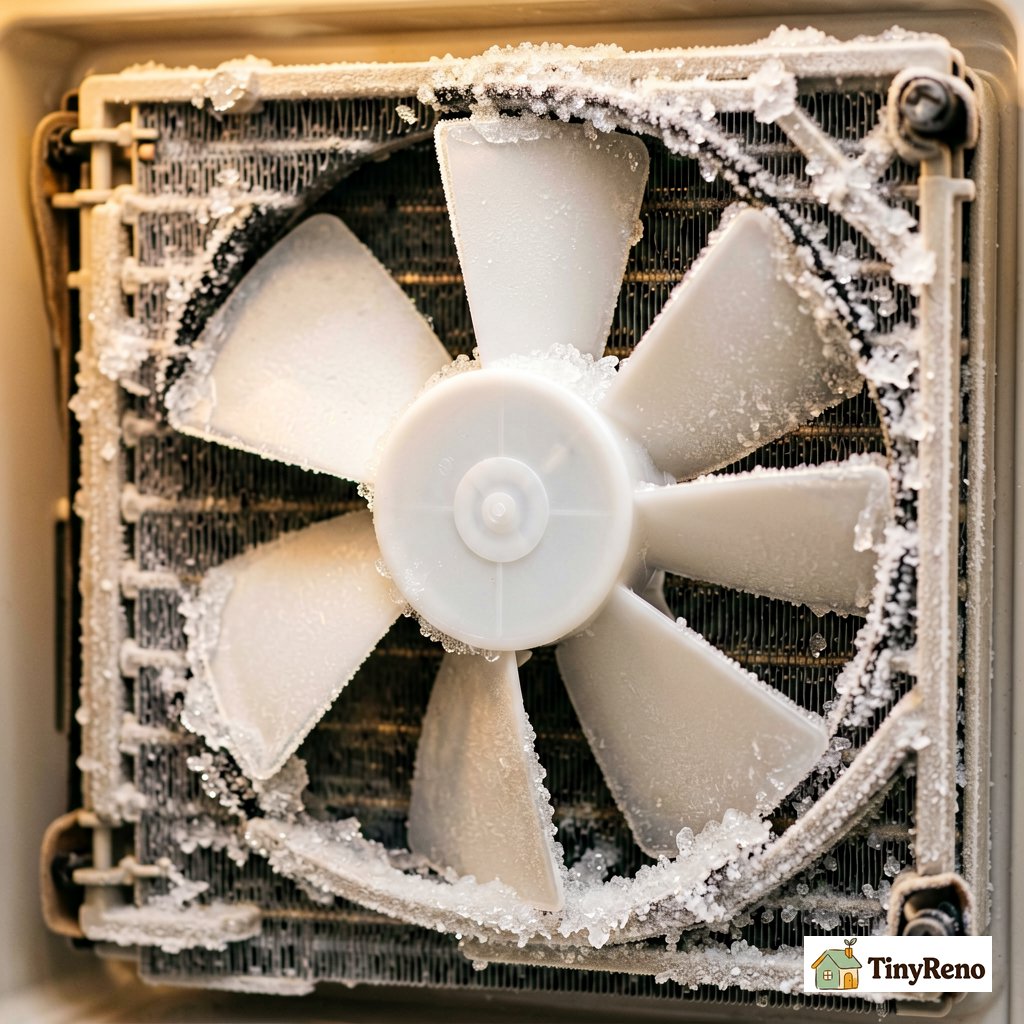
The defrost system has failed and locked the blade in ice (most common cause)
Modern frost-free refrigerators run a defrost cycle every 6-12 hours: a heating element under the evaporator coils turns on for 20-30 minutes, melting any frost that has accumulated, and the resulting water drains into a pan under the fridge where it evaporates. Three components run this cycle: a defrost timer (or main control board on newer models), a defrost heater, and a defrost thermostat that tells the heater when to shut off.
When any one of those three fails, the defrost cycle stops running. Frost continues to accumulate on the evaporator coils. Within a week or two, the frost creeps around the evaporator fan blade until the blade can't spin. The fan motor strains against the locked blade, eventually burns out, and the freezer compartment stops moving air.
The fix is to replace the failed component plus the fan if the motor has burned out. The most common failure is the defrost thermostat — a $15 part that snaps onto the evaporator coil. The heater is $30-50. The timer or control board is $50-150. Diagnose which has failed by testing continuity with a multimeter: a working thermostat shows continuity when cold and open when warm. A working heater shows 20-40 ohms of resistance. A working mechanical timer cycles between defrost and run modes on a schedule you can verify by listening for the click every 6-12 hours. Electronic control boards don't make an audible click—check the diagnostic code or use a multimeter instead.
The repair takes 1-2 hours including the time to fully defrost the evaporator coils with a hair dryer before reassembling. Skipping the manual defrost means the new parts install into an already-frozen system, and the test doesn't tell you anything.
The fan motor itself has burned out (the one that needs a new fan)
If the fan blade spins freely when you push it but the motor doesn't run on its own, the motor has failed. This is sometimes a separate failure from the defrost issue — motors wear out after 8-12 years of constant operation. But it can also be the secondary failure of the frost-lock scenario above, where the motor burned out trying to turn a locked blade.
The test is to disconnect power at the breaker or unplug the fridge, then use a non-contact voltage tester to confirm the circuit is dead. Open the freezer back panel and spin the fan blade with a finger. If the fridge is under warranty, call the manufacturer before you touch anything—DIY repairs can void it. If it spins smoothly and the motor doesn't start when you restore power, the motor is bad. Replacement fan motors are $25-50 and snap into the existing housing. The job takes about 20 minutes once you've diagnosed it.
One trap: don't buy the cheapest aftermarket fan motor. The OEM part is $40-60; the no-name $15 version usually has a shorter bearing life and will fail again in 18-24 months. The savings aren't worth doing this repair twice.
The main control board isn't sending power to the fan (the one that fools the diagnostic)
On many refrigerators made in the last 15-20 years, the main control board (sometimes called the "motherboard") controls the fan, the compressor, the defrost cycle, and the damper. Check your model's wiring diagram to confirm before assuming the board is involved. If the board fails partially — some functions work, others don't — the fan can stop while everything else keeps running. The freezer light works, the compressor cycles on and off normally, the ice maker makes ice, but the fan never spins.
The diagnostic clue is that nothing else is wrong, but the fan specifically isn't running. You can verify this with a multimeter on the fan motor's power connector: if you're getting 0 volts when the fan should be running, the board isn't sending power, and the board is the problem.
Main control boards are $100-250 depending on the model. Replacement is usually just unplugging the old one and plugging in the new one — no soldering. The expensive part is the board itself, not the labor.
Before ordering a board, check the wiring harness between the board and the fan motor. A corroded or loose connector at the fan end can mimic a failed board. Pull the connector, clean the pins with electrical contact cleaner, reconnect firmly, and test again before you spend $150 on a board.
The refrigerator evaporator fan's replacement procedure depends on your model. Some fans are accessible from the front of the freezer compartment; others require removing the back panel inside the freezer. Either way, take photos of every wire and connector before disconnecting, and bag the screws so they don't migrate into the evaporator drain.
The fan blade has cracked or warped (the one you can see)
Plastic fan blades get brittle with age. After 10-15 years, the blade can develop a hairline crack that throws it off-balance. The motor still spins, but the blade wobbles. The wobble eventually wears the bearing and the motor burns out.
The visual diagnostic is to look at the fan blade while it's spinning (with the door open and the door switch held down so the fan stays running). Keep your fingers clear of the blade—use a flashlight to inspect it from a distance, not your hand. A cracked or warped blade will be visibly out-of-round. You'll also hear a rhythmic thumping sound from the freezer that wasn't there a month ago.
Replacement blades are $10-20. The repair is the same as a motor replacement — open the panel, pull the old blade off the motor shaft, push the new one on. Some blades are specific to the motor model; bring the old one to the parts supplier or photograph it before ordering.
The damper door between freezer and fridge has failed (the one that isn't actually the fan)
The evaporator fan moves air inside the freezer compartment. A separate damper door — usually in the wall between the freezer and the fresh-food section — opens and closes to let cold air flow into the fridge. If the fan runs, you can hear it, the freezer is cold, but the fridge is warm, the damper is the problem, not the fan.
Damper doors fail in two ways: the actuator motor burns out (the door stays closed), or the door itself sticks (usually from spilled food or ice in the duct). The first is a $50-100 part. The second is a cleaning job — pull the duct cover, wipe out any debris, make sure the door swings freely.
You can confirm this is your problem by checking the temperature with a thermometer in the fresh-food compartment. If the freezer is at 0°F but the fridge is over 50°F, the damper isn't opening. If both compartments are warm, the problem is the fan or the defrost system, not the damper.
If your refrigerator is more than 15 years old and you're dealing with any of these failures, the cost-benefit starts to favor a new fridge. New refrigerators use significantly less energy than 15-year-old models—often 30-40% less, depending on the model and your usage. A $400 repair on a fridge that uses $200/year more in electricity than a new one is a bad investment. Check the energy guide sticker on your existing fridge and compare it to current models before committing to the repair.


Discussion (0)
Sign in to join the discussion