

Why does my dishwasher smell like rotten eggs? My friend asked me that exact question after his dinner guests kept glancing at the kitchen drain. He told me he'd cleaned the dishwasher three times with two different "freshener" products and it smelled worse after each cycle. I went over, opened his Bosch, and located the source in about sixty seconds.
The smell wasn't the food bits. It wasn't the heating element. It was a slimy black layer inside the drain hose that no rinse cycle was going to touch. The question "why does my dishwasher smell like rotten eggs" almost always has one of four answers. Two are inside the machine—the filter and the sump. Two are in the plumbing—the drain hose biofilm and the air gap fitting. The 60-second sniff test below tells you which one you're dealing with.
Why does my dishwasher smell like rotten eggs in the first place? It's hydrogen sulfide gas, produced by anaerobic bacteria that don't need oxygen. They live in three places inside a typical dishwasher, and figuring out which one is yours takes about a minute.
The 60-second sniff test that locates where the smell lives
Open the door. Smell the bottom of the tub where the filter sits—if it's strong here, the filter or the sump is the problem. Now lean down and smell the air gap fitting on the sink (the small chrome cylinder next to the faucet). If that's the strongest, the smell is coming up through the drain line. If neither spot smells strong but the whole machine does, the drain hose biofilm is the likely culprit (the small chrome cylinder next to the faucet). If that's the strongest, the smell is coming up through the drain line, not from inside the dishwasher at all.
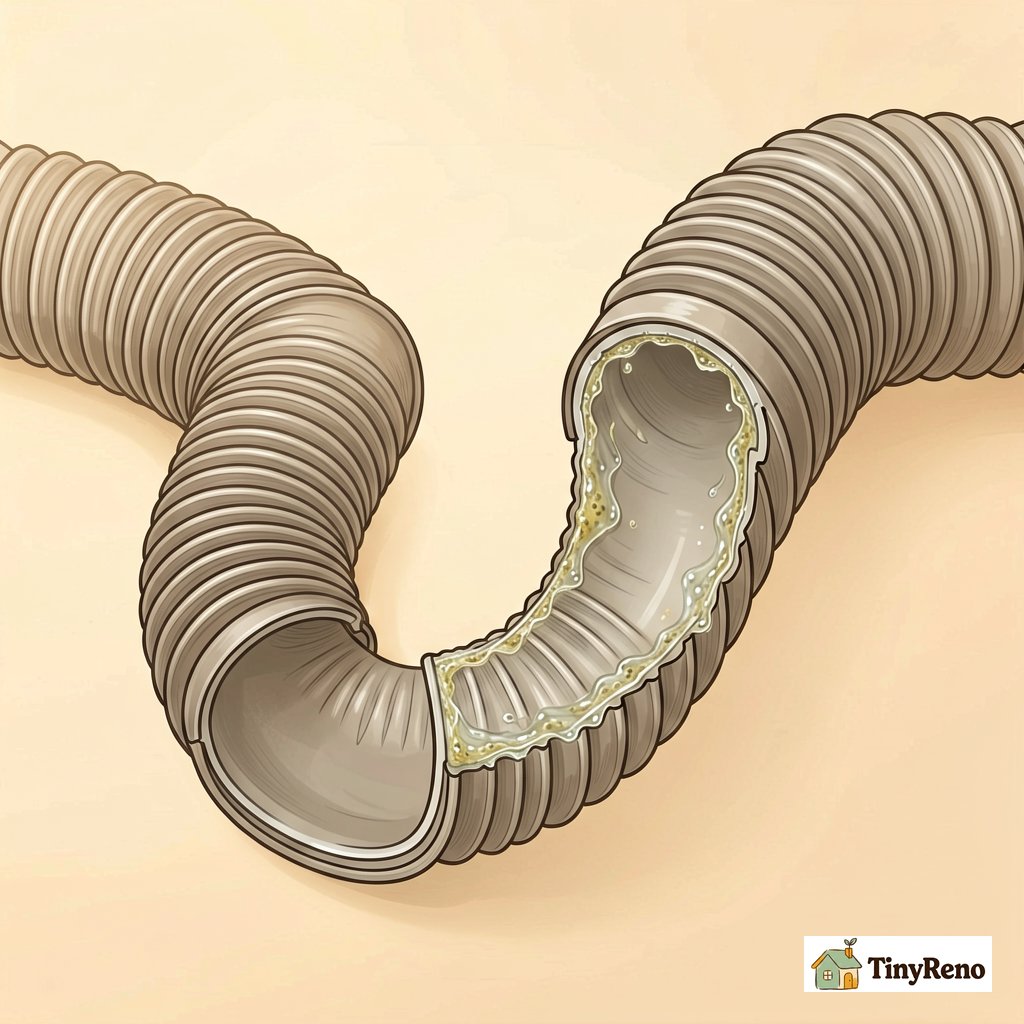
Most "why does my dishwasher smell like rotten eggs" cases trace back to the third spot — the drain line — even though people assume the smell is the dishwasher itself. That's because sulfur-reducing bacteria love the dark, wet, low-oxygen environment inside a flexible drain hose. They don't just live there; they build a layer called biofilm that protects them from anything you pour down the drain.
Biofilm in the drain hose (the most common one nobody mentions)
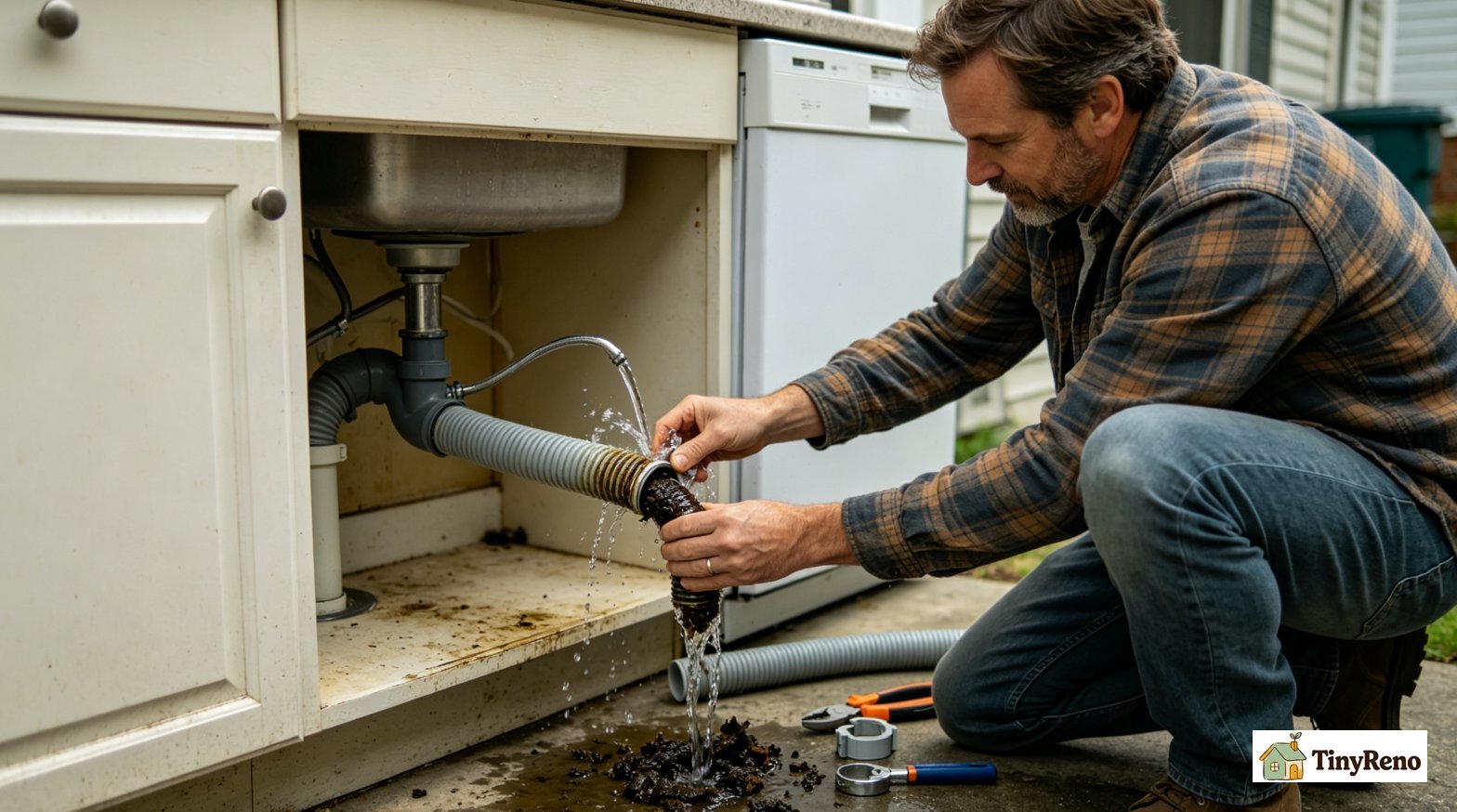
The drain hose is the ribbed black or gray hose that runs from the back of the dishwasher, usually up to the underside of the sink countertop, then down to the garbage disposal or sink tailpiece. That high arc isn't just for backflow prevention. It's also the perfect habitat for biofilm.
Biofilm is a community of bacteria glued together by a slimy matrix they secrete. Inside that matrix, anaerobic bacteria — bacteria that don't need oxygen — convert sulfates from the water (and from food residue) into hydrogen sulfide. That's the rotten-egg gas. Hot water doesn't kill the biofilm because the bacteria inside are protected. Bleach doesn't reach them because the matrix shields them. What does work is mechanical disruption — physically breaking up the layer so the bacteria lose their protection. This is the actual reason a dishwasher smells like rotten eggs even after you've cleaned the tub three times.
The fix: pour two cups of white vinegar into the empty dishwasher, run a hot cycle. Then once a month, run an empty hot cycle with a quarter cup of baking soda scattered across the bottom rack. The vinegar step dissolves the mineral part of the biofilm. The baking soda step adds a mild abrasive and helps neutralize the vinegar residue so it doesn't damage rubber seals over time. Running them in sequence is gentler on the machine than using vinegar alone every month. This is the actual chemistry, and it's why "natural cleaning" advice that uses only one of the two often disappoints.
For a deeper reset, disconnect the drain hose at the sink end and flush it with a garden hose outside. You'll see the biofilm come out in chunks. Reattach with a new hose clamp ($3 at any hardware store). This takes about twenty minutes if you're reasonably handy, and it fixes most cases where the smell is coming from the drain line.
The filter is the second-most-likely spot
Most people don't know their dishwasher has a filter, and even fewer clean it. On a Bosch, the filter is at the bottom center of the tub — a round cylinder that twists out. On a Frigidaire, it's usually a flat mesh screen at the back-left of the tub floor. On a Whirlpool, it varies by model but is always somewhere on the tub floor.
A filter that's gone four months without cleaning holds a paste of food particles, grease, and water. That paste sits in warm, damp, low-airflow conditions every single day between cycles. Anaerobic bacteria love it. The smell rises through the door seal when you open the dishwasher the next morning — and you wonder why the dishwasher smells like rotten eggs.
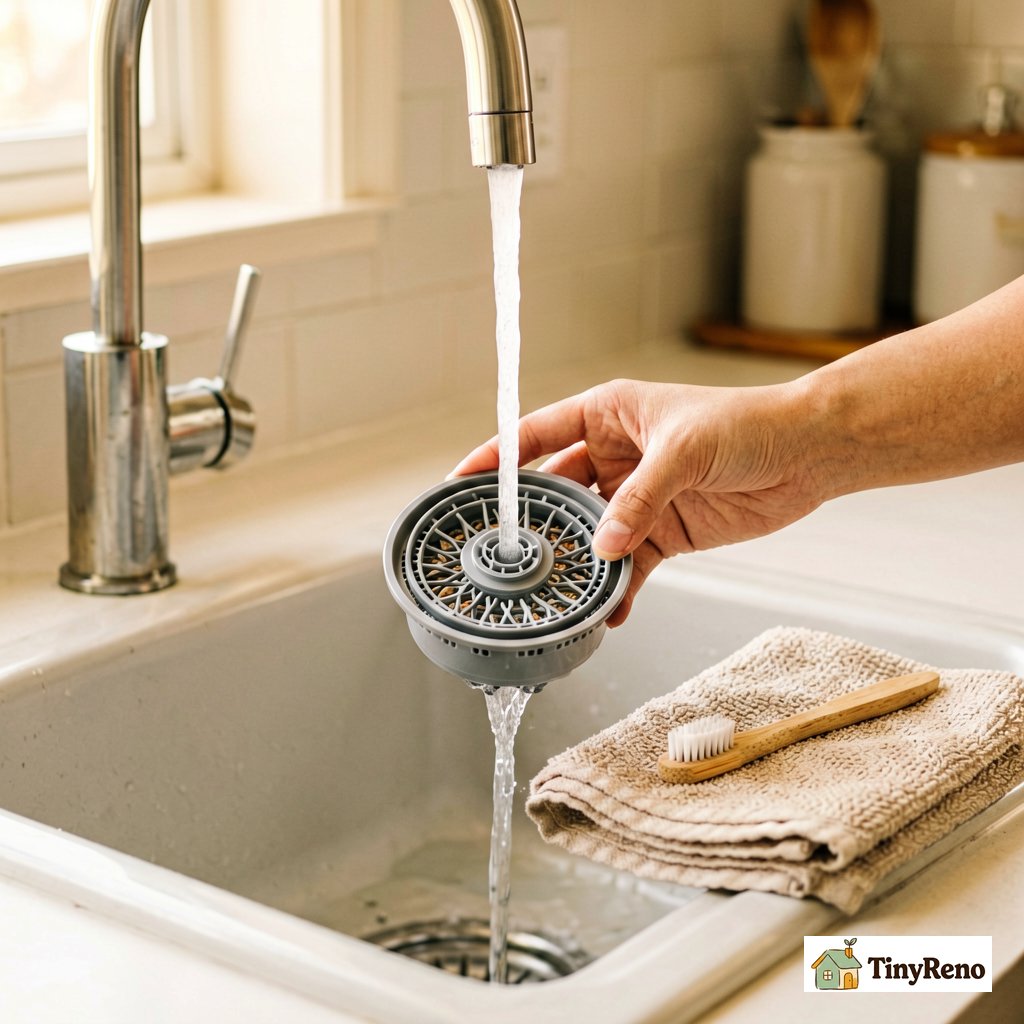
Twist the filter out. Rinse it under hot water with an old toothbrush. Scrape the well it sits in with the same toothbrush. There's almost always a slime ring around the filter housing that doesn't come out with the filter itself. Reinstall. Run an empty hot cycle to rinse any loosened debris through the drain. This step alone fixes many dishwasher smells that aren't biofilm-in-hose problems.
Water sitting in the sump (the standing-water smell)
After every cycle, the drain pump is supposed to pull almost all the water out of the sump — the recessed well at the bottom of the tub where the filter sits. If your dishwasher has standing water in that well twenty minutes after the cycle ends, the drain pump is failing. The water sits there for hours between cycles, picks up whatever food bits made it past the filter, and turns into a small swamp.
Check this with a flashlight and a dry paper towel. Pull the filter, look into the well. If there's more than a centimeter of standing water, the drain is not clearing properly. Check the drain hose for kinks or clogs first. If the hose is clear and the water still sits there, the drain pump is the likely culprit. Replacement pumps run $30 to $60 and are a moderate DIY job — unplug the unit, pull it out, flip it on its side, swap the pump from underneath. Not a beginner repair, but not a $300 service call either.
A related but distinct problem: if the water in the sump is clean but won't drain, the drain hose is probably kinked or clogged at the high loop. If it's dirty, the pump impeller is probably jammed with a piece of broken glass or a bone fragment. Different fixes, but both start with the same flashlight-and-towel test — and both can leave you asking "why does my dishwasher smell like rotten eggs" long after you've cleaned the tub.
The "clean it every week" advice that actually makes it worse
Here's the advice I see on every cleaning blog: "Run a cleaning cycle every week to prevent dishwasher smells." This is exactly backwards.
Frequent cleaning cycles—running an empty hot cycle with vinegar, baking soda, or a commercial cleaner—can actually make the smell worse. Here's why: the cleaning cycle kills the surface bacteria but doesn't reach the biofilm inside the drain hose or the sump. When the cycle ends, the surviving bacteria in those hard-to-reach places recolonize the tub faster because there's no competing surface bacteria left. The smell comes back stronger within a few days. The correct cadence is once every two to three months. That's enough to keep the biofilm from building up without stripping the machine every week. Each cleaning cycle briefly reduces the smell, but the rebound is faster and stronger because you've cleared out the competition. So three weeks later, you ask again why the dishwasher smells like rotten eggs — and the cleaning you did made it worse.
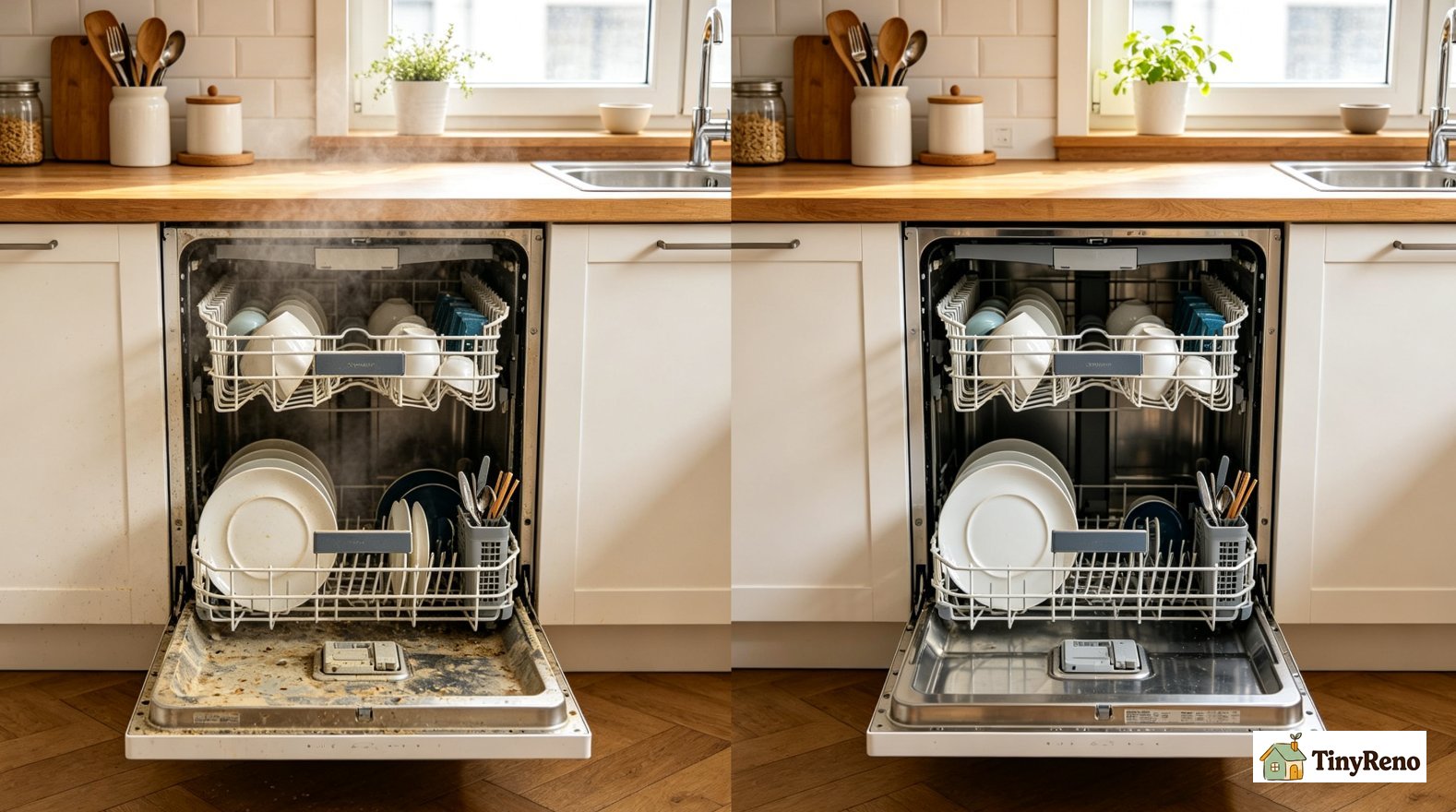
The correct cadence is once every two to three months, not weekly. Use the baking-soda-plus-vinegar sequence described above, do it on a Sunday morning when you can run two back-to-back cycles, and then leave the dishwasher alone. Between deep cleans, scrape plates before loading. That's it. The dishwasher is a closed wet system; it doesn't need weekly interventions, and intervening too often makes the underlying problem harder, not easier.
If the smell comes back within a week of a deep clean, the problem is upstream — usually the drain hose biofilm or a failing air gap fitting — and no amount of inside-the-dishwasher cleaning will solve it. At that point, the hose flush described in section two is the right next step.


Discussion (0)
Sign in to join the discussion