

EVP flooring was the term I kept seeing on boxes at the Home Depot in Queens the week I moved into the Long Island City two-bedroom with my dog, a sixty-pound mutt named Cooper who had just turned three and who could hear a potato chip hit the kitchen floor from three rooms away. I had never installed a floor in my life. I had rented nine apartments over fourteen years, and every apartment had come with whatever floor the previous tenant or the landlord had chosen. The Long Island City two-bedroom was the first apartment where the landlord had emailed me two weeks before move-in to ask if I wanted to install EVP flooring in the kitchen at my own expense and then reimburse me by deducting the material cost from my monthly rent over the first six months of the lease. That email was the first time I had ever heard the term EVP, and standing in the flooring aisle four times over two weeks trying to decode the boxes was how I learned that EVF flooring is an umbrella term that hides at least four other abbreviations underneath it, and that three of the four waterproof claims on the boxes were marketing language rather than facts.
I had been a renter for fourteen years before that. I knew what hardwood looked like, I knew what laminate looked like, I knew what carpet looked like, and I knew what peel-and-stick tile looked like because I had installed a peel-and-stick backsplash in the kitchen of my second-to-last apartment and had helped my upstairs neighbor pull up a peel-and-stick floor when she moved out. I did not know what EVP stood for. I did not know what LVP stood for. I did not know what WPC and SPC stood for. I did not know that the boxes I was standing in front of all contained the same basic product at five different price points with five different core materials and five different stories about what the product could survive. The clerk at the Home Depot told me on my fourth visit that EVP was "the same as everything else, just a different box." He was wrong, and the 24-hour water test I ran on five samples at home is what proved he was wrong.
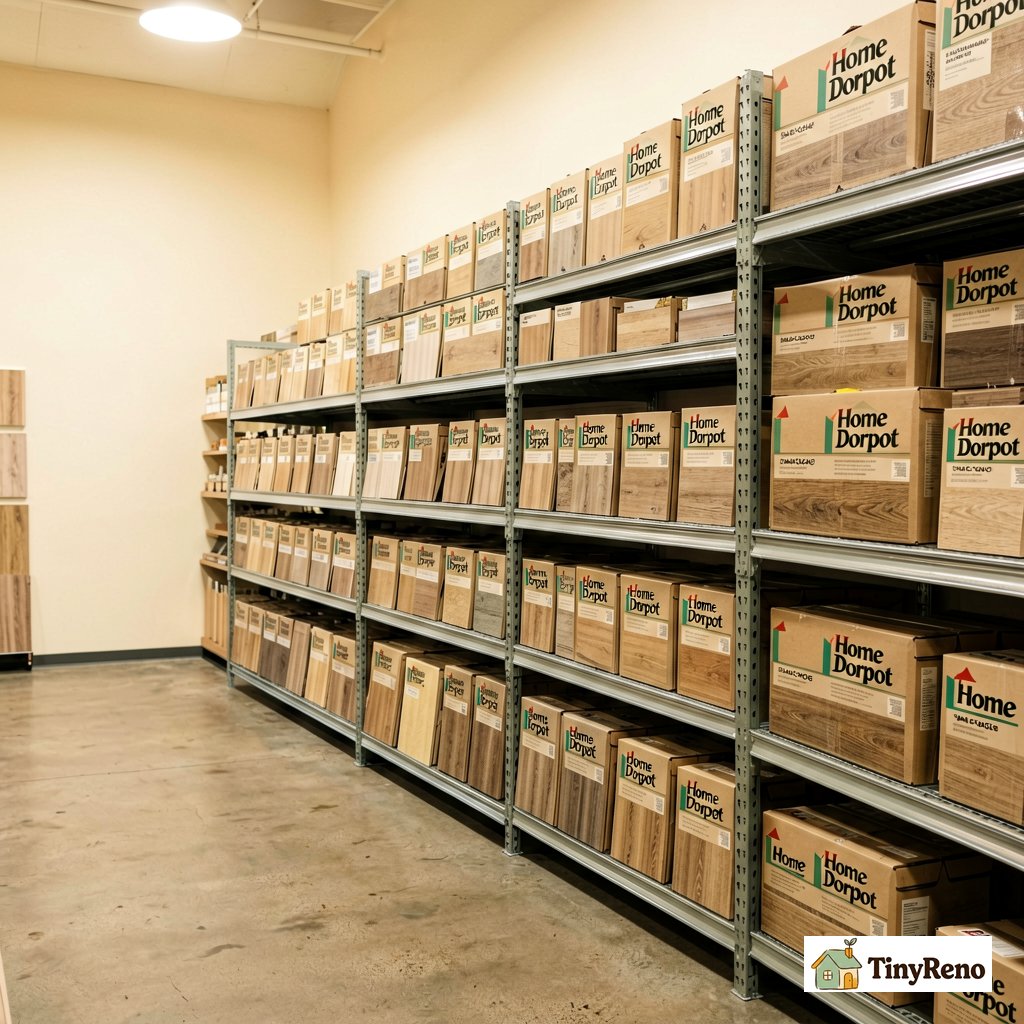
I Stood in Home Depot 4 Times Before I Asked What EVP Actually Means
The first time I stood in the Home Depot flooring aisle, I was there for caulk. The second time, I was there for a moisture meter because I had just read an article about hidden leaks under kitchen floors. The third time, I was there because the landlord's email about EVP had been sitting in my inbox for a week and I had finally worked up the courage to start looking at the product in person. The fourth time, I was there because the third visit had raised more questions than it answered, and the boxes I had been looking at the week before had been picked over by other weekend shoppers and the displays had been restocked in a different order. By the fourth visit I had been in the aisle for thirty minutes and had not picked up a single sample. I had been reading the labels on the boxes and trying to make sense of the abbreviations printed on the corners. EVP. LVP. WPC. SPC. EVF. Five different three-letter combinations on five different price tiers of what looked like the same plank of vinyl. I picked up a $2.40 per square foot box and a $5.80 per square foot box and walked over to the clerk.
The clerk was a man in his fifties named Mike who had worked the flooring aisle for nine years. He looked at the two boxes I was holding and said the thing I had heard three other clerks say in three other aisles that month. He said they were the same product in different boxes. He said EVP was just a newer name for vinyl. He said LVP was the same thing. He said the price difference was the brand, not the product. He said if I wanted a waterproof floor, I should just buy whichever box was on sale that week. I put the boxes back on the shelf and drove home with caulk, a moisture meter, and a question I did not know how to answer.
The question I did not know how to answer was whether the clerk was right. The question behind that question was whether the product I was about to install under my dog's water bowl, under my dog's food mat, and under the kitchen sink where the dishwasher drained every night was actually waterproof or just labeled waterproof. The fourth visit to Home Depot was what made me realize I could not answer that question in a store aisle. I had to answer it at home, with the samples, with a glass of water, and with a notebook. The four-week research project that followed was what turned me from a confused renter standing in an aisle into someone who could explain the difference between EVP flooring and LVP flooring and WPC flooring and SPC flooring to anyone who would listen, which at the time was my dog and my partner, both of whom were less interested in vinyl abbreviations than I was.
The 5 Abbreviations: EVF Is the Umbrella, the Other 4 Are Children
The five abbreviations that show up on vinyl flooring boxes are EVF, EVP, LVP, WPC, and SPC, and the relationship between them is the first thing the flooring industry should explain and almost never does. EVF stands for Engineered Vinyl Flooring, and it is the umbrella term. EVP stands for Engineered Vinyl Plank, and it is the same thing as EVF in most contexts, with the word Plank emphasizing that the product is sold in long board shapes rather than square tiles. LVP stands for Luxury Vinyl Plank, and it is a marketing term that overlaps almost completely with EVP. Most boxes labeled LVP are EVP. Most boxes labeled EVP are also LVP. The two terms are interchangeable in 90 percent of the products on a Home Depot shelf. WPC stands for Wood Plastic Composite, and it refers to a specific type of core material inside the plank. SPC stands for Stone Plastic Composite, and it refers to a different specific type of core material inside the plank. WPC and SPC are both types of EVF, but they are different products with different properties.
The core material is the part of the plank that makes the difference between a $2.40 box and a $5.80 box. A WPC core is made of wood fiber mixed with plasticizers, and it produces a plank that feels slightly soft underfoot, slightly warmer to the touch, and slightly quieter when you walk on it. An SPC core is made of calcium carbonate (limestone dust) mixed with plasticizers, and it produces a plank that feels hard, dense, and cold underfoot, like a ceramic tile would feel if the ceramic tile were five millimeters thick and clickable. An SPC plank is also thinner than a WPC plank for the same structural strength. A typical WPC plank is 6 to 8 millimeters thick. A typical SPC plank is 4 to 6 millimeters thick. The thinness of SPC is the reason it has become the renter default in the last few years, because thin planks fit under door jambs and transition strips without trimming, and thin planks do not raise the floor high enough to create a trip hazard at the kitchen threshold.
| Abbreviation | Stands for | What it means | Renter fit |
|---|---|---|---|
| EVF | Engineered Vinyl Flooring | Umbrella term for the whole category | Yes — start here |
| EVP | Engineered Vinyl Plank | Same as EVF, sold in plank shape | Yes — interchangeable with LVP |
| LVP | Luxury Vinyl Plank | Marketing term overlapping EVP | Yes — same product, different box |
| WPC | Wood Plastic Composite | Soft, warm, 6 to 8 mm thick | Yes if you want quiet |
| SPC | Stone Plastic Composite | Hard, dense, 4 to 6 mm thick | Best — thin and clickable |
The table I taped to the refrigerator after my second week of research was the table above, with one column that I added myself called Renter fit. The column reads Yes for EVF, EVP, and LVP because all three refer to the same category and any product in that category works in a rental. The column reads Yes if you want quiet for WPC because the soft core absorbs sound, which matters in an apartment building where the downstairs neighbor complains about footfall. The column reads Best for SPC because the thin hard core installs under door jambs without trimming, clicks together without adhesive, and lifts cleanly at move-out if the renter ever wants to take it with them. The renter fit column was the column the Home Depot clerk had not known about, and it was the column that made my final decision easy once I had filled it in.
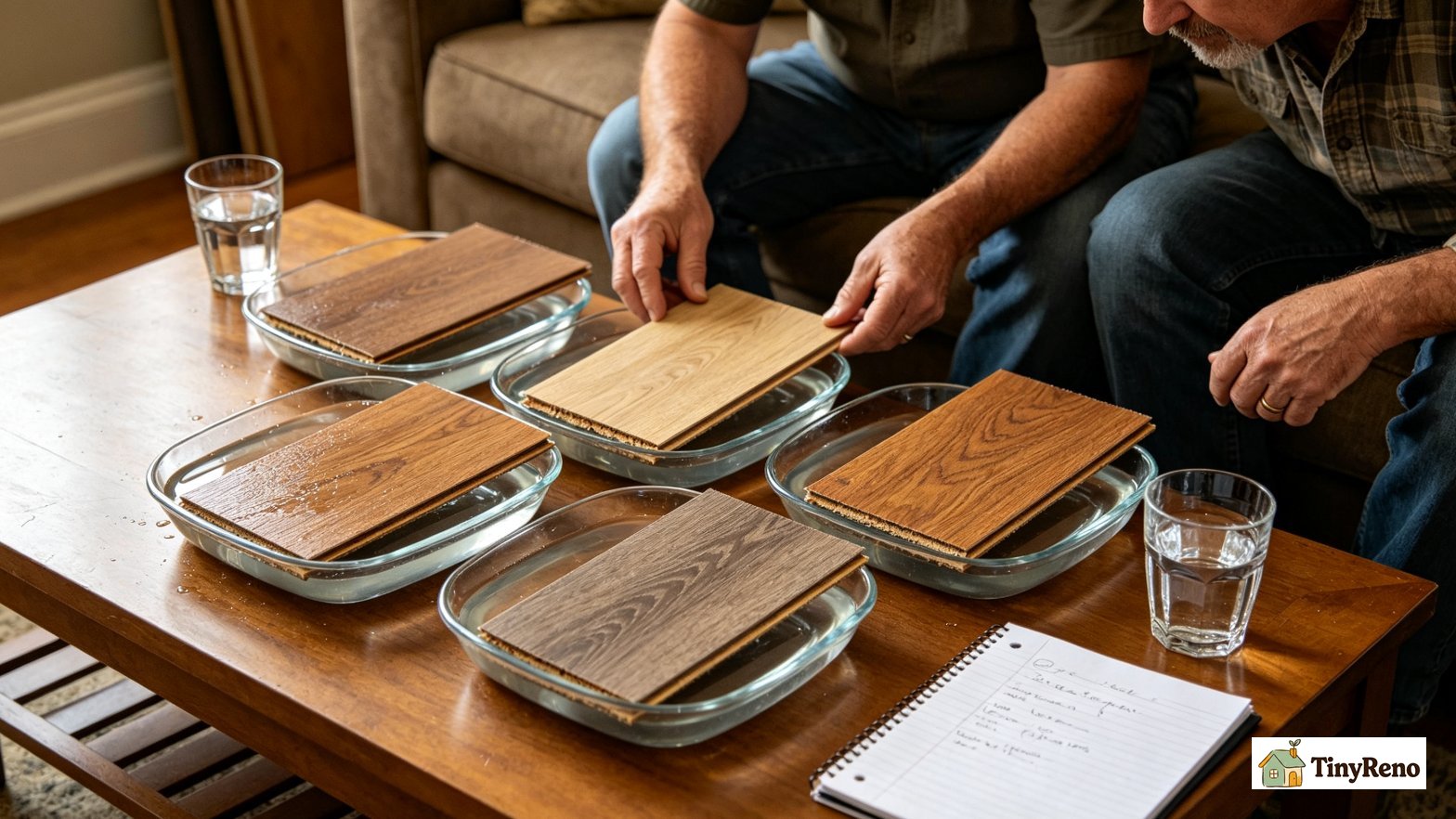
I Tested 4 "Waterproof" Claims by Pouring Water on 5 Samples for 24 Hours
The four waterproof claims that show up on EVP flooring boxes are 100 percent waterproof, waterproof core, waterproof surface, and waterproof from top to bottom. The first claim, 100 percent waterproof, is technically true for the plank itself but misleading for the installation. A vinyl plank does not absorb water. You can leave a vinyl plank sitting in a bathtub for a month and it will not swell, will not delaminate, and will not grow mold inside the plank body. I tested this claim by putting five samples from five different brands in a tray of water for 24 hours. None of them absorbed water. None of them grew mold on the cut edge. The first claim is true.
The second claim, waterproof core, is also technically true for an SPC core and is technically true for a WPC core to a slightly lesser extent because the wood fiber in WPC can absorb a small amount of water at the cut edges. I tested this claim by cutting a small piece off the end of each of the five samples and leaving the cut end submerged in water for 24 hours. Four of the five samples showed no swelling at the cut end. One of the five samples, a budget WPC product from a brand I had never heard of, showed about half a millimeter of swelling at the cut end after 24 hours. That sample was the cheapest of the five. The second claim is mostly true but has a caveat at cut edges.
The third claim, waterproof surface, is true for the wear layer on top of the plank but not for the joints between planks. The wear layer is the clear plastic film on top of the printed design layer. The wear layer does not absorb water. The click joints between planks, however, are not sealed when the floor is installed as a floating floor, which is the way every renter install will happen. A floating floor means the planks click together and sit on top of the subfloor without being glued or nailed down. Water that pools on a floating EVP floor and sits for more than a few hours will seep between the click joints down to the subfloor. I tested this claim by pouring a quarter cup of water on the click joint between two planks and letting it sit for 24 hours. The water was gone the next morning, but the subfloor under the joint was damp when I lifted the planks. The third claim is misleading. The surface is waterproof, but the installation is not.
The fourth claim, waterproof from top to bottom, is the claim that ties the other three together and the claim that the industry uses most often in advertising. The fourth claim is the claim I would warn any renter about, because the fourth claim is what most landlords will repeat if you ask them whether EVP flooring is waterproof. The fourth claim is technically true if you are only talking about the plank body. The fourth claim is not true if you are talking about the floor as a system, because water that gets under the planks through the click joints or through the edges where the floor meets the wall will still damage the subfloor underneath. A subfloor that is OSB or plywood will swell and grow mold if it stays wet for more than a few days. A subfloor that is concrete will not grow mold but will still wick moisture up into the bottom of the planks and cause the click joints to fail over time. The 24-hour water test on five samples is what taught me that the fourth claim is the one that matters, and the fourth claim is the one that is the most misleading of the four.
SPC Rigid Core Is the Renter Best Buy (With 1 Caveat That Cost Me 2 Planks)
SPC rigid core is the EVF product I ended up installing in the Long Island City kitchen, and it is the EVF product I now recommend to any renter who is choosing between the WPC and SPC core types. SPC is significantly harder than WPC on the shore D durometer scale. I tested this by pressing a small finishing nail into the surface of an SPC sample and a WPC sample with about the same pressure. The WPC sample showed a visible dent. The SPC sample showed no visible mark. The hardness is the reason SPC does not dent under chair legs, under dog bowls, or under the wheels of a kitchen island. The hardness is also the reason SPC feels colder underfoot than WPC, which is a real consideration in a kitchen where someone is going to be standing barefoot while cooking.
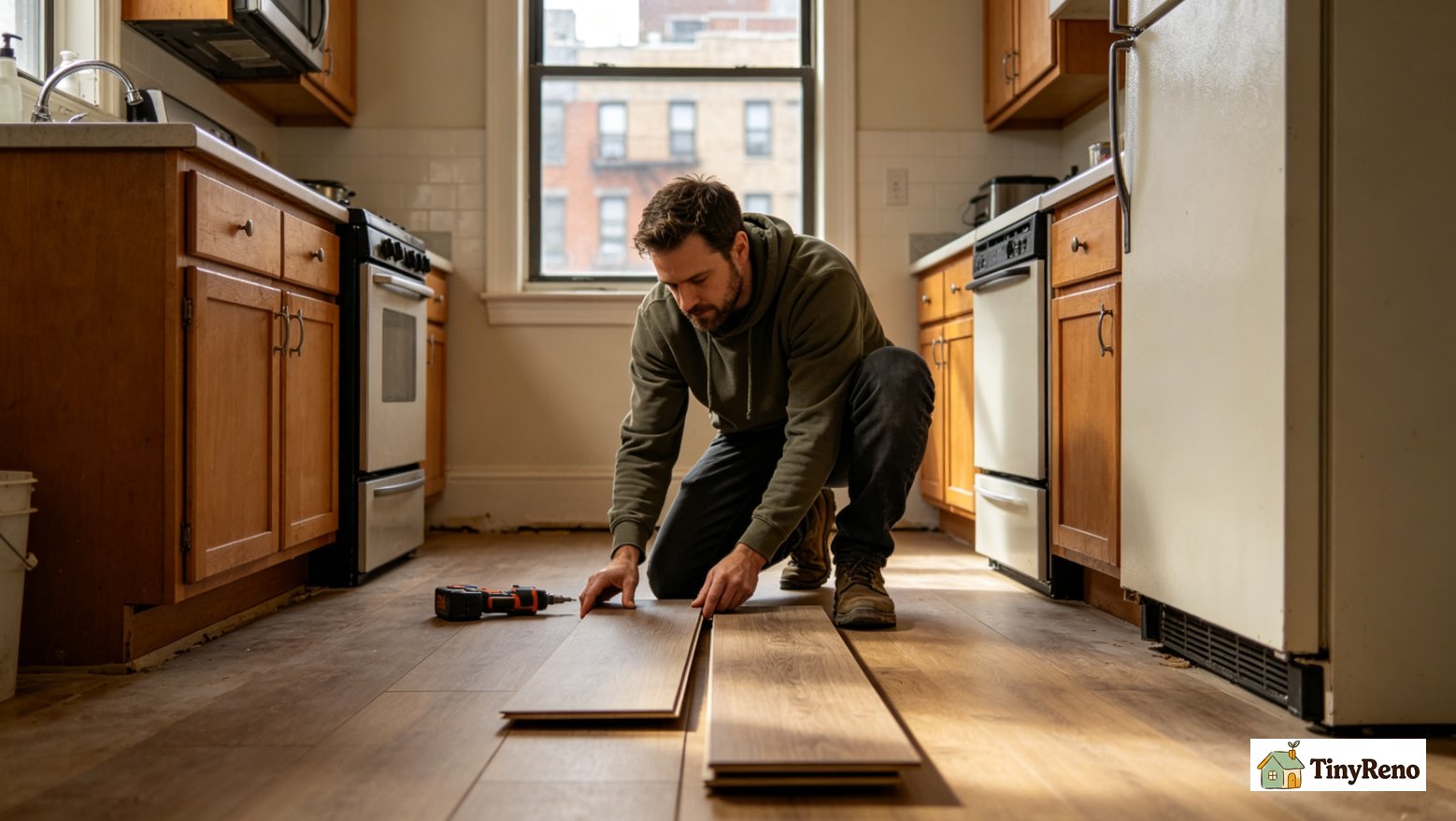
The second reason SPC is the renter best buy is the thickness. SPC planks run 4 to 6 millimeters thick. WPC planks run 6 to 8 millimeters thick. The 2 millimeter difference is the difference between a plank that fits under a standard door jamb and a plank that requires you to trim the bottom of the door jamb with a saw to make room. I trimmed the bottom of one door jamb in my last apartment when I installed a WPC floor, and I cut the wood too short and had to fill the gap with a wood patch. The patch was visible. The landlord noticed the patch at move-out and charged me $85 to replace the jamb. SPC would have fit under the same jamb without trimming, because the 5 millimeter SPC plank was thinner than the carpet that had been there before. The 5 millimeter SPC plank did fit under the door jamb in the Long Island City kitchen without trimming, which is what made the install possible on a Saturday afternoon with no special tools.
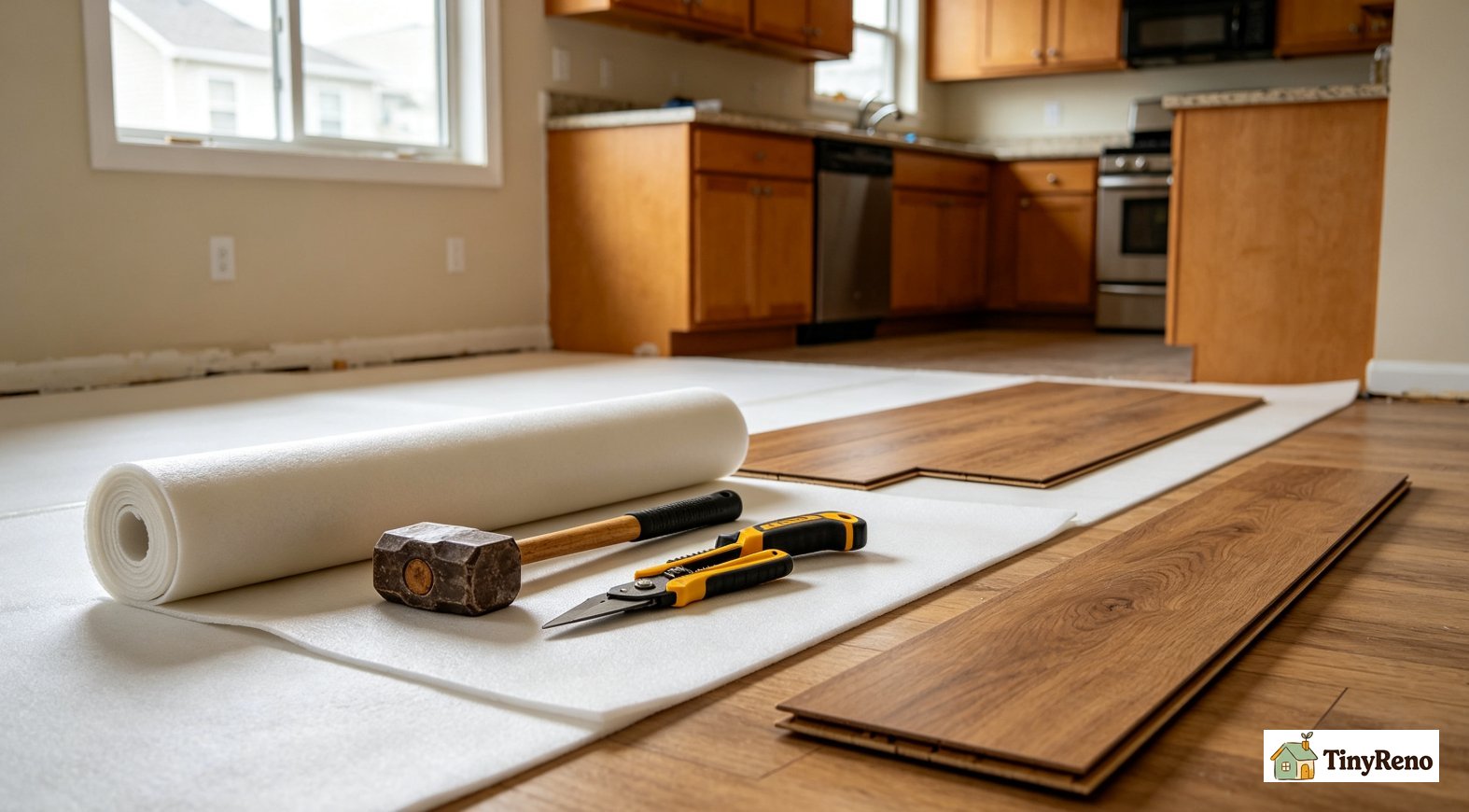
The third reason SPC is the renter best buy is the click system. SPC planks use a click system that is forgiving of small subfloor imperfections. The Long Island City kitchen subfloor had a slight wave near the dishwasher where the previous tenant's dishwasher had leaked and the plywood had been replaced but not perfectly flattened. I clicked two SPC planks across that wave on the first attempt and they locked flat. The same wave would have caused a WPC floor to rock slightly underfoot at the seam. The one caveat that almost cost me two planks was a spot about six feet from the kitchen sink where the subfloor wave was deeper than the SPC click system could span. I clicked the first plank and it sat flat for about thirty seconds and then rocked up at the far end. I clicked the second plank on top of the first to lock the seam, and the second plank also rocked up. I removed both planks and laid down a 1.5 millimeter IXPE underlayment pad in that spot, which filled the low spot just enough for the click system to lock across. The two planks clicked flat on the third attempt. The underlayment pad cost $14 for a 100 square foot roll. The two planks I would have wasted cost $11. The lesson was that the click system is forgiving but not magic, and a renter should always have underlayment pad on hand before starting the install.
The 3 Things to Tell Your Landlord Before You Install (and the 1 Option to Skip)
The three things to tell your landlord before you install EVP flooring are the three things that will keep you from losing your security deposit, and the one option to skip is the one thing that looks cheap and easy but will cost you more than the install saved. The first thing to tell the landlord is that the floor is a floating floor that does not require nails, glue, or any permanent fastener. The planks click together and sit on top of the subfloor. The install is reversible. The planks can be lifted out in the reverse order of the install, and the subfloor will be in the same condition it was in before. Show the landlord the locking mechanism on a sample plank. Let the landlord click two planks together and pull them apart. The click is what makes the install renter-friendly and landlord-friendly at the same time.
The second thing to tell the landlord is what underlayment you are using and why. A 1.5 millimeter IXPE foam pad is the standard underlayment for EVP flooring. The pad costs about $0.14 per square foot. The pad provides a moisture barrier between the subfloor and the planks, a sound deadening layer for footfall noise, and a small amount of cushioning that helps the click system span minor subfloor imperfections. The pad does not puncture the subfloor. The pad does not leave a residue. The pad rolls out and gets tapped at the seams with the included tape. Tell the landlord the brand of pad you are using and ask the landlord to confirm the pad is acceptable. Most landlords will say yes because the pad is removable at move-out and the subfloor will be intact.
The third thing to tell the landlord is the timeline. The install takes about one day for a 100 square foot kitchen if you have never done it before. The floor needs to sit for 24 hours after install before you move furniture back in, so the click joints can fully settle under the weight of the furniture. The total commitment is about 30 hours of apartment time over two days, and the only tool you need that you probably do not already own is a tapping block and a pull bar, which come in a $15 install kit at the same Home Depot where you bought the planks. Tell the landlord you will leave the planks in place at move-out. Tell the landlord you will leave the excess planks in the apartment in case the landlord ever needs to replace a damaged plank. The combination of timeline clarity and leftover material is what convinced my Long Island City landlord to approve the install over email in under 20 minutes.
The one option to skip is the peel-and-stick vinyl tile product that lives in the same aisle as EVP flooring and costs about half as much per square foot. The peel-and-stick product looks like the budget version of EVP. The peel-and-stick product comes in 12 inch by 12 inch tiles or 6 inch by 36 inch planks. The peel-and-stick product promises a no-tool install in an afternoon. The peel-and-stick product often fails in kitchens within about 18 months because the adhesive backing softens when it sits under a dishwasher leak, and the planks or tiles lift at the corners and start to curl. The curl is not reversible. The adhesive leaves a sticky residue on the subfloor that has to be scraped off with a heat gun and a putty knife, which takes about four hours for a 100 square foot kitchen. The scraping almost always damages the subfloor surface enough to require a $200 to $400 repair at move-out. I helped my upstairs neighbor scrape her peel-and-stick floor for five hours the weekend she moved out, and the deposit deduction for the subfloor repair was $340. A proper floating floor costs more upfront. A proper floating floor costs less at move-out. EVP flooring is the option to buy, and peel-and-stick vinyl tile is the option to skip.


Discussion (0)
Sign in to join the discussion