

High traffic porcelain tile was the flooring upgrade my mom asked for the week before her sister's retirement party landed on her porch. The sample at the shop was porcelain, looked dense, and the guy behind the counter said it would hold. Eight months later she slid a terra-cotta planter six inches across the entryway and a chip the size of a quarter popped out of the face, exposing a beige subfloor I'd never seen in a photo. That chip is the reason I now have rules for high traffic porcelain tile, and the reason I checked every spec on the next four flips before I'd let a homeowner buy a single box.
I'd been a renter for eleven years before that. The first apartment I rented on my own was a railroad in Astoria with a black grout white tile bathroom floor that I mopped twice a week and never once thought about the rating stamped on the box. Owning a flip is what taught me the difference, and a chipped porch on a Tuesday in March is what made me start asking questions the tile aisle usually dodges. This is what I learned across seven properties and four tile shop conversations, including the one where the owner scratched two samples on the back of my hand to make his point.
My Mom's Porch Tile Cracked on a Planter
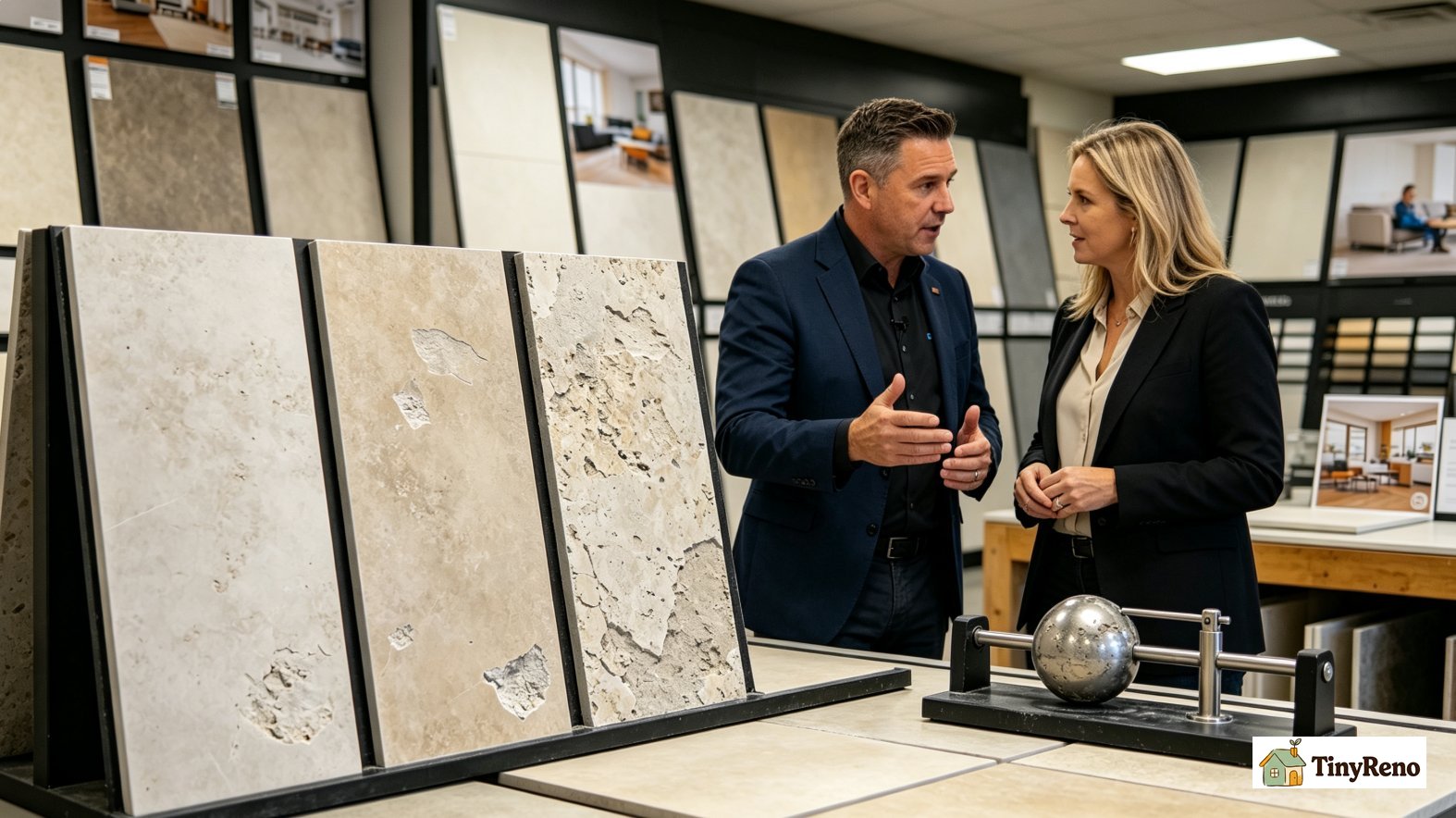
The chip on my mom's porch wasn't dramatic. The crack ran about two inches from one corner, the chip was maybe the size of a quarter, and the planter was maybe twelve pounds wet. The face of the tile was a warm beige with faint veining, the kind of "wood-look porcelain" that was on display in three of the four shops I visited later that month. The crack happened because that tile was not rated for what was sitting on top of it.
I went back to the box in her garage and read the fine print for the first time. The tile was a porcelain, but it was an 8 millimeter body with a glazed surface, and the box said "light residential" in the bottom corner. The box also listed a PEI rating of 2, which I had to look up because I'd never seen PEI on a flooring box before I started flipping. Light residential means a guest bathroom that gets foot traffic in socks. My mom's porch sees boots, sand, salt, and a forty-pound dog three times a day.
The fix was not cheap. We paid a tile guy $340 to pull four tiles from the entryway, set new ones, regrout, and reseal. The new tiles cost $4.20 a square foot instead of $1.95, which adds up to about $180 more on a 45-square-foot porch. My mom still has the receipt taped to the inside of her hallway closet door. That $180 difference is what would have kept the chip out of her entryway in the first place.
The second property I flipped after that, I made the same mistake on a mudroom, but I caught it before the closing walkthrough. The buyer's inspector walked in, looked at the box label in the garage, and asked me, point blank, why I'd installed a PEI 2 in a mudroom. I didn't have an answer. I ate the $420 to rip it out and start over with a PEI 4 rated porcelain. That second mistake cost me a lot more than the first one, but it taught me the rule I now give every client.
The PEI Rating Nobody Told Me About
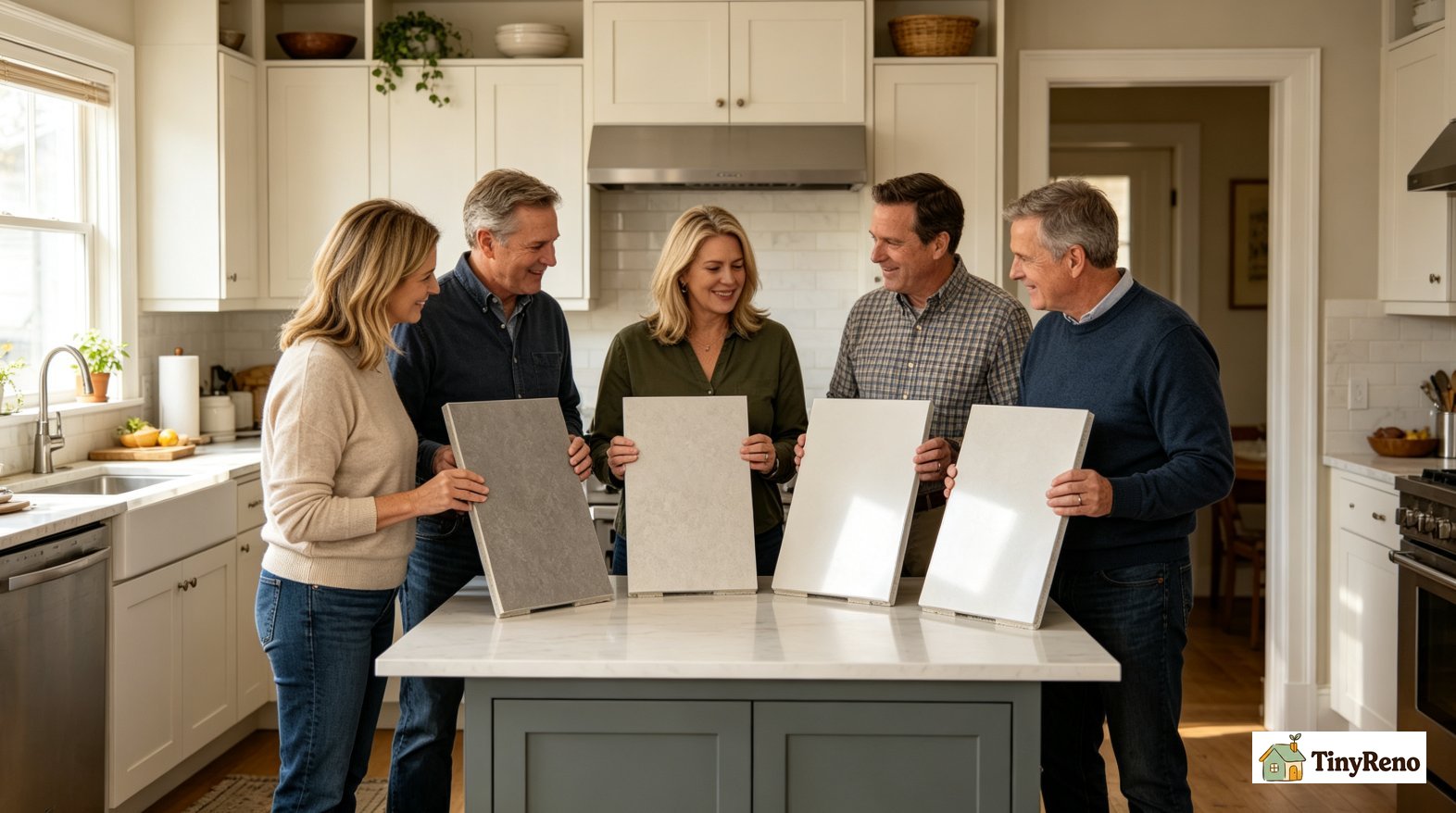
PEI stands for Porcelain Enamel Institute, and it grades the surface glaze of a tile on a scale from 1 to 5. The grading is done by running a steel ball across the surface under load and counting the revolutions before the glaze shows wear. PEI 1 is a wall tile that should never see a foot. PEI 2 is light residential, like a guest bathroom. PEI 3 is medium residential, which covers most living areas. PEI 4 is light commercial, which covers most entryways, kitchens, and mudrooms. PEI 5 is heavy commercial, which is what you want for an airport or a restaurant floor.
The tile shop owner in Cleveland Park told me the PEI rule the way he told it to me, with both samples in his hand and the chip from my mom's porch in a paper bag on the counter. He said that any tile with a PEI below 4 should not go in an entryway, a kitchen, a mudroom, a laundry room, or any space where someone will walk in with shoes on more than once a week. He said PEI 3 is fine for a bedroom or a dining room. He said PEI 2 is for a backsplash behind a stove, not a floor.
The same shop owner pulled out a sheet of paper and wrote down the four specs he said every buyer should check before they walk out with a box. The four specs were PEI rating, thickness, finish, and whether the color went through the body of the tile or only sat on the surface as a glaze. He said the fifth thing to check, the one most buyers skip, is the coefficient of friction, which is the slip rating. He said the slip rating is what keeps the buyer who has the PEI 4 tile from slipping on it in socks and breaking a hip.
That conversation is the reason the second flip's mudroom is still holding. The PEI 4 porcelain I swapped in cost $3.60 a square foot instead of the $1.80 PEI 2 I'd originally bought. The color went all the way through the body of the tile, not just across the surface, which means when the dog runs a claw across it, the scratch doesn't show as a different color underneath. Three owners have lived in that house since I sold it, and the last one emailed me a year ago to ask what tile it was because she wanted to match it in a hallway addition.
Porcelain vs Ceramic on the Back-of-the-Hand Test
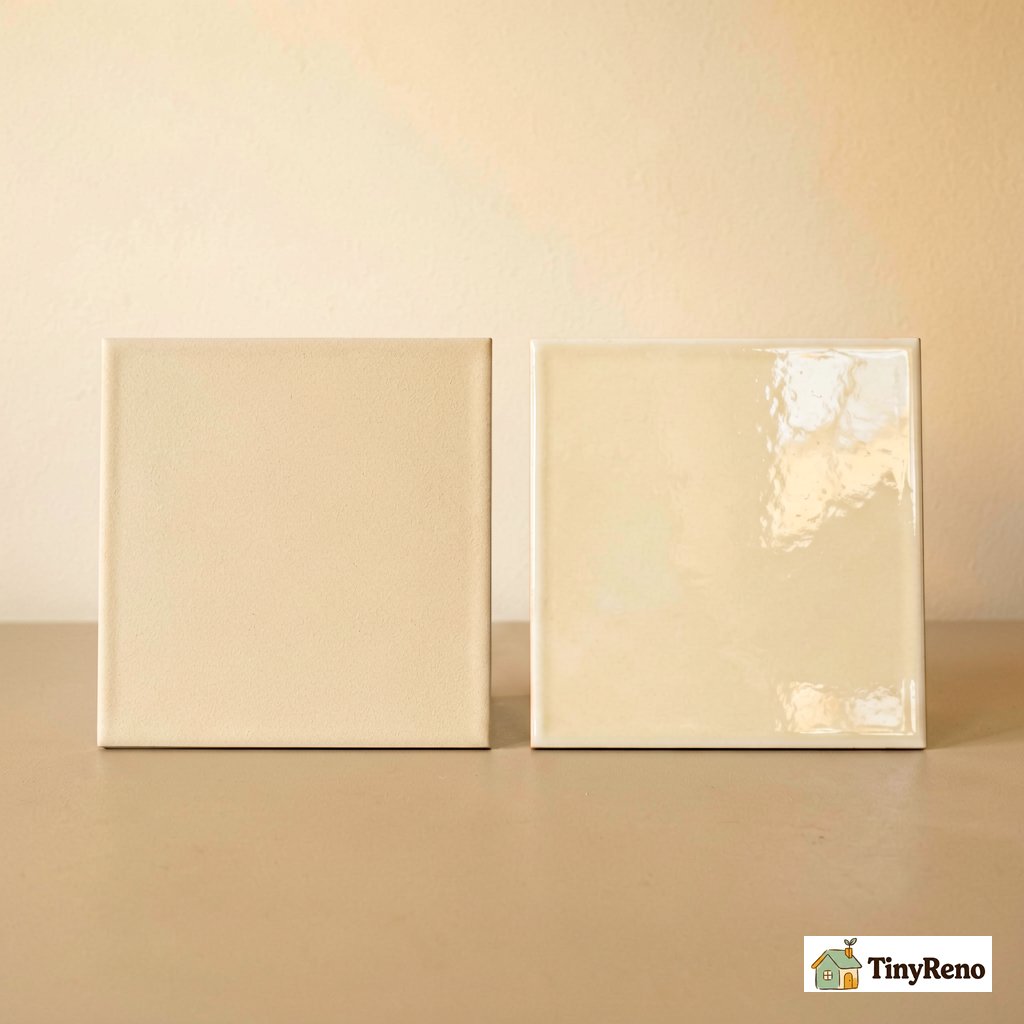
Most buyers walk into a tile shop and pick porcelain because it's the more expensive option. Expensive does not mean more durable, and the back-of-the-hand test is what the Cleveland Park shop owner used to show me why. He took a $1.50 per square foot ceramic sample and a $4.20 per square foot porcelain sample, held them face down on the back of my left hand, and dragged each one across the skin three times with firm pressure.
The porcelain left no mark. The ceramic left three faint lines that looked like pencil scratches but were actually micro-abrasions on the surface glaze. He pointed at the lines and said that's what happens to a ceramic floor after a year of dog traffic, a year of chair legs, a year of dropped cast iron. He said porcelain doesn't do that because the surface is fired at a higher temperature and the clay body is denser, which is also why it costs more and weighs more per box.
| Spec | Ceramic ($1.50/sqft) | Porcelain ($4.20/sqft) |
|---|---|---|
| Water absorption | More than 3% | Less than 0.5% |
| Body density | Soft, chalky when broken | Hard, glassy when broken |
| Back-of-hand test | Leaves faint scratches | No visible mark |
| PEI 4 available? | Rare, often only PEI 3 | Common across most lines |
| Best room for the spec | Bathroom wall, laundry floor (low traffic) | Entryway, kitchen, mudroom, commercial |
The other thing the shop owner pointed out, which is something I'd never noticed on a box before, is the water absorption rating. Ceramic absorbs more than 3% water by weight. Porcelain absorbs less than 0.5%. The water absorption rating is why a porcelain floor can sit under a dripping boot for an hour without swelling, while a ceramic floor in the same spot will start to lift at the edges within a season. He handed me a chip from a ceramic tile he'd pulled out of a Bethesda basement that had been down for nine years, and you could see the chalky clay body where the glaze had worn through.
For a renter, the porcelain price difference is real. A 100-square-foot kitchen at $4.20 a square foot is $420. The same kitchen at $1.50 a square foot in ceramic is $150. The $270 difference buys a lot of takeout. But if you're the renter who plans to live there for five years, and the landlord lets you choose the floor, the porcelain is the one that survives the security deposit walk-through. The ceramic is the one that gets a "tile damage" line item on the move-out statement.
The 4 Specs That Make High Traffic Porcelain Tile Survive
The four specs the Cleveland Park shop owner wrote on the paper are the four specs I now check on every flip and every rental renovation I help a friend with. They are not the four specs the box puts on the front of the label. The front of the label has the color, the size, and the price. The four specs are on the back of the box, in small print, and they are the difference between a floor that lasts ten years and a floor that lasts ten months.
The first spec is PEI 4 or higher. Anything below PEI 4 is for a wall or a backsplash or a guest bathroom that gets foot traffic twice a week. A real entryway, a real mudroom, a real kitchen floor with a stove and a fridge and a sink, needs PEI 4 minimum. The shop owner said he'd never put PEI 3 in a flip property because the buyer's home inspector will flag it and the buyer's lender will require a replacement before closing.
The second spec is thickness. Most residential porcelain is 8 to 10 millimeters thick. The 8 millimeter boxes are cheaper and easier to cut, but they crack under heavy furniture and under the kind of drop a cast iron pan takes from counter height. The 10 millimeter boxes cost about 30 cents more per square foot and resist that drop. For a mudroom or a kitchen where someone is going to drop a pot, 10 millimeter is the floor you want. For a bedroom, 8 millimeter is fine because nobody is dropping a cast iron pan on the bedroom floor.
The third spec is finish. A matte or textured finish hides micro-scratches. A glossy or polished finish shows every scratch and every drip mark and every boot print. The shop owner said the only time he recommends a polished finish is in a formal dining room or a living room that gets used twice a year. He said he would not put polished porcelain in a kitchen, an entryway, or any room where someone will walk in with shoes on. The glazed finish is what makes the chip on my mom's porch look the way it does—the glaze on top chipped, not the body underneath.
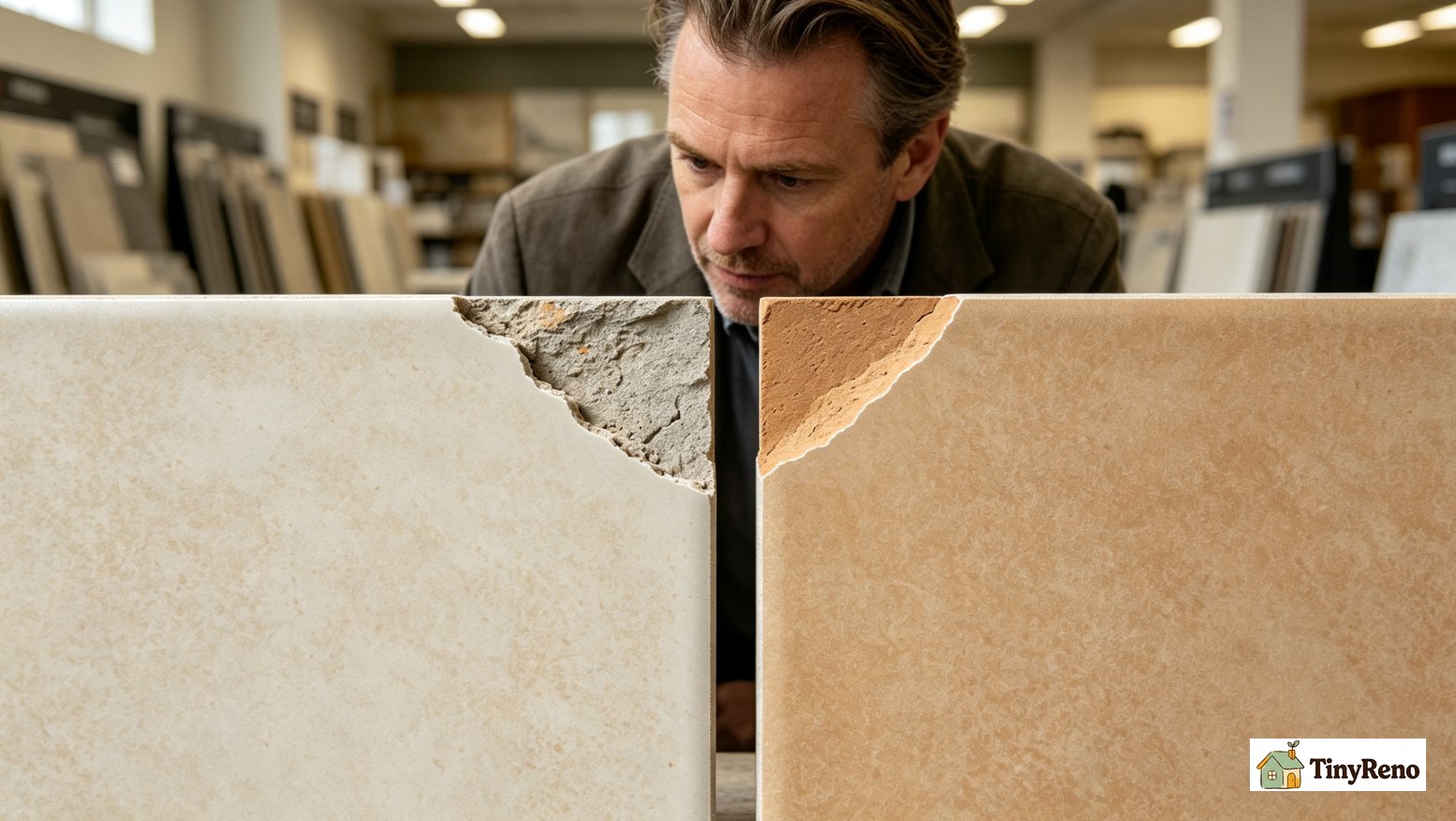
The fourth spec is through-body color. Through-body color means the color goes all the way through the tile, not just across the surface. A glazed tile has the color printed or sprayed on top, and when that color chips off, you see a different color underneath. A through-body tile has the same color from the surface to the back, so a chip looks like a small dent instead of a crater. The shop owner said through-body color costs about 60 cents more per square foot and is the only kind of porcelain he stocks for entryway installs. The five sample chips I keep in my garage are all through-body, and none of them have chipped in three years of moving furniture and planters across them.
My 3 Rules for Flip Clients (and the 1 Finish I Refuse to Sell)
The three rules I give every flip client are PEI 4 minimum, 10 millimeter thickness for any ground-floor room, and through-body color for any room that opens to the outside. The rules are not negotiable on a flip, because the buyer's inspector will check the box, the buyer's lender will require PEI 4 or higher, and the buyer's first winter will tell them whether the floor was worth what they paid for it.
For a renter who is choosing between landlord-approved floors or who is installing a peel-and-stick overlay on top of an existing tile, the rules simplify. If the existing tile is porcelain with a PEI 4 rating and a matte finish, leave it alone. If the existing tile is ceramic with a PEI 2 rating and a glossy finish, the landlord is the one who should replace it, not you. A peel-and-stick mosaic tile on top of a bad ceramic floor is a band-aid, not a fix. The ceramic under it will still crack, and the peel-and-stick will move with it.
The one finish I refuse to recommend is the white polished porcelain that the big box stores put on display at eye level. The display sample is clean and the price is high and the showroom floor under it looks immaculate. That floor is glossy because the showroom is mopped twice a day and nobody walks on it with shoes. The first week you live with it, the dog's claw marks will show. The first month, the chair scratches will show. The first year, the entryway will look like a checkerboard of wear patterns. The high traffic porcelain tile that survives is the one nobody puts on the display floor, because it's matte and textured and a little dull, and the one that actually holds up to a real house with a real dog and a real kid.
修改后:Mom's porch has been tiled twice in four years. The first tile was the original PEI 2 that chipped. The second tile is the $4.20 per square foot PEI 4 matte through-body I installed myself with a borrowed wet saw—and it's still holding. The chip from the original tile is in a frame on her hallway wall now, next to the receipt. The chip is in a frame on her hallway wall now, next to the receipt. The frame cost more than the tile would have.


Discussion (0)
Sign in to join the discussion