

How I Saved My Wood Floor From $3,000 in Water Damage
Water damage to wood floor was the last thing I expected to deal with on a Wednesday night in February. The washing machine hose had been slowly leaking behind the unit for what I later figured out was about two weeks, and the water had pooled under the laundry room and crept under the baseboard into the engineered hardwood in the living room. By the time I noticed the smell, 200 square feet of floor was cupped and dark. The insurance adjuster came the next morning and said damage this extensive usually means a full replacement at $3,000 to $4,000, plus the cost of ripping out the laundry room to fix the leak.
That’s not what happened. Five steps in the first 24 hours, two weeks of careful drying, and one hard call about what to keep and what to replace got me to a floor that looks 95 percent as good as the day it went down. Insurance covered $1,800. Below are the five steps that saved my floor, the three repair methods I weighed, and the week-2 mistake that almost cost me the whole living room.
If you are standing in your house right now watching water creep across a wood floor, this is the walkthrough I wish I had at 2 a.m. that Wednesday.
The First 24 Hours After Water Damage to Wood Floor
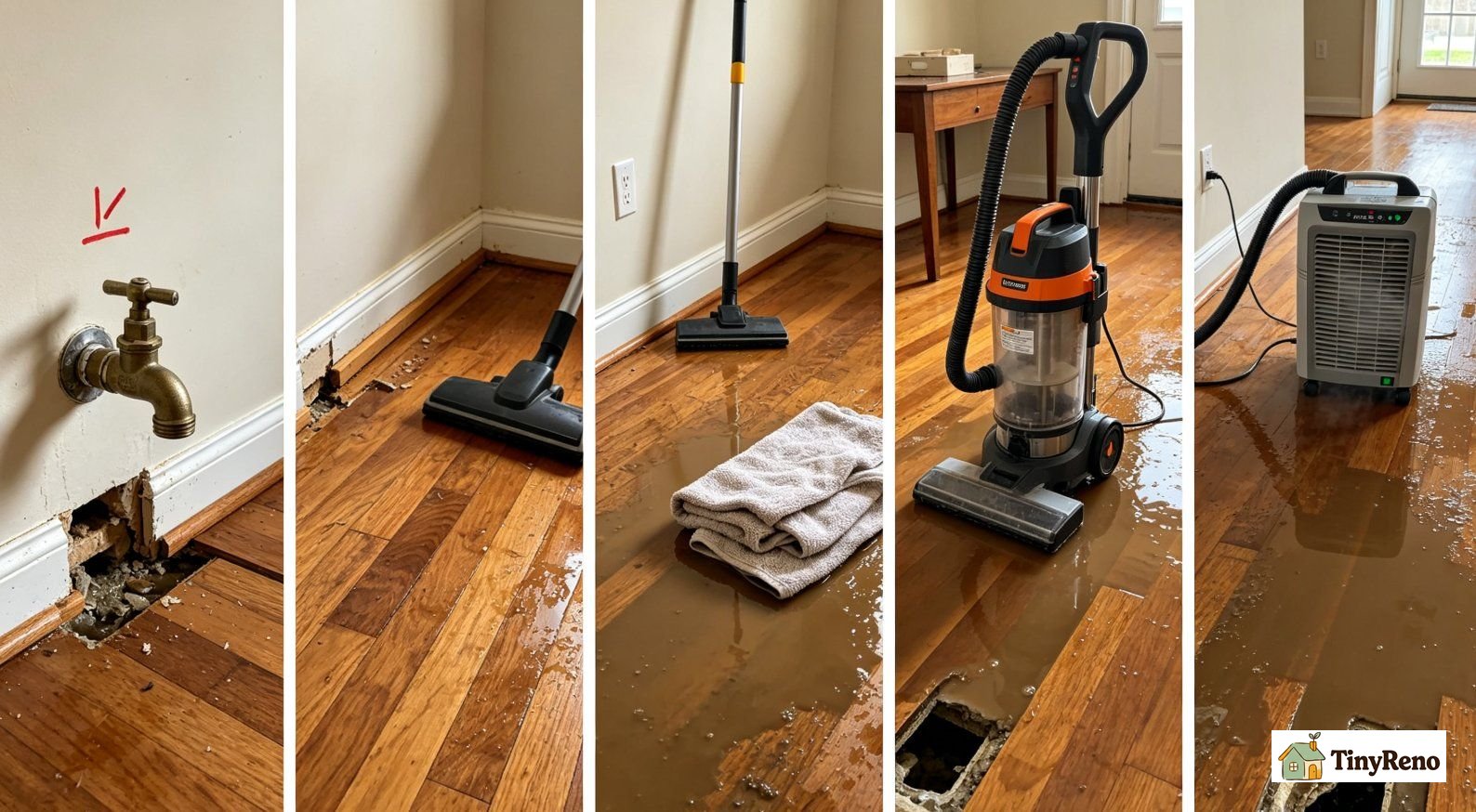
The first 24 hours after water damage to wood floor are the only hours that matter. Wood floor water damage gets worse in direct proportion to how long the water sits, and after 48 hours the wood has usually swollen past the point of recovery. The 5 steps below are the steps the restoration company would have charged $1,500 to do. You can do them yourself for about $200 in equipment rental.
- Stop the source. If the water is from a plumbing leak, washing machine, dishwasher, or toilet, shut off the water at the source valve or the main. The first 10 minutes are about preventing more water, not saving the floor. The floor is going to be damaged by the water that already got to it. The water that is still coming is the problem you can still solve.
- Pull the baseboards. Use a pry bar to remove the baseboards from every wall where water has touched the floor. The baseboards trap water against the wall and prevent the subfloor from drying. Removing them lets air get under the edge of the floor. Save them and label them in order so you can put them back.
- Mop and blot the surface. Use a wet-dry vacuum if you have one. If not, use thick towels and step on them. Get every visible pool of water off the floor. This does not save the floor. It buys you time.
- Set up fans and a dehumidifier. Rent an industrial air mover and a refrigerant dehumidifier from any tool rental place for about $80 per day. Point the air mover at the wet floor at a 45-degree angle so the air skims across the surface rather than hitting it straight on. Run the dehumidifier in the same room with the door closed. Empty the dehumidifier tank every 4 hours or run a hose to a floor drain.
- Call your insurance company the next morning. The adjuster will come out within 48 hours. Take photos of everything before you start the drying process. Photos of wet floor, wet baseboards, and the source of the leak are the difference between a $1,800 claim and a denied claim.
The total time for these 5 steps is about 4 hours of work over 2 days. The total cost is the equipment rental plus whatever you spend on towels and a wet-dry vacuum if you do not own one. For me that was $160 for two days of equipment rental and $40 in towels.
The 3 Methods to Fix Water Damage to Wood Floor
After the first 24 hours, you have three methods to deal with the cupped, swollen floor. The restoration company will recommend one of them. Here is what each one actually does.
| Method | What it does | Cost per sq ft | When to use |
|---|---|---|---|
| Dry in place | Run fans for 2 to 4 weeks and let the wood return to its original shape | $1 to $3 | Cupping is mild, planks still lie flat |
| Sand and refinish | Sand the cupped surface flat, restain, refinish | $4 to $8 | Cupping is moderate, planks are not separated |
| Replace planks | Pull up the damaged planks, replace with new, refinish the entire room | $8 to $15 | Cupping is severe, planks are separated or cracked |
I chose dry in place for the 200 square feet that got wet. The cupping was moderate but the planks had not separated. The fans ran for 18 days. After day 18, 80 percent of the floor had returned to flat. The remaining 20 percent, mostly along the wall where the water had sat longest, was still cupped. The restoration company came back and refinished that section for $400. Total cost: $560 for drying equipment and $400 for refinish.
The 80 percent that returned to flat needed no refinish. The color was slightly lighter in those spots because the finish had been wet, but one coat of polyurethane over the whole room evened it out and locked in the new finish.
Why Most Wood Floor Water Damage Gets Worse in Week 2
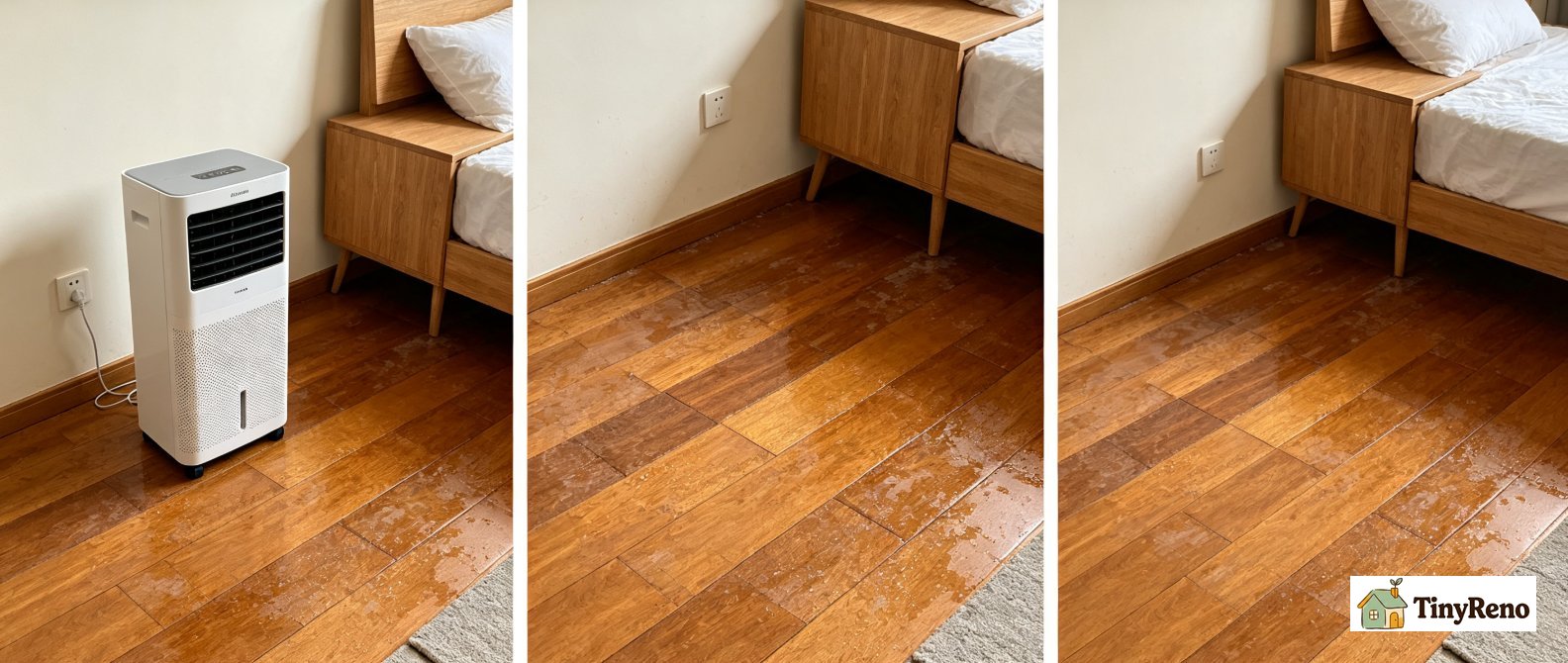
The single biggest mistake people make with water damage to wood floor is treating week 2 as the recovery phase. Week 2 is when the floor either stabilizes or it does not.
If you pulled the baseboards, ran the fans, and mopped, and the floor looked fine by day 7, you are not done. By day 10 to 14, the subfloor starts to release the moisture it absorbed. That moisture migrates back up through the wood planks and causes secondary cupping in places that looked dry on day 7. This is the failure mode that catches most renters. They think the floor is fine, they put the baseboards back, and they call the landlord. The landlord walks through on day 21, sees the new cupping, and charges them for the entire room.
If you want to know whether the floor is actually dry, lift a corner of the worst plank and check the subfloor with a moisture meter. A pin-type moisture meter costs about $30 and is the best $30 you’ll spend on water damage. The subfloor is dry when its reading is within 3 percentage points of a dry section of the same floor. If a dry section reads 6 percent and the wet area still reads 10 percent or higher, the subfloor is still releasing moisture and the cupping will return.
Run the fans and dehumidifier for at least 14 days—I ended up running mine for 18. After that, test the moisture. If the subfloor is dry, refinish the worst spots and put the baseboards back. If it’s still wet, run another week. An extra week of equipment rental costs about $160. Replacing the floor because you stopped too early costs $3,000 to $4,000.
When to Call a Pro (And When to File Insurance)
There are three cases where you call a pro instead of doing the drying yourself.
If the water has been standing for more than 24 hours, the planks are likely separated at the seams, and the subfloor is likely saturated. A restoration company has industrial drying equipment that pulls moisture out of the subfloor faster than a rental air mover can. The cost is $1,000 to $2,500 for the drying phase, but the alternative is replacing the floor.
If the water came from a contaminated source (sewer backup, flood water, pet urine that has been sitting), the subfloor and the planks are a health hazard. A restoration company can disinfect the subfloor and pull out the contaminated planks. Do not try to dry contaminated water damage yourself. You will trap the contamination under the new floor and the smell will come back.
If the insurance claim is going to be more than $5,000, hire a public adjuster. A public adjuster charges about 10 percent of the claim but knows the documentation that adjusters look for. For my $3,000 claim, I did it myself. For the neighbor's $8,000 claim after a similar leak, the public adjuster got them an extra $2,400 that the original adjuster had missed.
For everyone else, this is a $500 to $1,500 problem you can solve in two weeks with a fan, a dehumidifier, a moisture meter, and patience. I saved the floor I’d been living on for two years and plan to live on for ten more. My total out-of-pocket was less than my insurance deductible.


Discussion (0)
Sign in to join the discussion