

Yes, You Can Install Laminate Flooring Over Tile
Can you install laminate flooring over tile was not the question I started with. Can you install laminate flooring over tile is the question that saved my $1,200 demo budget and got my family into our new rental in eight weeks. The question I started with was whether we could move into our new rental in two months without re-tiling the kitchen. The kitchen had 1970s harvest-gold tile that the landlord would not replace and my wife would not live with. The tile guy quoted $1,200 for two days of demo and retile. The move-in date was eight weeks away. I had never installed any floor over any other floor. The Home Depot kid in the flooring aisle said yes, you can install laminate flooring over tile, and here is what you need.
That weekend I laid 220 square feet of click-lock laminate over the existing tile in about 14 hours of work, with one trip back to the store for a transition strip I forgot. The floor has been down for two years, through three toddler birthday parties, one dishwasher leak, and a move-out walk-through. The landlord got his deposit back and asked me how I got the floor so flat. Here is the answer, the three tile types that do not work, and the $200 in tools that did the job.
If you are staring at a kitchen full of tile you do not want to demo and a move-in deadline that does not have room for a contractor, this is the walkthrough I wish I had the Friday before I started.
Why Most Tiles Can Hold Laminate (And the 3 That Can't)
One thing to consider before you buy: laminate flooring is not waterproof. The core is MDF or HDF, and if water gets into the click joints, the core swells and the floor buckles. In a kitchen, the risk is real — a leak under the sink, a dishwasher that overflows, a fridge that defrosts on the floor. If you want the look of laminate with better water resistance, look for SPC (stone plastic composite) or WPC (wood plastic composite) flooring. They cost a little more but they can handle a spill. If you go with laminate, put a waterproof mat under the sink and check the dishwasher hose every six months.
The reason you can install laminate flooring over most tile is that laminate is a floating floor. It does not attach to the subfloor with nails or glue. It clicks together, sits on top of an underlayment, and rests on whatever is underneath. As long as the tile underneath is solid, level, and stable, the laminate will be solid, level, and stable. That is why a homeowner or renter asking can you install laminate flooring over tile usually gets a yes from the flooring aisle, as long as the subfloor passes the tests below.
| Tile type | Can you install laminate over it? | Why |
|---|---|---|
| Standard ceramic or porcelain | Yes | Hard, flat, glued tight to the subfloor |
| Natural stone (marble, slate) | Usually | Same as ceramic, but check for cracking |
| Large-format 18 x 18 or larger | Yes, with leveling | Grout lines can telegraph through thin laminate |
| Cracked or hollow-sounding tile | No | Movement will crack the laminate joints |
| Loose or curling tile | No | Will continue to lift and break the laminate |
| Cushion-backed vinyl tile | No | Too soft, laminate will bounce and separate |
The 3 tile types you cannot install laminate over are cracked tile, hollow tile, and cushion-backed vinyl tile. Cracked tile means the subfloor moved at some point, and the movement will continue to telegraph through the laminate. Hollow tile means the thinset failed and the tile is no longer bonded to the subfloor. Cushion-backed vinyl tile is too soft, and the laminate will bounce when you walk on it, eventually separating at the click joints.
To check for hollow tile, tap every square foot with the handle of a screwdriver. A solid tile sounds like a thud. A hollow tile sounds like knocking on a door. Mark any hollow tile with a pencil. You have three options for those: pull them and reset them with fresh thinset, fill the void with self-leveling compound, or pull them and fill the hole with cement board.
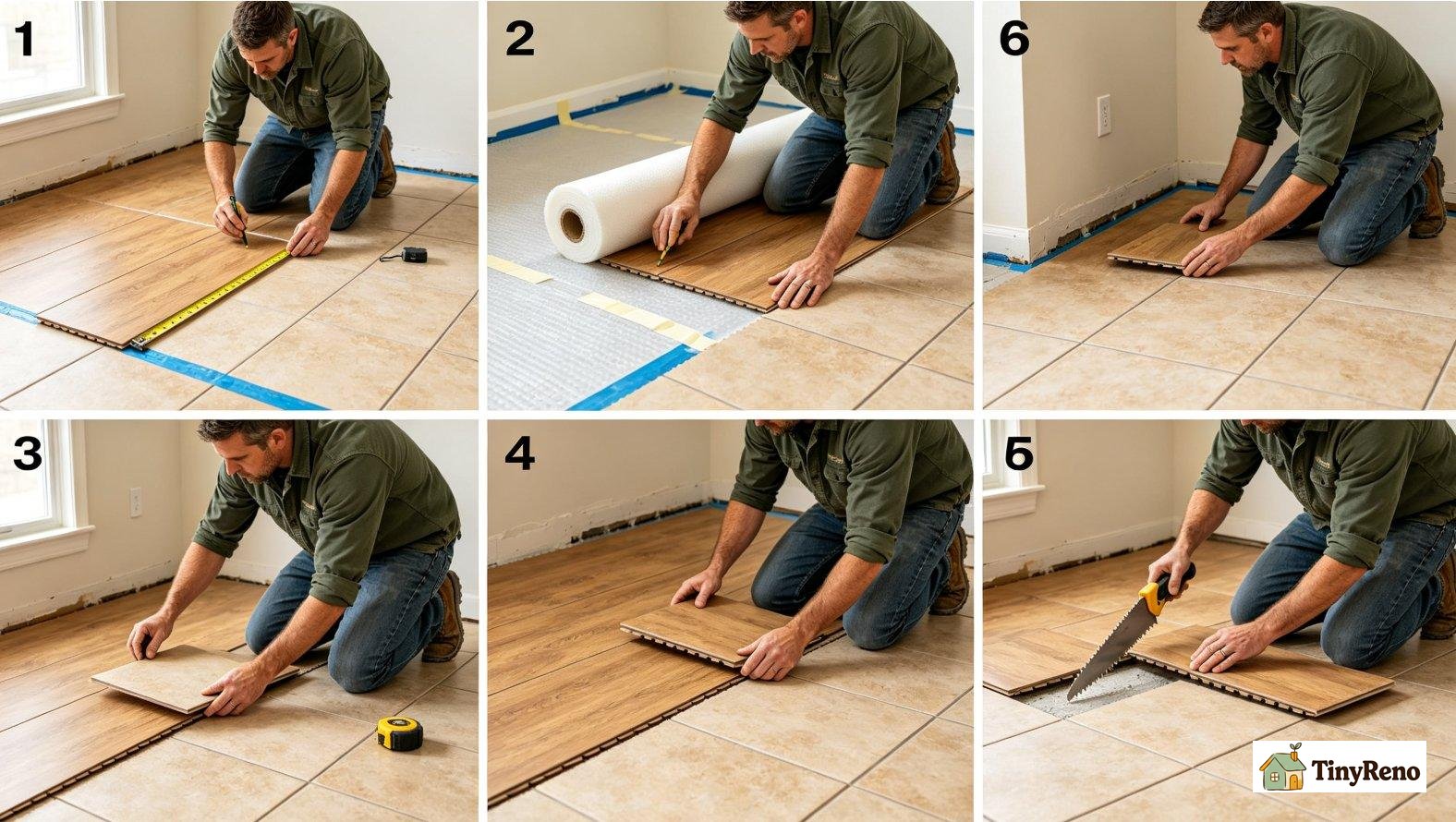
The 6 Steps to Install Laminate Flooring Over Tile
If your tile is solid and level, here is the six-step method that has worked for me on three different kitchens and one bathroom.
- Measure and order 10 percent extra. Measure the room in feet and inches, multiply length by width, add 10 percent for cuts and waste. Order one full extra box of the same dye lot for future repairs. The dye lot changes every production run and matching three years later is almost impossible.
- Install underlayment over the tile. The underlayment is a thin foam pad that goes between the tile and the laminate. On a wood subfloor, you just need the foam. On a concrete or tile floor, you need a foam pad with a built-in vapor barrier — sometimes sold as a "2-in-1" underlayment. The vapor barrier keeps moisture from the concrete from reaching the laminate core. It costs a few dollars more per roll. Don't skip it.
- Start in the corner, work toward the door. Click the first row together against the straightest wall in the room. Use spacers along the wall to maintain a 3/8-inch expansion gap. The gap is what lets the floor expand and contract with humidity. Skip it and the floor will buckle in July.
- Stagger the joints by at least 12 inches. Do not line up the end joints of adjacent rows. A running bond pattern hides the seams and makes the floor look more like real wood. A stack bond pattern (joints lined up) looks like cheap laminate and is more likely to separate.
- Cut around obstacles with a jigsaw, not a circular saw. Door jambs, radiator pipes, and odd corners need a jigsaw with a fine-tooth blade. A circular saw throws chips and dust, and the tear-out will chip the tile underneath. Use a jigsaw, take your time, and sand the cut if the gap is too tight.
The total install time for a 200-square-foot kitchen using this method is about 14 hours of active work spread over a weekend. That doesn't count the 24-hour cure time for the self-leveling compound if you need it, or the 30 minutes you'll spend reading the instructions after you make a mistake. That is a Saturday of full work and a Sunday morning of finishing and trim.
3 Mistakes I Made on My First Laminate-Over-Tile Job
I made three mistakes on my first laminate-over-tile kitchen that you do not have to make.
- Skipping the leveling compound on a high grout line. I had a tile floor with 3/8-inch grout lines, and I figured the underlayment would absorb the difference. It did not. The grout lines telegraphed through the underlayment and showed as bumps in the laminate where every grout line crossed. I had to pull up the floor, trowel self-leveling compound over the entire kitchen, let it cure for 24 hours, and start over. The mistake cost me a full weekend.
- Not pulling the dishwasher before laying the floor. I laid the laminate up to the dishwasher and called it done. The dishwasher sat on the old tile, the floor was 1/2 inch higher than the dishwasher, and I could not pull the dishwasher out without ripping the floor. When I moved out and the next tenant's dishwasher died, the replacement install cost $180 because the installer had to cut the laminate to get the old one out. That $180 came out of the next tenant's pocket, not mine — but it was a problem I created by not pulling the dishwasher before I laid the floor. If you have a dishwasher, pull it before you lay the floor. It's a 20-minute job.
- Forgetting the transition strip at the doorway. I finished the kitchen floor on Saturday night, looked at the threshold to the dining room, and realized I had no transition piece. The tile in the dining room was 1/4 inch higher than my new laminate. Without the strip, anyone stepping from the kitchen to the dining room caught their toe on the edge. The Sunday morning trip back to Home Depot cost me two hours and $28.
The leveling compound mistake cost me a weekend. The dishwasher mistake will cost the next tenant of that apartment a service call. The transition strip mistake was annoying but cheap. All three were avoidable, and all three were in the instructions that I did not read until after I had made them.
Before you buy anything, check your lease. Most leases say "no alterations without written consent," and laying a floating floor in the kitchen is an alteration. I asked my landlord in writing and got a written yes before I started. If your landlord says no, don't do it. If your landlord is unreachable, don't do it. The $719 in materials is cheap compared to a lease violation.
The $200 in Tools That Beat the $1,200 Quote
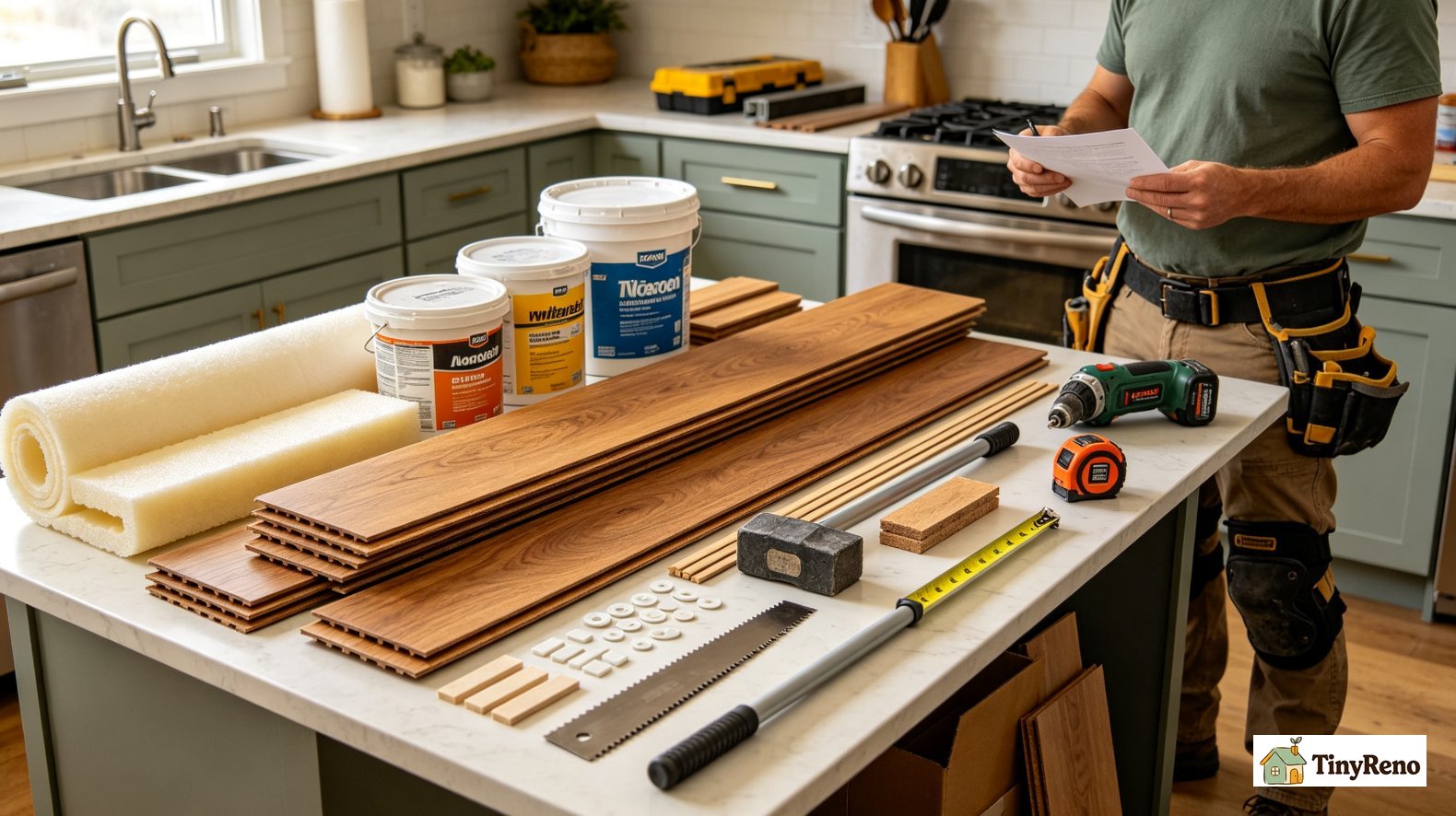
Here is the full list of what I bought for the kitchen floor, with prices that were accurate at my local Home Depot in 2025.
| Item | Cost | Already owned? |
|---|---|---|
| Laminate flooring (220 sq ft + 10 percent waste) | $550 | No |
| Underlayment (220 sq ft) | $45 | No |
| Self-leveling compound (one bag) | $30 | No |
| Transition strip | $28 | No |
| Spacers (24-pack) | $8 | No |
| Tapping block and pull bar | $25 | No |
| Jigsaw blades (3-pack, fine tooth) | $18 | No |
| Tape measure, pencil, utility knife | $0 | Yes |
| Knee pads | $15 | No |
Total spend: $719. Here's the real comparison. The tile guy quoted $1,200 for labor. If I had hired him, I would have paid $1,200 for labor plus $500 to $800 for tile — $1,700 to $2,000 total. The laminate route cost $719 all-in, including materials and tools. The savings was about $1,000 to $1,300. I did not have to do any of that, because I left the tile in place and floated the laminate on top.
The one case where you have to stop and call a pro is if the tile is cracked, hollow, or coming loose. In that case the old tile has to come up before any new floor goes down. That's a different job than what this article covers. The $1,200 quote was for labor only — it didn't include the cost of new tile. If your tile is sound, you don't need that quote. You need $719 and a weekend. Trying to float over a bad tile floor will get you a laminate floor that separates at the click joints within six months and a landlord on the move-out walkthrough who can point to every seam.
For everyone else, can you install laminate flooring over tile is a question with a clear answer: yes, in a weekend, for about $700, and with a floor that will last until you move out or the dishwasher dies, whichever comes first.


Discussion (0)
Sign in to join the discussion