

How to remove coffee from carpet without leaving a ring. That was the question I typed into my phone at 8:14 p.m. on a Tuesday, the night before I had to hand my apartment back to the landlord. I was carrying a full mug of cold brew down the hall, missed the edge of the rug in the living room, and watched an entire cup arc across the off-white wall-to-wall. The landlord was coming at 9 a.m. the next morning. I had 46 minutes before the landlord knocked, and I had no idea how to remove coffee from carpet without making it worse.
That night I pulled up six cleaning videos, called my mom, and made one very small mistake that almost made the stain permanent (more on that in a minute). What follows is the method that got the ring out, the three things most renters do wrong when they try to remove coffee from carpet, and the one case where you should call the landlord before you try anything yourself.
The 40-Minute Coffee Panic
Before I tell you what worked, here is what was happening in my head. The spill was about the size of a dinner plate. I had a white microfiber cloth in the kitchen, baking soda under the sink, white vinegar in the pantry, and a stack of clean towels in the bathroom. I had no Rug Doctor, no Resolve, no carpet cleaning service on speed dial. I had 46 minutes, a security deposit on the line, and one shot to figure out how to remove coffee from carpet before the landlord walked in the door.
The first thing I did was wrong. I grabbed the cloth and rubbed. The stain spread from a dinner plate to a small pizza. That is when I stopped, sat on the floor, and called my mom. She told me to blot, not rub, and to use cold water, not hot. The stain stopped spreading by 8:23 p.m.
What Coffee Actually Does to Carpet Fibers
Coffee is a tannin stain. Tannins are the same family of compounds that make red wine, tea, and soy sauce permanent on fabric. When the liquid hits a fiber, the tannins bond to the dye sites in the carpet, and as the water evaporates, those tannins get concentrated in a ring around the edge of the original spill. That ring is why a 30-second spill leaves a ghost you can see for months, and why most renters who try to remove coffee from carpet on their own end up with a bigger stain than they started with.
The other thing coffee does is carry oils from the roast. On light carpet, that oil dries slightly darker than the surrounding fiber, which is why even a fully cleaned spot can look "off" once it dries. The fix is to lift both the tannins and the oil out of the fiber, not just the visible color. That is also why knowing how to remove coffee from carpet is not just about stain color, it is about residue you cannot see.
The 6-Step Method to Remove Coffee from Carpet (Fresh and Old Stains)
The method below is the full version. On the night before the walkthrough, I didn't have time for the full version. I did steps 1, 2, and 6 — blot, flush, press-dry. That got me through the walkthrough. The next week, I ran the full method on a 12-hour-old ring that had already set. That's when the baking soda paste made the difference. If you have time for all six steps, do all six. If you have 46 minutes, do 1, 2, and 6, and come back to the rest later.
I tested this on the fresh spill that night, and again the following week on a 12-hour-old coffee ring from a mug I missed on the kitchen floor. The fresh spill needed one round of baking soda paste. The 12-hour ring needed two. The difference is how deep the tannins had time to migrate. Same method, slightly different timing. Here is the order that matters most when you remove coffee from carpet.
- Blot, do not rub. Press a dry white microfiber cloth straight down on the spill. Hold it for 10 seconds, lift, move to a clean spot on the cloth, repeat. Rubbing pushes the coffee deeper into the fiber pad and widens the stain. Blotting pulls it up. This is the step most people get wrong when they remove coffee from carpet at home.
- Flush with cold water. Pour about half a cup of cold water directly on the spot. Don't drown the carpet, just enough to dilute what's left. Blot again with a clean part of the cloth. You'll see brown come up. Repeat twice.
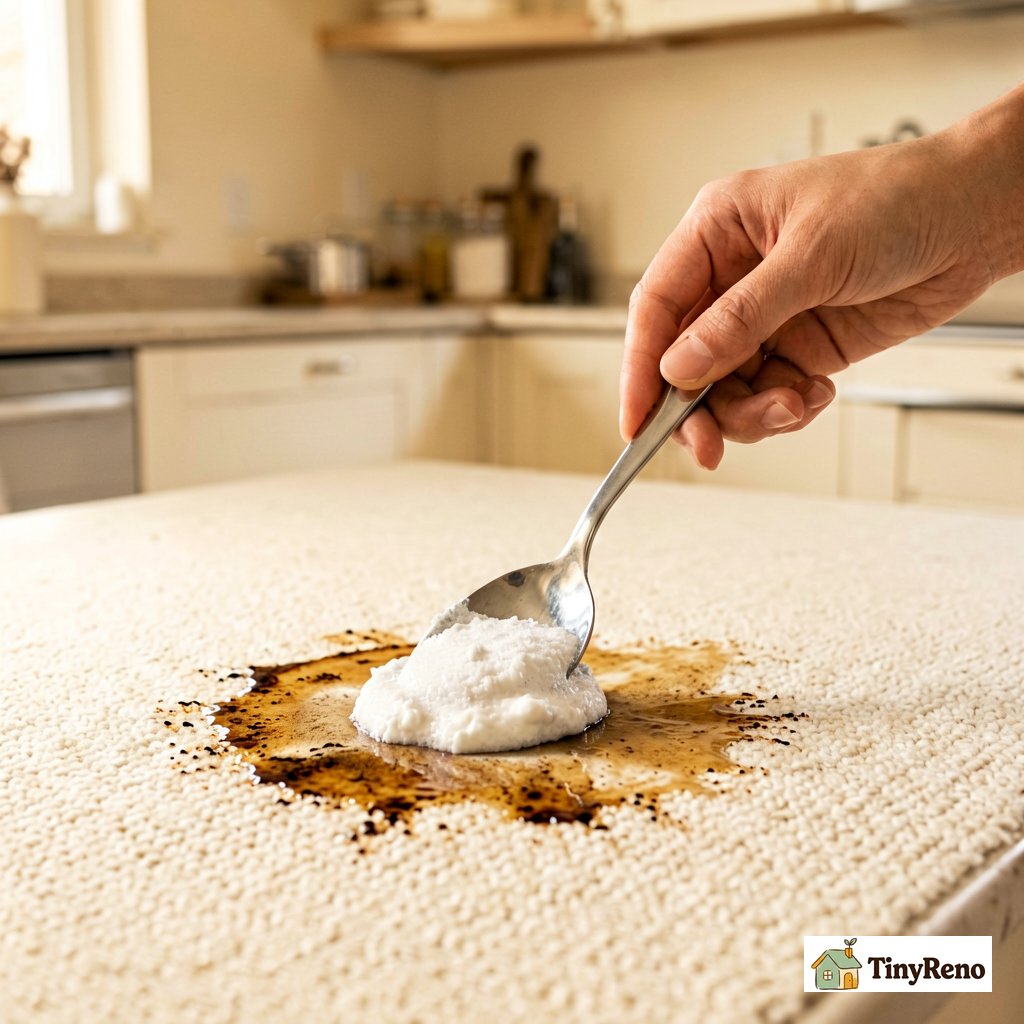
- Apply a baking soda paste. Mix two tablespoons of baking soda with one tablespoon of cold water into a thick paste. Press it into the still-damp spot with a spoon, edge to edge, slightly past the visible ring. Let it dry completely, 30 to 45 minutes. It will pull up residue you couldn't see.
- Vacuum the dried paste. Use the hose attachment, not the beater bar. The beater bar can grind dried baking soda into the fiber. Vacuum slowly, going with the carpet grain.
- Treat what remains with a vinegar solution. Mix one part white vinegar to two parts cold water. Dampen a clean cloth with the mix and press it onto any remaining discoloration. Hold for 60 seconds, then blot dry. Do not pour vinegar directly on the carpet.
- Dry the area flat. Place a dry white towel over the spot and weigh it down with a heavy book. Leave it overnight. Air-drying leaves a water ring. Press-drying does not.
On my 12-hour-old ring, step 3 took two rounds of paste before the residue stopped lifting. On the fresh spill, one round was enough. The difference is how deep the tannins had time to migrate.
3 Mistakes Renters Make That Set the Stain
These are the three calls I took from friends that same week when each of them tried to remove coffee from carpet and ended up with a permanent mark. All three cost a chunk of their deposit, and none of them had to remove coffee from carpet on a 46-minute deadline like I did.
- Using hot water "to clean better." Hot water opens the fiber and sets tannins like an inkjet printer. Cold water keeps the fiber closed and the tannins mobile. Every carpet cleaning guide I have read since lists this as rule one. If you remember nothing else when you remove coffee from carpet, remember this.
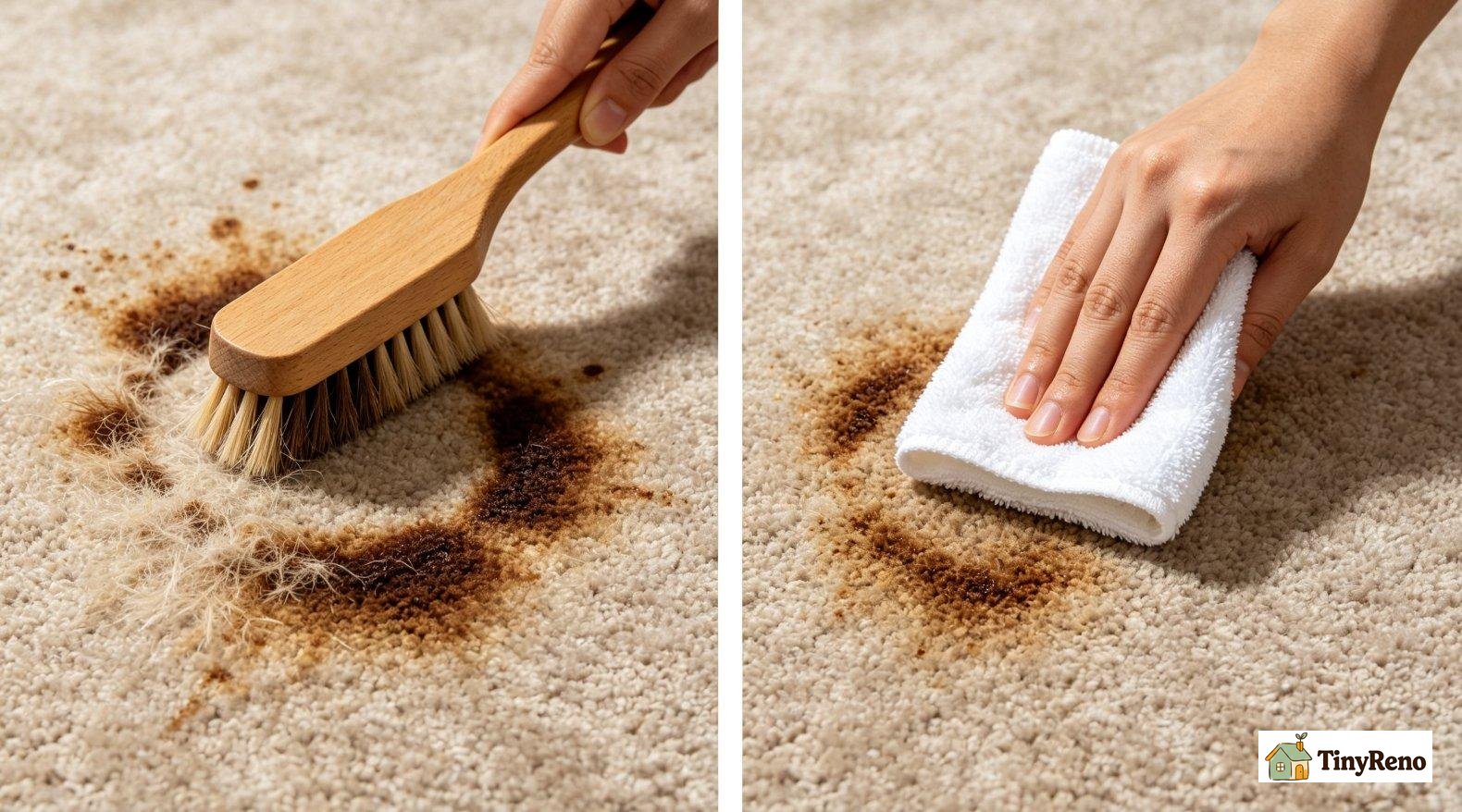
- Scrubbing with a brush. A brush frays the carpet surface and spreads the stain sideways. The spot ends up twice as wide with a fuzzy halo. A cloth and your hand are enough.
- Skipping the press-dry. Letting the spot air-dry is what creates that brown ring around the original spill. The towel-and-book trick is what prevents it.
The mistake I almost made that night was skipping step 3. I had blotted, flushed, and was about to declare victory at 8:38 p.m. Then my mom said, "Did you do the baking soda?" I had not. The paste pulled up another shade of brown I could not see under the room light, and it taught me that most "how to remove coffee from carpet" guides skip the most important step.
When to Skip DIY and Call the Landlord First
Three cases where trying to remove coffee from carpet on your own can cost you more than the stain.
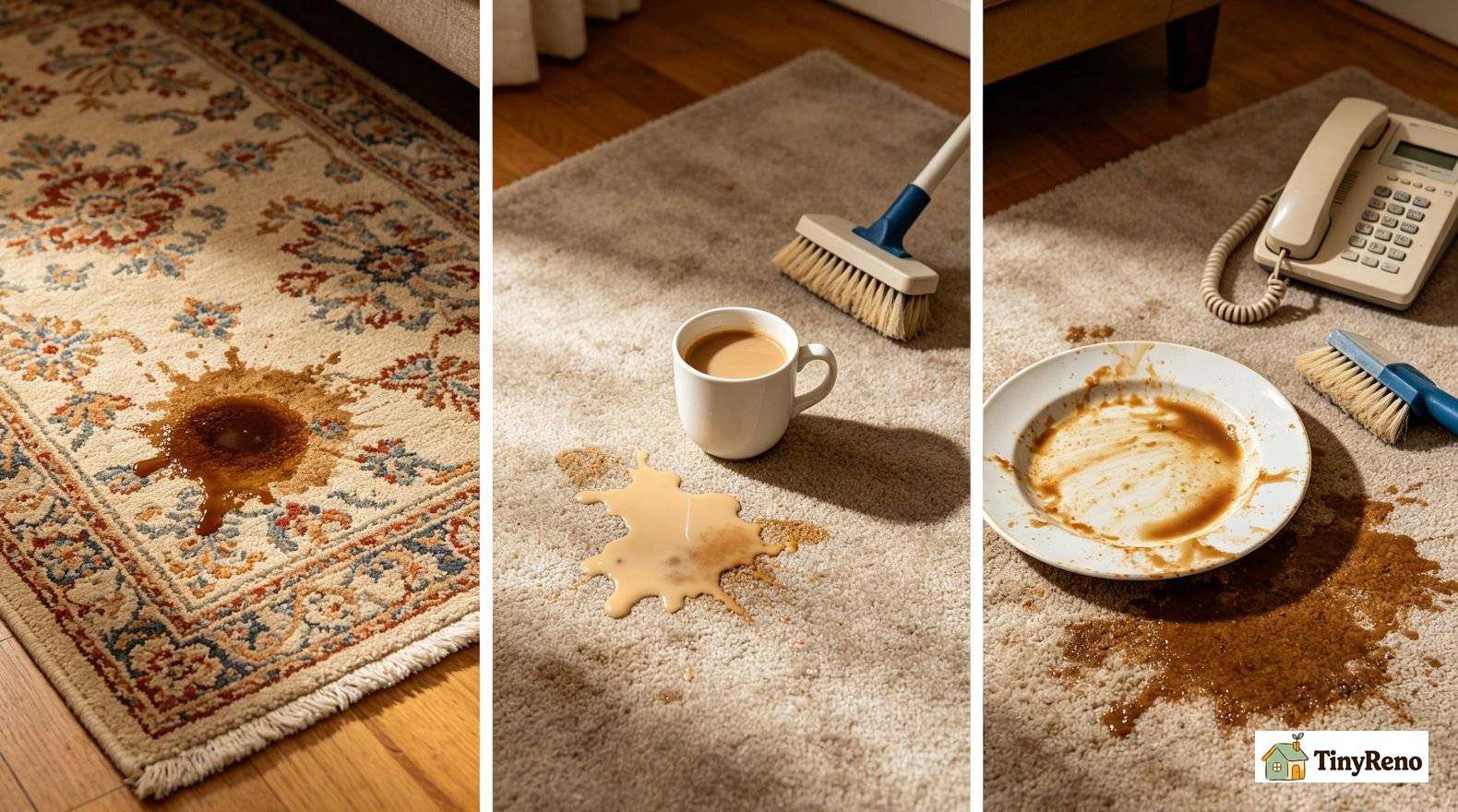
If the spill is on a wool or silk area rug — not the wall-to-wall carpet — stop. Wool and silk react to water and vinegar in ways that can shrink or yellow the fibers permanently. If you rent, check your lease. Some leases list wool rugs as "do not clean" and any damage is an automatic replacement charge. In that case, call a professional before you touch it.
If the coffee had milk, cream, or sugar in it, you are dealing with a protein stain on top of the tannin stain. The baking soda paste alone will not break down the milk proteins. You need an enzyme cleaner, and if you do not own one, a damp cloth with a drop of dish soap works in a pinch. But milk-based spills that sit for more than four hours start to smell, and smell complaints from downstairs neighbors are harder to dispute than a stain.
If the spot is bigger than a dinner plate, the DIY method will get the surface clean but not the pad underneath. The pad will keep wicking old coffee back up into the fiber for weeks. In that case, call a professional and ask if they can do a sub-surface extraction. In my zip code, that runs $90 to $140 for a single room. In a deposit dispute, it is cheaper than losing $300.
For everything else, the six steps above are the method that got my final walk-through to take four minutes instead of forty when I tried to remove coffee from carpet the night before. The landlord pointed at the spot, looked at me, said, "I don't see anything," and handed me the deposit slip. The spot that had looked like a dinner plate at 8:14 p.m. was invisible under normal light. I'm not sure it would have survived a blacklight. But the walkthrough wasn't a blacklight. It was a glance from the doorway. That's the gap the method fills.


Discussion (0)
Sign in to join the discussion