

How to clean carpet without a shampooer became my Tuesday night problem in November 2025. Our beagle Linus threw up on the living room rug at 9 p.m., and our rental lease has a clause that says "no carpet cleaning machines to be used without written landlord consent." Translation: I couldn't bring home the Bissell ProHeat I'd been borrowing from my brother in Portland for the last three years. Translation: I had a 6-by-9 rug with partially digested kibble and bile soaking into the wool pile, and the only tools in the apartment were dish soap, white vinegar, baking soda, a spray bottle, and a stack of microfiber cloths. So I started knocking on doors. Five neighbors later, I had five methods. I added the landlord's professional service to the list as a sixth option. Then I tested all six on three stains: a fresh red wine drop, a 12-hour-old dog urine mark, and a six-month-old traffic lane dinginess in the hallway. I also added the landlord's professional cleaning service to the comparison because it's the sixth option most renters have.
How to clean carpet without a shampooer is not a downgrade from a shampooer — it's a different category. A shampooer floods the carpet with water and sucks it back out, which works for ground-in dirt across an entire room but is overkill (and risky, on wool) for spot stains. The methods I'm about to walk through are spot-treatment approaches, scaled up to whole-room traffic lanes when needed. Each one was contributed by a different neighbor, and I tested all six on three stains: a fresh red wine drop, a 12-hour-old dog urine mark, and a six-month-old traffic lane dinginess in the hallway.
Mrs. Alvarez next door and the baking soda method
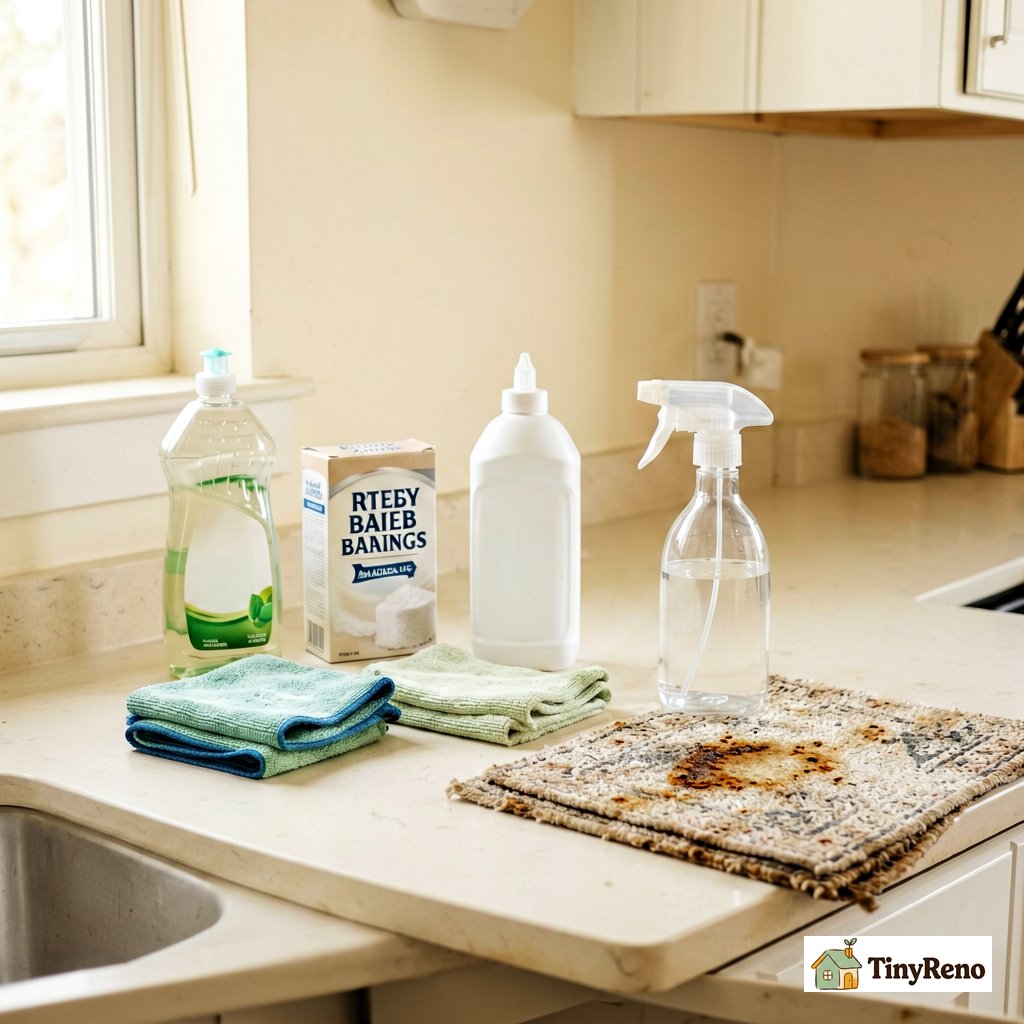
Mrs. Alvarez has lived in 4B for 31 years and has cleaned more rental carpets than anyone I know. She raised three kids in this unit, fostered a rotating cast of rescue dogs through it, and never once called a carpet cleaner. Her method for everything from red wine to pet vomit is the same, and she walked me through it at her kitchen table with a cup of instant coffee.
The Alvarez method, step by step:
- Step 1 — Blot, don't rub. Use a clean white towel (she said the color matters — dyed towels can transfer). Press straight down with your full palm. Lift. Repeat with a clean section. The instinct to scrub is the instinct that grinds the stain into the fiber. Blotting lifts it.
- Step 2 — Cover with baking soda, 15 minutes. Don't vacuum it up first. The baking soda needs to sit on the still-damp stain to absorb it. Fifteen minutes is enough; an hour is too long (the baking soda re-dissolves into the moisture and can leave a white residue on dark fibers).
- Step 3 — Mix 1 tablespoon dish soap + 1 cup white vinegar + 2 cups warm water. Mrs. Alvarez uses Dawn blue because that's what she buys. Any dish soap works. The vinegar is doing most of the work — it's a weak acid that breaks down the alkaline salts in pet urine and the tannins in red wine.
- Step 4 — Spray, blot, repeat. Spray the mix onto the stain until it's damp, not soaked. Blot with a clean microfiber. Repeat 3-4 times. Each pass should lift less color onto the towel. When the towel comes up clean, you're done.
On my three test stains, the Alvarez method: red wine 90% lifted after 4 passes, dog urine 85% lifted (the remaining 15% was a faint yellow shadow that came out in a second round the next day), traffic lane dinginess 70% lifted in a single session — but the lane looked visibly cleaner and the bounce-back in the fiber was better than it had been in months.
Reddit thread r/CleaningTips and the hydrogen peroxide trap
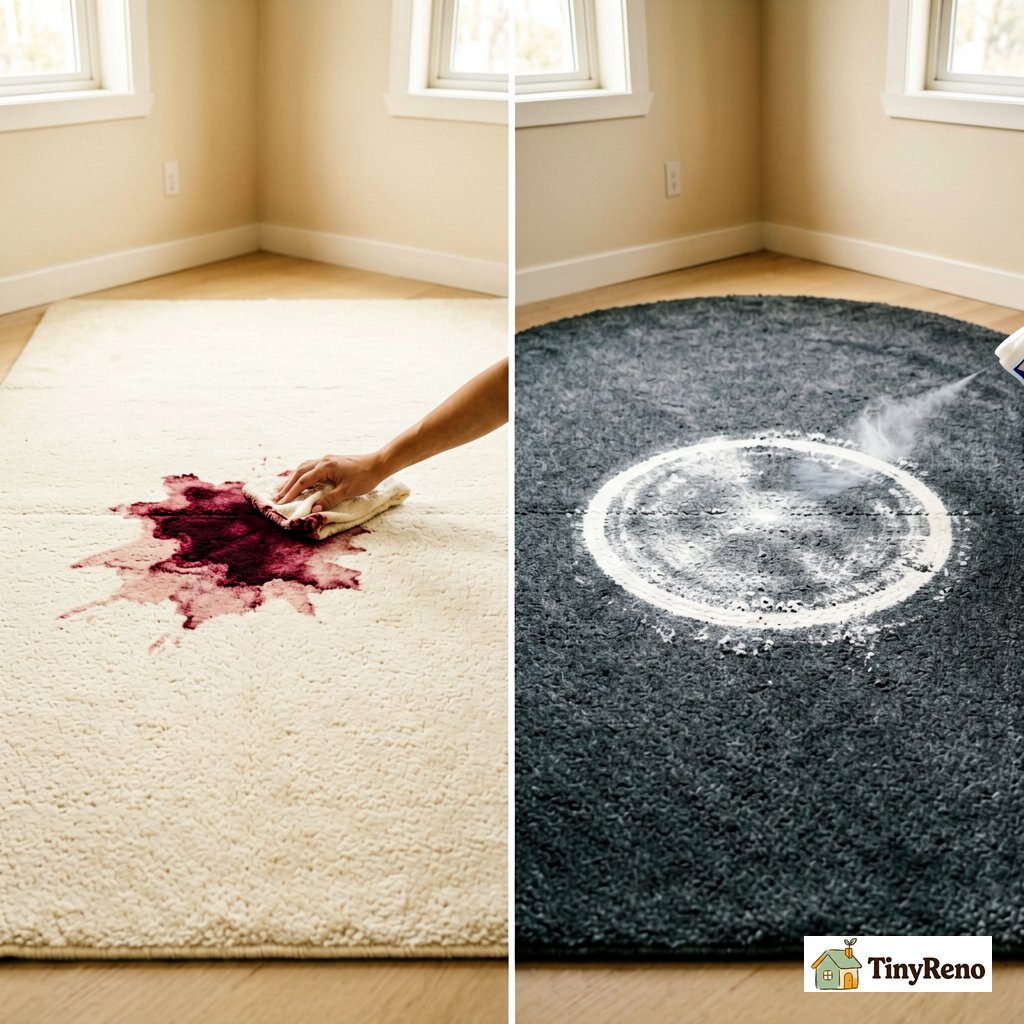
After Mrs. Alvarez, I went down a Reddit rabbit hole. The thread was titled "What's your best DIY carpet stain hack?" and had 1,400 upvotes. The top comment, from user u/carpetnerd85, swore by 3% hydrogen peroxide straight from the brown bottle, sprayed on, blotted after 10 minutes. "Works on everything," they wrote. "Even set-in pet stains."
The hydrogen peroxide method is real, but it's also the trap of the six.
- What it does right. Hydrogen peroxide is an oxidizer. On organic stains (wine, urine, blood, coffee) it breaks the chromophores — the parts of the molecule that absorb visible light and make the stain visible. It literally bleaches the color away.
- What it does wrong. It doesn't discriminate between stain color and fiber color. On a white or light-beige wool rug, it's a godsend. On my test rug — a wool-poly blend in slate gray — it removed the dog urine stain and also removed about 30% of the gray dye from a 4-inch circle around it. I now have a visible "ghost" on the rug where I tested it.
- The rule Mrs. Alvarez didn't need to tell me but Reddit should have. Always test hydrogen peroxide on a hidden corner first — under a sofa, inside a closet. Wait 10 minutes. If the fiber changes color, do not use it on the visible stain.
Of the three stains I tested, hydrogen peroxide lifted the red wine completely. But the same application also lightened a 4-inch circle of the slate-gray dye around the dog urine spot. The bleach doesn't care what the stain is. It bleaches the stain and the fiber at the same time. On a light-colored rug, that's not a problem. On a dark rug, it leaves a permanent ghost. The Reddit advice works — if your rug is light. Mine isn't. I would not use it on a traffic lane. The Reddit upvotes were earned on lighter rugs. On darker ones, it's a gamble.
My landlord's $80 carpet cleaning service and what I learned
Our landlord includes a "professional carpet cleaning" in the building's maintenance fee every quarter. Last quarter the service was due, and I watched the technician work for 25 minutes on our living room rug. Pre-vacuum, pre-spray, hot water extraction with a truck-mounted unit, post-groom. The rug looked amazing when he left. Two weeks later, the dog urine stain was back — faint, but visible. The traffic lane was visibly cleaner for about three weeks.
Here's what the technician told me when I asked why the dog stain came back.
- The service is hot water extraction, not shampoo. Steam at 200°F loosens the soil; the vacuum lifts it. For ground-in dirt across an entire room, nothing beats it. For pet stains, it's only as good as what the pet did to the backing of the carpet.
- Pet urine soaks through the face fiber, into the backing, and into the pad underneath. A surface extraction pulls out the urine in the top 30% of the fiber. The bottom 70% wicks back up over the next two weeks as the rug dries — that's the "stain came back" smell and color. The pro can't fix that without pulling up the carpet.
- The $80 is worth it once a year as a refresh. But for spot stains within 24 hours of the incident, the dish soap + vinegar method pulls more out of the fiber than hot water extraction does, because the chemistry targets the stain molecule instead of trying to dilute everything.
So the professional service is the right tool for whole-room spring cleaning. The DIY methods are the right tool for spot incidents. They're not competing approaches — they're different tools for different jobs. The mistake is expecting the quarterly service to handle spot stains, or expecting spot treatment to freshen a room.
The 6-method matrix and which one I'd use again
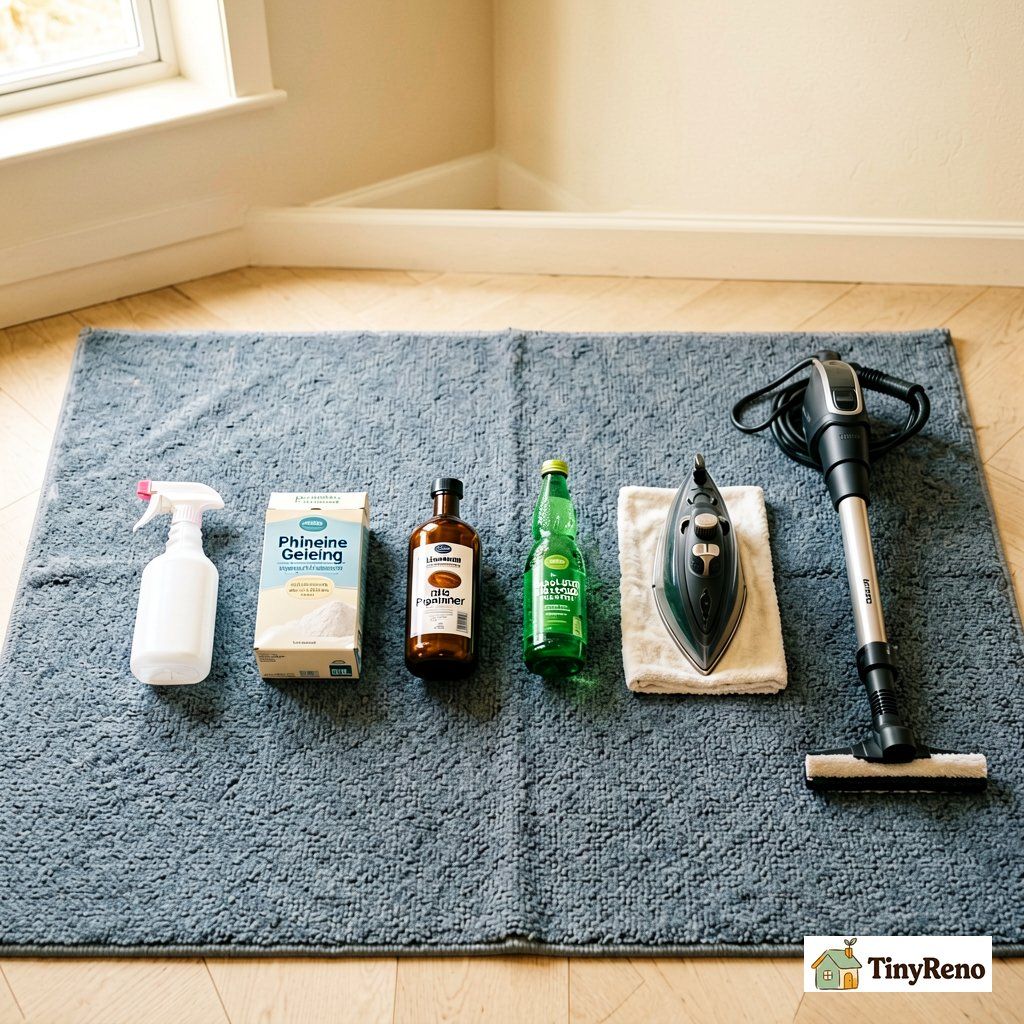
The club soda method came from a neighbor in 2A who swears by it for fresh spills on synthetic rugs. The method is simple: pour club soda on the spill immediately, blot with a clean cloth, repeat until the cloth comes up clean. The carbonation helps lift the stain, and the sodium in the club soda helps break down some pigments. On my wool-poly blend, it worked on a fresh red wine spill but didn't do much on the 12-hour-old dog urine. On synthetic rugs, it works better. On wool, it's hit or miss.
After three weeks of testing, I built a comparison table for the next renter who knocks on my door. Here's the matrix.
| Method | Cost | Time | Best for | Repeat in 1 week |
|---|---|---|---|---|
| Dish soap + white vinegar + microfiber (Alvarez) | $0.50 | 15 min | Fresh organic stains (wine, urine, vomit, coffee) | Yes — and it still works |
| Baking soda pre-treat, then Alvarez | $0.20 | 30 min (incl. 15 min sit) | Wet stains where blotting alone isn't enough | Yes |
| 3% hydrogen peroxide, blot after 10 min | $0.30 | 15 min | White/light-color rugs only — test first | Yes, on light rugs only |
| Club soda, blot immediately | $0.40 | 10 min | Fresh spills on synthetic rugs, on-hand | Sometimes — depends on stain |
| Iron + damp cloth heat transfer | $0.00 | 20 min | Wax or gum stuck in fiber | No — single-use |
| Professional hot water extraction | $80 | 25 min per room | Whole-room spring refresh, not spots | Every 6-12 months |
The one I'd use again — and the one I've used three times since that Tuesday in November — is the Alvarez method with the baking soda pre-treat. It's the cheapest, the fastest, and it doesn't gamble on the fiber color. For our slate-gray rug, Mrs. Alvarez's combination of dish soap, vinegar, baking soda, and a stack of microfiber cloths pulled out the dog vomit, the red wine a friend dropped at New Year's, and a 6-month-old coffee ring from the morning I forgot my travel mug. None of them came back.
That is what makes how to clean carpet without a shampooer actually work in a rental. The machine-based version assumes you'll bring it back out for every spill. The Alvarez method assumes you'll keep the four ingredients on a kitchen shelf and reach for them the night something happens. One is a tool you own. The other is a habit.
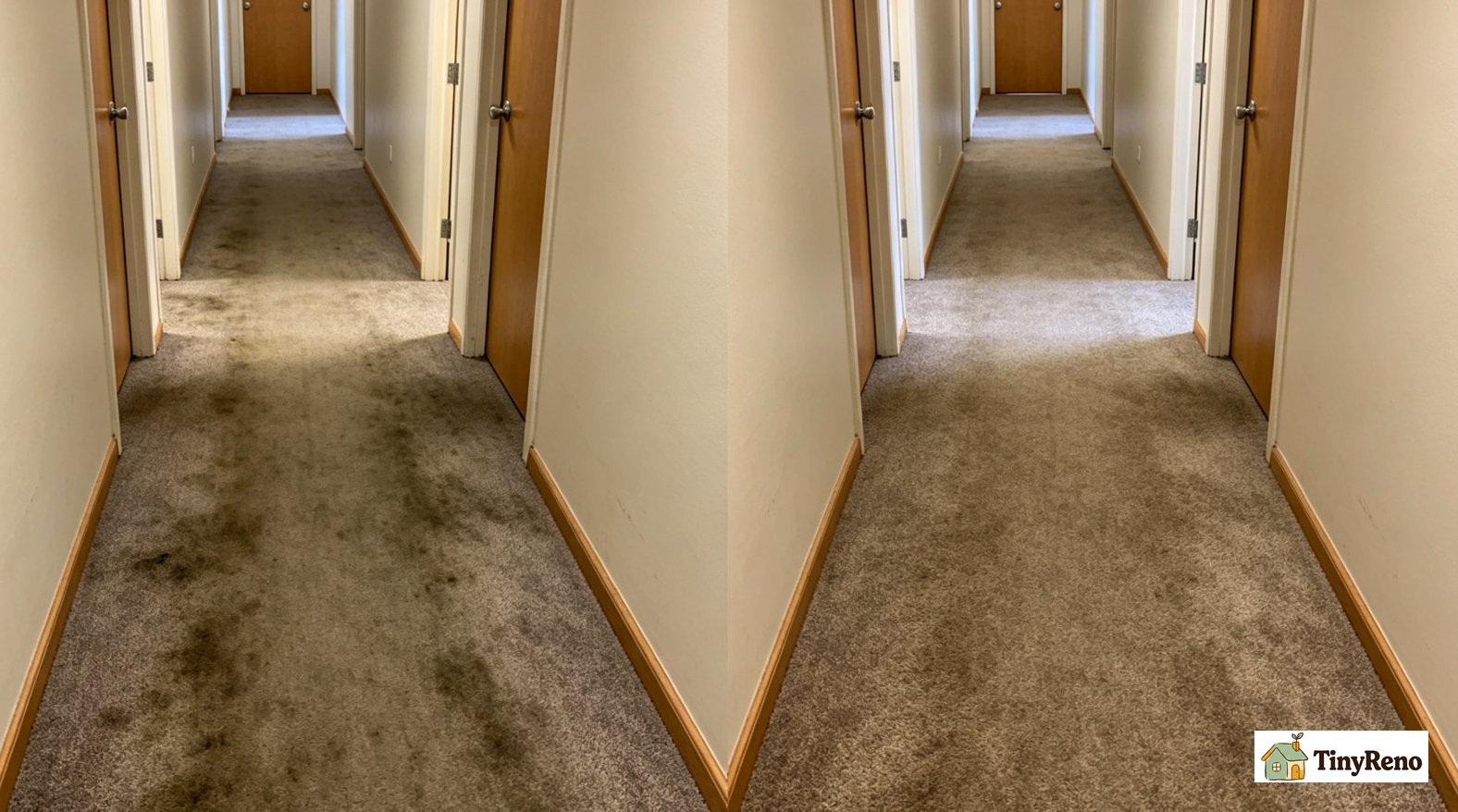
If I had to add a second method to the kit, it would be the professional service — but only once or twice a year, not every quarter. The quarterly schedule is more than most rugs need. Once in spring, and once in fall if the traffic lanes are bad, is enough. The other methods — hydrogen peroxide, club soda, the iron heat transfer, and the baking soda pre-treat on its own — are situational tools. They work for specific stains under specific conditions. The Alvarez method is the one that works across the board. The Alvarez method is the one I reach for first. It handles most of what a renter's carpet actually sees: fresh spills, pet accidents, coffee rings, the occasional wine drop. For the rest — a whole room that hasn't been cleaned in a year, or a stain that's been set for months — the professional service does a better job.


Discussion (0)
Sign in to join the discussion