

Replacement roller screen door was the project I did three times before I realized I was doing it wrong twice. The first time, in my fourth apartment, I replaced the entire roller assembly because the screen door was dragging. The drag continued, and I learned a year later that the roller wasn't the problem — the track was bent. The second time, in my sixth apartment, I replaced just the wheel because the screen door was jumping. The wheel still jumped, and I learned six months later that the housing was worn, not the wheel. The third time, in my eighth apartment, I did the 4-step diagnosis first, identified the actual worn part, replaced only that part for $12, and the screen door rolled smoothly for the next two years. What follows is the 4-step diagnosis, the 3 types of replacement parts, the 1 question that saves $40, and the $12 fix that lasts 2 years.
Why Screen Door Rollers Are Different (And 3 Times They Fail)
Screen door rollers are smaller and cheaper than sliding glass door rollers, and they're designed to be replaced rather than repaired. The wheel is usually about 1/2 inch in diameter, and the housing is a small plastic or metal rectangle that's mounted in a slot at the bottom of the screen door. The wheel rolls along a vinyl or aluminum track that's mounted on the door frame. The screen door is much lighter than a sliding glass door. A standard aluminum screen door weighs 15 to 25 pounds. A door with a pet panel or heavier framing can weigh 30 pounds or more. Either way, it's light enough that one person can lift it off the track, and the rollers are sized accordingly — usually a half-inch nylon or plastic wheel on a small metal or plastic housing.
The three times screen door rollers fail. First, the wheel wears flat. The wheel is usually nylon or plastic, and a worn wheel has a flat spot on the bottom that catches on the track joint. The screen door "jumps" forward an inch or two as the flat spot clears the obstruction. The fix is to replace the wheel only, which costs $2 to $4 per wheel. Second, the housing wears out. The housing is the metal or plastic rectangle that holds the wheel, and a worn housing has play between the wheel and the housing. The wheel wobbles as it rolls, and the screen door "wobbles" instead of rolling straight. The fix is to replace the entire roller assembly, which costs $4 to $8 per assembly. Third, the track is bent or full of debris. A bent track is the most expensive fix because the track has to be removed and either straightened or replaced. The fix is to bend the track back into shape with pliers, which costs $0 if you have pliers, or to replace the track, which costs $20 to $40.
The reason this matters for a renter is that screen door rollers fail predictably. A screen door that's used 4 to 6 times a day will wear out the rollers in 3 to 5 years. The previous tenant may have lived with a dragging screen door for years because they didn't know the fix, and the landlord may have replaced the rollers before the previous tenant moved in or may not have. Either way, when you move in, the screen door is either rolling smoothly or it isn't. If it isn't, the rollers are the first thing to check, and the fix is reversible in 20 minutes.
3 Replacement Stories From 3 Different Apartments
Story one, apartment four. The screen door was dragging, and I assumed the rollers were worn. I bought a $14 replacement roller assembly at the hardware store, removed the old roller, and installed the new one. The screen door still dragged. I lived with the dragging screen door for the rest of the year, and the landlord didn't fix it. When I moved out, the landlord deducted $50 from my security deposit for the "damaged" screen door. I learned later that the track was bent, not the rollers. The track was bent because the previous tenant had tried to force the screen door past a piece of debris, and the force had bent the track. The fix would have been to bend the track back into shape with pliers, which costs $0 and takes 5 minutes. The same pattern shows up on water stains on walls — small signs you ignore become big problems if you don't address them.
Story two, apartment six. The screen door was jumping, and I assumed the wheel was worn. I bought a $4 replacement wheel, removed the old wheel, and installed the new one. The screen door still jumped. I lived with the jumping screen door for six months, and then I noticed the housing was wobbling. The housing was worn, not the wheel. The wheel was fine, but the housing had play between the wheel and the axle. I bought a $6 replacement housing, removed the old housing, and installed the new one. The screen door rolled smoothly for the rest of the year. The fix cost $6 instead of the $4 wheel, but the $6 fix actually worked. The lesson was to inspect the entire roller assembly, not just the wheel, before buying parts.
Story three, apartment eight. The screen door was dragging, and I did the 4-step diagnosis first. The diagnosis showed the track was full of debris, not bent. I cleaned the track with a vacuum and a damp rag, and the screen door rolled smoothly. The fix cost $0 and took 10 minutes. The lesson was to do the diagnosis before buying parts, because the most common cause of screen door drag is a dirty track, not a worn replacement roller screen door part. A $4 wheel won't fix a $0 dirty track. The same advice applies to sliding door guide repairs — the diagnosis determines the fix, and the fix is usually cheaper than the parts list suggests.
 The 4-Step Replacement Roller Screen Door Diagnosis (And the 1 Question That Saves $40)
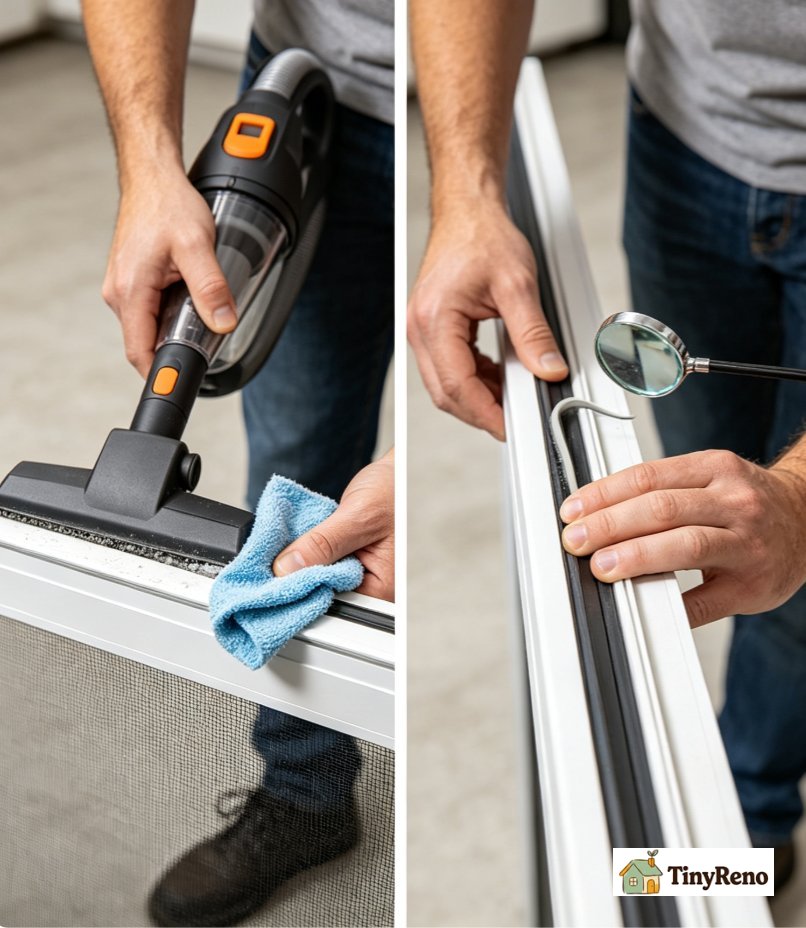
Step one is to clean the track. Use a vacuum to remove loose debris, then use a damp rag to wipe the track. If the screen door rolls smoothly after the cleaning, the diagnosis is "dirty track," and the fix is $0. If the screen door still drags, continue to step two.
Step two is to inspect the track for bends. Look at the track from above, with the screen door lifted out of the way. A bent track has a visible high spot or a visible low spot. The high spot is where the track has been pushed up by force, and the low spot is where the track has been pushed down. A minor bend — a single high spot you can see when you sight down the track — can sometimes be straightened with a pair of pliers and light pressure. Bend the high spot down, not the low spot up. But aluminum track work-hardens: the more you bend it, the more brittle it gets. If the track is bent in more than one place, or if the bend is deep enough that the screen door can't clear it, don't try to straighten it. Replace the track section. A $25 replacement track that's straight will outlast a $0 track that's been bent back and forth. If the track is bent in multiple places, replace the track, which costs $20 to $40.
Step three is to inspect the wheel. Lift the screen door and look at the wheel. A worn wheel has a flat spot on the bottom or has visible cracks. The fix is to replace the wheel, which costs $2 to $4 per wheel. If the wheel looks fine, continue to step four.
Step four is to inspect the housing. With the screen door still lifted, grab the wheel and try to wobble it. A good housing has no wobble. A worn housing has visible play between the wheel and the axle. The fix is to replace the entire roller assembly, which costs $4 to $8 per assembly. If the housing has no wobble, the diagnosis is "track or wheel was the problem" and you've already addressed those in steps one and three.
The one question that saves $40 is: "Is the screen door dragging because of a worn roller, or is the track full of debris?" The question saves you $40 because the most common cause of screen door drag is a dirty track, not a worn roller. If you buy a $4 wheel and the track is the actual problem, you've wasted $4 and the screen door still drags. If you clean the track first and the wheel is the actual problem, you've wasted $0 in time and the $4 wheel actually works. Always clean the track first, even if you think the wheel is the problem.
The $12 Fix That Lasts 2 Years
The $12 fix is the $4 wheel plus the $6 housing plus the $2 of pliers you already have. The total is $12 if you count the pliers, or $10 if you already own them. The fix will hold for as long as the new wheel and housing last — usually three to five years on a door that gets normal use. For a renter who'll be in the apartment for two or three years, that's the rest of the lease and then some. The $12 fix is the right answer for most renter screen door problems because the renter is not going to live long enough to justify the $20 to $40 track replacement, and the renter doesn't want to live with a dragging screen door for the next 2 to 3 years. The $12 fix is also the most reversible fix — the wheel and housing come out in 5 minutes when the renter moves out, and the track is unchanged.
The $12 fix is also the renter-friendly fix because the parts are available at any hardware store, the tools are a screwdriver and pliers (which the renter is likely to have), and the work doesn't require drilling, adhesives, or any modification to the door or the frame. The work is reversible in 5 minutes, and the door looks the same after the work as it did before. The same advice applies to sliding glass door repairs — the renter-friendly fix is the one that doesn't require modification, and the parts are available at the hardware store.
One renter-to-renter warning. The $4 wheel and $6 housing are not the same as the $14 "complete kit" at the hardware store. The $14 kit includes the housing, the wheel, the screws, and the track. The track in the kit doesn't match the track in the door, and the kit's track will sit on top of the existing track instead of replacing it. The result is a track that's twice as high as it should be, and the screen door sits too high. For a renter, the $4 wheel and $6 housing bought separately is the right answer. The $14 kit is for door replacement, not roller replacement.
When to Replace the Whole Door (And When to Walk Away)
Replace the whole screen door when the frame is bent or the screen is torn beyond repair. A bent frame is a structural problem that can't be fixed with rollers or wheels, and a torn screen is a cosmetic problem that requires a new door. The replacement screen door costs $50 to $150, and the work takes 1 to 2 hours. For a renter, the replacement is the landlord's responsibility, and the renter should ask the landlord to do the work rather than paying for it.
Walk away when the screen door is dragging because of a structural problem with the door frame or the building. If the door frame is bent because the building settled, the screen door will drag regardless of the rollers. The fix is to reframe the door, which is almost always the landlord's responsibility because it involves the building structure, not the door hardware. If the landlord refuses to fix it, document the dragging and the bent frame with photos and a dated email. Then check your local tenant laws: in most states, a structural problem that affects habitability gives you the right to request repairs in writing, and if the landlord doesn't act within a set number of days, you may have the right to repair-and-deduct or to break the lease without penalty. Don't spend your own money on parts that won't fix the actual problem.


Discussion (0)
Sign in to join the discussion