

Patio door roller is the term I used for 8 years before I realized it covers four different products. The first time I went to the hardware store to buy a replacement, I expected to find one shelf with one kind of roller. What I found was an entire aisle with 12 different boxes, each with a different part number, each marked "patio door roller," each priced between $4 and $40. The clerk told me to "match the brand," but the brand on the door was a sticker that had been painted over, and I couldn't read it. I bought the cheapest one, brought it home, and it didn't fit. What follows is the four types I tested across three patio doors, the three signs you actually need a new roller, the one type to skip, and the one renter hack that works when you can't match the brand.
The 3 Signs Your Patio Door Roller Is Worn
The first sign is drag. A new patio door rolls with one finger, and a worn patio door takes two hands. The drag is most noticeable at the start of the roll, when the door has to overcome the static friction of the worn wheel sitting in the track. If the door rolls freely once it's moving but is hard to start, the rollers are worn but not flat. If the door drags the entire length of the track, the rollers are flat or the track is full of debris. Clean the track first. If the drag continues, the rollers are flat.
The second sign is jumping or skipping. A worn wheel has a flat spot on the bottom, and as the door rolls, the flat spot catches on the track joint or on a piece of debris. The door "jumps" forward an inch or two as the flat spot clears the obstruction. The jumping is annoying and it gets worse over time. By the time the door is jumping 6 to 8 times per roll, the rollers need to be replaced. The same pattern shows up on discolored walls in apartments — small signs you ignore become big problems if you don't address them.
The third sign is the door sitting lower on one side than the other. A worn roller compresses more than a new roller, and the door tilts. The tilt is usually visible at the top of the door, where the gap between the door and the frame is wider on the worn side. The tilt also means the door doesn't seal against the frame on the worn side, and air leaks in around the door. If the door is tilted and the air leak is cold, the rollers are the most likely cause. Adjusting the rollers may bring the door back to level, but if the adjustment screw is at its maximum, the rollers are worn and need to be replaced.
The 4 Patio Door Roller Types (And What Each Costs)
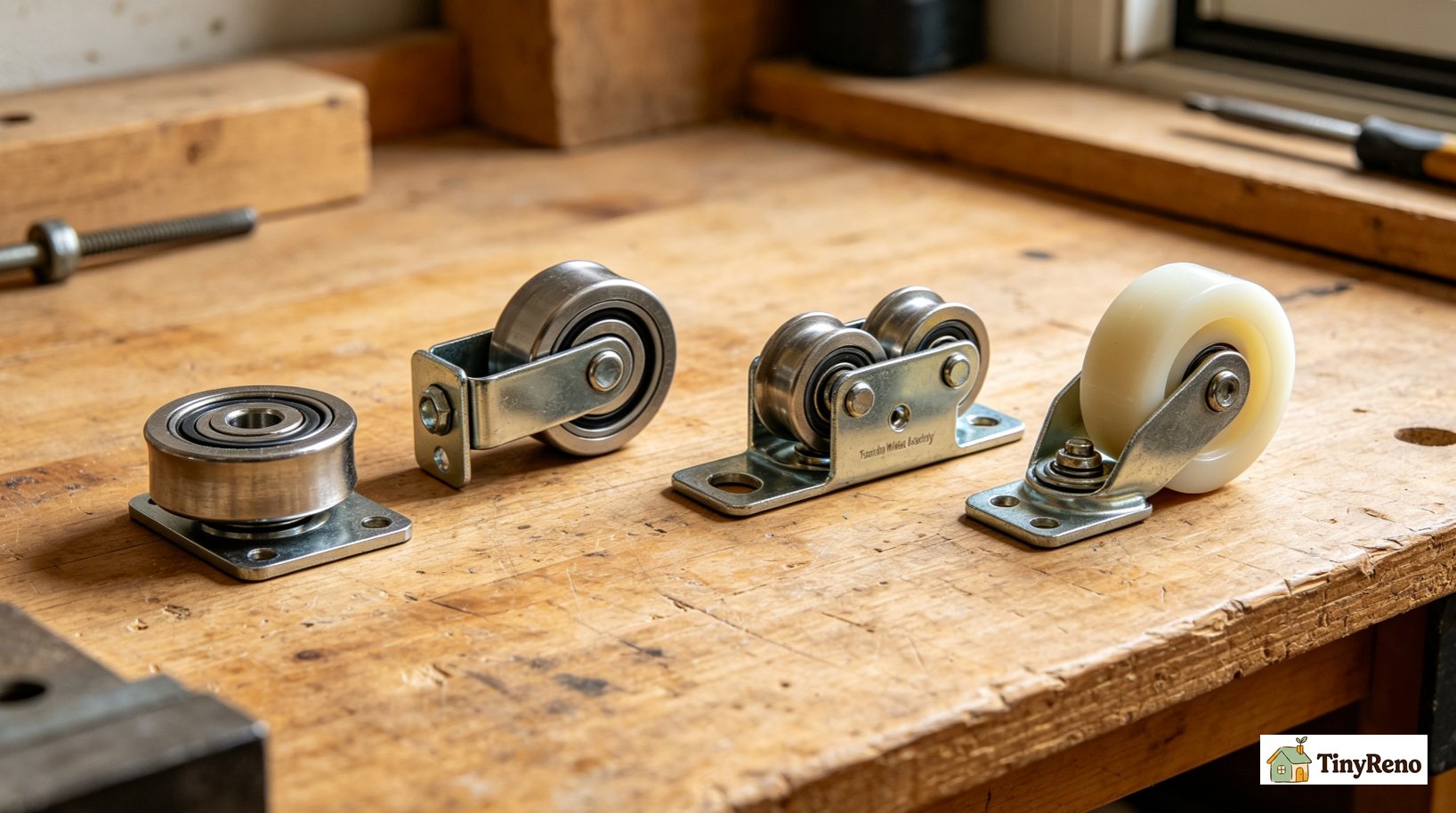
There are four common roller types for patio doors. They differ in the material (steel vs. nylon), the bearing type (plain vs. sealed ball bearing), and the number of wheels (single vs. tandem). Here's what each one is for.
Type one is the standard steel wheel with a plain bearing. This is the most common one, and it's what comes with most builder-grade patio doors from the 1990s and 2000s. The steel wheel is durable, the plain bearing is quiet, and the cost is $4 to $8 per wheel. The downside is that the plain bearing requires periodic lubrication, and a renter who doesn't lubricate will see the wheel seize in 10 to 15 years. For a rental where you might not live long enough to worry about long-term maintenance, the plain bearing steel wheel is the right choice.
Type two is the steel wheel with a sealed ball bearing. This is the upgrade choice for higher-end patio doors, and it's the choice for doors that get heavy use (4+ times a day, or with kids who play with the door). The sealed ball bearing means the wheel doesn't need lubrication, and the steel wheel handles debris in the track better than a nylon wheel. Cost is $12 to $20 per wheel. The downside is that the sealed bearing can fail if water sits in the track, and a renter who doesn't control the weather can't prevent the track from getting wet.
Type three is the tandem wheel assembly. This is two wheels stacked on the same axle, and it's the choice for heavy patio doors (over 250 pounds) or for doors that are dragging because the original single wheel didn't have enough surface area. The tandem wheel is overkill for most renter doors but is the right answer if the door weighs more than 250 pounds or if the original single wheel wore a flat spot in less than a year. Cost is $18 to $30 per wheel.
Type four is the nylon wheel. The nylon wheel is the quietest of the four, and it's the choice for patio doors that are part of a bedroom or living area where noise matters. The nylon wheel doesn't have a bearing at all — the wheel spins on a metal axle, and the friction between the wheel and the axle is low enough that the wheel rolls freely. Cost is $3 to $6 per wheel. The downside is that the nylon wears down faster than steel, and a single piece of gravel in the track can flatten a nylon wheel in months. For a renter where the track may not be perfectly clean, the nylon wheel is the safe choice — but if the track is dirty, the nylon wheel will fail faster than the steel wheel.
The same logic applies to water stains on the wall — the right product depends on the surface, and the shelf doesn't always tell you which surface the product is for. The hardware store doesn't mark which roller is best for which door.
How to Match the Roller to Your Door Brand
Most patio door rollers are not universal — they fit specific door brands. The brands I see most often in rentals are Andersen, Pella, Marvin, Milgard, and Jeld-Wen. There's also a large number of no-name builder-grade doors that don't have a brand at all. If your door doesn't have a brand sticker, the housing pattern is the only way to match it. Each brand has a different roller housing, and the housing has to match the slot in the door. The way to identify the brand is to look at the door's top corner — there's usually a small sticker or stamped logo. The brand may be painted over, but the stamp is usually visible if you look at the corner of the door from the inside.
If you can't find the brand, the next step is to remove one of the existing rollers and bring it to the hardware store. The clerk can match the housing pattern to a replacement. The match has to be exact — the housing has to fit the slot in the door, and the wheel diameter has to match the track height. If the clerk can't match it, the online retailers have cross-reference charts that match the housing pattern to a replacement. The online price is usually half the hardware store price, but the shipping takes 3 to 5 days.
If you can't remove the existing roller (because the screws are stripped or the housing is seized), the last resort is to measure the housing and the wheel. The housing is usually 1 inch wide by 3 inches long, and the wheel is usually 1 to 1.5 inch diameter. The measurement is enough to narrow down the replacement to 2 or 3 options, and the cross-reference chart at the hardware store will identify the right one. For a renter, this is the slowest path, but it's the only path when the door is older than 20 years and the brand is no longer in production.
So how did I finally match mine? I did what the article says: I removed one of the old rollers, brought it to the hardware store, and the clerk matched the housing pattern to a replacement. It took three trips — the first roller I bought didn't fit, the second was the wrong wheel diameter, and the third was right. The lesson wasn't that the hardware store is unreliable. The lesson was that I should have brought the old roller with me on the first trip instead of trying to match by brand alone.
The 1 Type to Skip (And the 1 Renter Hack That Works)
The one type to skip is the "universal fit" roller that doesn't match a specific brand. These are usually low-quality wheels with a housing that has to be filed or sanded to fit the door. The filing introduces metal shavings into the track, and the shavings wear the new wheel down in months. The price is lower than a matched roller, but the lifespan is shorter. A universal-fit roller that costs $4 might last two years. A matched roller that costs $15 might last ten. The cost per year of use is actually lower for the matched roller, even though the upfront price is higher. For a renter, the universal fit is not worth the savings.
The one renter hack that works when you can't match the brand is to upgrade to a sealed bearing steel wheel that's slightly larger than the original. The sealed bearing wheel is the same diameter as the original, and the slightly larger wheel accommodates a wider track or a worn housing. The fit is not perfect, but it's close enough to roll. The wheel will last 8 to 10 years instead of 12, but for a renter who'll be in the apartment for 2 to 3 years, 8 to 10 years is plenty. The same advice applies to door handle repair kits — the generic part is good enough for a renter who won't be there long enough to see it fail.
When to Call the Landlord (And What to Ask For)
A worn one is the landlord's responsibility under most leases. The argument is that the rollers are a wear part, and the landlord is responsible for wear parts. The rollers are not something the renter caused — they wore out from use, and the renter is using the door the way the door is meant to be used. If the landlord argues, the renter can point out that the door was working when the previous tenant moved out (or was it?), and the rollers are now worn, and the wear happened during the tenancy.
What to ask for. The landlord should pay for the parts and either send a handyman or allow the renter to do the work. If the landlord sends a handyman, the parts and labor are on the landlord. If the renter offers to do the work, the right ask is reimbursement for the parts, not a rent reduction. Get the landlord's agreement in writing before you buy anything. If the landlord refuses to pay for the parts, don't do the work — the roller is a wear part, and wear parts are the landlord's responsibility in most leases. Doing the work without written approval can be treated as an unauthorized modification, even if you're fixing something that was already broken. The parts cost is usually $8 to $30. If the landlord agrees to reimburse the parts, that's a fair outcome. If the landlord agrees to a rent reduction for your time, that's generous. But don't expect the rent reduction — the landlord's obligation is to cover the parts, not to pay you for your labor.


Discussion (0)
Sign in to join the discussion