

How to change rollers on sliding glass door was the project that finally taught me that a sliding door is basically a heavy piece of glass on four tiny wheels. Most residential patio doors weigh between 150 and 250 pounds, depending on the size and glass thickness. A 6-foot door with standard glass is usually around 150 to 180 pounds. An 8-foot door with double-pane glass can be over 250 pounds. If you're not sure how heavy yours is, assume it's heavier than you think, and get a second person. Two people lifting a 180-pound door is easy. One person lifting a 180-pound door is how people get hurt, and the wheels are the entire mechanism. The first time I tried to fix a dragging patio door in my third apartment, I thought I needed to adjust the track. I spent an hour cleaning the track with a vacuum and a toothbrush, and the door still dragged. The second time, in my fifth apartment, I assumed the door was warped from age. It wasn't warped. The rollers were flat. The third time, after watching a 14-minute YouTube video and ordering a $14 set of rollers online, I learned the actual fix. What follows is the five steps I'd do now, the four roller types I tried across three different doors, the one tool you actually need, and the one step most people skip that determines whether the door actually rolls or just sits there.
Why Sliding Glass Door Rollers Fail (And the 3 Signs You Need New Ones)
Sliding glass door rollers are typically 1 to 1.5 inch diameter wheels made of nylon, steel, or a ball-bearing assembly. The wheels sit in a metal housing that's mounted in a slot at the bottom of the door. The slot is accessible from the side of the door, and the housing has an adjustment screw that lets you raise or lower the door without removing the housing. The wheel rolls along an aluminum or vinyl track that's mounted on the floor or threshold. When the wheel is new, the door rolls with one finger. When the wheel is worn, the door takes two hands and a prayer.
The three signs that mean you need new rollers rather than just a track cleaning are: the door drags even after the track is clean and the wheels are visibly shiny but the door still won't roll; the door sits lower on one side than the other, meaning one wheel is compressed more than the other; and the door makes a clicking or grinding sound as it rolls, meaning the wheel bearing has failed. In all three cases, the fix is to replace the rollers, not to clean the track. The track cleaning is a maintenance step that extends the life of the rollers, but it doesn't fix a worn roller.
The reason this matters for a renter is that the rollers are a wear part, and they fail predictably. The lifespan of the rollers depends on the type of wheel and how clean the track stays. Nylon wheels on a clean track typically last 5 to 8 years. Steel ball bearing wheels can last 10 to 15 years. If the track has grit or sand in it, both types wear out faster. A door that gets used 10 times a day will wear out its rollers sooner than a door that gets used twice a day. There's no single number that fits every door. The previous tenant may have lived with a dragging door for years because they didn't know the fix, and the landlord may have replaced the rollers before the previous tenant moved in or may not have. Either way, when you move in, the door is either rolling smoothly or it isn't. If it isn't, the rollers are the first thing to check, and the fix is reversible in 30 minutes.
The 5-Step Renter Install (With the 1 Step Most People Skip)
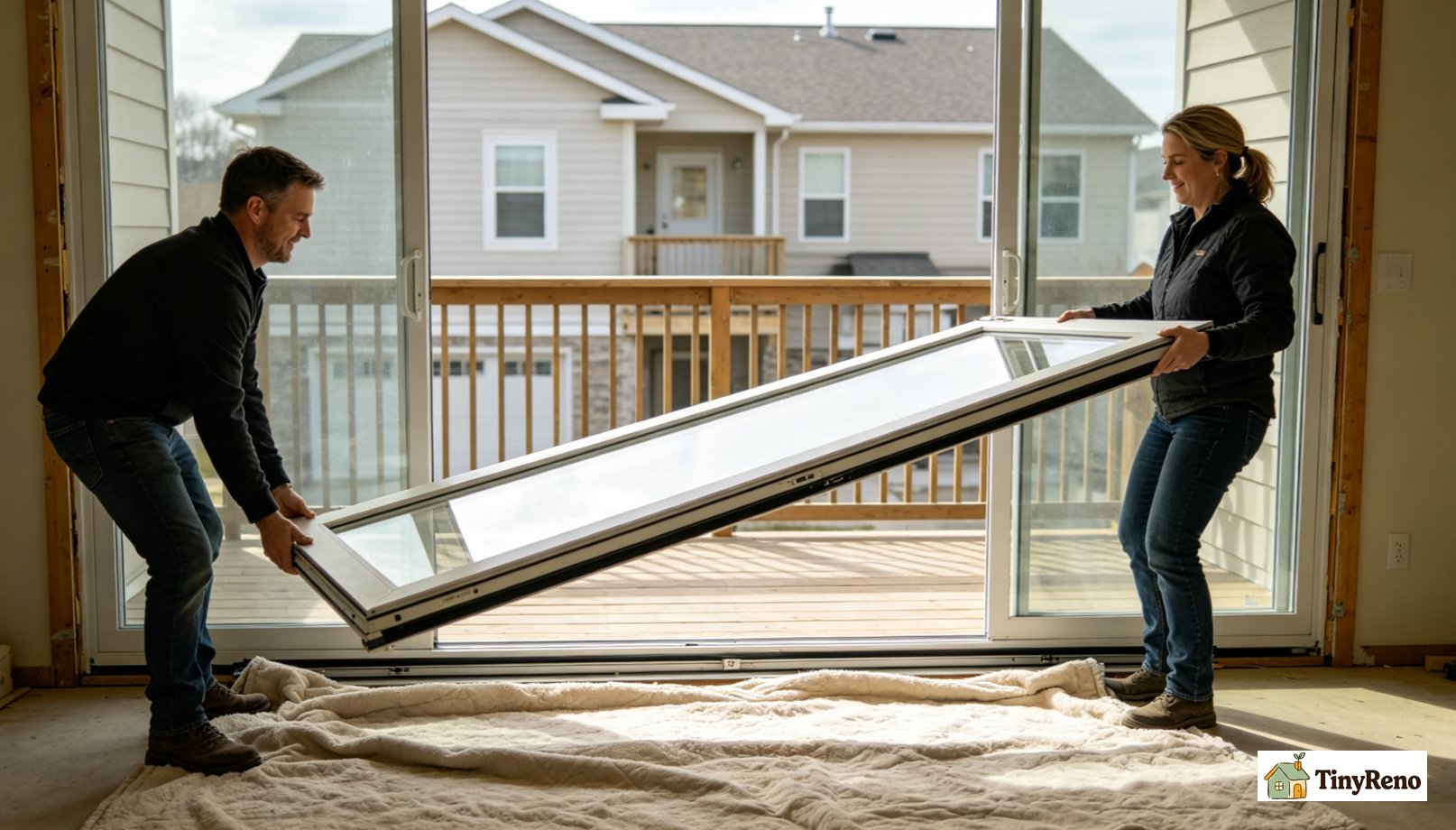
Step one is to remove the door from the track. This is the step that intimidates most people because a sliding glass door weighs 200 pounds and the door has to come off the track without breaking the glass. The trick is to lift the door straight up while a helper pulls the bottom of the door toward you, away from the frame. On most doors, the door lifts about half an inch before the rollers clear the track. If the door won't lift, the adjustment screws are too high and the rollers are jammed into the track. Turn both adjustment screws counter-clockwise (lowering the door) by two full turns, then try lifting again. The door should come free. Two people are required for this step. One person lifting a 200-pound door alone will either drop the door or hurt their back. The same risk profile applies to water stains on the ceiling — the job looks simple but the failure mode is expensive.
Step two is to lay the door flat on a soft surface and remove the rollers. The rollers are at the bottom of each side of the door. Each roller housing is held in place by two screws (or one screw, depending on the brand). Remove the screws, slide the roller housing out of the door, and the wheel is now accessible. Most rollers can be replaced without removing the door from the frame, but removing the door makes the rest of the job much easier. If you don't have a helper, you can do the job with the door in the frame, but you'll be working in a cramped position and the screws are easy to drop into the track.
Step three is to match the old roller to the new one. Take the old roller housing to the hardware store and find a match. The match has to be exact — the housing has to fit the slot in the door, and the wheel diameter has to match the track height. Most sliding glass door rollers are 1 to 1.5 inch diameter, and the most common housing is a 1 inch wide by 3 inch long rectangle. If you can't find an exact match at the hardware store, order online. There are about a dozen common roller patterns, and the online retailers have cross-reference charts that match the pattern to the door brand.
Step four is to install the new rollers. Slide the new housing into the slot, replace the screws, and tighten until the housing is snug but not over-tight. Over-tightening the screws can crack the housing or strip the screw hole in the door, and either failure requires drilling and tapping a new hole, which is not a renter fix. The screws are usually 1/4 inch or 5/16 inch hex-head, and the same screwdriver that removed the old rollers will install the new ones.
Step five of how to change rollers on sliding glass door is the one most people skip: adjust the rollers before you put the door back on the track. The adjustment screw on the housing lets you raise or lower the door. Turn both adjustment screws clockwise (raising the door) until the new wheel just barely clears the track when the door is lifted. The door should sit on the wheels with about 1/8 inch of play between the bottom of the door and the top of the track. If the door is too high, it won't sit on the wheels. If the door is too low, the wheels won't engage. Either failure means the door won't roll, and you'll be back at step one wondering what you did wrong.
The 4 Roller Types I Tried + the 2 I'd Skip
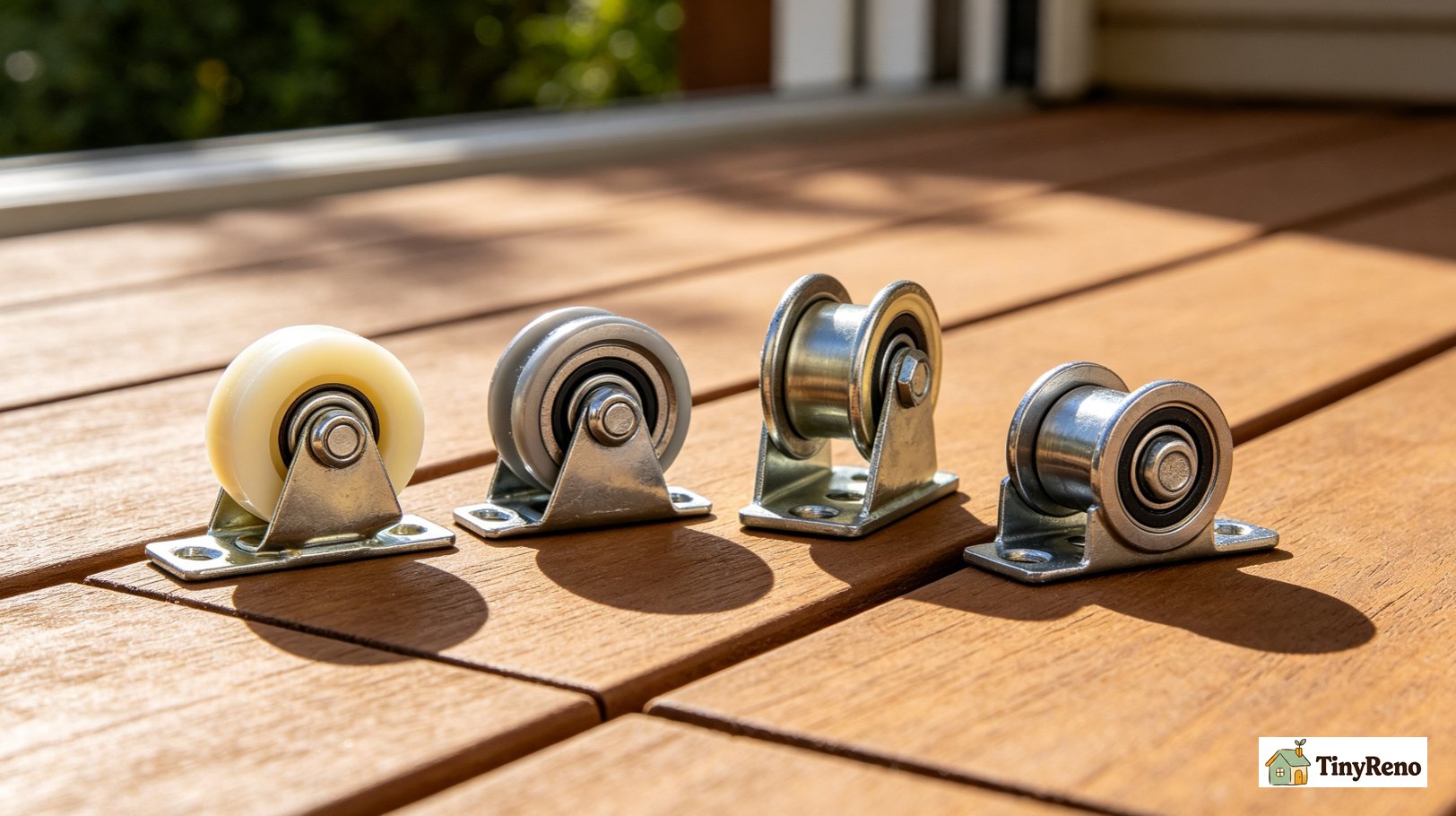
Roller type one is the standard nylon wheel. This is what comes with most sliding glass doors from the factory, and it's what the hardware store stocks as the default replacement. The nylon wheel is quiet, smooth, and lasts about 8 years under normal use. Cost is $4 to $8 per wheel. The downside is that the nylon wears down if the track has any debris in it, and a single piece of gravel can flatten a nylon wheel in months. For a rental where the track may not be perfectly clean, the nylon wheel is the safe choice.
Roller type two is the steel ball bearing wheel. This is a metal wheel with ball bearings inside, and it's the upgrade that most door manufacturers use on higher-end doors. The steel ball bearing wheel is quieter than the nylon wheel, lasts longer (12+ years), and handles debris in the track better. Cost is $12 to $20 per wheel. The downside is that the ball bearings can seize if water sits in the track, and a renter who doesn't control the weather can't prevent the track from getting wet.
Roller type three is the tandem wheel assembly. This is two wheels stacked on the same axle, and it's the choice for heavy doors (over 250 pounds) or for doors that are dragging because the original single wheel didn't have enough surface area. The tandem wheel is overkill for most renter doors but is the right answer if the door weighs more than 250 pounds or if the original single wheel wore a flat spot in less than a year. Cost is $18 to $30 per wheel.
Roller type four is the adjustable steel wheel with sealed bearings. This is the highest-end option, and it's the choice for commercial doors or for homeowners who want to never replace the rollers again. The sealed bearing keeps water out, the steel wheel handles any debris, and the adjustment range is wider than the standard wheel. Cost is $25 to $40 per wheel. For a renter, this is overkill.
The two roller types I'd skip. The first is any roller that's labeled as "universal fit" without a brand match. These are usually low-quality wheels that don't match any specific door, and the housing has to be filed or sanded to fit the door. The filing introduces metal shavings into the track, and the shavings wear the new wheel down in months. The second is any roller that's sold as a "complete kit" with new track. The kit is for door replacement, not roller replacement, and the track in the kit won't match the track in the door.
The 1 Tool You Actually Need (And 3 You Don't)
How to change rollers on sliding glass door takes only one tool you actually need: a screwdriver. Most sliding glass door roller housings are held in place by 1/4 inch or 5/16 inch hex-head screws, and a multi-bit screwdriver with both sizes will remove and install the rollers. Cost is $8 for a basic set, and the same screwdriver will work on every other renter project you have. You don't need a power drill, you don't need a hex key set, and you don't need a specialty door tool kit.
If the door won't lift because the adjustment screws are jammed, the 90-second workaround is to use a flathead screwdriver to gently pry the door up at the bottom edge while a helper pulls the bottom of the door toward you. The flathead screwdriver goes between the bottom of the door and the track, and the prying force is applied straight up, not toward you. Prying toward you will crack the door frame. Second, a track cleaning solution. The track can be cleaned with a vacuum and a damp rag, and the cleaning solutions are usually just expensive soap. Third, a lubricant for the new rollers. Some rollers come pre-lubricated, some don't. The steel ball bearing wheels need a drop of light machine oil on the bearing before install — running them dry will shorten their life. The nylon wheels don't need oil, and adding oil to a nylon wheel just attracts dust. Check the packaging. If it says "pre-lubricated," skip the oil. If it doesn't, add one drop of light oil to the bearing and wipe off the excess. The same advice applies to spackle versus caulk — the right product depends on the gap, and the test is whether the fix holds under real-world pressure, not whether it looks good in the store.
If You Can't Lift the Door (The 90-Second Workaround)
If the door won't lift because the adjustment screws are jammed, the 90-second workaround is to use a flathead screwdriver to gently pry the door up at the bottom edge while a helper pulls the bottom of the door toward you. The screwdriver goes between the bottom of the door and the track, and the force is applied straight up. But this is the step I'd avoid if you can. A screwdriver slips easily on a smooth track, and if it slips while you're leaning into it, you can cut yourself or crack the door frame. If the adjustment screws won't lower the door enough to lift it by hand, the better move is to call the landlord or a door company. The $50 to $100 they charge for removal is cheaper than a broken door or a broken hand.
If the door still won't lift after the prying workaround, the rollers are seized and the door will need to be removed by a professional. Most door companies will remove a sliding glass door for $50 to $100, and the work is faster than trying to force the door yourself. For a renter, the $50 to $100 is cheaper than a broken door or a broken back, and the work is reversible when the door goes back on the track.


Discussion (0)
Sign in to join the discussion