

Three years and four apartments into noticing this, I finally know what a wood window stool is, why the previous tenants always left it stained, and the 20-minute fix that held for three years in my last place. The reason it took me three years is that nobody calls it by its actual name — the property manager says "the ledge under the window," the carpenter says "the sill cap," and the maintenance guy says "that thing that's peeling again." They're all talking about the wood window stool, and once you can name it, the stains stop being mysterious.
What a Wood Window Stool Actually Is (And Why the Name Is Confusing)
A stool is the horizontal trim piece that sticks into the room at the bottom of the window opening. It's the part you put a plant on, the part that gets water rings from a glass left overnight, and the part that turns black in the corners when the humidity climbs. It is not the same thing as the window sill. The sill is the exterior piece that angles outward to shed water. It sits on the outside of the window, below the sash, and you can't see it from inside. The piece directly behind the stool is the rough sill, which is part of the framing. The stool is the finished trim that you can see and touch from the room side.
Below the stool is the apron, which is the flat trim board that runs along the wall underneath. The stool and the apron are joined at the ends by two small return pieces that complete the box. Behind the stool and the apron is the rough opening, the wall framing, and on the exterior side, the actual sill that does the water-shedding work. The reason this matters for a renter is that when a stain shows up on the wood window stool, the source is almost always on the room side — a plant, a humidifier, an open window in a storm — not a roof leak. Roof leaks show up on the wall, not the stool.
The 3 Stains I Got in My First Year (And What Each One Meant)
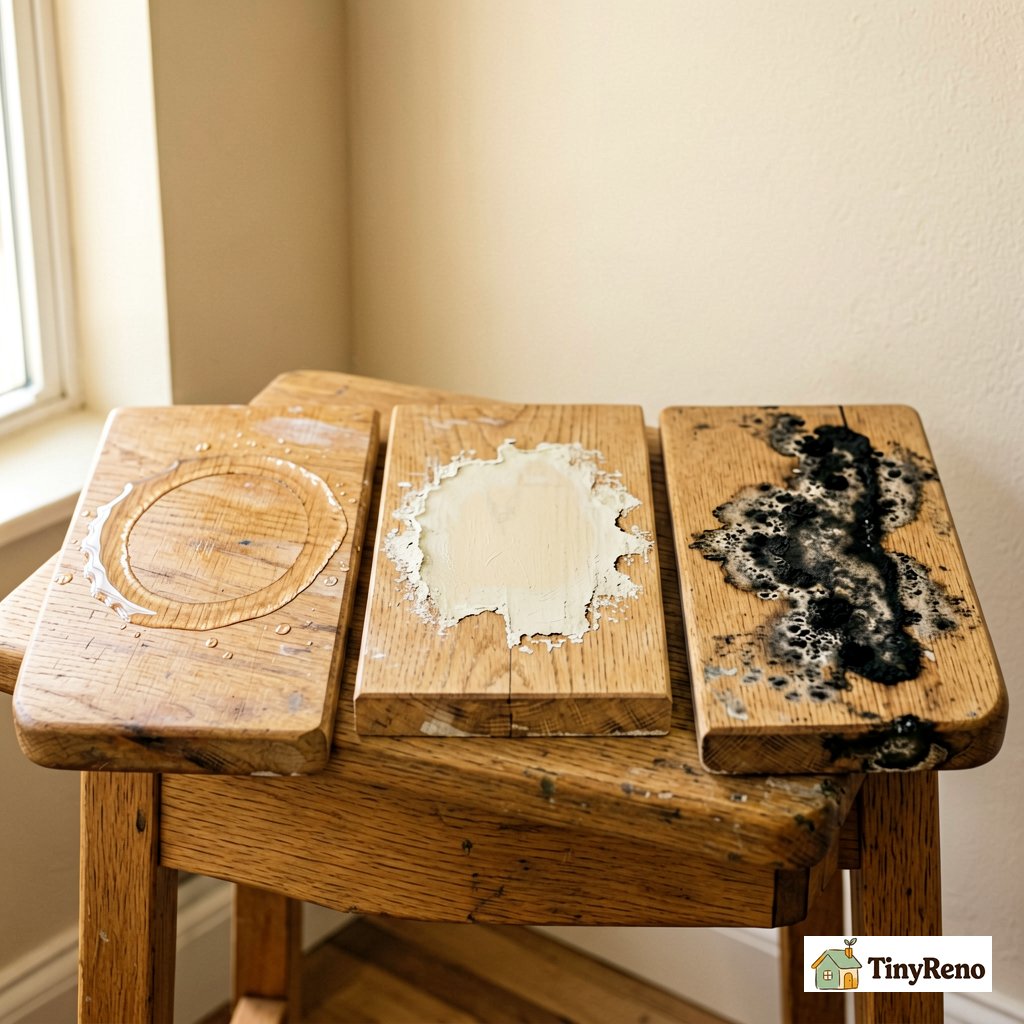
Year one, apartment one, the stool had a single dark ring the size of a coffee mug. The previous tenant had clearly set a planter on it without a saucer. The finish was gone in that ring and the raw wood underneath had darkened from water exposure. This is the most common stool stain and the easiest to live with — if it's truly just a ring and the wood feels dry to the touch, you can leave it. It will not spread. The dark color is tannins that have already oxidized into the wood grain.
Year one, apartment two, the stool had a soft, darker patch in the corner nearest the radiator. I had asked the landlord about it before I knew what a wood window stool was. When I pressed it with a fingernail, the finish gave a little. This is a different problem — the varnish or polyurethane has failed and the raw wood underneath is taking on humidity from the room. The fix is to stop the moisture source, not to refinish the wood. In my case the radiator was off for the summer and the patch dried out and hardened by the next winter. The finish never came back. The spot felt harder after it dried, but a soft spot that dries and hardens may still have compromised fibers. If it stays soft, crumbles, or spreads, that's rot, not just finish failure, and it's worth showing to the landlord.
Year one, apartment three, the stool had a black mold ribbon along the back edge where the stool meets the apron. This is the stain that makes renters panic because it looks like the wall is rotting. It is almost never the wall rotting. The corner where the stool meets the apron is the lowest air-circulation point on the entire window, and if the room is humid for any reason — cooking, drying clothes indoors, a bathroom with no fan — the mold will grow in that corner first. The fix is to address the humidity and clean the corner with a diluted vinegar solution, not to call a contractor. The same pattern shows up on discolored walls in apartments for the same reason.
Why the Stool Stains First (And the Sill Doesn't)
The wood window stool takes the abuse because of three physical realities. One: it's horizontal, so water sits on it instead of running off. Two: it's finished on the top surface only, so the front edge and the back edge where the stool meets the wall are raw wood, and raw wood absorbs water faster than finished wood. Three: it's the most visible trim piece in the room, so the sun hits it during the part of the day when UV is most likely to break down the varnish. The rough sill behind the stool is protected from the room's humidity by the stool itself, which is why it rarely shows stains. The exterior sill is angled and finished, but it's outside the building envelope. That's why the stool always looks worse than the sill even when the actual water exposure is the same.
The finish on a builder-grade stool is almost always a single coat of oil-based polyurethane sprayed at the factory. One coat is enough to survive a closing walkthrough and not enough to survive three years of a humidifier running 12 hours a day. By the time you move in, the finish is already mid-life. The reason your landlord's "freshly painted" apartment always has a stained stool is that the painter masked the stool, didn't refinish it, and the existing finish was already failing. The previous tenant's habits show up in the stool because the finish was already thin when they moved in, and their daily routine — a humidifier, a plant without a saucer, a window left open in the rain — finished it off.
The 20-Minute Fix That Held for 3 Years
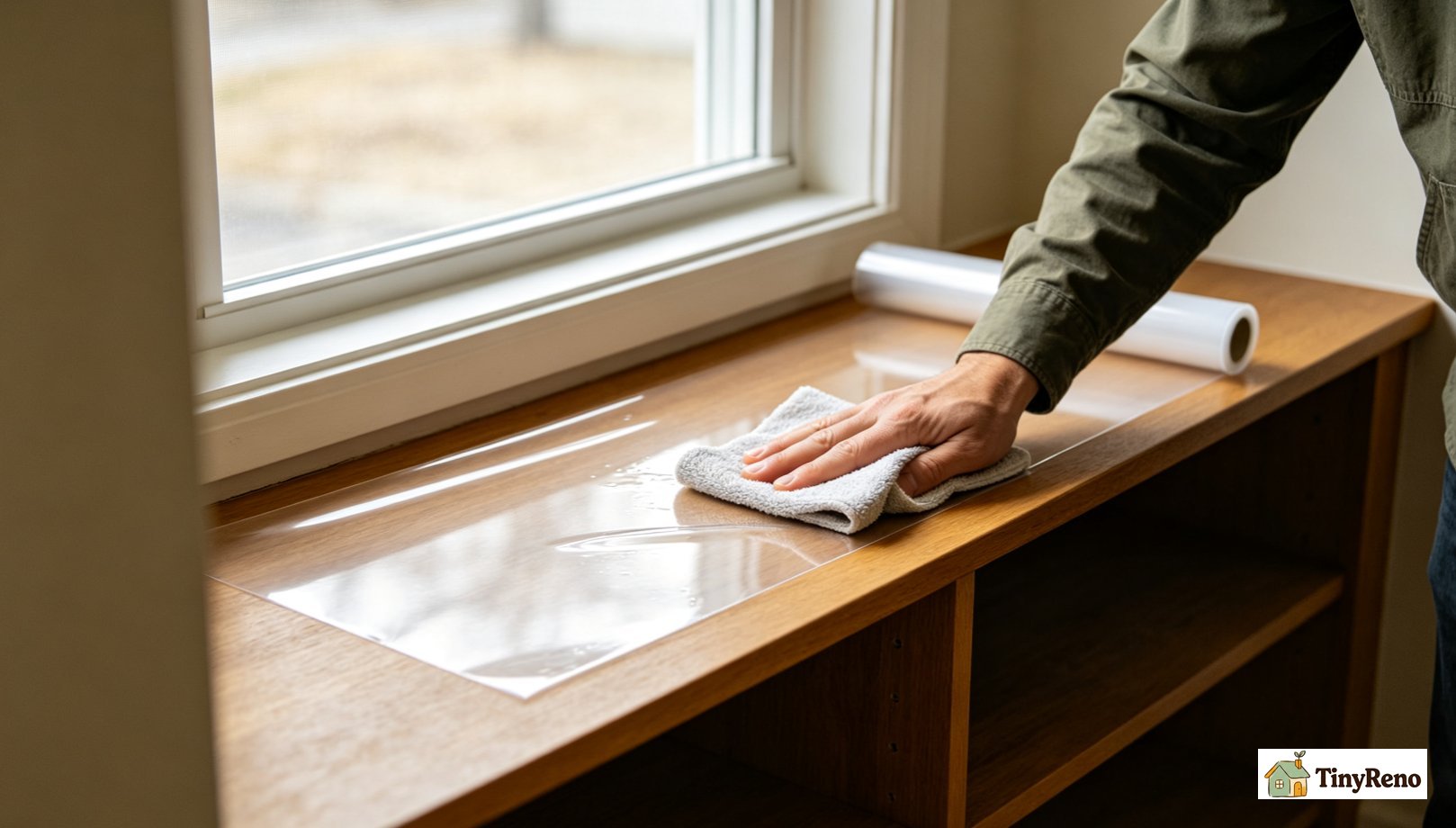
The fix is not to refinish the stool. Refinishing means sanding, which means dust, which means a day's work and a conversation with the landlord. The fix is to put a barrier between the wood and whatever is staining the surface. The barrier that works in a rental is a clear peel-and-stick vinyl film cut to the size of the stool top. The brand I used was the clear shelf liner from the dollar store — the kind that comes in a roll and feels like contact paper. Cost was $4 for a roll that covered six windows. Time to install was 20 minutes for the first window, 10 minutes for each one after.
The reason this works for three years instead of one is that the film is replaceable. When the film starts to yellow or peel at the corners, you pull it up, clean the wood underneath with a damp rag, and put down a new piece. The wood underneath never sees direct water because the film is the new finish. The shelf liner I used has a water-based adhesive that lifts with a damp rag, and it came off in five minutes when I moved out. But not all clear vinyl films use the same adhesive. Test a corner first: press a small piece down, wait a day, and peel it up. If it leaves residue or pulls the finish, try a different brand.
One renter-to-renter warning. Do not use the opaque vinyl tiles designed for floor installation on a wood stool. The adhesive is permanent and will pull the finish off the wood when you try to remove it. Stick to the clear shelf liner. The shelf liner is the only renter-safe barrier that holds up for more than one season and removes cleanly at move-out.
When to Call the Landlord (And When to Leave It Alone)
The stool is the landlord's responsibility to maintain, but the standard for "needs repair" is loose. A water ring is cosmetic, not structural. A soft patch that dries out over a season is cosmetic, not structural. A black mold ribbon that returns after cleaning is a sign of a humidity problem, not a trim problem, and the landlord is unlikely to fix humidity. The only time to escalate is when the wood is visibly swollen, the finish is peeling in sheets, or the stool has separated from the apron at the corner. Those are signs of a window leak, and window leaks are usually the landlord's job — but check your lease. Some leases classify window maintenance differently, and some landlords will try to push it back on the tenant. If the leak is from outside the building envelope, it's almost always on them.
If the stain bothers you, the $4 shelf liner fix is faster, cheaper, and more reversible than any conversation with the landlord. The stool will be there when you move out, and the next tenant will put a plant on it without a saucer, and the cycle will continue. The 20-minute fix is the only part you control.


Discussion (0)
Sign in to join the discussion