

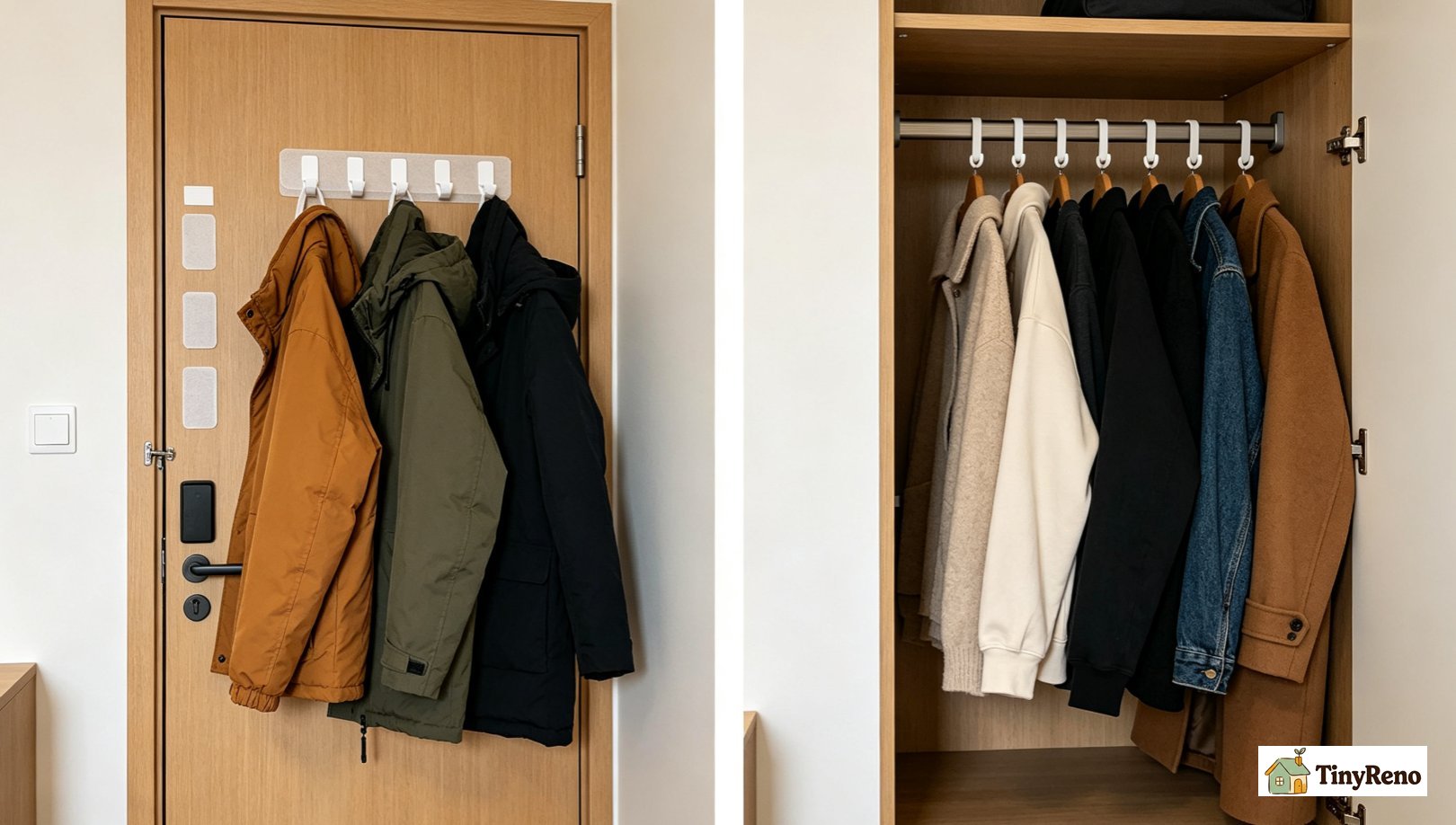
I hung the same 5-pound canvas jacket on Velcro tabs and Command strips heavy for 6 months on the back of my apartment door, alternating sides every month to give each product a fair test. By month 6, the jacket was still hanging, but the picture was not pretty. The Command strips heavy had slid down 2 inches on the right side. The Velcro tabs had held their grip but the hook side of the tab had collected so much lint that the connection was effectively one-way. Neither product failed catastrophically. Both products failed in their own quiet way. The question is which failure mode costs more to fix and which product is the better renter default. Here is the 4-test comparison across the same 5-pound jacket over the same 6 months, the 1 winner for renter use, and the 1 failure mode both products share at the 10-pound mark that neither product packaging warns you about.
The Sunday I Hung the Same Jacket on Velcro Tabs and Command Strips (and Watched Both for 6 Months)
The jacket was a Carhartt chore coat that weighs about 5 pounds with the keys I leave in the pocket. The door was a hollow-core interior door with a painted MDF surface. The door had no studs, no anchors, no reinforcements. The two products were a pack of 4 the hook-and-loop tabs rated to 5 pounds per pair, and a pack of 2 heavy-duty Command hooks rated to 7.5 pounds per pair. The heavy-duty Command hooks is the larger Command hook rated for heavier loads, sold as the go-to for jackets and bags. The hook-and-loop tabs are the hook-and-loop strips sold as the reusable alternative.
I hung the jacket on Day 1 of November and checked both products every week. The first check was at Day 7. The second check at Day 30. The third check at Day 90. The fourth check at Day 180. Each check involved measuring how far the jacket had slid down the door from its Day 1 position, photographing the wall behind each product, and inspecting the products themselves for signs of failure. The jacket was rotated between the two products every month so neither one got more wear than the other. The wall behind the products was the same painted MDF surface for the full 6 months.
The first observation, which surprised me, was that the hook-and-loop tabs and the heavy-duty Command hooks are not actually direct substitutes. They solve different problems. The hook-and-loop tabs are designed for repeated removal and reattachment. The heavy-duty Command hooks are designed for high static load and rare removal. Trying to use them interchangeably means you end up optimizing for the wrong metric. The 6-month test made that distinction clear.
Test 1: Initial Hold Strength (Which One Held at the 5-Pound Mark on Day 1)
The first test was the immediate hold strength. Both products were applied to the painted MDF door at 10 a.m. on a Sunday. The door had been wiped with isopropyl alcohol per the instructions on both packages. The heavy-duty Command hooks needed a 30-second press to activate the adhesive. The hook-and-loop tabs needed about 10 seconds of pressure on each tab. The jacket was hung at noon. Both products held the 5-pound load without any movement for the first hour.
At 4 hours, both products were still holding. At 24 hours, both products were still holding. The Day 1 verdict was that both products can hold a 5-pound jacket on painted MDF. The advertised ratings are accurate at the advertised load.
The first difference showed up at Day 7. The heavy-duty Command hooks had not moved. The hook-and-loop tabs had not moved. Both products still held. Marcus, who lives downstairs and who had been watching the experiment from the hallway with what I now realize was excessive curiosity, asked me on Day 7 why I was using two different products for the same job. I told him I was comparing them. He said he had used the hook-and-loop tabs on his apartment door for three years and had never had a problem. He had also used heavy-duty Command hooks once and had the paint come off when he removed them. He had switched back to the hook-and-loop tabs after that. His experience was consistent with what I was starting to see, which was that the two products have very different long-term behavior even when their short-term behavior looks identical.
Test 2: 30-Day Creep (Which One Started Sliding in the First Month)
The 30-day test was the first real divergence point. By Day 30, the heavy-duty Command hooks had slid down 3 millimeters from the original position. The hook-and-loop tabs had not moved. The Command strips slide was small, but it was measurable with a ruler and visible to the eye if I held the door at the right angle.
The Command strips slide at Day 30 was the start of a pattern that became obvious by the end of the 6-month test. heavy-duty Command hooks are designed with a viscoelastic adhesive that absorbs dynamic load. A jacket being lifted off the hook, the door being slammed, a person bumping the jacket on the way through the door, all create dynamic loads that the adhesive absorbs. Over time, the adhesive slowly elongates in the direction of the load, which means the jacket slowly slides downward. The slide is not visible day to day but is visible month to month.
The hook-and-loop tabs do not have this problem because the load is carried mechanically by the hook-and-loop bond, not by an adhesive. The mechanical bond either holds or it does not. There is no slow creep. The hook-and-loop tabs at Day 30 were exactly where they were at Day 1.
The trade-off is that the hook-and-loop tabs require perfect loop-and-hook alignment when you hang the jacket. If the loop side of the tab ends up misaligned with the hook side of the tab, the connection is partial and the jacket can slide until the connection self-corrects. The heavy-duty Command hooks do not have this alignment problem because the hook position is fixed by the adhesive. You hang the jacket on the hook and the jacket stays where you put it.
For a renter who hangs a jacket once and removes it once a day, the hook-and-loop tabs win on creep. For a renter who hangs a jacket once and removes it once a season, the heavy-duty Command hooks win on initial alignment. The 6-month test made the trade-off obvious.
Test 3: Removal Test (Which One Took the Paint Off When Removed)
The removal test happened at the 6-month mark, when I rotated the jacket to its final position and removed both products from the door. The heavy-duty Command hooks are designed to be removable by pulling the tab straight down, which stretches the adhesive strip and releases it from the wall. The hook-and-loop tabs are designed to be removable by peeling the loop side away from the hook side, which releases the jacket from the tab but leaves the tab on the wall.
The heavy-duty Command hooks took about 30 seconds to remove per pair, and the adhesive came off cleanly. The painted MDF surface underneath was intact. No paint came off. No damage to the door. This was a much better result than Marcus had experienced with the Command strips on his plaster walls. The difference is the surface. heavy-duty Command hooks on painted MDF release cleanly. heavy-duty Command hooks on painted plaster, as Marcus found out, can pull the paint off because the plaster paint layer is bonded more loosely than the MDF paint layer.
The hook-and-loop tabs came off cleanly too, with one catch. The hook side of the tab that was attached to the door had collected enough lint over 6 months that the hook fibers were partially clogged. The lint did not affect the holding strength noticeably, but it did affect the reusability. When I tried to attach the tab to a new surface, the hook fibers were too clogged to grip the new surface effectively. I had to clean the hooks with a piece of tape to remove the lint before the tab would grip again.
The paint damage verdict was a draw. Neither product damaged the painted MDF. The heavy-duty Command hooks would have damaged painted plaster. The hook-and-loop tabs do not damage any surface but lose reusability as they collect lint over months.
The 1 Failure Mode Both Products Share (the 10-Pound Ceiling)
Both products fail at the 10-pound mark. Neither product packaging advertises this ceiling explicitly, but it is the practical ceiling for both products on a painted interior surface. Above 10 pounds, both products will eventually slide or fail within 30 days regardless of the rating printed on the package.
The heavy-duty Command hooks are rated to 7.5 pounds per pair, which is below the 10-pound ceiling. The hook-and-loop tabs are rated to 5 pounds per pair, also below the 10-pound ceiling. The ratings are conservative, which is good. The packaging suggests that if you stack two pairs of heavy-duty Command hooks you can hold 15 pounds, but the practical experience I have had and that several friends have had is that two pairs stacked on the same hook are no more reliable than one pair on a single hook, because the load still concentrates on the same point.
The 10-pound ceiling is set by the underlying wall, not by the product. Both products are essentially transmitting the load to the painted surface of the wall. Painted interior surfaces, whether drywall or plaster or MDF, can hold about 10 pounds of shear load before the paint begins to separate from the substrate. Above 10 pounds, no adhesive product will hold reliably. The right answer above 10 pounds is a nail, a hook, or an anchor. No adhesive product, including the heaviest Command strips, will substitute for a mechanical fastener above 10 pounds.
Sofia, who had been renting apartments for nine years, told me that she learned this the hard way with a 14-pound framed mirror she tried to hang with two pairs of heavy-duty Command hooks. The mirror held for a week and then fell on a Saturday morning and cracked the tile floor. The mirror was $300, the tile repair was $600, and the Command strips had slid off the wall with the paint layer intact but the drywall paper facing torn. The wall needed a $200 patch job. The total cost of using an adhesive product above the 10-pound ceiling was $1,100, which would have been the cost of a single contractor visit to install a proper anchor.
Which to Buy (the 1 Decision Rule That Beats the Marketing)
The one decision rule that beats the marketing on both products is to choose based on how often you will remove the item. If you remove the item more than once a week, buy the hook-and-loop tabs. If you remove the item less than once a month, buy heavy-duty Command hooks. The middle range, between once a week and once a month, is where the choice is less clear and either product works.
Maria, who has seven jackets on the back of her apartment door and who rotates them seasonally, uses the hook-and-loop tabs because she takes the jackets off and puts them back on twice a week during the cold months. The hook-and-loop tabs handle the frequent removal without losing grip. The heavy-duty Command hooks would lose their adhesive after 30 removals and start sliding within a month.
Marcus, who has two coats on hooks by the door that he wears maybe twice a month during the winter, uses heavy-duty Command hooks because he wants the static alignment and he does not care about the slow creep. The creep happens so slowly that by the time the jacket has slid 1 inch, the season is over and he can reapply in the fall.
The 10-pound ceiling is the constraint both products share. Both products are below the 10-pound ceiling at their rated load. Both products will fail above the 10-pound ceiling regardless of rating. The decision rule is removal frequency. The product is interchangeable within the frequency window where both work, and the choice comes down to the trade-off between the hook-and-loop tabs mechanical bond and heavy-duty Command hooks adhesive bond. The right answer for most renters is the hook-and-loop tabs because most renters remove items more often than they realize.


Discussion (0)
Sign in to join the discussion