

How to hang a canvas painting on a plaster wall was the question I asked a hardware store employee in February, and got four different answers from four different people in the same afternoon. The first said I needed a hammer and nail. The second said I needed picture wire and D-rings. The third said I needed a cleat system that cost $40. The fourth, a retired frame shop owner named Roger, told me the answer depends on three things: the canvas weight, the wall type, and whether the canvas is stretched or rolled. None of the other three had asked any of those questions. Canvas paintings are not framed pictures. They do not have a rigid back, they do not have a frame, and the hanging hardware on a canvas is usually just a thin wire or a single D-ring stapled to the wood stretcher bars on the back. Treating a canvas like a framed picture is how renters end up with a $200 painting on the floor and a Command Strip still glued to the wall. How to hang a canvas painting depends on three things: canvas weight, wall type, and whether the canvas is stretched or rolled. Here are the four methods that work on stretched canvas, ranked by what I have actually used in four apartments, why three of them cost less than $5 and one of them is worth every penny of $40, and the one mistake that will pull a stretcher bar loose from the canvas itself.
The Tuesday I Hung a Canvas Painting With a Single Nail (and Watched It Tilt 20 Degrees in an Hour)
The canvas was a 24-by-36 inch oil painting my grandmother had given me, worth maybe $300 in street value and $3,000 in family value. I had moved into a third-floor apartment in Jamaica Plain with plaster walls and a lease that prohibited drilling in anything other than drywall. I figured a single nail in the plaster wall, angled slightly upward, would hold a canvas painting for years. I figured wrong.
The first problem was that a single nail on a stretched canvas creates a pivot point. The canvas hangs from one point on the back wire or D-ring, which means the bottom of the frame can swing left or right depending on air movement, walking patterns, or whether the cat decides to jump on the couch below it. Within an hour the canvas was tilted 20 degrees from horizontal. Within a week the bottom left corner had rubbed against the wall enough to leave a gray smudge on the plaster that I then had to repaint at move-out. The fix was not a bigger nail. The fix was a two-point hanging system that locked the canvas in place at the top corners, not at a single middle point.
Roger's advice, which he gave me the next day when I went back to the hardware store, was that a stretched canvas is essentially a wood frame wrapped in fabric, and the only reliable way to hang it is to engage with the wood frame, not with the canvas surface. The four methods he gave me, ranked by use case, are below.
Why Canvas Paintings Hang Differently From Framed Pictures (the Weight Distribution Trap)
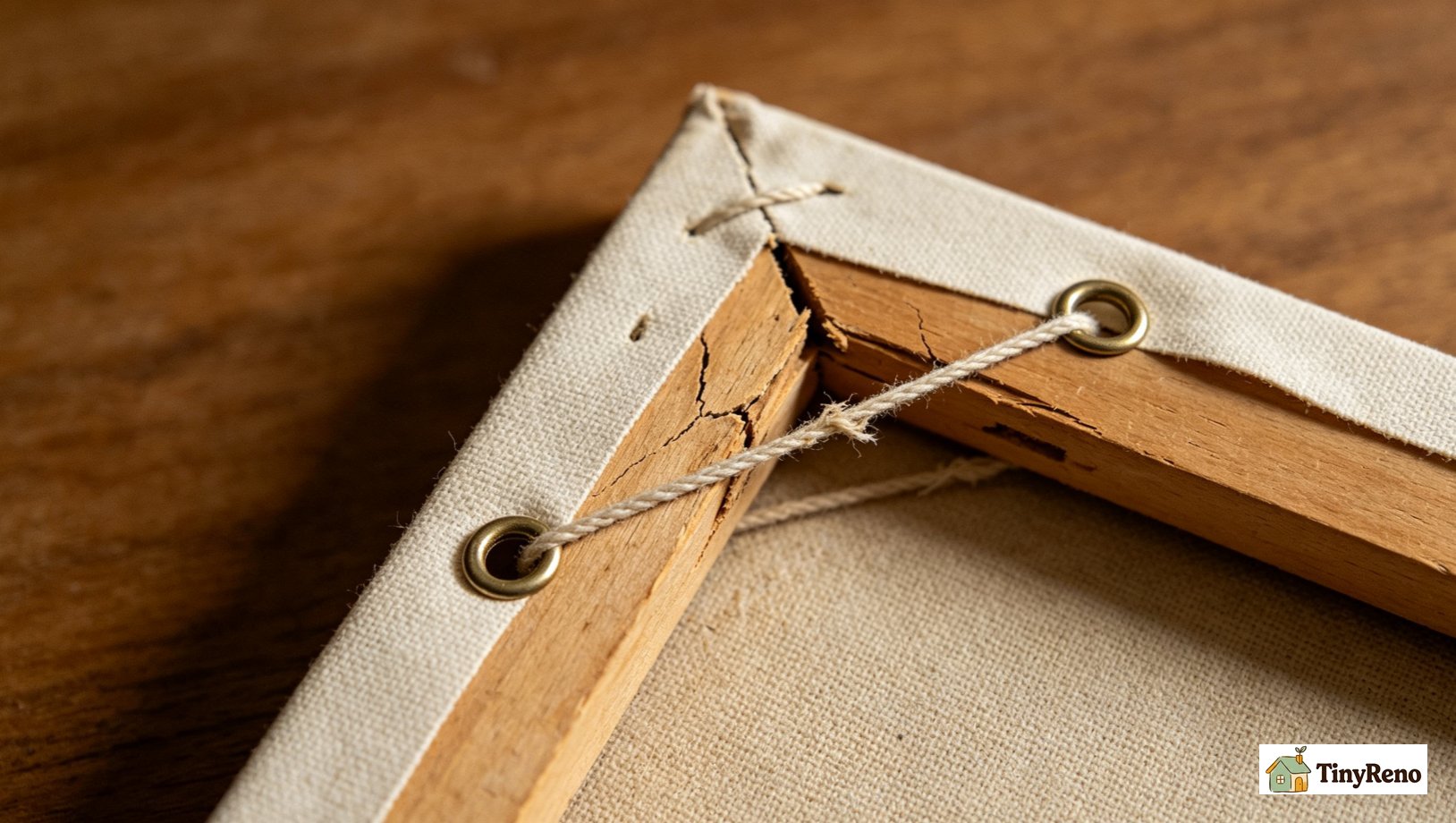
Canvas paintings are different from framed pictures in three structural ways that determine which hanging method works. First, the canvas surface is fabric, not glass, and the weight is carried entirely by the wood stretcher bars around the perimeter. Second, the back of a canvas painting usually has only one or two hanging points, a thin wire strung between two D-rings or a single D-ring at the top center, while a framed picture has a rigid back with multiple attachment points. Third, the canvas fabric itself is not strong in tension across the surface, which means you cannot pull it tight against a wall without distorting the image.
The weight distribution trap is what most first-time canvas hangers fall into. They treat the canvas like a framed picture and use a single nail or hook. The single hanging point lets the canvas swing. The swinging puts lateral force on the wood stretcher bars at the top corners, which are the weakest structural part of the frame. Over weeks or months, the swinging loosens the corner joints and the canvas begins to sag visibly at the corners. By the time you notice the sag, the corner joints are already damaged and the only fix is re-stretching the canvas, which costs $80 to $150 at a frame shop.
The second trap is the wire. Most canvases ship with a thin picture wire strung between the D-rings on the back. The wire is rated for the canvas weight in static load, but it has no tolerance for the dynamic swinging that a single nail produces. Over six to twelve months, the wire fatigues at the contact points where it loops through the D-rings, and one of the loops breaks. The canvas falls. The fix is not stronger wire. The fix is a two-point hanging system that prevents the swinging in the first place.
What I Tried Next: 4 Hanging Methods Ranked by Canvas Type
The four methods I worked through over four apartments are below. I ranked how to hang a canvas painting by the type of canvas they work best on and by the trade-off between cost, damage to the wall, and security. The order is cheapest and easiest to most expensive and most secure.
| Rank | Method | Canvas Type | Cost | Wall Damage |
|---|---|---|---|---|
| 1 (cheapest) | Two nails + D-ring repositioning | Light canvases under 5 lb | $1 | 2 small nail holes |
| 2 | Sawtooth hanger + single nail | Light to medium, under 10 lb | $2 | 1 small nail hole |
| 3 | Two D-rings + picture wire + two nails | Medium to heavy, 10 to 25 lb | $4 | 2 small nail holes |
| 4 (most secure) | Cleat system with metal interlocking strips | Heavy or valuable, 25 lb and up | $35 to $50 | 2 to 4 small screw holes |
Method one, two nails plus D-ring repositioning, is the renter compromise. You move the existing single D-ring on the back of the canvas to the two top corners, then drive two small nails into the wall at the matching positions. The two-nail system eliminates the pivot point and prevents swinging. Cost is about $1 for two nails. Wall damage is two small nail holes that patch with $3 of spackle at move-out. The catch is that repositioning the D-ring requires pulling out the original staples and re-stapling, which is doable but irreversible on the canvas.
Method two is the sawtooth hanger, which is a small metal strip with teeth that attaches to the top center of the wood stretcher bar. You drive a single nail into the wall, and the sawtooth hanger hooks onto the nail. This works for canvases under 10 pounds and is reversible without damaging the canvas. The catch is the single-nail pivot problem from before. For canvases under 5 pounds, the pivot is minor. For canvases approaching 10 pounds, the pivot returns. One clarification: when I say a single nail works for a canvas under 5 pounds, I mean it holds the canvas up. It doesn't prevent the sway. A light canvas will still swing with air movement or a slammed door. If the canvas is over a couch or a bed, even a light canvas can be knocked off its nail by a cat or a person. For anything over a walkway or a sleep surface, use the two-nail method even if the canvas is light.
Method three is the traditional two D-rings plus picture wire plus two nails. This is what frame shops recommend for canvases 10 to 25 pounds. You install two D-rings on the back of the canvas about 6 inches apart, string picture wire between them, and drive two nails into the wall to match. The two-nail system locks the canvas in place and prevents swinging. Cost about $4 for two D-rings, a 3-foot length of picture wire, and two nails. Wall damage is two small nail holes.
Method four is the cleat system, which is what museums and galleries use for valuable canvases. A cleat is two interlocking metal strips, one attached to the wall and one attached to the back of the canvas. The strips lock together at an angle and can hold the canvas securely against any movement. Cost is $35 to $50 for the cleat pair plus installation. Wall damage is two to four small screw holes. The cleat system is overkill for most renters but is the right answer for a canvas you cannot replace. "Cleat system" covers a few different products. The simplest is a French cleat — two interlocking angled strips. The more secure version is a Z-bar, which has a Z-shaped cross section and locks the canvas flat against the wall. Both work. The Z-bar is better for heavy canvases because it prevents the canvas from tilting forward. Ask for Z-bar at a frame shop if the canvas is over 30 pounds.
The Method That Worked (and the 3 Tools You Need for Method 3)
The two D-rings plus picture wire plus two nails method is the one I landed on for my grandmother's oil painting and have used for every medium-to-heavy canvas since. Total cost about $4. Total time about 20 minutes for the first canvas, 10 minutes for each subsequent one. The three tools you need are a staple gun or a hammer and small nails, a 3-foot length of picture wire, and two D-ring hangers from any hardware store. The D-rings cost about $1 each, the wire costs about $2, and you use existing nails from the wall.
The exact sequence is below.
- Place the canvas face-down on a clean flat surface. Measure the width of the wood stretcher bar at the top.
- Mark two points on the top stretcher bar, each about one-sixth of the width in from the left and right corners. For a 36-inch canvas, that puts the D-rings about 24 inches apart, which is much more stable than the 6 inches that factory frames sometimes use. If you're working with a smaller canvas, keep them at least 8 inches apart, and never closer than 3 inches from the corner. These are where the D-rings will go.
- Screw or staple the D-rings into the wood stretcher bar at the marked points. Make sure the D-rings are oriented so the wire will run horizontally between them.
- String the picture wire through both D-rings, leaving about 3 inches of slack on each side. Twist the wire around itself three times to secure.
- Measure the distance between the two D-rings on the back of the canvas. Transfer that distance to the wall, marking two points at the desired height.
- Drive two nails into the wall at the marked points, leaving about half an inch of the nail head protruding. The wire loops over the nail heads and locks the canvas in place.
The two-nail system prevents the swinging because the canvas is constrained at two points rather than pivoting on one. The wire holds the canvas close to the wall so it cannot swing forward or back. The result is a canvas that hangs level and stays level for years without adjustment. My grandmother's painting has been hanging on this system for seven years across three apartments, with two of the moves requiring patching the nail holes at move-out and redrilling at the new place. Total cost over seven years: about $12 in D-rings and wire.
The Mistake I'd Skip Next Time (and the Question to Ask Before You Hang)
If I were hanging another canvas today, I would skip the single-nail method entirely and start with method two or three. The single nail is the canvas equivalent of the Command Strip on brick wall from earlier in this guide: it looks like it works, it holds for a while, and it fails at the worst possible time. The two-nail method costs $3 more and prevents the swing that causes the slow damage to the stretcher bars.
The question to ask before you hang any canvas painting is how much it would cost to replace, not how much it cost to buy. My grandmother's oil painting is irreplaceable in family terms, which is why I switched to the two-nail method after the first near-fall. A $20 print from a thrift store can tolerate the single-nail risk. A $500 original cannot. The hanging method should match the replacement cost, not the purchase price.
The other thing I would skip is the wire that ships with the canvas. The factory wire is usually the thinnest wire the frame shop can get away with, rated for static load only. Replace it with a heavier picture wire from the hardware store. The heavier wire costs $2 and reduces the fatigue failure risk. But heavier wire means more load on the D-rings, so check that the D-rings are screwed into solid wood, not just stapled. If they're stapled, add a screw or replace the D-rings with screw-mounted ones. The wire is only as strong as the attachment points at each end. The factory wire is a starting point, not a finishing point.


Discussion (0)
Sign in to join the discussion